There is now an ever-increasing body of digital records, albeit dispersed and often project-dependent, much of which would support meaningful further analysis, re-use and re-tasking to build on the objective of their original production. This highlights one of the key structural weaknesses that impacts on the reuse of this data, which relates to the management and dissemination of digital records. There is no centralised inventory of 3D records, with the exception of that created for prehistoric rock art with ScRAP, that clearly indicates what has been recorded, how it has been recorded and what formats the data are currently in.
This leads inevitably to work being potentially duplicated, that the opportunity for comparing records generated at different times is lost, as is the potential for thematic studies that draw together records generated from multiple fieldwork events. Underlying this problem are well-recognised issues of long-term data preservation (Richards et al 2013, Niven et al 2014), the use of standardised metadata and paradata (see the London Charter, Bentkowska-Kafel et al 2012, Jeffrey 2010) as well as multiple issues that arise with data ownership, and sharing under confusing and/or restrictive data licensing regimes.
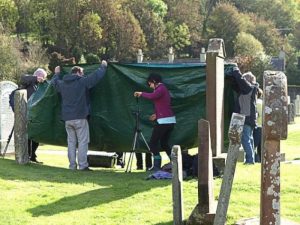
The affordable long-term curation of digital data in all forms remains a thorny issue, but is this situation in changing as archiving of big datasets become increasingly normal. For instance, over a thousand 3D models of rock art, co-created with communities using SfM photogrammetry during Scotland’s Rock Art Project, together with several thousand raw images, were deposited with the HES digital archive (ScRAP Case Study).
There is also the broader issue that where 3D digital datasets are actively curated for future use, they are often archived as discrete items, rather than being part of a wider body of information and without mechanisms linking them to broader research material. This situation has arisen at least in part because existing recording strategies are mainly conservation and communications-led, rather than research-driven. Conservation priorities, as opposed to research, tend to be piecemeal rather than thematic and comprehensive, although the HES Rae project (HS Focus Magazine 2012), the Scottish Ten project and Scotland’s Rock Art Project are comprehensive with regard to the legal status of their targets, covering HES properties, Scottish UNESCO World Heritage Sites, and prehistoric rock art sites respectively.
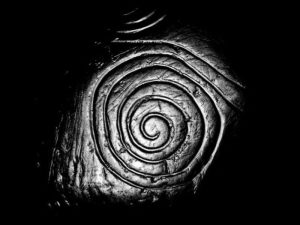
Historically, digital recording practice has been technically led rather than being developed or exploited with the needs of researchers or public audiences in mind. In part, this was because of the difficulty of expert recording practitioners and non-technical academics in communicating at the same technical level. This situation is also changing, however, as the techniques become increasing user-friendly and applied to academic enquiry (Case Study 7: Imaging techniques: the ‘Making a Mark’ project). There are still many as-yet unexplored areas where digital technology could contribute to academic research, such as digital records of carved stones in their reconstructed landscape settings, subject to different seasons, lighting etc. Although the potential of digital recording for individual stones is recognised, and has been implemented on a large scale by ScRAP, we still need to explore more fully the value of what ‘virtual re-contextualisation’ might deliver. With the growing application of digital modelling and visualisation techniques, their potential for research is gaining momentum and providing new insights into the creative processes and decisions embodied in carved stones.
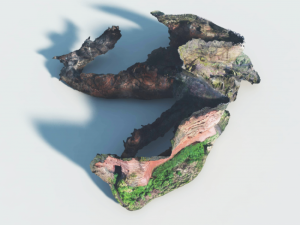
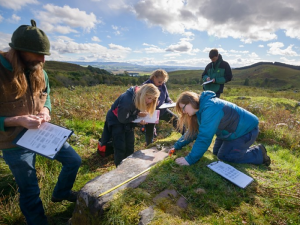
There are growing cases of a seamless integration between the deployment of digital recording technologies and research-led approaches which demonstrate that work with the public and communities of interest through these technologies holds out notable potential as means of engagement (Case Study 36: Wemyss Caves). Community-friendly 3D modelling techniques, such as SfM photogrammetry, provide a valuable means both for widespread public use and for freely sharing the outcomes via online platforms such as Sketchfab. There is increasing reflection on the nature of the relationships between community groups, digital heritage professionals and the outputs they have created. Such work is indicating that some of the social values invested in the original object can be translated to or recreated in the process of replication and 3D model capture (Jeffrey et al 2015). This is contingent on a number of factors but points to a key aspect of the digital record from this perspective as being the process itself, who does it and why, as much as the actual output files (Community co-production).
At the beginning of democratization of digital technologies, there was some anxiety about it becoming ‘a double-edged sword’. This related to outmoded ‘preservation by record’ arguments and the potential that more easily generated accurate physical records (eg via 3D printing or other computer-controlled production methods) could be deployed at the expense of conserving physical remains or used to justify rather than simply mitigate the re-location of monuments from their original context and communities. This anxiety most likely arose from some of the grander claims made when the technologies were in their infancy but, currently, digital recording is considered most useful for analysis, re-visualisation, enhancement and a great tool for inclusivity, as it enables ‘remote access’ for those not able to physically visit archaeological and historical sites.
As with all forms of recording, analogue or digital, the final records have multiple uses, but are not considered as surrogates for the original. As exemplified by community co-production the recording process itself is not a neutral activity and does have implications for how the original is subsequently perceived both by heritage professionals and the multiple forms of community in which the original is situated (Case Study 6: The ACCORD project, community co-production).