
Although our understanding of prehistoric rock art and its social and cultural significance has improved considerably in recent years through projects such as ScRAP, there are still significant gaps in our knowledge. Crucially, the chronology of rock art remains an open debate. While the relationship between carvings and other archaeological features can be used indirectly to date rock art, we lack materials and other data that can be used to date it directly. Few excavations of rock art sites have been undertaken, and almost all have been in Kilmartin and Perth and Kinross. The excavation of two carved rock outcrops at Torbhlaren in Kilmichael Glassary (Kilmartin), directed by Andrew M Jones (Stockholm University), provided valuable new insights into activities surrounding the creation of rock art (Jones et al 2011).
This work revealed a clay platform with a cobbled stone pavement constructed against the edge of one carved rock. The platform was covered in a vast amount of quartz and quartzite fragments and river pebbles, some of which had possibly been used as hammerstones to make the carvings, whilst charcoal from the scooped feature dug into the platform dated to AD 680-890 at 95.4% confidence (AD 760-870 at 68.2% confidence), suggesting prolonged significance of the site. The cobbled platform was preceded by a small posthole structure in the same location, with evidence for the remains of a clay floor surface or daub from possible walls.
Material from the fill of the postholes produced a radiocarbon date of 2,580-2,340 BC at 95.4% confidence (2,570-2,510 BC at 68.2% confidence), placing it near the end of the Late Neolithic period. Radiocarbon dates of c 2,900 BC were also returned on pollen, collected from sealed deposits within a fissure in the rock surface, together with a group of stone tool debris and possible hammerstones. Although these dates may not be directly related to the creation of the rock art, when considered together with the archaeological remains, they provide important evidence for prehistoric activity in the area around the rock art.
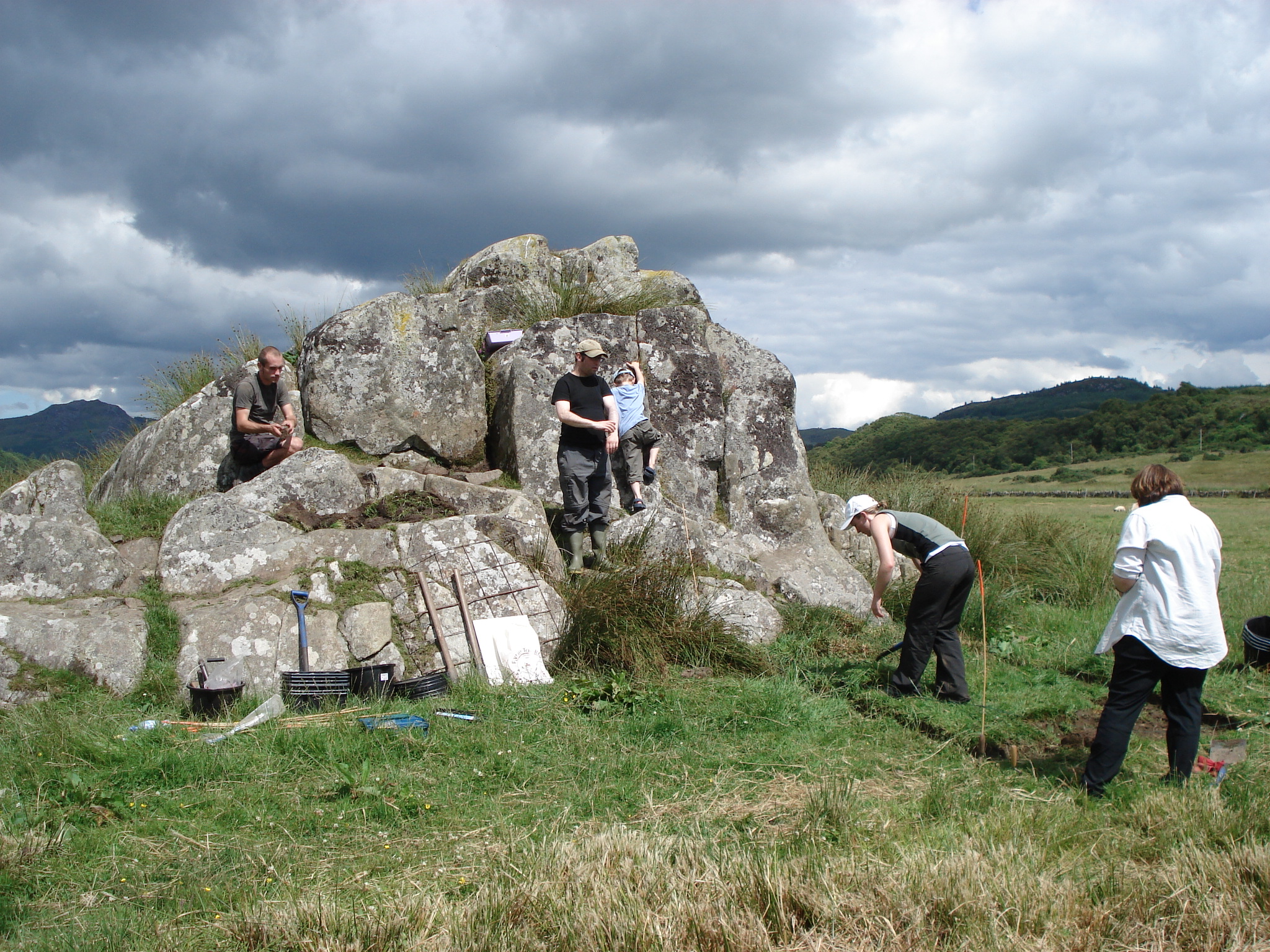
Excavations were also carried out by Richard Bradley (University of Reading) at Ben Lawers, Tayside and Urlar Farm, Strath Tay in Perth and Kinross (Bradley et al 2012, 2019). The work at Ben Lawers excavated around four carved and two uncarved rocks, and revealed a patten of activity similar to that at Torbhlaren. A cobbled area was identified adjacent to the most elaborately carved rock, together with large amounts of quartz, some flint artefacts associated with fissures on the rock surface, and two Arran pitchstone blades. More recently, excavations around carved rocks were carried out at Strath Tay, directed by Tertia Barnett for Perth and Kinross Heritage Trust and involving local community volunteers. This work also revealed deliberate deposits of quartz, and evidence of burning associated with the most elaborately carved panel.
These few excavations have provided new perspectives on our understanding of rock art. They have drawn attention to the material and sensory dimensions of rock art production, allowing us to consider that the performances and experiences involved in making and using the carvings, and memories of these experiences, were as important to prehistoric communities as the rock art itself. Further excavations are essential to enhance our knowledge of the nature and chronology of activities associated with creating rock art and develop a better appreciation of what types of panels were a focus for one-off and recurrent activities.