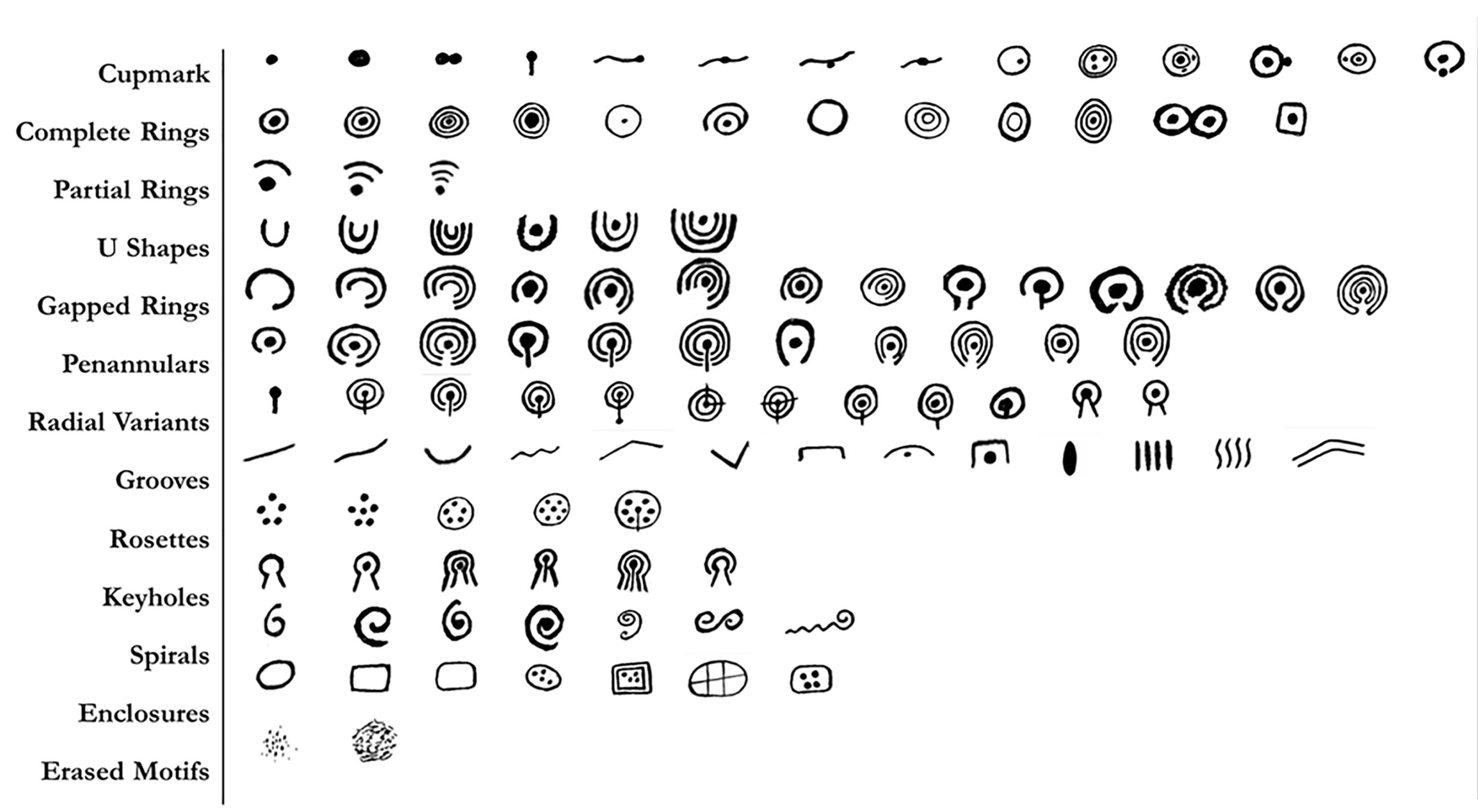
Prehistoric rock art in Scotland is similar across the country, but also displays distinct regional identities. This is especially apparent in the different types of carved motifs. In recent years, digital recording and enhancement techniques, such as Structure from Motion Photogrammetry (SfM), have revealed details that were previously nearly impossible to identify with the naked eye, and enabled the identification of micro-variations in the designs. The cup-and-ring motifs, for example, are often not ‘just’ a cupmark surrounded by circles, but display remarkable variations. Rings can be gapped, open on one side, conjoined at one end, continue into longer lines on one side, or the gapped ends can develop into straight parallel lines, converge with radial grooves.
The study of 3D models of more than 1,000 panels documented by ScRAP demonstrated that this variability is an intrinsic part of the Atlantic Rock Art tradition, and each difference may refer to a specific meaning. These variations are widespread across Scotland, together with other details such as the interplay between motifs and natural features of the rock surfaces, the type of rock chosen for carving, and the patterns of location in the landscape. They indicate that the tradition was shared through a system of cultural transmission. The motifs were not just randomly copied, but were adapted by different communities according to their particular preferences and identities (Valdez-Tullett 2019, Barnett et al 2024).