Prehistoric rock art in Scotland refers to the geometric, mainly circular motifs, carved into boulders and outcrops in the landscape. The carvings were created during the Neolithic and Early Bronze Age, between 4,000 and 1,600 BC, but may also had significance in the Iron Age and more recent periods. Over 3,000 carved stones are known in Scotland today, with more discovered each year and probably many yet to be found (ScRAP). Since a large amount of rock art has been destroyed, eroded, or buried beneath turf and peat, the total number may have originally been considerably higher.
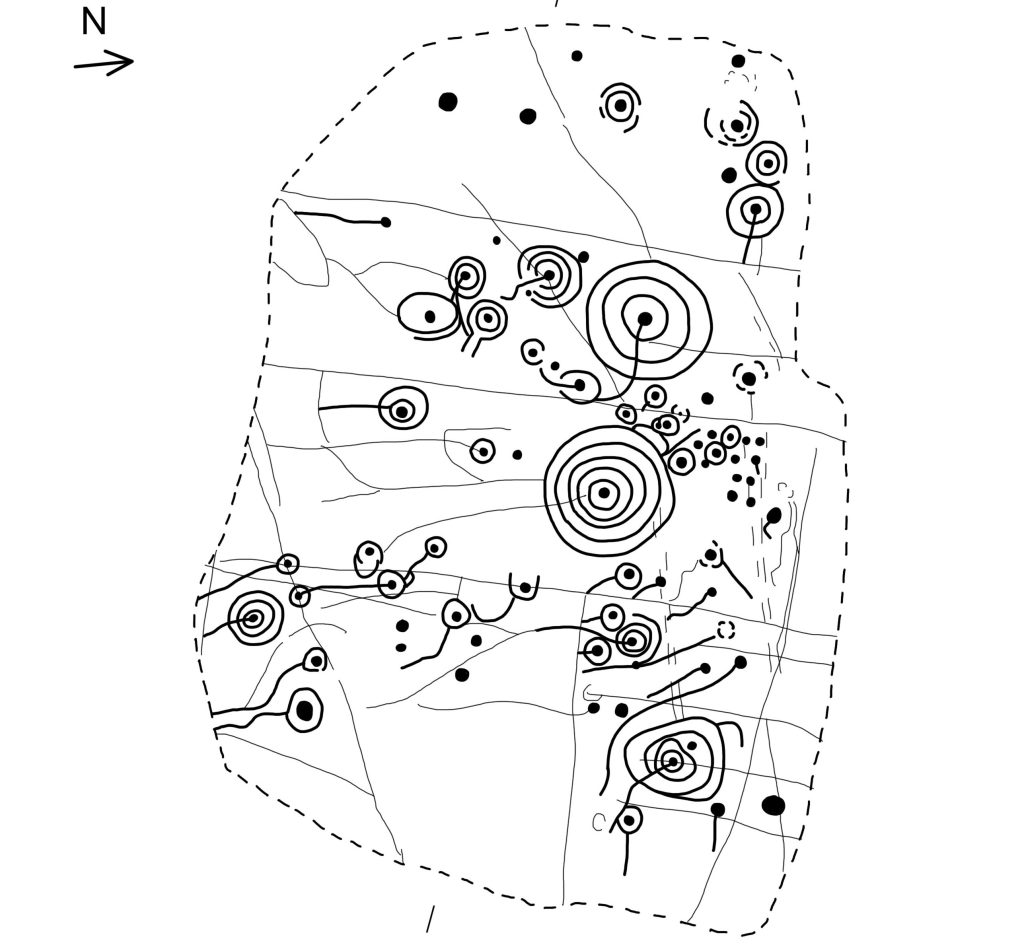
The basic motifs comprising Scotland’s rock art – cupmarks, rings and grooves – have numerous subtle variations, combinations and arrangements. Motif variations include cup-and-rings, with or without radial lines extending from a central cupmark or rings, penannulars (gapped rings), rosettes (a circle of cups usually around a central cupmark), keyholes and rare spirals. In most cases, the panels are standardised and simple with only one or two motif types on each, even when the rock surface is heavily carved. However, a small proportion of panels have elaborate designs comprising a wider range of motif types. It is likely that the motif variations were not random, but significant and deliberately chosen.
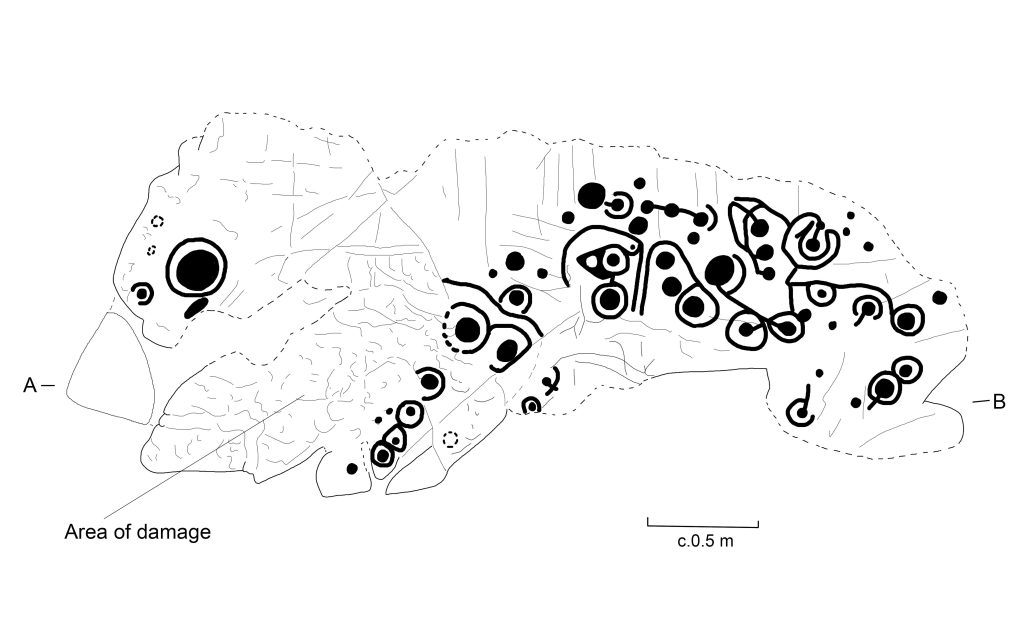
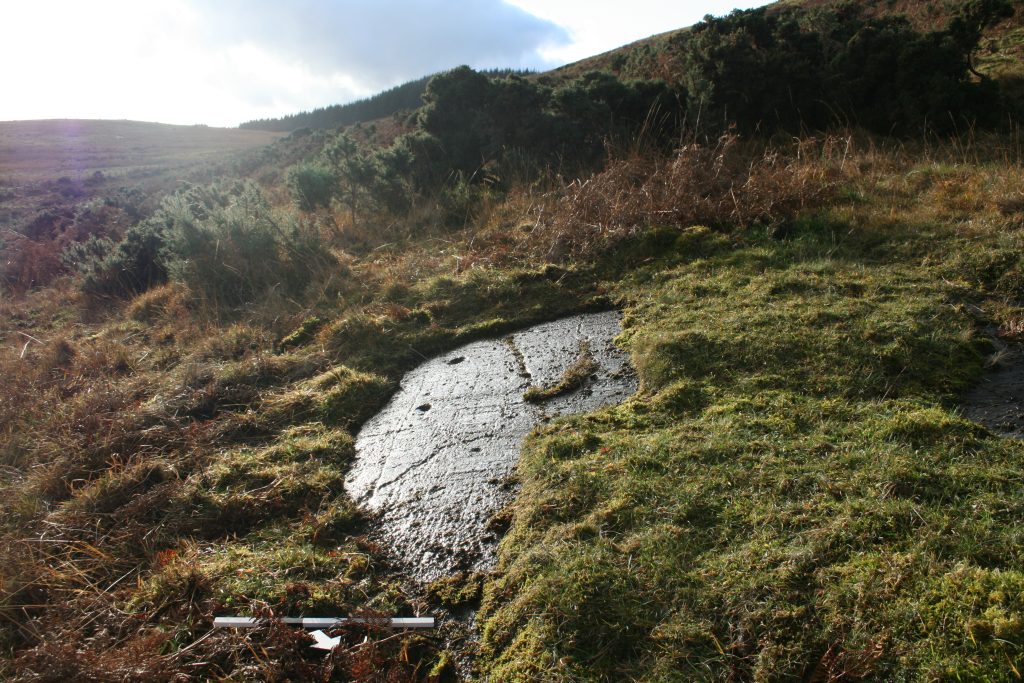
The motifs are typically carved on flat or gently sloping, low-lying rock surfaces, although there are rare cases where they are found on cliff faces, such as at Ballochmyle in Ayrshire. A diversity of rock types was used, from soft, fine-grained sandstones in the Lothians to hard, coarse-grained granites or gneiss in parts of North East and North West Scotland. The motifs respond to the shape, textured and natural features of the rock surface, suggesting that certain rocks were selected for carving due to their particular characteristics (eg Jones 2006, 2009). The carvings were undoubtedly meaningful to the people that created them, and capture unique information about past beliefs and values, but their abstract nature makes them challenging for us to understand and appreciate today.
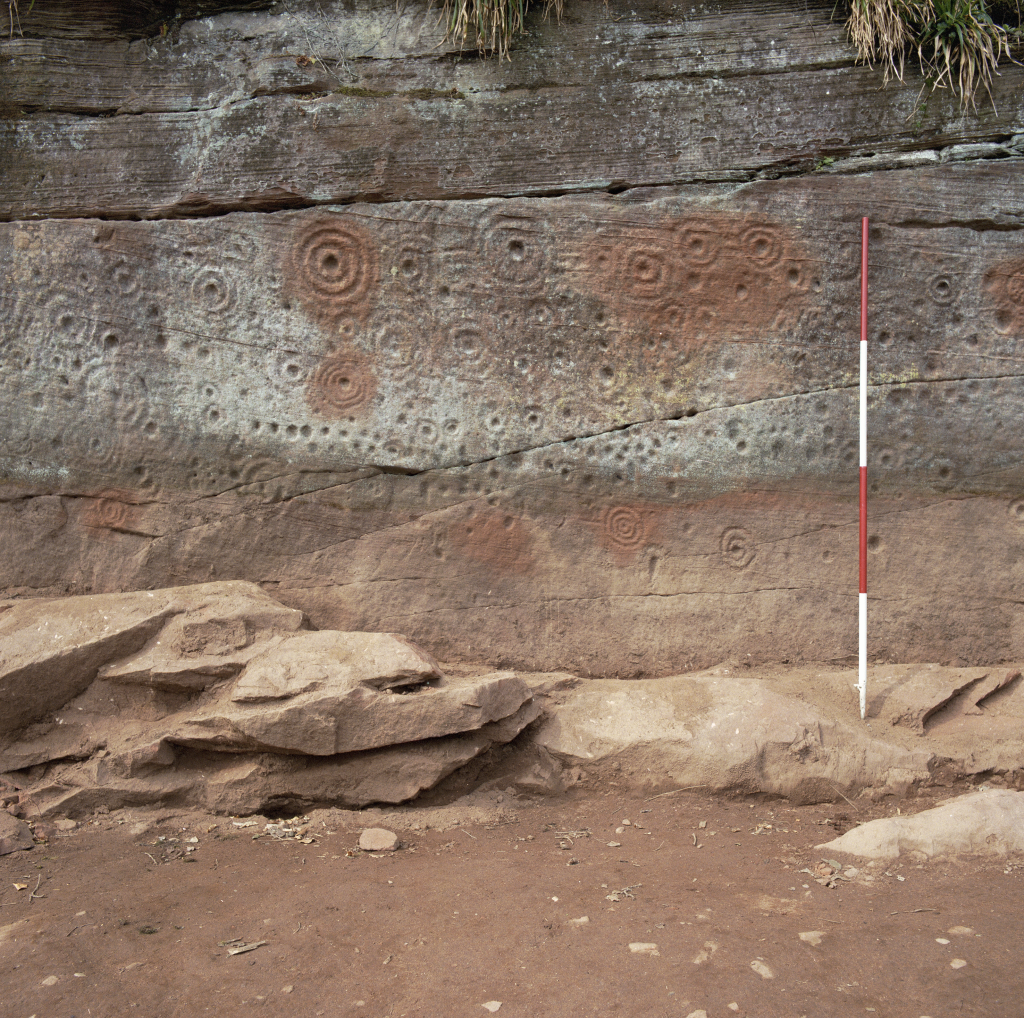
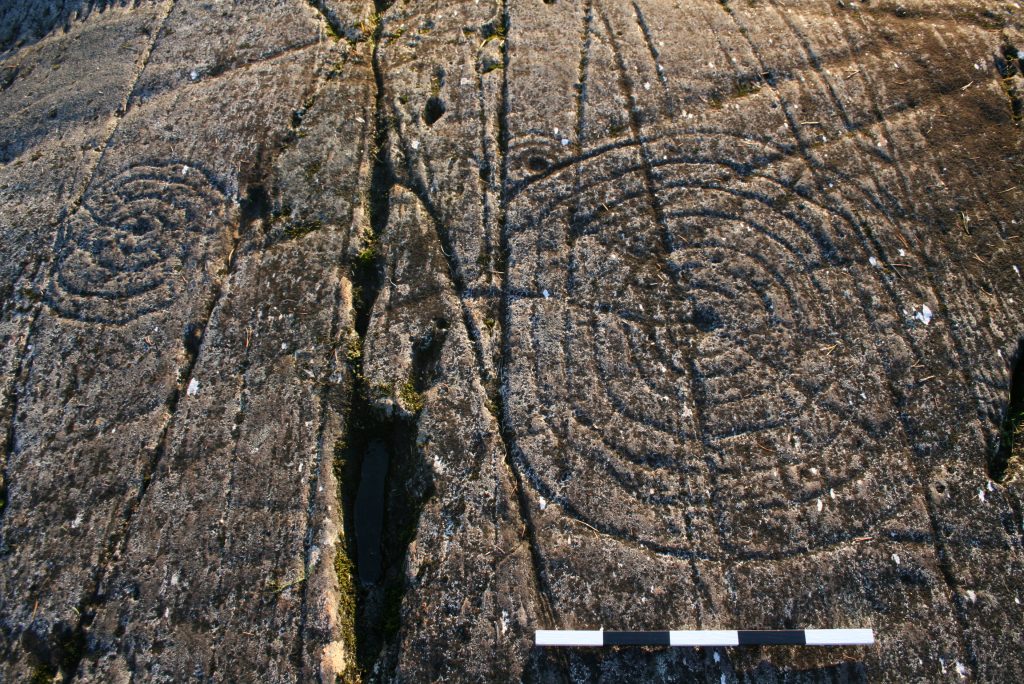
Comparable carvings were created at this time elsewhere in Atlantic Europe, including England, Wales, the island of Ireland, North West Spain and Portugal, forming a prehistoric tradition referred to as Atlantic Rock Art (see 2.1.6 Across the Atlantic). The similarity of rock art across Atlantic Europe is redolent of a network of shared knowledge, ideas, and customs connecting Neolithic and Early Bronze Age communities throughout this region (Bradley 1997, Valdez-Tullett 2019).
Rock art was made by repeatedly striking, or ‘pecking’, the rock surface with a stone tool, such as the possible hammerstones in quartz and quartzite recovered from excavations at Torbhlaren, Argyll (Jones et al 2011). Experimental archaeology using stone tools has produced simple cup-and-ring motifs in around 90 minutes on schist, whereas carving motifs into harder rocks would have been more laborious (Jones et al 2011). There is currently no clear understanding of whether each panel was created in a single event or over a lengthy time period, although modification and superimposition of motifs revealed in some 3D models indicates repeated carving activity at certain sites (Valdez-Tullett 2019, see new Rock Art section 3.3.2).
In Orkney, traces of red ochre and white clay on incised stones within Neolithic structures at Skara Brae, and stones with red ochre decoration together with pigment grinding equipment from Ness of Brodgar, raises the possibility that rock art motifs elsewhere in Scotland were once painted but, so far, there is no conclusive evidence of this. The ‘Colouring the Neolithic Project’, funded by the Society of Antiquaries of Scotland, has started to investigate the possibility of coloured rock art.
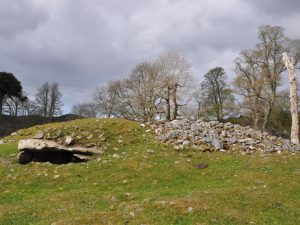
While the majority of rock art is in the open air, a small proportion is associated with Neolithic and Bronze Age ritual structures, notably funerary and standing stone monuments. In many cases the carvings have been deliberately extracted and re-used from earlier landscape contexts, while others were made specifically for placement within the monument. Coincidental recycling in later structures, such as field walls, clearance cairns and gateposts, is not uncommon. Carved stones are sometimes positioned significantly within Iron Age hillforts, souterrains, brochs and huts, leading to some debate about whether re-use in these structures was purposeful (eg Barnett 2022, Hingley 1996).
Excavations of Neolithic structures at Ness of Brodgar in Orkney have recovered hundreds of carved stones, many featuring faint incised, rectilinear motifs comparable to some Passage Tomb Art (Card and Thomas 2012, Thomas 2016). Their form, technique and context differ from Atlantic Rock Art, and their density and variety are unparalleled in Britain. Rectilinear carvings have been identified within structures near Arasaig, Highland and Early Bronze Age burial monuments in Scotland and England, and appear to belong to a separate but related carving tradition (see Highland Framework section 5.6.4).
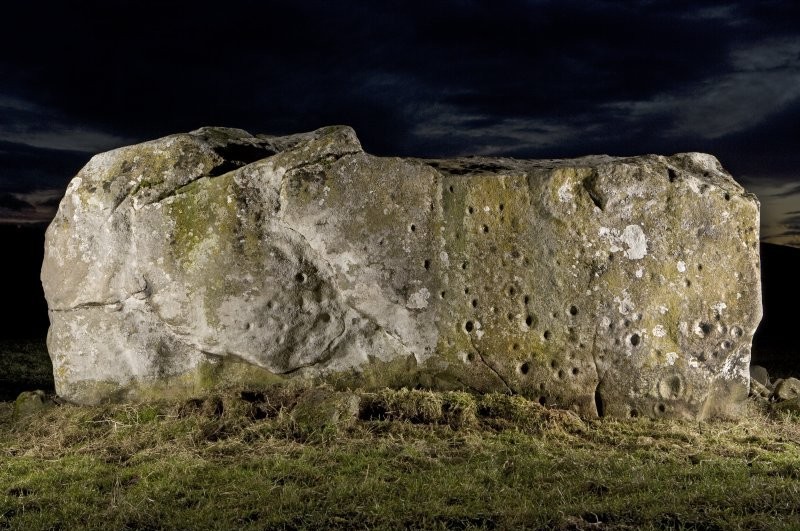
Prehistoric figurative carvings are rare in Scotland and found almost exclusively within Early Bronze Age burials in Kilmartin, Argyll. Here, several examples of carved axe-heads resembling earliest Bronze Age metal counterparts, and the unique animal images revealed at Dunchraigaig Cairn in 2020, may denote international exchange networks in the Kilmartin area towards the end of the 3rd millennium BC (see Dunchraigaig Case Study).