Shetland’s Bronze Age remains largely ephemeral. Comparatively few Bronze Age sites have been identified across Shetland with any certainty, let alone excavated and fully investigated. The archetypal features of the Scottish Bronze Age, namely copper and copper-alloy metalwork, new and individual burial styles and Beaker pottery, are currently under-represented in Shetland’s archaeological record, although there appears to be a Shetland variant of Beaker pottery (Mason 2018). Shetland’s Bronze Age, however, betrays some singular characteristics. Although evidence for metalworking in this period is particularly rare, the manufacture and use of steatite vessels is a defining feature, as is the dominance of burnt mounds in the archaeological record.
Within the wider context of Scotland’s Bronze Age, the range and distribution of known site types across Shetland stands out. More than 90% of Shetland’s known Bronze Age sites comprise burnt mounds. Unsurprisingly, therefore, burnt mounds have become key to understanding Shetland’s Bronze Age and represent relatively well researched sites and topics for this period. During the 1990s, the Shetland Burnt Mounds Project established a programme of survey and excavation examining over 20 burnt mound sites (Anthony 2004, Moore and Wilson 1999, 2000). Key excavations include Tangwick (Moore and Wilson 1999), Cruester (Moore and Wilson 2000, 2001, 2008) as well as a series of burnt mound investigations in South Nesting (eg Skellister, Dockrill et al 1998). Synthesis, re-evaluation, further dating and experimental work on burnt mounds can be found in two recent doctoral theses (Anthony 2004, Doughton 2014).
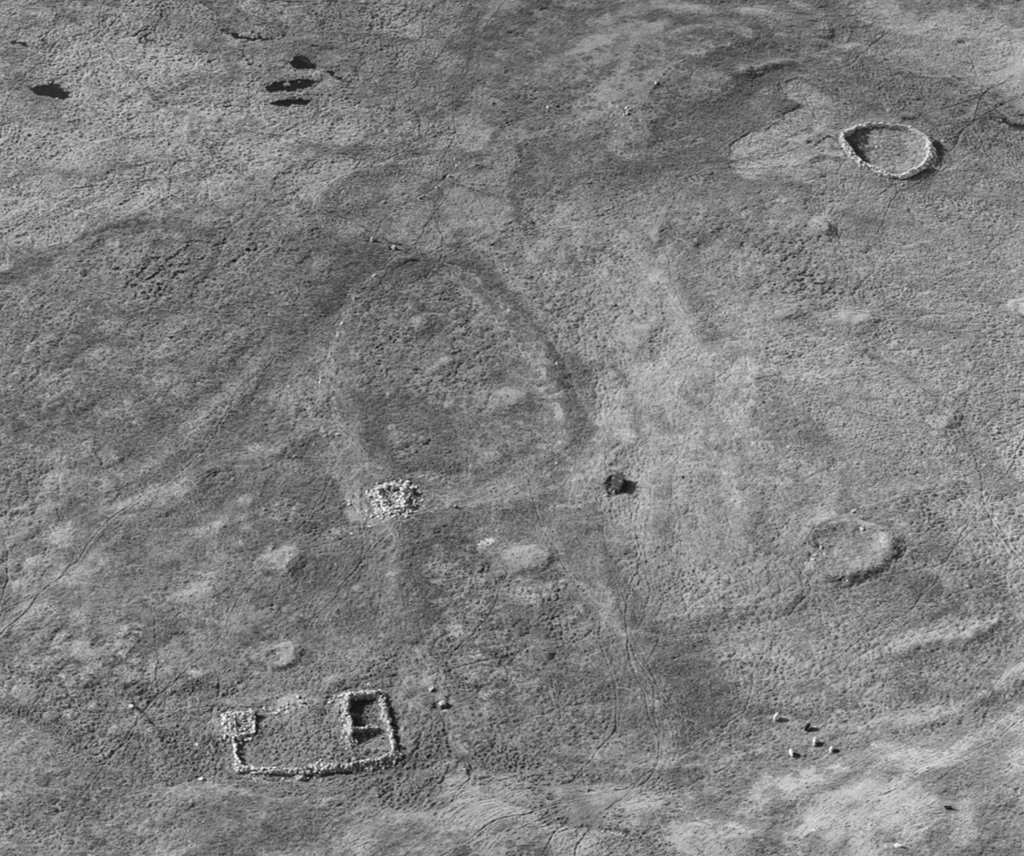
Bronze Age settlements across Shetland have proved hard to locate since they are hard to distinguish from those attributed to the Neolithic on typological grounds and settlement sites make up a relatively small proportion of known Bronze Age sites across the region. The key site for this period is the paired oval houses at Sumburgh, excavated by Raymond Lamb in the 1960s and 1970s in advance of the new runway at, and subsequently written up by Jane Downes (Downes and Lamb 2000). At least seven other similar oval-shaped houses have been found at locations across Shetland, including Stanydale, Ness of Gruting, Gruting School, Benie Hoose, Yoxie, Houlland, Sands of Breckon, and The Gairdie, as well as at multiperiod sites such as Jarlshof and Clickhimin. Notably, within a settlement context, most Bronze Age radiocarbon dates are associated with sites traditionally ascribed to other periods; either later sites which have yielded surprisingly early dates that pushed initial site activity back into the Bronze Age, or earlier prehistoric sites where activity extends into this period.
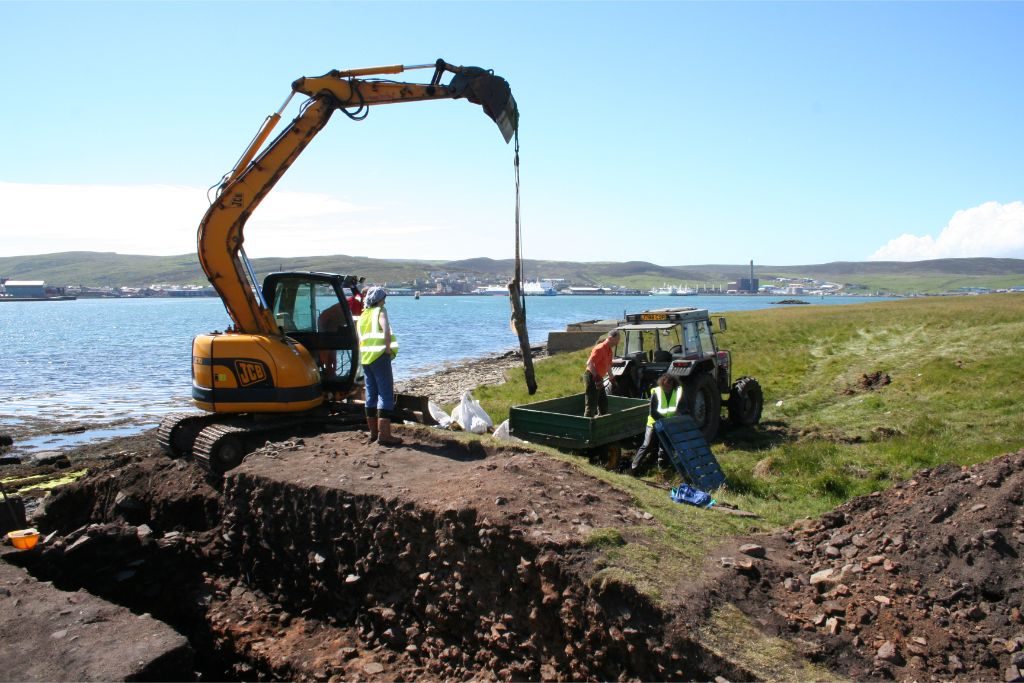
There is clearly more to understand here with regard to the establishment of Bronze Age settlements across Shetland and their relationship with earlier and later settlements. More reliable dates for this period will undoubtably expand current understanding, open up new questions about the chronology and structure of Bronze Age settlements and help refine current thinking on prehistoric landscapes. The nature and range of Bronze Age funerary practices across Shetland, specifically the relationship between funerary sites and settlements, are also poorly understood in comparison with other parts of Scotland. The discovery of a densely occupied prehistoric landscape centred around a Bronze Age cremation cemetery, identified in advance of the spaceport developments in Unst, brings new insights to our knowledge and understanding of this period across Shetland (see SIRFA Case Study: Shetland Spaceport). This project also further reinforces the important role that developer-funded projects have in contributing to previously under-studied and largely invisible archaeology.
You can download the datasheet for more information on the Bronze Age sites and c14 dates from Shetland.
Bronze Age Research Questions
SIRFA SH46: Where is Shetland’s Bronze Age art?
More information on this question
Local framework numbering:
SIRFA SH46
More information:
As with previous periods, there is a distinct lack of artwork from Shetland for the Bronze Age period. What are the reasons for this? Is it related to the use of organic components that no longer survive? Or due to a tendency to recycle precious resources during this period? It is likely that further dedicated survey work, as well as opportunities discoveries and those via developer-funded work, will enhance datasets. In a developer-funded context, the research significance of material culture needs to be emphasised.
SIRFA SH47: What IS the Shetland Bronze Age?
More information on this question
Local framework numbering:
SIRFA SH47
More information:
Based on current evidence, Shetland’s Bronze Age remains largely ephemeral – tricky to define and pin down. What defines the Bronze Age in Shetland? What does it look like, where is it and how does it differ from other areas? The settlement and Landscape evidence for this period is spectacular, but poorly dated. In the first instance, therefore, current data and knowledge needs to be synthesised and collated alongside a reliable dating programme in order to better understand and clarify the nature of the dataset. There is good reason to believe that a number of Bronze Age monuments are currently misidentified and pushed date-wise into the Early Iron Age. Similarly, some Bronze Age sites are likely to have been misassigned to the late Neolithic. Addressing this question is likely to result from the culmination of multiple projects. It is recommended that the primary focus should be on synthesis and dating. In a developer-funded context, the research significance of dating and other post-excavation work needs to be emphasised, in addition to the accurate and thorough recording of structures and material culture.
SIRFA SH48: How do Shetland’s burnt mounds compare with Orcadian and Hebridean burnt mounds?
More information on this question
Local framework numbering:
SIRFA SH48
More information:
Burnt mounds are found across the British Isles, including across Shetland where they are seemingly abundant. During the 1990s, the Shetland Burnt Mounds Project established a programme of survey and excavation examining over 20 burnt mound sites (Anthony 2004; Moore and Wilson 1999; 2000). Key excavations include Tangwick (Moore and Wilson 1999), Cruester (Moore and Wilson, 2000; 2001 and 2008) as well as a series of burnt mound investigations in South Nesting (Dockrill et al 1998). Synthesis, re-evaluation, further dating and experimental work on burnt mounds can be found in two recent doctoral theses (Anthony 2004; Doughton 2014). Burnt mounds are probably better studied in Shetland than anywhere else in Scotland. There is potential however, for enhancing our interpretation of this dataset, specifically by bringing a more holistic and comparative perspective to current interpretations. There is still a lack of consensus on what these sites were, how they were used and what they represented and meant to prehistoric communities. The burnt mounds in the Outer Hebrides and Orkney radically differ from one another; how do Shetland’s burnt mounds compare? Do they share characteristics with either of these groups, or do they present a third regional variation on the burnt mound theme? Work to date suggests that Shetland’s burnt mounds have small cellular structures under them, comparable with Liddle (Osbister) in Orkney. How do the burnt mounds across these three areas compare chronologically? Does the distribution of known burnt mounds differ between these places and what does this suggest about their use? Further, systematic radiocarbon dating and the utilisation of data from existing excavations should be an integral part of this work. In a develop-funded context, the research significance of dating and other post-excavation work needs to be emphasised, in addition to the accurate and thorough recording of structures and material culture.
SIRFA SH49: Was there a Chalcolithic in Shetland?
More information on this question
Local framework numbering:
SIRFA SH49
More information:
The appearance of a discernible Chalcolithic in Shetland remains unclear. Given that evidence for copper and bronze is scant, is it even an appropriate term to use to describe the earliest metalworking period in Shetland? Instead, is this transitionary period defined more by the continual use of Neolithic pottery styles and techniques and continuity in architecture? There is some evidence for derivative Beaker-styled pottery (Mason 2018) which tells us something about this transitionary period, but there is clearly more to unpick here. More comprehensive assemblages of well dated material culture should help to give a clearer outline to this transitionary period. The use of museum archives and collections will be important for this area of research, as will the application of systematic radiocarbon dating. In a developer-funded context, the research significance of dating and other post-excavation work needs to be emphasised.
SIRFA SH50: What does a Bronze Age site-based chronology look like for Shetland?
More information on this question
Local framework numbering:
SIRFA SH50
More information:
For Shetland, the overall chronology of known Bronze Age sites remains sketchy; where are the early, middle and later Bronze Age sites and how did the structure of the wider Bronze Age landscape change over time? In order to gain a clearer understanding of the Bronze Age and the development of the Bronze Age landscape across Shetland, a better chronology of known sites needs to be established and synthesised. Once created, how does Shetland’s Bronze Age chronology compare to Orkney and the Outer Hebrides’ Bronze Ages? Researchers need to be mindful to the identification of multi-period structures and/or site reuse within chronological frameworks. This is of particular importance and relevance when studying transitionary periods, and it is hoped that this will allow for a clearer understanding of the arrival of new cultures, religions, and technologies. These are complex questions that is unlikely to be addressed fully within a single research project; it is encouraged that a series of projects (or PhDs) are designed to tackle it. These questions would likely benefit from synthesising grey, published and unpublished literature, in addition to data and knowledge collated by museums. Although a chronology for funerary sites and burnt mounds has made progress in recent years, in terms of domestic architecture and land use new dating evidence is desperately needed. Dedicated survey work to increase known sites, as well as excavation work will clearly be crucial in moving these questions forward, alongside dedicated programmes of scientific dating. In a developer context, the research significance of dating and other post-excavation work needs to be emphasised as well as the potential for survey, evaluation and monitoring work to greatly enhance Bronze Age datasets.
SIRFA SH51: How can Shetland’s Bronze Age pottery chronology be improved?
More information on this question
Local framework numbering:
SIRFA SH51
More information:
The use of pottery for relative dating has long been an integral part of archaeological work. It is therefore of utmost importance that ceramic chronologies can be provided and improved. Is this possible to do in Shetland? Where there appear to be periods that are aceramic, alternative relative dating methods must be carefully considered. Further, what alterative materials and technologies were utilised during these relatively aceramic periods and why? The use of museum archives and collections is highly recommended, alongside dedicated dating programmes. To fully address the potential of this question requires new thinking and the development of innovative approaches. In a developer-funded context, the research significance of material culture, dating and other post-excavation work needs to be emphasised.
SIRFA SH52: Why are there so many burnt mounds in Bronze Age Shetland?
More information on this question
Local framework numbering:
SIRFA SH52
More information:
Whilst burnt mounds are found across the British Isles, there is a very high number of them found in Shetland. Why do they survive when many other features do not? Or are we just failing to recognise contemporary sites? Does their survival relate to the local folklore and superstitions? Or is their preservation a factor of location and environment? Or is there something else specific about Shetland’s Bronze Age and the significance of burnt mounds? This is a complex question that is unlikely to be addressed fully within a single research project; it is encouraged that a series of projects (or PhDs) are designed to tackle it. In a developer-funded context, the research significance of burnt mounds, including dating and other post-excavation work on these sites, needs to be emphasised, in addition to the accurate and thorough recording of structures and material culture of this period.
SIRFA SH53: What was Shetland’s Bronze Age environment like?
More information on this question
Local framework numbering:
SIRFA SH53
More information:
An understanding of the Bronze age environment is crucial to informing interpretations and understanding of the Bronze Age life. Where was the coastline, what flora and fauna defined the island environment, what of the soils and their stability? Were there any significant changes to the Neolithic flora and fauna into and through the Bronze Age? Were there significant climatic changes during this period? If so, what triggered these changes? Further, what does an understanding of Shetland’s Bronze Age environment tell us about life at the time? Did increasing peat growth initiate a shift in settlement during the Bronze Age? In order to address these questions, synthesising current knowledge and data is likely a first step which will also help determine more specific research gaps going forward. It is likely that a range of new and established methodologies will be employed to address this broad research areas. Within a developer-funded context, the research significance of environmental data from this period should be emphasised.
SIRFA SH54: What was the structure of Shetland’s Early Bronze Age exchange network?
More information on this question
Local framework numbering:
SIRFA SH54
More information:
Currently, it remains poorly understood how Shetland featured in wider Early Bronze Age exchange (or trade) networks. Likewise, understanding of internal trade networks during this period is limited. Where was the starting point for exchange and trade routes from and to Shetland? How far did these networks extend? What was transported and traded along these routes? Further, is it possible to determine if these networks interlinked with different settlements and locales within Shetland? It is anticipated that new methodologies will be developed or ‘transferred’ from other disciplines to further this research. Increasing the dataset for Shetland’s Early Bronze will undoubtedly help address these questions more fully. Is it possible to find out where tin and copper was being sourced from during this period? Dedicated survey work to increase known sites, as well as excavation work will clearly be crucial in moving these questions forward, alongside dedicated programmes of scientific dating. In a developer-funded context, the research significance of dating and other post-excavation work needs to be emphasised as well as the potential for survey, evaluation and monitoring work to greatly enhance Early Bronze Age datasets.
SIRFA SH55: Where are Shetland’s Late Bronze Age settlements?
More information on this question
Local framework numbering:
SIRFA SH55
More information:
Bronze Age settlements in Shetland have proved difficult to locate. More specifically, there are key gaps in our knowledge of Late Bronze Age through to Early Iron Age houses across Shetland. Late Bronze Age houses have been identified at Jarlshof. But where are the rest of Shetland’s Late Bronze Age settlements? Are Late Bronze Age sites hidden within broad categories of either ‘prehistoric’ or ‘Neolithic/Bronze’ sites? How do we go about identifying Late Bronze Age settlements.? It is expected that initial forays into this topic will utilise results of prior survey work. Targeted survey work to identify likely Late Bronze Age settlements and excavations to clarify occupation dates of known sites will undoubtably move these questions forward. More reliable dates will be the key to unlocking research potential here. In a developer-funded context, the research significance of dating and other post-excavation work needs to be emphasised as well as the potential for survey, evaluation and monitoring work to greatly enhance known Bronze Age settlements.
SIRFA SH56: What was the pattern of Bronze Age settlement across Shetland?
More information on this question
Local framework numbering:
SIRFA SH56
More information:
Bronze Age settlements in Shetland have proven difficult to locate. Where are they? What was their density across the landscape? Are Bronze Age structures in fact hiding amongst unknown or multiperiod sites? How did patterns of settlement change throughout the Bronze Age period? It is expected that initial forays into this topic will utilise results of prior survey work. Targeted survey work to identify likely Late Bronze Age settlements and excavations to clarify occupation dates of known sites will undoubtably move these questions forward. More reliable dates will be the key to unlocking research potential here. In a developer-funded context, the research significance of dating and other post-excavation work needs to be emphasised as well as the potential for survey, evaluation and monitoring work to greatly enhance known Bronze Age settlements.
SIRFA SH57: What was the relationship between Shetland’s Neolithic and Early Bronze Age settlements?
More information on this question
Local framework numbering:
SIRFA SH57
More information:
Did Early Bronze Age settlement sites have their roots in Neolithic sites and locales? Can we further evidence settlement continuity from Late Neolithic through to the Early Bronze Age? What evidence is there for multi-period settlements that span these periods and for reused and modification of sites over long periods of time? Does continuity and reused explain the ongoing difficulties researchers have had in locating Bronze Age settlements across Shetland? Is this why the Shetlandic Bronze Age is often viewed as underpopulated? These complex questions are unlikely to be addressed fully within a single research project; it is encouraged that a series of projects (or PhDs) are designed to tackle it. Targeted survey work to identify likely transition settlements and excavations to clarify occupation dates of known sites will undoubtably move these questions forward. A better chronology via dedicated programmes of scientific dating will be needed to move these debates forward. In a developer-funded context, the research significance of dating and other post-excavation work needs to be emphasised as well as the potential for survey, evaluation and monitoring work to greatly enhance known Bronze Age settlements.
SIRFA SH58: What agricultural system was in use during Shetland’s Bronze Age?
More information on this question
Local framework numbering:
SIRFA SH58
More information:
Major steps towards understanding Shetland’s prehistoric landscape have been made by Turner (2012) and Christie (2019). But there remains a lack of chronological refinement and thus key gaps around how the Bronze Age landscape was structured and used. Is it possible to determine what agricultural systems were in place in Shetland during the Bronze Age? Was it pastoral, arable, or mixed? Further, was this an agricultural economy? Was the economy of this time more complex than is typically assumed? Further, is there any evidence to show how land was managed? The introduction of farming is usually associated with the establishing of field walled field systems; is this correct? Where are the land divisions for crops or animals? If they were in use why have they not yet been found? It is likely that this will be best answered through landscape survey, strategic excavation strategies as well as continued analysis of existing assemblages. The general paucity of Bronze Age dates and is also a barrier to further research here. Within a developer-funded context the significance and value of retaining and analysing faunal remains and environmental evidence needs emphasis.
SIRFA SH59: What did Bronze Age resource usage look like in Shetland?
More information on this question
Local framework numbering:
SIRFA SH59
More information:
As with previous periods, it is currently unclear what key resources were utilised by Bronze Age communities across Shetland. The research gap is to better identify resources exploited during this period as well as information about their use. Seasonality must be considered, in addition to variations in resource usage that may have been related to age, sex, gender, etc. As with the Neolithic, there is the additional interplay of the sea, crops (or agricultural resources), and wild resources throughout the Bronze Age. Is there a shift in resource use and exploitation from previous periods? Was this significant? It is likely that these questions will be addressed through analysis of materials and collections already held in institutions and museums, as well as materials emerging from new excavations. Interdisciplinary approaches will also be important, as well as archaeological survey. In a developer-funded context, the research significance of all environmental data for this period needs to be emphasised.
SIRFA SH60: Did Beaker migration reach Shetland?
More information on this question
Local framework numbering:
SIRFA SH60
More information:
What evidence is there for Beaker culture arriving in Shetland? Is there Beaker pottery evidence in Shetland? There is some evidence for derivative Beaker-styled pottery (Mason 2018) which tells us something about this transitionary period, but there is clearly more to unpick here. Is there evidence of a population migration during this time? Beaker culture appears to have manifested relatively uniquely in the Outer Hebrides, is this also the case for Shetland? If this is the case, then what was the ‘Shetlandic Beaker Culture’ like? How does it manifest in the archaeological record? It is anticipated that primary steps towards this research area will involve surveying and/or the use of existing survey data to locate potential sites, in addition to excavations and the study of museum collections. In a developer-funded context, the research significance of dating and other post-excavation work needs to be emphasised as well as the potential for survey, evaluation and monitoring work to greatly enhance known Beaker sites.
SIRFA SH61: What were Bronze Age boats in Shetland like?
More information on this question
Local framework numbering:
SIRFA SH61
More information:
As with earlier periods, there has yet to be any direct evidence for Bronze Age boats in Shetland. Nevertheless, it is assumed that boats were used during this period. What did they look like and what were they made of? How big were they? Did they differ in any way to boats used in the Neolithic or Mesolithic? Had some of the practicalities of getting to and from Shetland changed since these previous eras? Is there evidence to suggest changes in marine resource exploitation during this period? Were there notable shifts in seafaring requirements; in fishing technology or species, in importing/exporting materials, or wider social or political connections? What about the availability of materials for making boats, such as wood; did this change into or through the Bronze Age with potential impacts on the types of boats that were made? It is suggested experimental archaeological approaches are considered alongside more traditional techniques, such as palaeoecology, palaeoclimatology and physical archaeological evidence from excavations. It is likely that further dedicated survey work, as well as opportunities discoveries and those via developer-funded work, will enhance datasets. The use of experimental archaeology for this area of research is highly encouraged. Public engagement through such work is also recommended. In a developer-funded context, opportunistic discoveries of remains potentially related to seafaring should be considered a priority.
SIRFA SH62: Did new or different populations arrive and settle in Shetland at the beginning of the Bronze Age?
More information on this question
Local framework numbering:
SIRFA SH62
More information:
Is it possible to detect the arrival of new people associated with the Beaker Culture and the beginning of a recognisable Bronze Age through the use of stable isotope and DNA analysis? Can these scientific techniques be better deployed to expand our understanding of population influxes to Shetland and to evidence the arrival of new or different people during this period? The exploration of this topic is reliant on the increased ability to retrieve Early Bronze Age skeletal remains (human and animal) – identifying, excavating and dating human remains of this period is therefore a first crucial step towards addressing these questions. Thereafter, programmes of radiocarbon dating, alongside stable isotope analysis and ancient DNA studies are considered to be fruitful ways forward. In a developer-funded context, the significance of any potential Bronze Age human remains should be emphasised, as well as the need for funded post-excavation work.
SIRFA SH77: Did the importation of domestic animal species into Shetland continue into Later Prehistoric periods?
More information on this question
Local framework numbering:
SIRFA SH77
More information:
Sheep, cattle and horses were not native to Shetland but were instead brought to these islands as domesticated species during the Neolithic. However, is there evidence to suggest that domestic species continued to be imported to Shetland into and throughout Later Prehistory? A better grasp of the origin and species management of later prehistoric domesticates has the potential to further our understanding of Shetland’s Iron Age and Bronze Age economies and wider political connections. It is recommended that archaeological sciences are utilised to explore this topic, most notably stable isotope analysis (both mobility and dietary). In a developer-funded context, the research significance of faunal material needs to be emphasised.
If you have answered a research question, or have an update to add about a specific site or period, you can use our inline comments to flag the change and keep the frameworks up to date.
Register for an account, or login now to add updates and comments to our existing frameworks.