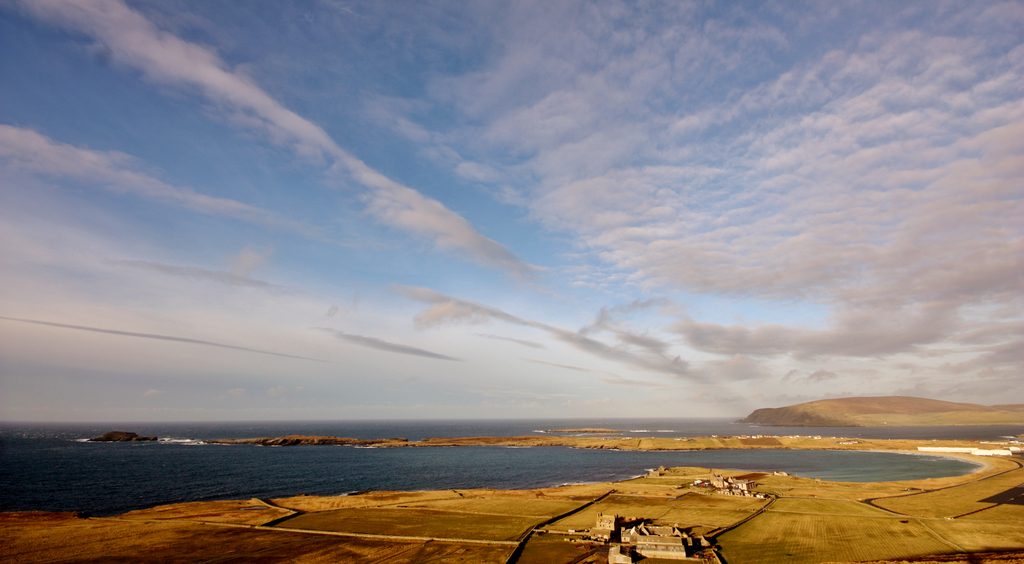
The evidence for Mesolithic activity in Shetland is minimal. Currently no Mesolithic sites have been confidently identified in Shetland, although radiocarbon dates from midden material at West Voe, Sumburgh, fall within what can be defined as the Mesolithic-Neolithic transition periods (Montgomery et al 2013). Judging by current evidence, it remains reasonable to still ask whether Mesolithic populations were present at all across these islands. It is important to recall, however, that 20 years ago, direct evidence for a Hebridean Mesolithic was similarly non-existent, postulated primarily from indirect, environmental evidence (see Outer Hebrides Palaeolithic & Mesolithic section).
A better understanding of Shetland’s climatic, environmental and coastal changes for this period will undoubtably aid our understanding of potential Mesolithic activities here. It is likely that Mesolithic sites in Shetland, if they exist, are now underwater or beneath deep deposits of peat. Developing new interdisciplinary methods and projects, learning from and collaborating with researchers from other disciplines, are all likely to lead to more positive results for all three regions.
Developer-led archaeology also has a crucial role to play. For other periods, such as the Neolithic and Bronze Age, key narrative-altering information about Shetland’s prehistory has emerged through large-scale commercial projects, especially where these activities involved substantial peat stripping in areas previously under- or un-investigated, as at Hill of Crooksetter, and more recently at Lamba Ness. The potential for developer-funded fieldwork to uncover previously unknown early prehistoric landscapes therefore remains high and should be considered a real possibility in most, if not all, archaeological fieldwork projects.
You can download the datasheet for more information on the Palaeolithic and Mesolithic sites and c14 dates from Shetland.
Palaeolithic & Mesolithic Research Questions
SIRFA SH1: Is Shetland’s Mesolithic archaeology distinguishable from the islands’ early Neolithic?
More information on this question
Local framework numbering:
SIRFA SH1
More information:
There is still no clear evidence for Mesolithic activity across Shetland. Why is this? The assumption is that this is due to either poor preservation or poor visibility – are we looking in the wrong locations? But how distinctive is Shetland’s Mesolithic archaeology? Are archaeologists instead finding evidence of a very early Neolithic activity? This question takes a different approach to the issue of Shetland’s missing Mesolithic remains.Developer-funded work is likely to play an important role; trial trench evaluations and archaeological monitoring provide scope for identify sites and material across large, previously uninvestigated areas and landscapes. Offshore development (pipelines, cables, fish farming, dredging) also have the potential to reveal Mesolithic remains. Attention should also be paid to areas where there is some natural silting up of coastal areas. Opportunistic discoveries, through developer-funded work for example, should be regarded as highly significant.
SIRFA SH2: When was the earliest human activity and settlement across Shetland?
More information on this question
Local framework numbering:
SIRFA SH2
More information:
It is currently still unclear when the earliest human activity took place on Shetland. Further, it is not yet clear what the character and nature of this initial activity was. What activities were carried out? When did the first human settlements appear? Were these transient populations, or sedentary? Is it possible to determine the nature of colonisation, or when it took place? Opportunistic discoveries, through developer-funded work for example, should be regarded as highly significant. In these circumstances, dating and other post-excavation work will be priority.
SIRFA SH3: What was the chronology of the Mesolithic-Neolithic transition across Shetland?
More information on this question
Local framework numbering:
SIRFA SH3
More information:
Transitionary periods are notoriously tricky to pin down. The Shetlandic Mesolithic-Neolithic transition is especially so, given the lack of known Mesolithic sites or archaeology. When did this transition begin? Do the dates and material culture line up with what is witnessed in Orkney? Or, indeed, elsewhere in Scotland? Additionally, what did this transitionary period look like? Reassessment and reanalysis of existing datasets, reports, archives and collections, alongside new programmes of meaningful scientific dating, are likely ways forward. In a developer-funded context, the research significance of dating and other post-excavation work needs to be emphasised.
SIRFA SH4: What was the land and seascape like at the time of Mesolithic settlement across Shetland?
More information on this question
Local framework numbering:
SIRFA SH4
More information:
To understand Shetland ‘s Mesolithic populations, it is crucial to understand the environment they existed in and moved through. Our understanding of sea level change in Shetland lags behind research in other areas, notably Orkney. We also need more palaeoenvironmental and palaeoclimatology data for Shetland’s Mesolithic. What is the extent of current knowledge on the environment during this period? What is known about the land and seascape during colonisation and initial settlement? How should researchers synthesise this data? This area of research will rely on inter-disciplinary work, particularly focusing on palaeoenvironmental data and palaeoclimatology. It is unlikely that these questions will be addressed via a single project. It is likely that in response to this question researchers will need to take a multi-disciplinary and holistic approach. In a developer-funded context, the research significance of environmental data needs to be emphasized.
SIRFA SH5: Where are Shetland’s Mesolithic sites?
More information on this question
Local framework numbering:
SIRFA SH5
More information:
A significant concern with understanding Shetland’s Mesolithic is in the ability to find or locate Mesolithic sites. It is currently believed that most of these sites were coastal and are therefore likely to now be underwater. To what extent is this the case? Are all Mesolithic sites now inundated? If this is the case, what methodologies should be utilised to locate and explore these sites? Is it possible to excavate them? It is possible that new methodologies will be developed to tackle this research area. Additionally, the training of marine/underwater specialists for this topic is encouraged and considered of particular importance for Shetlandic archaeology as a whole. Training recreational divers to identify Mesolithic remains might pay dividends for example. Developer-funded work is likely to play an important role here; trial trench evaluations and archaeological monitoring provide scope for identify sites and material across large, previously uninvestigated areas and landscapes. Opportunistic discoveries of potential Mesolithic remains should be considered a priority in this context. More consistent and targeted surveys within a research context may also be valuable, although knowing where to look is the first challenge. The development of new approaches, techniques and methods, especially with regards to marine/underwater survey approaches, has huge potential.
SIRFA SH6: What types of structures did Shetland’s Mesolithic population use?
More information on this question
Local framework numbering:
SIRFA SH6
More information:
Given the ephemeral nature of the Mesolithic across Shetland, it is unclear to what degree these early populations were mobile and what their structures looked like. If itinerant populations were present across Shetland, did they build and use portable structures? Is it possible to locate potential campsites? What might these buildings have looked like or been constructed of? Developer-funded work is likely to play an important role; trial trench evaluations and archaeological monitoring provide scope for identify sites and material across large, previously uninvestigated areas and landscapes. Opportunistic discoveries of potential Mesolithic remains should be considered a priority in this context.
SIRFA SH7: What did pre-Neolithic resource usage look like across Shetland?
More information on this question
Local framework numbering:
SIRFA SH7
More information:
What resources were available during this early stage of Shetland’s occupation? What would have been considered the key resources? Is it possible to identify them and their usage in the archaeological record? Further, what factors would have impacted on their usage? Were these seasonal? Were there social restrictions/requirements? How should these be explored? It is expected that addressing this question will rely on palaeoenvironmental research and data, as well as osteoarchaeological or zooarchaeological research if any skeletal remains are recovered. Reassessment of existing datasets, reports, archives and collections, alongside new programmes of material analysis are likely ways forward. In a developer-funded context, the research significance of faunal and environmental data needs to be emphasized.
SIRFA SH8: How big was Shetland’s pre-Neolithic population?
More information on this question
Local framework numbering:
SIRFA SH8
More information:
This is an aspirational question. Currently, there is a lack of information, data and sites to address this question in earnest. Nevertheless, it is recommended that future researchers consider ways of gauging the likely size of Shetland’s Mesolithic population. Is it possible to estimate how large a population might have been active in Shetland during the Mesolithic? And if so, what does this tell us about Mesolithic communities and about Shetland during this period? How do we understand population movements, dynamics, and resource usage during the Mesolithic without a sense of population size and density of activity? Developer-funded work is likely to play an important role; trial trench evaluations and archaeological monitoring provide scope for identify sites and material across large, previously uninvestigated areas and landscapes. Opportunistic discoveries of potential Mesolithic remains should be considered a priority in this context. In addition, new methods for modelling past populations and revised thinking on how this information is interpreted.
SIRFA SH9: What was the relationship between Shetland and continental Europe during the Mesolithic?
More information on this question
Local framework numbering:
SIRFA SH9
More information:
During the the UPL and the Mesolithic Doggerland still existed as a landmass above sea level joining southern England with continental Europe. Did communities in Shetland have a relationship with the populations of these areas? Can this be determined from material culture found in Shetland? What methodologies would be best utilised for exploring this question? It is likely that in response to this question researchers will need to take a multi-disciplinary and holistic approach, as well as working in conjunction with colleagues in England and elsewhere in Europe. It is likely that in response to this question researchers will need to take a multi-disciplinary and holistic approach, as well as working in conjunction with colleagues in England and elsewhere in Europe. In a developer-funded context, the research significance of Mesolithic remains needs to be emphasised.
SIRFA SH10: Did Mesolithic populations arrive in Shetland intentionally?
More information on this question
Local framework numbering:
SIRFA SH10
More information:
Is it possible to determine whether first contact with Shetland was accidental or intentional? Were people intentionally travelling to Shetland, or were they accidentally washed up? If their arrival was intentional, is it possible to estimate how and when they first became aware of Shetland? Did populations travel up periodically, perhaps even seasonally, or did they arrive with the intention of settling permanently? What methodologies could be used to explore these questions? It is likely that this cannot be explored or answered until a considerable level of work has been carried out on Mesolithic sites in general, and so it is recommended that researchers primarily focus on locating and excavating potential sites. It is likely that this cannot be explored or answered until a considerable level of work has been carried out on Mesolithic sites in general, and so it is recommended that researchers primarily focus on locating and excavating potential sites. In a developer-funded context, the research significance of potential Mesolithic remains needs to be emphasised.
SIRFA SH11: If Mesolithic people went to Shetland, what did their boats look like?
More information on this question
Local framework numbering:
SIRFA SH11
More information:
Thus far no boats this old have been found in Shetland – likely as a result of poor preservation conditions and organic construction materials. Despite a lack of evidence, is it possible to determine what they were likely made of? What size could these boats have been? What was the availability of boat making materials? What were the practical requirements at this time for getting to Shetland and landing on these islands? Were there significant differences in the ocean currents compared to today? What did the coastline look like, and did this impact the ability to land and launch boats in Shetland? Were sailing opportunities dictated by seasons? Was there a difference in the boats utilised for fishing, travelling, or perhaps even trading? It is expected that a significant portion of this work will rely on experimental archaeology. More reliable coastline modelling and a clearer picture of the palaeoclimate will also be important for understanding the necessary conditions for seafaring in and around Shetland during the Mesolithic. What were the waters around Shetland like during the Mesolithic in terms of storminess, fetch and distance for example? The use of experimental archaeology for this area of research is highly encouraged. Public and community engagement is also recommended. Likewise, the need for better coastline modelling and palaeoclimatic and palaeoenvironmental data will be hugely beneficial. Direct evidence from other areas and periods potentially comparable should also continue. In a developer-funded context, opportunistic discoveries of remains potentially related to seafaring should be considered a priority.
SIRFA SH12: How was the Shetlandic landscape used and structured across the Mesolithic period?
More information on this question
Local framework numbering:
SIRFA SH12
More information:
This is an aspirational question. Currently, so little is known about the Mesolithic across Shetland there isn’t enough information, data or sites to address this question. Nevertheless, this is the level of knowledge and understanding that researchers should aspire to. With more sites and data is should be possible to better characterise the landscape and seascape, its structure, how it was used and, crucially, how this changed over time. This question is likely to be best addressed through more consistent and focused field surveys, alongside multi-pronged, inter-disciplinary methods of data collection and a dedicated program of radiocarbon dating. Developer-funded work is likely to play an important role; trial trench evaluations and archaeological monitoring provide scope for identify sites and material across large, previously uninvestigated areas and landscapes. Opportunistic discoveries of Mesolithic remains are also likely to contribute key data.
SIRFA SH13: How did Mesolithic communities respond to environmental change across Shetland?
More information on this question
Local framework numbering:
SIRFA SH13
More information:
This is an aspirational question. Currently, there is a lack of information, data and sites to address this question in earnest. Nevertheless, this is the level of knowledge and understanding that researchers should aspire to. With more sites and data, a better understanding of the structure of the Mesolithic landscape alongside a better understanding of the palaeoenvironment, it should be possible to address these questions. It is unlikely that these questions will be addressed via a single project. A series of well-funded projects, almost certainly interdisciplinary and multi-proxy in nature, are likely ways forward. Within a developer-funded context, the importance of retaining faunal assemblages and environmental data for this period and funding post-excavation work needs emphasis.
SIRFA SH14: How did Shetland’s palaeoenvironmental change between the LUP and Mesolithic?
More information on this question
Local framework numbering:
SIRFA SH14
More information:
There are still large gaps in our knowledge and understanding of Shetland’s paleoenvironment, specifically with regard to the LUP and Mesolithic period. What was the nature of vegetation cover and how did this change over time? How did vegetation cover vary across and between islands? Where was the coastline and how did this change into the Mesolithic period? Were changes to the environment gradual or sudden? Can we identify periods of acceleration? And were rates of change regionally uniform or locally specific? It is unlikely that these questions will be addressed via a single project. A series of well-funded projects, almost certainly interdisciplinary and multi-proxy in nature, are likely ways forward. Within a developer-funded context, the importance of palaeoenvironmental data needs emphasising.
SIRFA SH15: Were pre-Neolithic populations inter-connected across Shetland’s islands?
More information on this question
Local framework numbering:
SIRFA SH15
More information:
This is an aspirational question. Currently, there is a lack of information, data and sites to address this question fully. Nevertheless, this is the level of knowledge and understanding that researchers should aspire to. With more sites and data, a better understanding of the structure of potential connections across Shetland during this period should be possible. Were the first Shetlandic populations made up of several independent groups (or clans/extended familial groups) or did a single group arrived and spread out from a single point. Is it possible to determine the connectivity across the earliest Shetlandic population(s), and does this give us any insight into how the Shetland islands were initially colonised? It is likely that these questions will be addressed partly through collation, reassessment and reanalysis of existing material and literature. More consistent and focused field surveys, alongside multi-pronged, inter-disciplinary methods of data collection and a dedicated program of radiocarbon dating will undoubtedly expand the dataset needed to address wider connections across the archipelago. Developer-funded work is likely to play an important role; trial trench evaluations and archaeological monitoring provide scope for identify sites and material across large, previously uninvestigated areas and landscapes. Opportunistic discoveries of potential Mesolithic remains should be considered a priority in this context.
SIRFA SH16: What is the earliest evidence for human habitation or activity across Shetland?
More information on this question
Local framework numbering:
SIRFA SH16
More information:
There has been no evidence found thus far for Palaeolithic activity among the Shetland islands. However, it is not clear whether the lack of evidence is evidence of absence or destruction of Palaeolithic sites in the ensuing centuries. The presence of Palaeolithic sites in Skye (Hardy and Ballin 2024) and Islay (Mithen et al 2015) may indicate that they also exist in the Outer Hebrides. It is likely that this question will be addressed via a combination of targeted survey and opportunistic discoveries via walk-over surveys, archaeological monitoring or evaluation within a developer-funded context and as a result of coastal erosion. Within a developer-funded context the research significance of any potential palaeolithic evidence information should be emphasised.
SIRFA SH17: Were there land mammals in Shetland during the Mesolithic?
More information on this question
Local framework numbering:
SIRFA SH17
More information:
Are we correct in assuming that there were no land mammals in Shetland for Mesolithic people to hunt? If so, did this mean that Mesolithic communities active in and around Shetland were reliant on sea resources? Did the lack of land mammals prohibit a sustained Mesolithic presence across Shetland? It is generally held that there were no indigenous mammals in Shetland, except perhaps otters. The only evidence of possible Mesolithic grazing comes from Dallican Water (Bennett, 1992). Palaeoenvironmental work could shed further light on this. The discovery of sites which are clearly Mesolithic in date and character has the potential to shed light on this. In a developer-funded context, the research significance of palaeoenvironmental work and potential Mesolithic remains needs to be emphasised.
SIRFA SH18: When did peat begin to develop in Shetland?
More information on this question
Local framework numbering:
SIRFA SH18
More information:
Peat growth was certainly underway across Shetland in the Neolithic, but when did it start and to what extent does it have the potential to answer questions about Mesolithic settlement? A lot of reliance in answering Mesolithic questions is placed on palaeoenvironmental work, but to what extent is this realistic? Dating peat cores from across Shetland could provide answers to this question. This could form the basis of one or more research projects. Opportunities to take environmental cores from developer funded projects should be maximised.
SIRFA SH19: What did Mesolithic tools look like in Shetland?
More information on this question
Local framework numbering:
SIRFA SH19
More information:
What did Mesolithic tools look like in Shetland how do we recognise them? Shetland has no naturally occurring flint. We have found the occasional beautifully worked pieces of quartz and a lot of quartz chips and non-descript pieces in later contexts. Did the Mesolithic settlers bring everything they needed with them or did they use something else which we are not recognising? Experimental replicas of flints in quartz and possibly other volcanic stone from Shetland would shed light on how easy it was to substitute other materials and also raise awareness of the kind of flakes which we should be looking for. Field walking is rarely undertaken in Shetland due to a lack of crops, however, a systematic programme of field walking after reseeding, silaging etc could potentially pay dividends.
SIRFA SH20: What was the effect of the Storegga landslide on Shetland’s Mesolithic landscape and population?
More information on this question
Local framework numbering:
SIRFA SH20
More information:
Can we identify specific impacts of the Storegga landslide and subsequent tsunami on Shetland’s palaeoenvironmental and cultural landscapes? How and where did the coastal line change as a result of these events? Can we identify areas of major sand redeposition? What was the impact of these potentially catastrophic environmental changes on Mesolithic land use and resource exploitation? What were the long-term impacts for land use and settlement, for Neolithic farming practices for examples. Tangentially, is there the potential for the preservation of earlier activity beneath deposited materials from this event? It is unlikely that these questions will be addressed via a single project. A series of well-funded projects, almost certainly interdisciplinary in nature, are likely ways forward.
If you have answered a research question, or have an update to add about a specific site or period, you can use our inline comments to flag the change and keep the frameworks up to date.
Register for an account, or login now to add updates and comments to our existing frameworks.