The archaeology of Shetland in the medieval period (AD 1100-1500) reflects the shift from the high to late Norse period. During this time, the archipelago transitioned from an expanding Viking frontier into a formalised, tax-paying territory of the Kingdom of Norway, prior to its geopolitical transfer to the Scottish Crown in 1468. Excavations have revealed evidence of increasingly professional trade, institutionalised governance, widespread Christianisation, and adaptation to a changing climate.
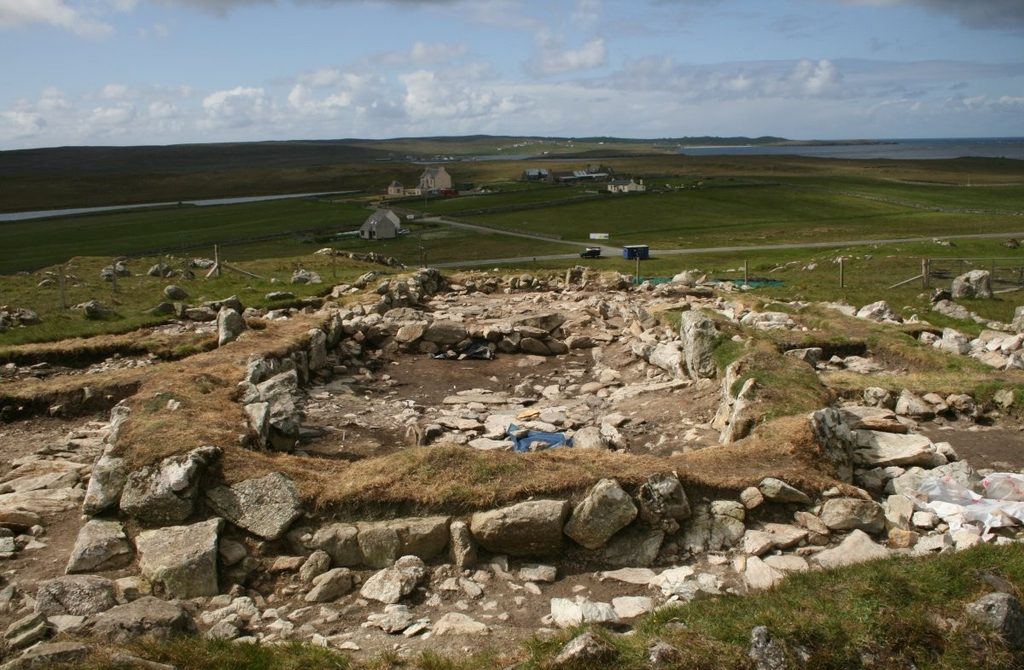
By 1100 AD, the popularity of open longhouses gave way to nucleated, multi-roomed farmsteads. Hamilton’s excavations at Jarlshof demonstrated this structural evolution (Phases VI–VII, 1956). Between the 12th and 14th centuries, older longhouses were partitioned into specialised rooms, separating domestic living spaces from kitchens and dairies. The Viking Unst Project, managed by Shetland Amenity Trust, exposed a similar trend at sites like Hamar and Belmont. In reaction to the cooling climate, communities built long-term infield and outfield boundary dykes and heavily manured the soil to sustain crops of barley and oats in colder weather (Turner et al 2013).
High-status sites show that Shetland was deeply integrated into the wider North Atlantic economy in the medieval period. Crawford’s excavations at The Biggings on Papa Stour revealed a 13th century timber-framed structure built on stone sill foundations. Historically tied to the estate of Duke Håkon of Norway (before his ascension to King), evidence from this royal farm includes high-quality, imported Scandinavian timber, demonstrating that the local elite maintained a direct link to the Norwegian mainland (Crawford 1999).
Late medieval middens across Shetland show a distinct shift toward commercial fishing. While the Catpund steatite quarry slowed its production of large soapstone bowls after 1300 AD, it adapted to produce large quantities of line sinkers and net weights. This material shift correlates with the emergence of the ‘fish event horizon’ in Orkney and Shetland (Barrett et al 2011). This phenomenon involved large-scale processing of dried cod and ling, which were traded for imported ceramics and German stoneware introduced by Hanseatic merchants (Forster and Turner 2009).
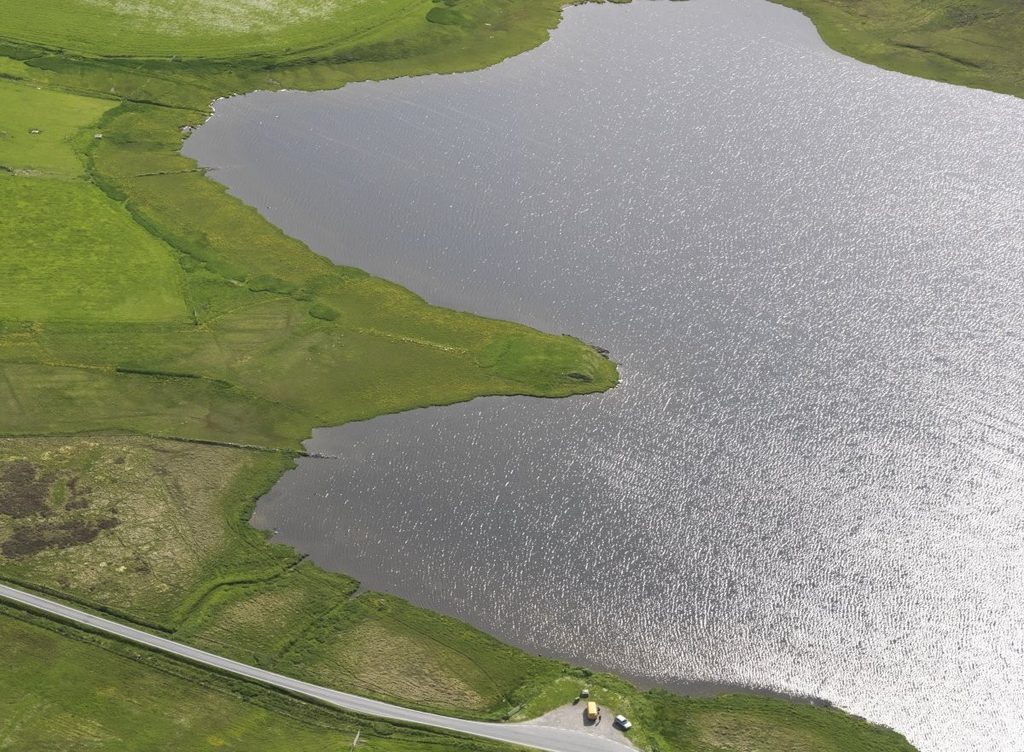
The administrative centre of medieval Shetland sat at Law Ting Holm in Tingwall. Architectural and landscape surveys confirmed that this promontory site served as the Althing (parliamentary assembly), where the Lawman gathered regional delegates to enforce the 1274 national law code of King Magnus the Lawmender (Coolen and Mehler 2014, Mehler et al 2018).
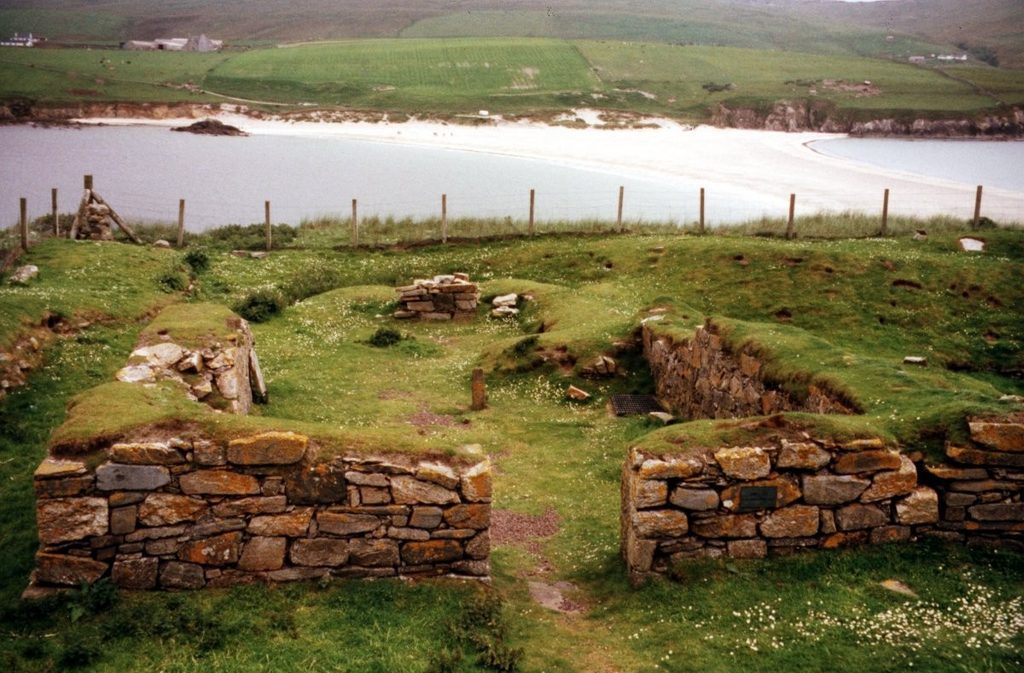
By the medieval period, pagan burials completely disappeared and were replaced by more formal Christian burials. At St Ninian’s Isle, excavation showed that a 12th century Romanesque chapel was constructed directly over older church foundations, and went on to serve as a primary Christian cemetery until the end of the 15th century (Barrowman 2011).
You can download the datasheet for more information on the medieval sites and c14 dates from Shetland.
Medieval Research Questions
SIRFA SH91: How did medieval disease epidemics impact Shetland?
More information on this question
Local framework numbering:
SIRFA SH91
More information:
Famously, the Black Death wiped out one third of Europe’s population. Whilst not so devastating, later plague outbreaks were no less terrifying and deadly. Relatively little, however, is known about the impacts of medieval plague epidemics on Shetland’s populations, communities, landscapes and society. Indeed, it is unknown whether all major medieval plague epidemics, known to ravage other parts of Europe, even reached Shetland. Given that there are very few historic references to medieval disease outbreaks in Shetland, how can archaeological evidence enhance knowledge and understanding of this topic? Does Shetland’s medieval burial evidence point to periods of disease outbreak? Is there evidence for periods of medieval settlement contraction or changes in subsistence strategy that might have occurred as a result of disease epidemics across the islands? If Shetland was spared some medieval disease outbreaks, then why was this? Can archaeological research identify indirect impacts of major disease outbreaks elsewhere in Europe, even where these didn’t reach Shetland? Interdisciplinary approaches are almost certainly the way forward here. A more detailed understanding of Shetland’s medieval settlements and burial sites will undoubtably help address these more specific research questions. In a developer-funded context, the significance of medieval remains to address questions about Shetlandic responses to plague outbreaks needs to be emphasised. Alongside this the importance of dating and post-excavation work.
SIRFA SH92: What was the effect of international conflict on Shetland during the Medieval period?
More information on this question
Local framework numbering:
SIRFA SH92
More information:
The impact of international conflicts – both involving Scotland and not – on Shetland is relatively understudied. Undoubtedly events such as the Wars of the Roses and the English occupation of Ireland had far reaching effects, but did they have any noticeable impact on Shetlandic life? What were these effects? Interdisciplinary approaches are almost certainly the way forward here. These questions would benefit from new theoretical and more holistic approaches. Reanalysis and synthesis of existing datasets will be key, including reanalysis of museums and archive collections. A more detailed understanding of Shetland’s medieval settlements will underpin new research. In a developer-funded context, the significance of medieval remains to address questions about Shetlandic responses to international conflict needs to be emphasised. Alongside this the importance of dating and post-excavation work.
SIRFA SH93: How did environmental changes impact Shetland during the medieval period?
More information on this question
Local framework numbering:
SIRFA SH93
More information:
What was the impact of climate fluctuations such as the Little Ice Age? How have the islanders altered their surrounding environment through the centuries? Older farming techniques are frequently romanticised and perceived as ‘better’ or ‘more sustainable’ – but was this the case? Existing palaeoecology and palaeoenvironmental studies may be relevant here but need to be synthesised with archaeological and historical evidence. We also need an understanding of localised environmental dynamics. Further interdisciplinary work on sea level change would also have a valuable contribution to make here. Within a developer-funded context, the importance of retaining faunal assemblages and environmental data for post-excavation work needs emphasis.
SIRFA SH94: What did the Medieval landscape look like across Shetland?
More information on this question
Local framework numbering:
SIRFA SH94
More information:
We have yet to understand the medieval use of landscape and routeways through it. What were the land divisions? How were the secular and religious landscapes separated? Further, due to an overall focus on prehistory, medieval settlement patterns and locations are understudied. How do these differ from preceding and succeeding periods settlement? There is existing research by Smith (2000) concerning land tenure from a documentary viewpoint, and Turner (2012) has carried out some preliminary work on land organisation, but far more is required. The approaches need to include integrated archaeology and documentary research projects, as this period tends to fall through the gaps. It is likely that these questions will be addressed partly through collation, reassessment and reanalysis of existing material and literature. Digital mapping, modelling and wider landscapes approaches are encouraged. It is likely that further dedicated survey work, as well as opportunities discoveries and those via developer-funded work, will enhance datasets. In a developer-funded context, the research significance of surveying, dating and other post-excavation work with the potential to inform on this period needs to be emphasised.
SIRFA SH95: What was everyday life like in Medieval Shetland?
More information on this question
Local framework numbering:
SIRFA SH95
More information:
Archaeology has tended to focus in on transitionary periods and changing of cultures. Whilst important, this has led to the everyday fading into the background. The Medieval everyday across Shetland is currently poorly understood. How did Medieval Shetlanders live day to day? Did this change notably during periods of social upheaval or change? The approaches need to include integrated archaeology and documentary research projects, as this period tends to fall through the gaps.
SIRFA SH96: How was Shetland’s medieval trade organised?
More information on this question
Local framework numbering:
SIRFA SH96
More information:
Prior to the establishment of merchants and the Hanseatic trade, how was Shetland’s medieval trade organised? Where was trade taking place? The Orkneyinga saga mentions beach markets in Orkney, further corroborated by archaeological evidence from excavations at Tuquoy. Were similar medieval beach or coastal markets in use in Shetland? Presumably the key to some of this lies in the coastal margins, both above and below the waterline. The potential for identifying trading sites should be highlighted in developer led work, especially where there is both an above and below sea level component.
SIRFA SH97: To what extent was wood used as a building material in medieval Shetland and where did it come from?
More information on this question
Local framework numbering:
SIRFA SH97
More information:
To what extent was wood used as a building material in Medieval Shetland? There was so little indigenous wood in Shetland by the Medieval period. Was this because most buildings were made of stone? Or was wood imported and if so from where? Was driftwood used? Was wood seen as a prestigious material? Does the use of imported (or drift) wood explain the lack of high-status buildings that survive from the early medieval period?
SIRFA SH98: How does the annexing of Shetland to the Scottish Crown in 1472 register archaeologically?
More information on this question
Local framework numbering:
SIRFA SH98
More information:
How did the annexing of Shetland to King James III of Scotland impact Shetlandic communities during the 15th century? Does this historically documented transfer of ownership and power register archaeologically? Are there recognisable impacts on material culture? Do we see evidence of major changes in the way people lived and identified themselves? Can an understanding of the relationship between political allegiance and everyday lives and identities in the 15th century, inform how we view major transferrals of power in Shetland’s earlier periods, such as the Pictish and Norse periods?
If you have answered a research question, or have an update to add about a specific site or period, you can use our inline comments to flag the change and keep the frameworks up to date.
Register for an account, or login now to add updates and comments to our existing frameworks.