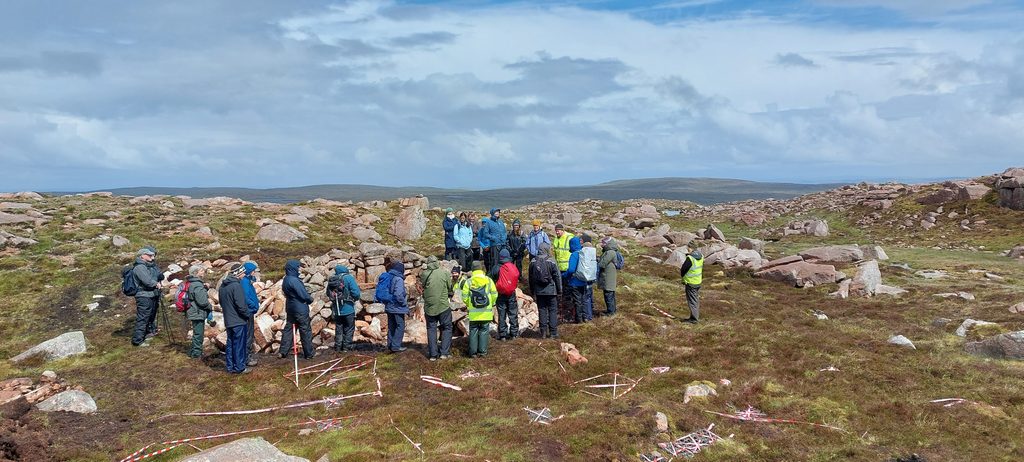
Shetland’s Neolithic period is unique in a Scottish context – the traditional Neolithic farming package seemingly arrived in Shetland several hundred years later than has been established for much of the Scottish mainland and thereafter the islands appear to have remained largely isolated from wider Scottish Neolithic trends, with material culture evolving into distinctive regional forms and styles. Despite well preserved archaeological evidence and the potential to offer valuable insights into the variability of Scotland’s Neolithic communities, Shetland’s Neolithic period still remains under researched. There are almost 400 sites across Shetland identified as Neolithic in date. It is telling, however, that despite the size of this dataset, there are currently less than 45 calibrated Neolithic radiocarbon dates for Shetland, highlighting the lack of study. The region has clearly not received the same level of systematic excavation and analysis as Neolithic Orkney, for example. That said, our understanding of this period has shifted substantially over the last few decades.
The North Roe Felsite Project (NRFP) has been a major initiative, investigating the quarrying, production, and distribution of felsite tools using geological surveys, excavations, and remote sensing technologies (Ballin 2017, Megarry and Cooney 2018, Megarry et al 2023). Similarly impactful has been the Danish Nationalmuseet’s Farming on the Edge. This project has emphasised, amongst other things, the similarity between Shetland’s Neolithic and that of southern Scandinavia, focusing on environmental adaptation and subsistence (Mahler and Anderson 2010, Mahler 2011, 2012). Other important work includes investigations into Shetland’s distinctive steatite-tempered pottery, which remains unique within Neolithic Britain.
Much of Shetland’s Neolithic research has focused on material culture, particularly the distinctive felsite tools and pottery, highlighting Shetland’s unique technological traditions. Re-analysis of material from the Scord of Brouster suggests that what were once considered Shetland’s earliest Neolithic houses may in fact be Bronze Age in date (Sheridan 2012). It is certainly hard to determine with any certainty where the Neolithic ends and the Bronze Age starts. With this in mind, Neolithic researchers will be eager to see the results of post-excavation analysis from developer-funded work at the Hill of Crooksetter, which has the potential to contribute substantially to our understanding of Shetlandic Neolithic settlement. Similarly, the absence of large-scale monuments and the relatively limited evidence for burials have made it challenging to reconstruct social structures, economic activity and belief systems for Shetland’s Neolithic.
The limited amount of Neolithic archaeological and palaeoecological research to date has focused on Shetland’s Mainland, and more work is needed to fill geographic gaps, as well as studies with a more comprehensive coverage of the wider archipelago. Research gaps in Shetland’s Neolithic include the need for a clearer chronological framework, particularly regarding the transition between Mesolithic and Neolithic periods and the shift to the Bronze Age. Steps towards establishing the nature and distribution of settlements have been made by Turner (2012) and Christie (2019), but there is a paucity of dating evidence and questions remaining as to why Shetland’s settlements appear to have been more dispersed than those in Orkney. There is limited knowledge of subsistence strategies, including the balance between agriculture, marine resources, and foraging. Material culture, such as the origins and functions of Shetland’s distinctive pottery and felsite tool production, requires further study, particularly regarding their development and trade networks.
The absence of large monuments, the distinctiveness of burial practices, and the apparent insularity of Shetland’s Neolithic culture compared to Orkney raise important questions about social identity and connectivity (see Sheridan 2013). Environmental factors, such as woodland coverage, climate change, and sea level rise, need more research with a focus on chronology to understand their impact on Neolithic life across Shetland. Additionally, studies on mobility and connectivity, including isotopic and DNA analysis, could clarify Shetland’s links to other regions. Finally, methodological gaps, such as the lack of systematic radiocarbon dating, remote sensing surveys, and integration of unpublished data, hinder a comprehensive understanding of Shetland’s Neolithic period.
You can download the datasheet for more information on the Neolithic sites and c14 dates from Shetland.
Neolithic Research Questions
SIRFA SH21: When was steatite first utilised to temper Neolithic pottery in Shetland?
More information on this question
Local framework numbering:
SIRFA SH21
More information:
The use of steatite in pottery tempering is highly unusual and specific to Shetland. Is it possible to determine when this practice first came into common use? Was this localised to specific islands/areas, or a Shetland wide practice? Further, does the use of steatite in this manner lend any unusual properties to the ceramics themselves? In other words, is it possible to determine what advantages might be lent to the pottery when using this method? Was the inclusion of steatite deliberate or accidental via local clay sources? How consistent were quantities of steatite tempering is in any given assemblage and across assemblages? Researchers are encouraged to make significant use of museum archive material; further, it is likely that addressing this question will rely on significant improvements in the known pottery chronology. In a developer-funded context, the research significance of material culture needs to be emphasised as well as the value of post-excavation work.
SIRFA SH22: Do we understand the everyday of Shetland’s Neolithic?
More information on this question
Local framework numbering:
SIRFA SH22
More information:
In general, archaeology aims to provide us with an understanding of the nature of everyday life throughout human history. However, we don’t yet have a clear understanding of the everyday during Shetland’s Neolithic? What constitutes the everyday ‘norm’ during this period? This is a very broad and wide-ranging question and is not likely to be answered with a single research project; it is encouraged that a series of projects (or PhDs) are designed to tackle it. This question encourages the synthesis of grey, published, and unpublished literature, in addition to synthesis of the knowledge held within museum collections. In a developer-funded context, the research significance of dating and other post-excavation work needs to be emphasised, in addition to the accurate and thorough recording of structures and material culture.
SIRFA SH23: What IS the Shetland Neolithic?
More information on this question
Local framework numbering:
SIRFA SH23
More information:
Whilst the Neolithic is broadly recognisable by specific factors, there can be localised differences in the physical archaeology. Is this the case for Shetland? What makes the Shetland Neolithic? Is this down to the material culture (eg the pottery), the structures, burial practices, or even diet? Does the Shetland Neolithic drastically differ from the Orcadian and Hebridean Neolithic? This question is very broad, and it is expected that this will be answered over the long term through the culmination of new information. Synthesis of contemporary knowledge should be carried out periodically, utilising grey, published and unpublished literature. By its very nature, this topic is multi-disciplinary and should be informed by ongoing excavations. Developer-funded work should be regarded as highly significant with respect to ongoing data collection for this topic, and should be integrated at all opportunities. In a developer-funded setting, emphasis should be placed on the importance of ensuring a maximised data collection.
SIRFA SH24: What can isotope work tell us about Shetland’s Neolithic populations?
More information on this question
Local framework numbering:
SIRFA SH24
More information:
Archaeological Sciences are increasingly an integral part of archaeological research and work. Extensive isotope has yet to be carried out on Neolithic Shetland material; what can this reveal? Did Neolithic populations across Shetland have dietary practices differing from the rest of Scotland (or the other Scottish island groups)? Is there evidence indicating population movements, for example incoming groups? The use of isotope work is reliant on the collation of skeletal remains (both human and animal) and as such this question requires the retrieval of such material. This is difficult and presents issues (as referenced elsewhere); it is unlikely this area will not see development until an increase in availability of skeletal remains is achieved. The integration of museum archives and collections into this work is crucial. Additionally, it should be noted that the collation of substantial quantities of isotopic data is required to improve accuracy and understanding of this data. Existing landscape studies (Turner 2013) provide wider context for isotope work in terms of the links between land capacity and population. In a developer-funded context, the research significance of bone (both faunal and human) needs to be emphasised as well as the importance of post-excavation work.
SIRFA SH25: What is the evidence for prehistoric artwork in Shetland?
More information on this question
Local framework numbering:
SIRFA SH25
More information:
Artwork or artistic outlets from this period are elusive in Shetland. How has this impacted current understanding and interpretation of societal creativity? How should researchers improve this understanding? Did the Neolithic populations utilise organic materials which have not survived? Or were these resources considered precious and were therefore recycled? Is it possible to determine what resources were utilised for this work? Further, is there a difference in the artwork of Shetland and Orkney? What does this tell us? It is likely that further dedicated survey work, as well as opportunities discoveries and those via developer-funded work, will enhance datasets. In a developer-funded context, the research significance of material culture needs to be emphasised. Additionally, commercial survey work should be carried out with an eye to making note of potential locations of hitherto unrecorded artwork.
SIRFA SH26: What was the chronology of Shetland’s Neolithic-Bronze Age transition?
More information on this question
Local framework numbering:
SIRFA SH26
More information:
The timing and chronology of the Neolithic-Bronze Age transition in Shetland is still not fully understood. Through the use of material culture, physical archaeology, radiocarbon dating, Bayesian chronological modelling, and survey work, is it possible to define the length and timing of this transition? Does this differ to elsewhere? Is the transition incremental, or drastic? How should multi-period/re-used sites and structures be integrated into this chronology? It is unlikely that these questions will be addressed via a single project. A series of well-funded projects, almost certainly interdisciplinary and multi-proxy in nature, are likely ways forward. In a developer-funded context, the research significance of dating and other post-excavation work needs to be emphasised.
SIRFA SH27: What was the chronology of felsite production during the Neolithic?
More information on this question
Local framework numbering:
SIRFA SH27
More information:
Felsite production was clearly a major part of the Neolithic economy. When did it start and end? Were there any shifts or changes in the process of quarrying, processing, or distribution of the felsite? How did this process evolve? Is it possible to map out the distribution routes, quarries, or processing locations and how they changed or evolved through time? Further, based on the example of felsite, is it possible to extrapolate how other major industrial activity was organised or structured? It is unlikely that these questions will be addressed via a single project. A series of well-funded projects, almost certainly interdisciplinary and multi-proxy in nature, are likely ways forward. In a developer-funded context, the research significance of dating and other post-excavation work needs to be emphasised.
SIRFA SH28: What is the chronology of known Neolithic sites?
More information on this question
Local framework numbering:
SIRFA SH28
More information:
An integrated chronology of Shetlandic Neolithic sites has yet to be created; this would substantially further Neolithic studies in this area. When created, what does this chronology show? A significant aspect of this is considering how unusual or odd features/sites should be integrated into this chronology. This work would require systematic radiocarbon dating, in conjunction with other suitable dating methods. New dating techniques may require development, alternatively the use of, for example, OSL, dendrochronology, sclerochronology, etc may be most suitable for particular site contexts. Archaeomagnetic dating potentially has a significant role in dating domestic settlement in future excavations. It is also recommended that Bayesian chronological modelling is utilised in the building of this chronology. In a developer-funded context, the research significance of dating and other post-excavation work needs to be emphasised.
SIRFA SH29: Why is Shetland’s Neolithic represented by so few monumental sites?
More information on this question
Local framework numbering:
SIRFA SH29
More information:
Current understanding of the Shetland Neolithic points to an almost complete lack of monumentality. In particular there appears to be a lack of major henge monuments and stone circles. Is this due to a difference in materials or resources available to the Neolithic populations? Or different cultural values, practices and perceptions of monumentality? Is it possible that henge-type monuments were present but subsequently removed or incorporated into sites in order to better utilise the land? Or perhaps as a result of incoming religions or faiths? Are researchers looking in the wrong places? Have these henge sites become water inundated since construction? For example, a setting of stones was recorded in north Lerwick in the early 20th century (Stout 1912) which may represent the remnants of a Neolithic monument. Or perhaps the monumental Neolithic sites synonymous with other areas never exist in Shetland? What methods should be utilised to explore this? Could it be that Shetland’s Neolithic communities expressed monumentality in alternative ways? Is this a result of distinct and unusual monumental sites that have not been found (or recognised), or a result of monumentality taking a fundamentally different shape here? Did agriculture, climate, resources, or landscape have monumental components in a way currently not understood? Were technologies or industries monumentalised in some way? Does current accepted knowledge confuse domestic subsistence sites with monumental sites? Or vice versa? Whilst primarily a theoretical question, it is also possible that further dedicated survey work, as well as opportunistic discoveries and those via developer-funded work, will reveal new site types of this period.
SIRFA SH30: Why are Neolithic burial cairns different in Shetland?
More information on this question
Local framework numbering:
SIRFA SH30
More information:
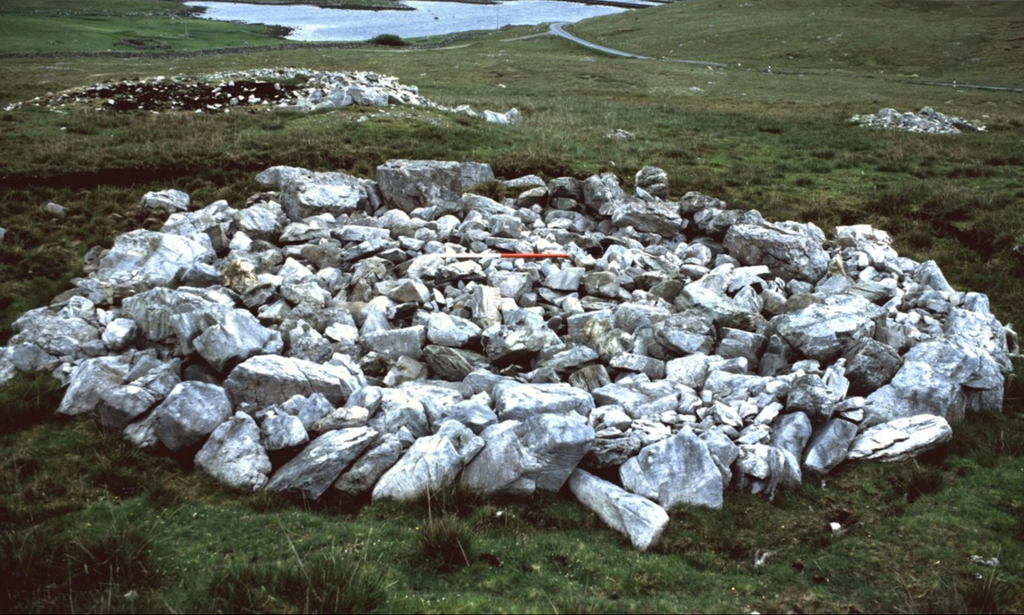
Shetland’s Neolithic cairns are different to those found elsewhere in Scotland. Intriguingly, Neolithic burial cairns in Shetland do share similarities with some of the larger Irish passage graves. However, they are notably smaller than those found in either Orkney or the Outer Hebrides and were clearly used very differently due to vastly contrasting sizes. Why is this? Is this due to a difference of available materials, or deeper cultural difference? or are there other explanations. Is it possible to determine this through the use of methodologies currently available? Whilst appearing primarily as a theoretical, address these questions will also likely benefit from further data through dedicated more survey work and with a potential later focus on long-term excavation efforts. In a developer-funded context, the research significance of dating and other post-excavation work needs to be emphasised, in addition to the accurate and thorough recording of structures and material culture.
SIRFA SH31: What was Shetland’s Neolithic environment like?
More information on this question
Local framework numbering:
SIRFA SH31
More information:
Understanding the environment is crucial to understanding the daily lives and lived experiences of Neolithic populations. How extensive was tree cover across Shetland during the Neolithic? What species of flora and fauna were extant during this period? How should this data and knowledge be synthesised? It is recommended that the primary step in this work focuses on the synthesis of current knowledge on the Neolithic environment; this will allow more specific research gaps to be identified and further focused on. This is likely to be a multi-disciplinary topic, involving palaeoenvironmental work along with palaeoclimatology and palaeoecology. A better understanding of the Neolithic coastline across Shetland will also be key. In a developer-funded context, the research significance of environmental data needs to be emphasised.
SIRFA SH32: Where were the majority of Shetland’s Neolithic dead disposed of?
More information on this question
Local framework numbering:
SIRFA SH32
More information:
Across the west side of Shetland there are number of neolithic burial cairns which appear to relate to nearby Neolithic settlements via associating land divisions. However, across other parts of Shetland, Neolithic settlements appear in isolation. Why is this? Where were the dead from these wider communities disposed of? Even where there are burial cairns, such as the west coast, numbers are small and can only ever have represented a tiny proportion of the wider Shetlandic population. Who was buried in cairns and why? What happened to everyone else? Is this the general lack of burial evidence for this period a result of the preservation rates amongst acidic soils, or a factor of the burial practices of the time? Or perhaps researchers looking in the wrong locations? Is it possible to locate burials (or burial rite spaces) near to settlements? What was the spatial relationship between burials (once located) and settlements? Were burials located a significant distance from the settlements, or very close by? It is likely that these questions will be addressed partly through collation, reassessment and reanalysis of existing material and literature. Digital mapping, modelling and wider landscapes approaches are encouraged. It is likely that further dedicated survey work, as well as opportunities discoveries and those via developer-funded work, will enhance datasets. In a developer-funded context, the research significance of surveying, dating and other post-excavation work with the potential to inform on this period needs to be emphasised.
SIRFA SH33: What was the impact of the emergence of agriculture in Shetland?
More information on this question
Local framework numbering:
SIRFA SH33
More information:
The arrival of agriculture was a landmark stage in the development of many cultures across the globe. However, the impacts of the arrival of farming are not necessarily examined beyond changes in diet and a shift to sedentary settlement. What were the impacts on Shetland’s environment? How did the arrival of crops and livestock impact on the flora and fauna? What was the extent of prehistoric cereal cultivation during this time? Further, what was the extent of usable land (for farming or otherwise)? What were the wider impacts of the arrival of agriculture on Shetland’s material culture? For example, the tools, pottery, artistic outlets, etc. Existing research has begun to address this and related questions (Whittle 1986; Turner 2013). However, there is a lot more detail to uncover. It is suggested that future research considers focusing on the South Mainland, which is likely to have been an attractive area for growing crops as well as beneficial to archaeological researchers in terms of preservation conditions. However, there is very little complementary palaeoenvironmental work for this region (although see Whittington et al 2003). It is unlikely that these questions will be addressed via a single project. A series of well-funded projects, almost certainly interdisciplinary and multi-proxy in nature, are likely ways forward. It is likely that these questions will be addressed partly through collation, reassessment and reanalysis of existing grey, published, and unpublished literature, in addition to synthesis of the knowledge held within museum collections and environmental data. Research may also be reliant on more survey work and data, with a potential later focus on long-term excavation efforts. In a developer-funded context, the research significance of surveying, dating and other post-excavation work with the potential to inform on this period needs to be emphasised, as well as environmental data and post-excavation work.
SIRFA SH34: Why were early prehistoric settlements so widely dispersed across Shetland?
More information on this question
Local framework numbering:
SIRFA SH34
More information:
One of the key ways in which Shetland differs from Orkney is in prehistoric settlement lay out. Why does the Neolithic population appear to be so spread out across Shetland? Furthermore, why do nucleated settlements appear to emerge so much later in Shetland than in Orkney? Is this view even accurate, or a result of biases in the current dataset? Was land capacity and related economics a key factor? It is expected that addressing this question will require a synthesis of field survey data in combination with long term excavation of settlements and environmental research. Geophysics and field walking across the South Mainland, an area that is both more fertile and more suitable for geophysics, might help to address knowledge gaps. As could geophysics across areas which have silted up post-Neolithic. Better dating and palaeoenvironmental evidence would also be helpful, as well as a better understanding of the Neolithic coastline. Have some Neolithic settlements been lost due to coastal erosion giving us a skewed pattern of settlement patterns? In a developer-funded contexts the significance of any Neolithic settlement remains needs to be emphasised.
SIRFA SH35: What was the character of Neolithic settlements across Shetland?
More information on this question
Local framework numbering:
SIRFA SH35
More information:
Neolithic settlement or domestic sites across Shetland, like much else for this period, remains relatively elusive. What was the character of domestic architecture and settlement layout in Shetland for this period? Additionally, is it possible to estimate the size of the populations who used these settlements? How does the character of domestic sites in Shetland compare with evidence from Orkney and the Outer Hebrides? It is very likely that for future research, extensive long-term excavations of domestic settlement sites will be required (such as seen at the Ness of Brodgar in Orkney). Developer-funded work is likely to play an important role; trial trench evaluations and archaeological monitoring provide scope for identify sites and material across large, previously uninvestigated areas and landscapes.
SIRFA SH36: What range of resources did Shetland’s Neolithic communities use and rely on for their subsistence?
More information on this question
Local framework numbering:
SIRFA SH36
More information:
It is currently unclear what the full range of resources exploited by Neolithic communities looked like in Shetland. Is it possible to identify the full range of resources and how and when they were used? Seasonality must be considered, in addition to variations in diet and resource usage that may have related to age, sex, gender, and such. In contrast to the Mesolithic, there is the additional interplay of the sea, crops (or agricultural resources), domesticated animals and wild resources throughout the Neolithic. Was there a shift in natural resource use into the Neolithic across Shetland? Was this significant? Further, how should this be explored? What methodologies should be utilised? Reassessment of existing datasets, reports, archives and collections, alongside new programmes of material analysis are likely ways forward. In a developer-funded context, the research significance of faunal and environmental data needs to be emphasised.
SIRFA SH37: Why is Shetland’s Neolithic so different to Orkney’s?
More information on this question
Local framework numbering:
SIRFA SH37
More information:
It is widely recognised that Shetland’s Neolithic is different to the Orcadian Neolithic. How well can this be evidenced? Does Shetland exhibit an entirely distinct identity from Orkney so early on in human history of these islands or are there some links and connections? Connections or insularity from Orkney’s Neolithic – why is this the case? Additionally, how should Fair Isle be integrated into a wider understanding of the Northern Isles and the North Sea during this period. Current evidence suggests that Fair Isle’s Neolithic aligns with Shetland rather than Orkney. Were Shetland’s Neolithic affinities with Ireland rather than Scotland (eg: chambered cairn types) and if so – why? Whilst appearing primarily as theoretical, address these questions will also likely benefit from further data through dedicated survey work and with a potential later focus on long-term excavation efforts. This is a very broad and wide-ranging question and is not likely to be answered with a single research project; it is encouraged that a series of projects (or PhDs) are designed to tackle it. In a developer-funded context, the research significance of dating and other post-excavation work needs to be emphasised, in addition to the accurate and thorough recording of structures and material culture of this period.
SIRFA SH38: What were Shetland’s Neolithic boats like?
More information on this question
Local framework numbering:
SIRFA SH38
More information:
Boats from the Neolithic are rare, and none have yet been found in Shetland. This is likely due to the poor preservation conditions. However, seafaring was likely an integral aspect of Neolithic Island life. What did Neolithic boats look like? How large were they? What materials were they made of? What was the availability of these materials? What were the practicalities of getting to and from Shetland in a boat during this period? Was seafaring seasonal? Where there any differences in boat sizes or types when trading, travelling, fishing, or hunting? Finally, were there any major differences between Neolithic seafaring technology and Mesolithic seafaring technology? More reliable coastline modelling and a clearer picture of the palaeoclimate will also be important for understanding the necessary conditions for seafaring in and around Shetland during the Neolithic. What were the waters around Shetland like during the Neolithic in terms of storminess, fetch and distance for example? The use of experimental archaeology for this area of research is highly encouraged. Public engagement through such work is also recommended. In a developer-funded context, opportunistic discoveries of remains potentially related to seafaring should be considered a priority.
SIRFA SH39: Did new or different populations arrive and settle in Shetland during the Neolithic?
More information on this question
Local framework numbering:
SIRFA SH39
More information:
The exploration of this topic is reliant on the increased ability to retrieve Neolithic skeletal remains (human and animal). If appropriate material is available, can DNA studies be used to expand our understanding of population influxes to Shetland and to evidence the arrival of new or different people during this period? This research question is unlikely to be answered through a single research project; it is encouraged that a series of projects (or PhDs) are designed to tackle it. Wider research funding to support ancient DNA studies will likely be necessary. In a developer-funded context, the recovery and analysis of human and animal remains from this period should be considered a high priority.
SIRFA SH40: To what extent was wood employed for building during Shetland’s Neolithic?
More information on this question
Local framework numbering:
SIRFA SH40
More information:
To what extent was wood employed for building during Shetland’s Neolithic? How would we find evidence of this? Excavation at the Scord of Brouster and Kebister produced evidence of building in wood underlying later stone buildings. Owen et al (REF) also identified additional possible hut platforms in the hillside above Kebister. This suggests that building in wood may have been common practice in the earlier Neolithic, but evidence is elusive, other than in cases where it underlies stone building. It challenges the perception that Shetland’s archaeology is always readily visible. Aerial photography is unlikely to reveal parch marks in a Shetland context and currently traces of wooden buildings are most likely to be found by chance. It is unlikely that these questions could be answered by a single project. Developer led projects should be aware of the potential to find post-holes etc and are likely to be a key method for taking this further. Remote sensing may have something to contribute to this question as techniques constantly develop. Future research projects which examine landscape rather than purely excavating individual sites, should include an element of predictive modelling and trial excavation to test apparently “blank” areas within a settlement, which have hitherto been ignored.
SIRFA SH41: Why is Shetland’s material culture so different from that of the Neolithic elsewhere across the UK?
More information on this question
Local framework numbering:
SIRFA SH41
More information:
Why is Shetland’s material culture so different from that of the Neolithic elsewhere across the UK? Were there influences from further afield? Why are Shetland knives not found outside Shetland? Shetland’s pottery styles are also different, and even the Beaker pottery is derivative. No stone balls have been found in Shetland. However, the beautiful and labour-intensive Shetland knives and axes made from the North Roe felsite demonstrate that life was not all about subsistence. Shetland’s material culture appears to be as insular as its settlement and funerary monuments. Reassessment of existing datasets, reports, archives and collections, from both inside of Shetland and further afield is required, together with new programmes of material analysis. Research programmes, including PhD studies, are the most obvious root for the synthetic work which would need to be undertaken here. In a developer-funded context, the research significance of post-excavation and contextual research needs to be emphasised.
SIRFA SH42: Why are there no monuments in Shetland’s Neolithic?
More information on this question
Local framework numbering:
SIRFA SH42
More information:
Current understanding of the Shetland Neolithic points to an almost complete lack of monumentality. Is this accurate? What methods should be utilised to explore this? Does this mean current researchers simply do not understand Shetland monumentality? Is this a result of distinct and unusual monumental sites that have not been found (or recognised), or a result of monumentality taking a fundamentally different shape here? Did agriculture, climate, resources, or landscape have monumental components in a way currently not understood? Were technologies or industries monumentalised in some way? Does current accepted knowledge confuse domestic subsistence sites with monumental sites? Or vice versa? Whilst appearing primarily as a theoretical, address these questions will likely be reliant on a considerable push in physical archaeological research across Shetland; It is likely that further dedicated survey work, as well as opportunities discoveries and those via developer-funded work, will enhance datasets and thus knowledge. In a developer-funded context, the research significance of dating and other post-excavation work needs to be emphasised, in addition to the accurate and thorough recording of structures and material culture.
SIRFA SH43: Why has a major Neolithic henge monument yet to be found in Shetland?
More information on this question
Local framework numbering:
SIRFA SH43
More information:
There appears to be a lack of monumental Neolithic sites in Shetland – this includes major henge monuments. Why does there not appear to be a single henge monument across any of the islands in Shetland? Is this due to a difference in materials or resources available to the Neolithic populations? Or different cultural values, practices and perceptions of monumentality? Is it possible that henge-type monuments were present but subsequently removed or incorporated into sites in order to better utilise the land? Or perhaps as a result of incoming religions or faiths? Are researchers looking in the wrong places? Have these henge sites become water inundated since construction? Or did they never exist in Shetland? It is likely that further dedicated survey work, as well as opportunities discoveries and those via developer-funded work, will enhance datasets and thus knowledge. In a developer-funded context, the research significance of dating and other post-excavation work needs to be emphasised, in addition to the accurate and thorough recording of structures and material culture.
SIRFA SH44: Is there a spatial relationship between Shetland’s Neolithic burials and Neolithic settlements?
More information on this question
Local framework numbering:
SIRFA SH44
More information:
Neolithic burials from Shetland are distinctly absent from the archaeological record. Is this a result of the preservation rates amongst acidic soils, or due to burial practices of the time? Or perhaps researchers looking in the wrong locations? Is it possible to locate burials (or burial rite spaces) near to settlements? What is the spatial relationship between burials (once located) and settlements? Were burials located a significant distance from the settlements, or very close by? It is likely that these questions will be addressed partly through collation, reassessment and reanalysis of existing material and literature. Digital mapping, modelling and wider landscapes approaches are encouraged. It is likely that further dedicated survey work, as well as opportunities discoveries and those via developer-funded work, will enhance datasets. In a developer-funded context, the research significance of surveying, dating and other post-excavation work with the potential to inform on this period needs to be emphasised.
SIRFA SH45: What agricultural system was in use during Shetland’s Neolithic?
More information on this question
Local framework numbering:
SIRFA SH45
More information:
Is it possible to determine what systems of agriculture were developed and in place during Shetland’s Neolithic? Was it a predominantly pastoral, arable, or mixed system? Further, was this an agricultural economy? Was the Neolithic subsistence economy more complex than is typically assumed? Further, is there any evidence to indicate how land was managed? The introduction of farming is usually associated with the establishing of field walled field systems; was this the case in Shetland? Where are the land divisions for crops or animals? If they were in use why have they not yet been found
If you have answered a research question, or have an update to add about a specific site or period, you can use our inline comments to flag the change and keep the frameworks up to date.
Register for an account, or login now to add updates and comments to our existing frameworks.