Scotland’s Islands Research Framework for Archaeology (SIRFA) is the culmination of a multi-stakeholder project coordinated by the University of Highlands and Islands Archaeology Institute in partnership with the Local Authority archaeologists at Comhairle nan Eilean Siar, Shetland Amenity Trust, and Orkney Islands Council. The project is supported by the Society of Antiquaries of Scotland and the Association of Local Government Archaeological Officers (ALGAO). The project was funded by Historic Environment Scotland as part of Scotland’s Archaeology Strategy. SIRFA also received funding from Bord na Gàidhlig to support the Outer Hebrides section of the framework, which aligns with the National Gaelic Language Plan 2022-2028 and Historic Environment Scotland’s Gaelic Language Plan 2023-2026.
In 2012 the Scottish Archaeological Research Framework (ScARF) was published. It assessed the current state of archaeology in Scotland, looking at what we know, where we have gaps, and used this to suggest areas for future research. The National ScARF provides an exemplary baseline for archaeological research in Scotland and a much-needed evaluation and synthesis of the current state of knowledge. It was soon realised, however, that regional frameworks were needed to identify more specific, detailed research questions that could support the establishment of research agendas and strategies at a regional level. This regional research framework is designed to steer researchers more efficiently towards key gaps, making better use of available funds and resources, inform and support funders of academic and community-based research, and provide support to those managing the historic environment, specifically local authority archaeologists and those working in developer-funded archaeology.
SIRFA is the regional research framework for the areas that fall within the three island-based local authority regions in Scotland: the Outer Hebrides, Shetland and Orkney. This combined region has an immensely rich archaeological heritage with sites of local, regional, national and international significance. Archaeological remains in the SIRFA region span from the Mesolithic to modern times.
Combined, this area includes almost 1,000 Scheduled Monuments, 1,702 Listed Buildings, 8 Inventoried Gardens and Designed Landscapes, 13 Conservation Areas, 2 World Heritage Sites, 38 Properties in Care and over 61,500 Historic Environment Records. Alongside this resource, exceptional preservation of archaeological material is a characteristic shared by all three island groups to varying degrees. The outcome of this is that these islands have been places where many new scientific techniques, archaeological methods and theoretical approaches have been developed, tested and demonstrated. The contribution that the Scottish islands have made to the development of Scottish archaeology is vastly disproportionate to their geographic size (Sharples 2015, 1).
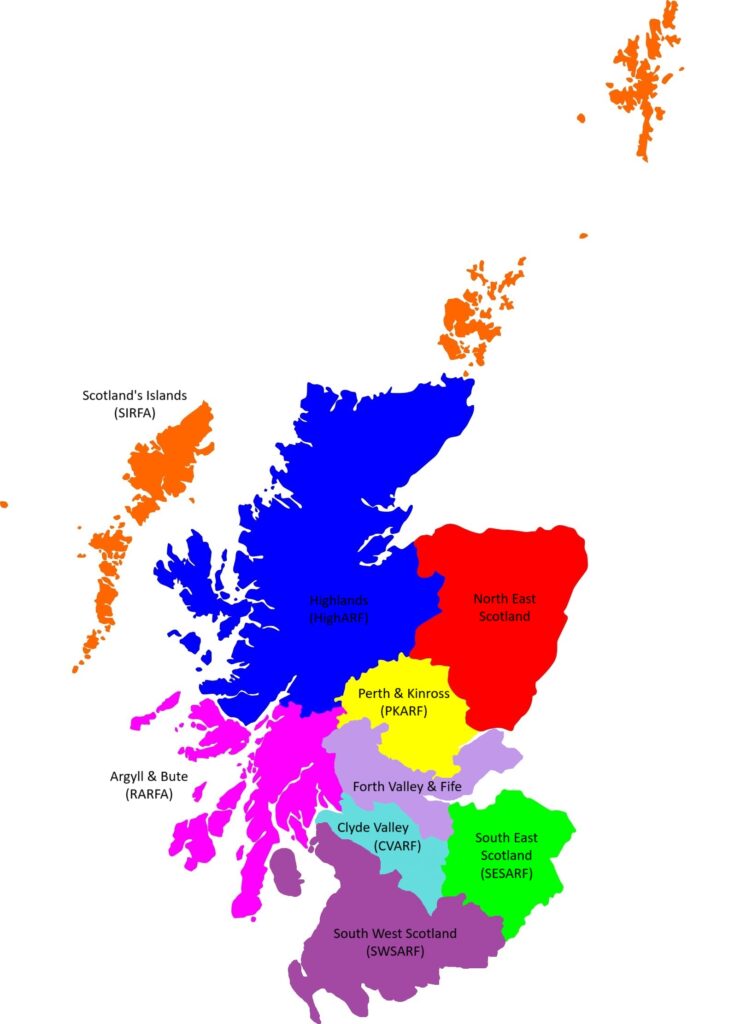
Each of these local authority areas comprise relatively discrete groups of islands, archipelagos, with their own distinct geography, environments, landscapes and histories of archaeological research. There are archaeological periods of study where the three archipelagos betray similar characteristics, shared aspects of material culture and where evidence suggests strong links and communication across and between the three island regions. However, there are just as many periods where archaeological research indicates the opposite due to distinct narratives, material culture and societies isolated from one another across the three regions. Furthermore, there is evidence for different relationships with ‘mainland’ areas and varying roles for these island groups within a wider British and European context.
Considering the three island groups together within this regional framework does not mean overlooking differences within and across these regions. Instead, throughout this framework we seek to specifically explore and learn from these dynamics through comparison and critical analysis.