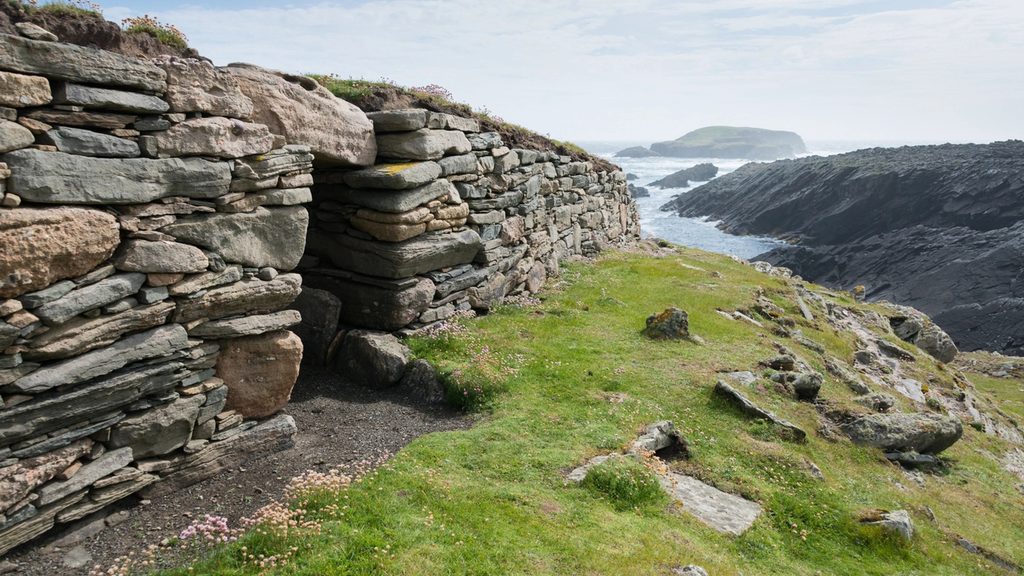
The Iron Age is arguably Shetland’s most visible and the most extensively researched archaeological period. There are more radiocarbon dates for Shetland’s Iron Age than there are for all other periods combined and sites with Iron Age material have been the subject of several longstanding research projects. The signature Iron Age sites (namely brochs but also wheelhouses in the later Iron Age), are by their very nature monumental and have therefore tended to dominate perception of later prehistoric landscapes.
In Shetland, there is an astonishingly large number of well-preserved brochs, with more 120 of these sites recorded in the HER. Some, but by no means all, are accompanied by nucleated settlements, suggesting complex social dynamics at play alongside the development of these settlements. But seemingly isolated examples are also common. A preoccupation with brochs, and other forms of monumental domestic architecture arguably persists in narratives for the Atlantic Scottish Iron Age more widely and Shetland is no different in this respect.
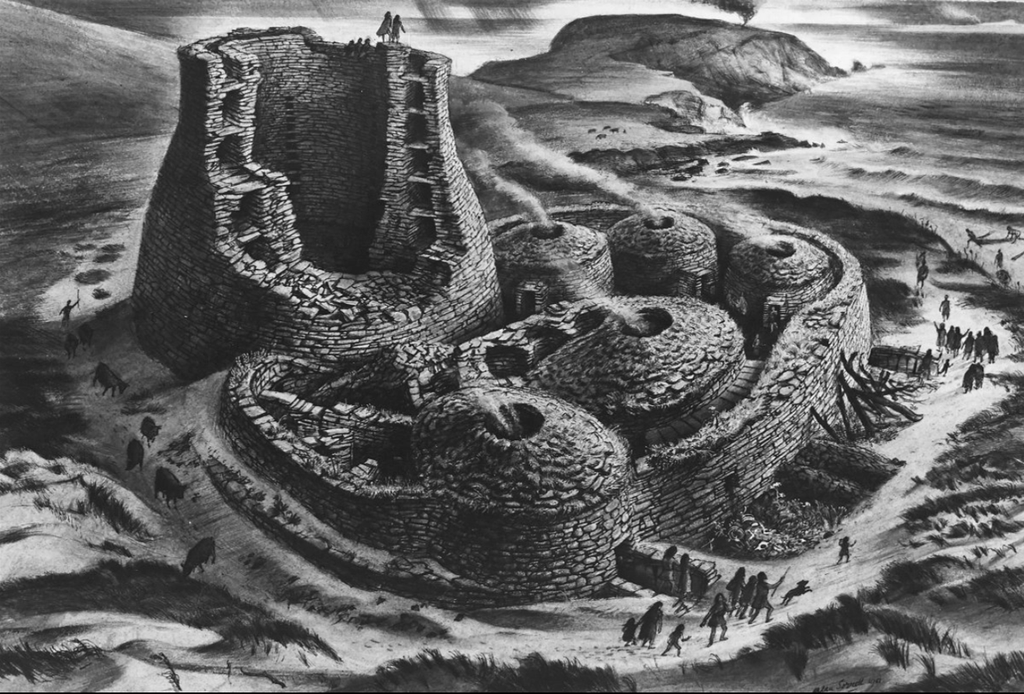
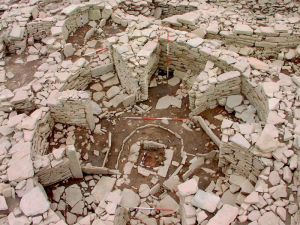
Photograph of reconstruction drawing of Jarlshof Iron Age broch village (original from F T Wainwright collection), courtesy of HES
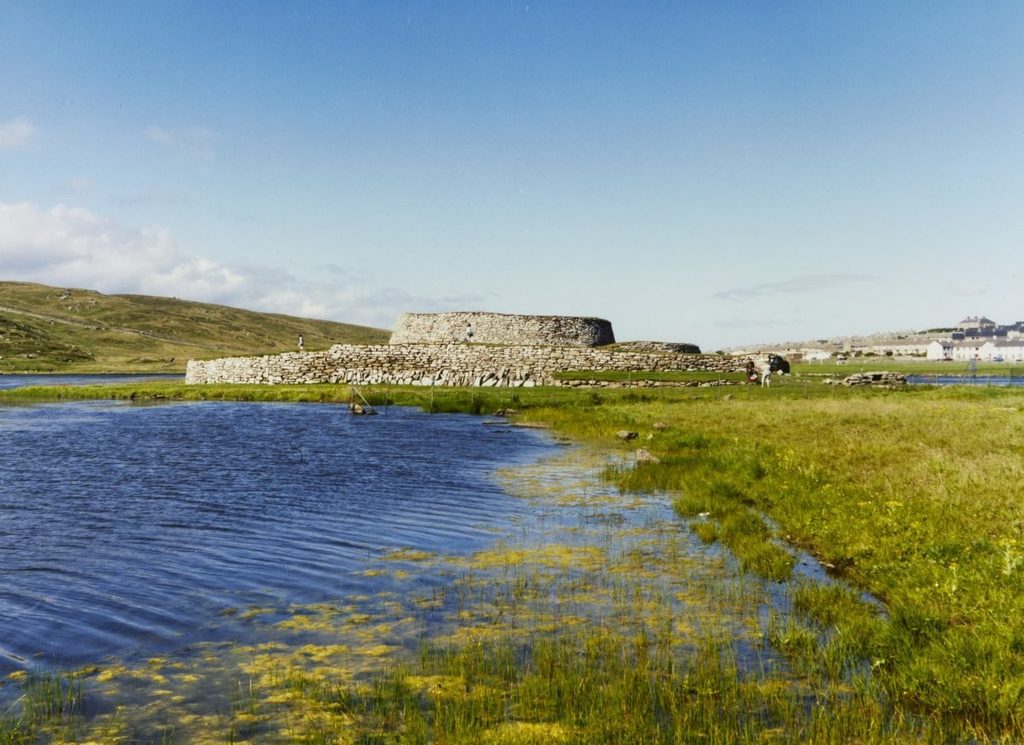
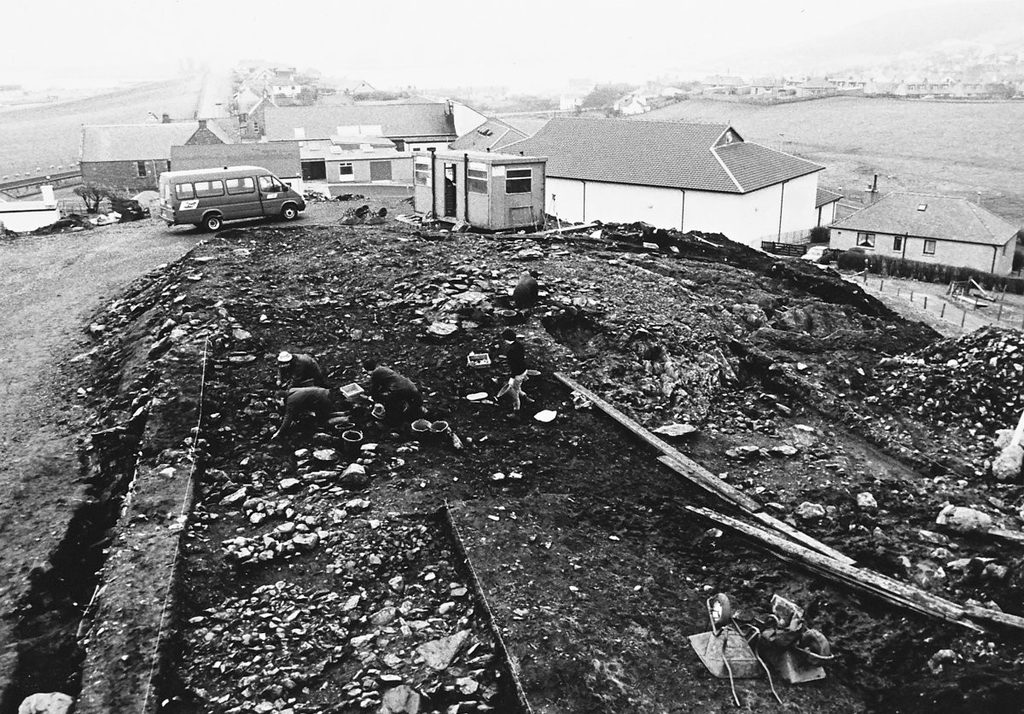
Antiquarians and early 20th century researchers, attracted by the monumentality of these sites, investigated numerous brochs across Shetland and in doing so established a strong baseline for future researchers. Late 20th century investigations at Jarlshof, followed by Curle and then Hamilton’s excavations in the 1930s and 1950s respectively, uncovered a well-preserved Iron Age settlement that included a broch as well as a series of wheelhouse structures. Later in the 1950s Hamilton’s continued interest in Shetland’s Iron Age saw the extensive excavation of Clickhimin broch, revealing complex occupation sequences (Hamilton 1968).
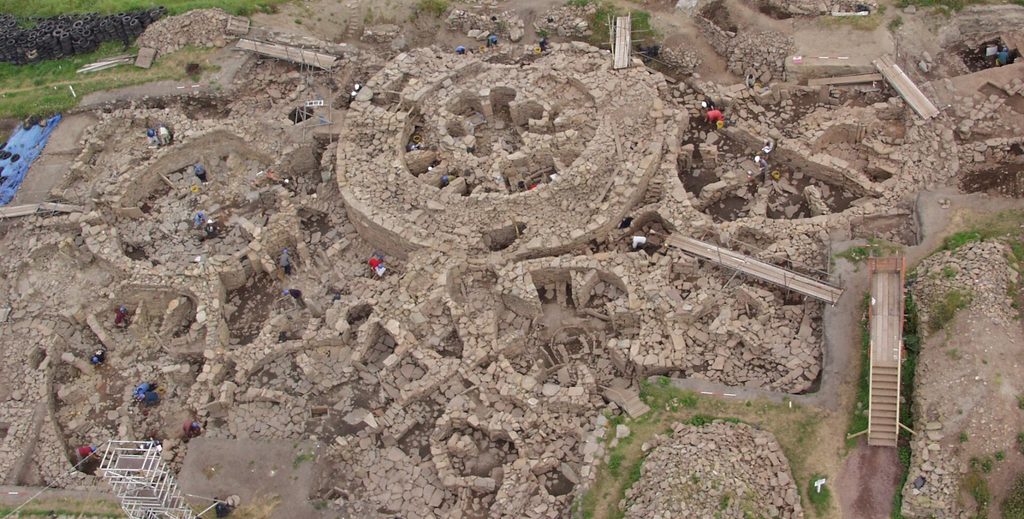
Between 1989 and 1990, Cardiff University’s excavation of Upper Scalloway broch provided significant insights into Shetland’s broch economy and social structure, complementing wider Atlantic Iron Age studies of the time (Sharples 2002, 2003). From the mid-1990s to the mid-2000s, the excavation of a broch and wider Iron Age village at Old Scatness was run by Shetland Amenity Trust in collaboration with researchers from Bradford University (Dockrill et al 2015). Fojut’s (1989) analysis of Shetland’s monumental Iron Age landscape has also been influential, particularly from a methodological perspective.
Monumental architecture as a feature of multiperiod settlements is another key characteristic of Shetland’s Iron Age archaeological record and its associated research. Excavations at Jarlshof for example showcased a long sequence of occupation from the Neolithic through the Iron Age to the Viking period. Similarly, Old Scatness is notable for provided insight into settlement continuity from the Iron Age into the Pictish and Norse periods (Dockrill et al 2010, 2019) and at Upper Scalloway, finds included a Bronze Age cremation urn, evidence of later Iron Age occupation, and medieval burials (Sharples 2002, Williamson 2020). These three sites are the key reference points for Iron Age research across Shetland, between them the subject of more than 35 years of excavation work. It is also noteworthy that more than 50% of Shetland’s Iron Age radiocarbon dates come from Old Scatness, with a further 10% from Upper Scalloway, further highlighting the contribution of these sites to our understanding of Shetland’s Iron Age chronology. Research at Old Scatness has been particularly significant in terms of developing and refining OSL dating techniques (Outram et al 2010) and relatedly contributing to debates concerning the origins of broch arhcitecture and the chronology of their subsequent development (Dockrill et al 2007).
Although broch and wheelhouse sites have historically attracted substantial researcher attention, there still remain some pressing knowledge gaps for Shetland’s Iron Age. The relationship between nucleated settlements and brochs needs further study—were they contemporary or did they develop in phases? Whilst brochs dominate Shetland’s Iron Age landscape, their construction and function clearly vary across the archipelago and across the wider Scottish island landscape. How do Shetland’s brochs compare to those in the Hebrides and Orkney? Were broch villages common or exceptional across Shetland, and how do they relate to and compare with Orcadian examples? Further research is needed to clarify the development, purpose, and relation to surrounding settlements.
Beyond brochs and wheelhouses, other Iron Age site types require attention including crannogs, blockhouses and souterrains. Crannogs in Shetland are under-researched, with little understanding of their construction timeline and use compared to mainland Scotland. Recent research into Shetland’s crannogs has identified 34 sites, including some linked to broch sites, raising further questions about their construction and function (Stratigos 2021). Blockhouses, rare outwith Shetland, also require further study regarding their purpose, origins, and relationship to the wider broch phenomenon. Souterrains in Shetland, as elsewhere, are in need of further excavation and dating work if we are to understand their role and significance across Iron Age society.
Economically, Shetland’s Iron Age was based on mixed farming, with evidence of controlled barley production, livestock management, and use of potential trade networks. However, surviving metalwork is scarce, raising questions about local production versus imports. Wood resources were also limited, suggesting reliance on driftwood and careful management. Further studies on pollen and environmental data are required to help clarify land use practices. Shetland’s role in wider Iron Age Atlantic networks, including its relationship with Pictish culture and wider economic connections, is still unclear. Were local production centres supplying only Shetland, or did they engage in external trade?
The extent to which later Iron age communities across Shetland identified with Pictish culture is also uncertain. There is also limited understanding of pre-Christian belief systems due to a scarcity of burial evidence. While past research has been fragmented, ongoing interdisciplinary studies using modern techniques offer exciting opportunities to refine Shetland’s Iron Age chronology and social history. Future studies will benefit from a focus on systematic dating of settlements, remote sensing for undiscovered sites, and interdisciplinary approaches combining archaeology, environmental science, and material analysis. Expanding excavation and post-excavation analysis, particularly in a developer-funded context, will be essential for addressing existing knowledge gaps.
You can download the datasheet for more information on the Iron Age sites and c14 dates from Shetland.
Iron Age Research Questions
SIRFA SH63: Did the importation of domestic animals species into Shetland continue into Later Prehistoric periods?
More information on this question
Local framework numbering:
SIRFA SH63
More information:
Sheep, cattle and horses were not native to Shetland, but were instead brought to these islands as domesticated species during the Neolithic. However, is there evidence to suggest that domestic species continued to be imported to Shetland into and throughout Later Prehistory? A better grasp of the origin and species management of later prehistoric domesticates has the potential to further our understanding of Shetland’s Iron Age and Bronze Age economies and wider political connections. It is recommended that archaeological sciences are utilised to explore this topic, most notably stable isotope analysis (both mobility and dietary). In a developer-funded context, the research significance of faunal material needs to be emphasised.
SIRFA SH64: What more can broch architecture and settlement layout suggest about Shetlandic Iron Age cultural identities?
More information on this question
Local framework numbering:
SIRFA SH64
More information:
Brochs are a major feature of Shetland’s Iron Age. Although, Shetland’s broch sites share many architectural and layout traits, there are nevertheless levels of variation throughout the archipelago. How and to what degree do Shetland’s broch sites vary in terms of their architecture and settlement layout? Furthermore, is there still more to glean from apparent variations with regard to the relationship been monumental architecture and Shetlandic identities during the Iron Age. Were the settlements around Shetland’s brochs, the so called ‘broch villages’, the norm or did they emerge in more exceptional circumstances? What about the apparent different between Hebridean and Northern Isles broch building– is this a factor primarily of different building materials and levels of preservation or are there other explanations for seemingly divergent architectures and settlement layouts between these places? Are variations in architectural manifestations of different identities and can further research inform on Iron Age identities more broadly? This is a broad and wide-ranging question and is unlikely to be answered with a single research project; it is encouraged that a series of projects (or PhDs) are designed to tackle it. This question encourages the synthesis of grey, published, and unpublished literature. New theoretical approaches are also encouraged. In a developer-funded context, the research significance of dating broch sites and other post-excavation work needs to be emphasised, in addition to the accurate and thorough recording of structures and material culture.
SIRFA SH65: How do Shetland crannogs compare to those found elsewhere in Scotland?
More information on this question
Local framework numbering:
SIRFA SH65
More information:
Recent research has significantly expanded our knowledge of crannog sites across Shetland (Stratigos 2021), as well as revealing new questions and highlighting research gaps. Some Shetland crannogs supported brochs. Were those crannogs built specifically for complex, monumental Iron Age architecture or was this pragmatic reuse? How does crannog construction and crannog use across Shetland differ or compare with Hebridean, highland and Orcadian crannogs? Were they constructed and used over similar time periods? What about the distribution of crannog sites – how does Shetland’s evidence compare with elsewhere? In light of recent discoveries in the Hebrides, greater attention should be given to the full suite of evidence across the Scottish islands, including Shetland. This is a broad and wide-ranging question and is unlikely to be answered with a single research project; it is encouraged that a series of projects (or PhDs) are designed to tackle it. It is likely that targeted survey work and GIS analysis, along with targeted excavations and systematic radiocarbon dating, will all play a role.
SIRFA SH66: What are Shetland’s blockhouses?
More information on this question
Local framework numbering:
SIRFA SH66
More information:
The blockhouse is unique to Shetland’s Iron Age. However, there is still a lack of consensus on what exactly a blockhouse is, when they were built and used and how they relate to Shetland’s wider monumental Iron Age architecture? How do we define these structures? Do we understand what their purpose was? Further, what was the chronology and timespan of their construction and use? How does this fit into the chronology of broch construction and settlement development? Some architectural similarities between blockhouses and brochs have been noted; what do these similarities suggest? Do blockhouses pre-date or post-date brochs? This is a broad and wide-ranging question and is unlikely to be answered with a single research project; it is encouraged that a series of projects (or PhDs) are designed to tackle it. It is likely that reanalysis of existing records will be key to unlocking understanding. In addition, new, targeted excavation to enhance knowledge and data. In a developer-funded context, the research significance of dating and other post-excavation work associated with blockhouses needs to be emphasised, in addition to the accurate and thorough recording of structures and material culture.
SIRFA SH67: How do Shetland’s souterrains compare with wider evidence for these enigmatic structures?
More information on this question
Local framework numbering:
SIRFA SH67
More information:
Souterrains are found across Scotland and Ireland. However, regional diversity across this class of monument also needs to be better understood, as does their general form and function. How do Shetland’s souterrains compare with those from outwith this archipelago? Are there recognisable architectural or layout features in Shetland’s souterrains that distinguish them from examples elsewhere? How were Shetland’s souterrains used? What was the purpose of underground structures in Shetland? Most of Scotland’s souterrains are understood to be Iron Age in date. When were the Shetland souterrains built and over what period were they used? How do souterrains fit into our broader understandings of Shetland’s Iron Age?
SIRFA SH68: What characterised pre-Christian beliefs and belief systems for Shetland’s Iron Age communities?
More information on this question
Local framework numbering:
SIRFA SH68
More information:
Very little is known of pre-Christian belief systems across Shetland. In the absence of substantial burial evidence and designated ‘ritual’ sites for this period, what evidence should archaeologists be looking for in order to better address this research gap? What methodologies should be used? Synthesis and reanalysis of existing archives and assemblages will be key. Shetland has several large scale Iron Age excavation projects to draw on here, as well as extensive museum collections. New methods and theorical approaches are also welcome developments. The continued recording and dating of Shetland’s Iron Ages sites and the recovery of securely dated Iron Age material, in both a targeted research and developer-funded context, will be instrumental for expanding knowledge around these broad research gaps.
SIRFA SH69: Did Shetland’s later Iron Age communities identify with a wider ‘Pictish’ identity?
More information on this question
Local framework numbering:
SIRFA SH69
More information:
Did communities across Shetland regard themselves as part of a wider ‘Pictish’ identity during the Late Iron Age? Does this suggest that more localised and regional identities took priority in Shetland? Or was ‘Pictish’ identity in Shetland expressed in other ways? Did all Later Iron Age communities across Shetland identify in the same way? How did local and regional identities and wider political allegiances change throughout Shetland’s later Iron Age? These questions would benefit from new theoretical and more holistic approaches. Reanalysis and synthesis of existing datasets will be key, including reanalysis of museums and archive collections. However, continued recording of new material from both developer-funded and research targeted survey and excavation, has the potential to expand knowledge around these broad research gaps.
SIRFA SH70: How was Shetland’s monumental Iron Age landscape structured?
More information on this question
Local framework numbering:
SIRFA SH70
More information:
Was there any patterning to the types of locations selected for broch building and monumental place-making within Shetland’s Iron Age landscapes? How do broch sites relate to wider resource locales, such as potential stone quarries, freshwater sources, agricultural land, natural landing bays, etc? What of the relationship between broch sites, and the overall chronology and structure of Shetland’s monumental Iron Age landscapes? Fojut (1989) and Smith (2004) have made inroads into this, but there is lots of potential to take these questions forward. Exploring the placing and wider locale of brochs within the Iron Age landscape has great investigative potential. Enhancing earlier landscape studies with new landscape and walk-over survey work, collecting, using and analysing remote sensing data, digital and non-digital mapping work and computer modelling and landscape simulation work are all likely to be fruitful ways forward. Within a developer-funded context, survey results in previously investigated or poorly investigated landscapes has the potential to bring new data and new perspectives to these questions.
SIRFA SH71: How extensive was iron manufacture and usage across Iron Age Shetland?
More information on this question
Local framework numbering:
SIRFA SH71
More information:
Very few artefacts of iron or copper have been found from Iron Age contexts across Shetland. Why is this? Does the lack of iron artefacts suggest an absence of metal working skills in Shetland’s Iron Age? There is evidence of bronze and silver working from some of Shetland’s later Iron Age village. But few metal working sites of this period have been excavated and evidence for smelting is thin on the ground. Alternatively, could the apparent lack of metal work reflect cultural avoidance of these materials or perhaps a culture predisposed to recycling metalwork? Where are the metal ore resources in Shetland? Potentially copper and bog iron are available locally. Does the lack of the former explain the absence of evidence for the latter? Whether manufactured locally or imported as finished, what other explanations are there for the general lack of iron and other metals in Shetland’s Iron Age assemblages?
SIRFA SH72: How were wood resources managed and used by Shetland’s Iron Age communities?
More information on this question
Local framework numbering:
SIRFA SH72
More information:
It is a well-held assumption, that monumental Iron Age architecture required substantial timber resources for flooring and roofing. What is the direct evidence for the use of timber as a building material during the Shetlandic Iron Age? What about other uses of wood during this period, for example for artefacts and fuel? How extensive and available were natural timber resources across Shetland during this period? Current thinking suggest that Shetland was not densely wooded during later prehistory. But it is possible that small, but effective, areas of woodland were carefully managed by Iron Age communities. If that was the case, how might this be better evidenced archaeologically? Driftwood may also have been an important and potentially sustainable resource. Essentially, how was wood used and where did it come from during Shetland’s Iron Age? Is there evidence to suggest a decline in timber resources during the Iron Age and if so, how does this correspond to changes in material culture and architecture? These complex research gaps likely require a range of multidisciplinary approaches to push our knowledge and understanding forward; targeted pollen studies and other environmental analyses, reanalysis of existing excavation records, archives and museum collections, opportunistic discoveries of wooden materials in waterlogged contexts, etc. In a developer-funded context, the significance of recovering, conserving and analysing environmental and other organic materials needs to be emphasised.
SIRFA SH73: What did the full range of Shetland’s Iron Age settlement and structures look like?
More information on this question
Local framework numbering:
SIRFA SH73
More information:
Whilst Shetland’s brochs and associated broch villages are relatively well known and well-researched (Dockrill 2003; Dockrill et al 2015), by comparison knowledge and understanding of other Iron Age structures and settlements remains poor. What did the full range of Iron Age settlement and structures look like and where are these sites? In particular, what other domestic structures were contemporary with the monumental broch sites, or did brochs and their associated broch villages represent the principal settlement locales during this period? If other, perhaps more modest structures, were in use during the Iron Age, how do researchers find them and what are the challenges? Targeted survey work is an obvious way forward. Is there also a role for ethnographic and placename studies in locating other Iron Age settlements? In a developer-funded context, the research significance of dating and other post-excavation work needs to be emphasised, in addition to field surveying and the accurate and thorough recording of structures and material culture.
SIRFA SH74: How did nucleated settlements develop during Shetland’s Iron Age?
More information on this question
Local framework numbering:
SIRFA SH74
More information:
Nucleated settlements (or ‘broch villages’) are well known across Shetland. They are also a feature of the Orcadian Iron Age. These are complex sites to understand and interpret. It is not yet fully understood how nucleated settlements across Shetland related chronologically to their associated brochs – were they broadly contemporary constructions, with broch and broch village in use over similar timespans? Or did they tend to represent temporally distinct episodes in broch site development? Why were some brochs associated with broch villages, while others remained as isolated structures? Were these decisions made when structures were first built, or did changing circumstances dictate if and when nucleated settlements emerged in Shetland? Did location, changes in population, availability of local resources play a role in these decisions? Or did these sites always have subtly different functions and uses? Targeted survey work is an obvious way forward. Is there also a role for ethnographic and placename studies in locating other Iron Age settlements? In a developer-funded context, the research significance of dating and other post-excavation work needs to be emphasised, in addition to field surveying and the accurate and thorough recording of structures and material culture.
SIRFA SH75: What can animal remains tell us about Shetland’s Later Prehistoric land use and management?
More information on this question
Local framework numbering:
SIRFA SH75
More information:
Research elsewhere in Scotland has successfully combined more traditional faunal analyses with newer laboratory techniques to better understand Later Prehistoric land management and animal husbandry (e.g. Iron Age dairying in the Hebrides). Is a similar approach possible and appropriate for exploring Shetland’s later prehistory? It is suggested that researchers explore multi-disciplinary approaches and utilise archaeological sciences, such as stable isotope analysis. This research will likely require appropriate datasets. Collating and assessing the potential of existing datasets and targeting new sites are likely to be key in moving this research forward. In a commercial context, the research significance of Later Prehistoric faunal material and Later Prehistoric farming, land management and agricultural remains needs to be emphasised.
SIRFA SH76: How extensive and wide-reaching were Shetland’s Iron Age trade networks?
More information on this question
Local framework numbering:
SIRFA SH76
More information:
Current evidence points to several substantial production centres across Iron Age Shetland; were these production centres purely for local consumption or did they develop in response to external trade? If Shetlandic material was consumed outwith these islands, then who were Iron Age communities trading with and where were materials exported to? How far away did Iron Age trade contacts reach from Shetland? Is there evidence for direct trade contacts with parts of Romanised Britain, for example, or were these second- or third-hand imports?
SIRFA SH78: What was the legacy of Shetland’s brochs during the Norse period?
More information on this question
Local framework numbering:
SIRFA SH78
More information:
Brochs dominate much of Shetland’s modern landscape and would have similarly dominated the landscape encountered by Norse settlers. How were these monuments understood and perceived by Norse settlers? What did these structures represent to them? How extensive is the archaeological evidence for reuse and adaption of brochs (and broch villages) during the Norse period? Additionally, how many of these structures were still function or used when Norse settlers arrived? This links to broader questions about the nature of Norse settlement; to what extent did the Norse settlers occupy previously unpopulated areas of Shetland and to what extent did they settle in existing domestic landscapes? Reevaluating existing survey and excavation records is likely an important first step. New data from targeted excavations and survey is also likely to move these questions forward. In a developer-funded context, the importance of recording and funding post-excavation work on multi-period and reuse sites that span the broch and Norse settlements, needs emphasis. In addition the value of carrying out archaeological surveys across previously uninvestigated landscapes.
SIRFA SH79: How were Shetland’s monumental Iron Age landscapes structured?
More information on this question
Local framework numbering:
SIRFA SH79
More information:
There is still more to learn from exploring wider monumental Iron Age landscapes across Shetland. What does the location of brochs within their wider Iron Age landscape suggest about the way these sites were used and perceived by Iron Age communities? Are there differences across Shetland and with other parts of Atlantic Scotland in terms of broch location and distribution? What about nucleated and non-nucleated broch settlements – are there differences in landscape setting and structure between these types of broch settlements? In comparison with other broch-building regions there has been less research in Shetland focused on the wider Iron Age landscape. There is an opportunity to expand existing research (Fojut 1979; 1982; Lamb 2010) and to embrace new methods, thinking and techniques in landscape studies to better understand the structure and significance of Shetland’s monumental Iron Age landscapes. New survey work, remote sensing, digital mapping and other landscape focused techniques are likely to be key to addressing these questions, as well as new techniques and approaches. Existing survey data and grey, published, and unpublished literature, excavation records and museum archives will likely also be of use. Within a developer-funded context, the value of walk-over surveys for contributing to wider landscape-scale questions about the past needs emphasising, specifically in areas previously under-explored or poorly recorded.
If you have answered a research question, or have an update to add about a specific site or period, you can use our inline comments to flag the change and keep the frameworks up to date.
Register for an account, or login now to add updates and comments to our existing frameworks.