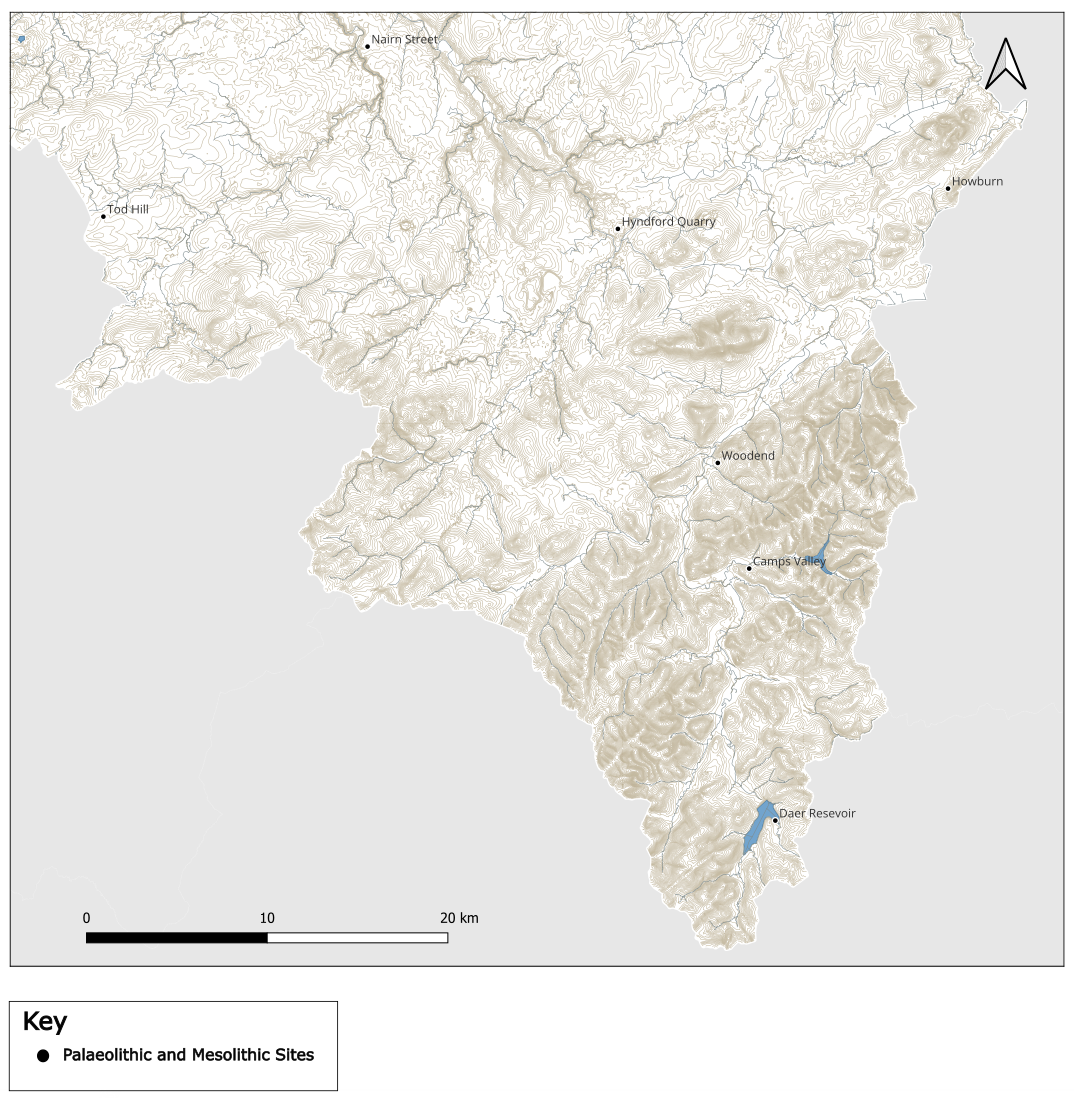
Finlay (2015) highlights the bias throughout Scotland towards impressive and coastal sites in Mesolithic research, often in the northwest of Scotland. While local community archaeology groups, like The Biggar Archaeology Group, have been central to locating Palaeolithic and Mesolithic material within the Clyde Valley. She also remarks that commercial archaeology and academic research have had little impact on the study of Palaeolithic and Mesolithic activity within the Clyde Valley (Finlay 2015, 8). In the time since the essay was written there has been some change, as commercial research found Mesolithic pits at Camps Valley and Woodend as well as Mesolithic dates returned from Hyndford Quarry and a single unstratified Palaeolithic tanged point located from commercial activity at Calder Water Windfarm.
The impact of commercial activity throughout the region is largely due to the development of wind farms in the southern uplands. This coupled with the activity of The Biggar Archaeology Group has led to a concentration of Palaeolithic and Mesolithic sites in South Lanarkshire which is yet to permeate academic research. Another concentration of sites within the Clyde Valley are in Inverclyde which flows from field walking from Newhall in the 1960s. Unfortunately, there is still an underrepresentation of Palaeolithic and Mesolithic sites throughout the rest of the local authorities of the Clyde Valley, which has not changed since the production of Finlay’s essay.