
Jenny Murray
In 2012, a small, portable altar made from bright red sandstone was handed into Shetland Museum and Archives (ARC 2013.79). This cross-inscribed stone led to a project that would enhance a little-understood ecclesiastical period in Shetland’s medieval history. The cross on its upper surface was stylistically identified as a 12th century engraving (Ritchie and Scott 2015, 193). Local geologist, Allen Fraser, examined the stone and confirmed that it was not comparable to Shetland’s geology and was most likely of Orcadian origin. This dicsovery inspired more questions than answers. For instance, why was the sandstone imported into Shetland and when?
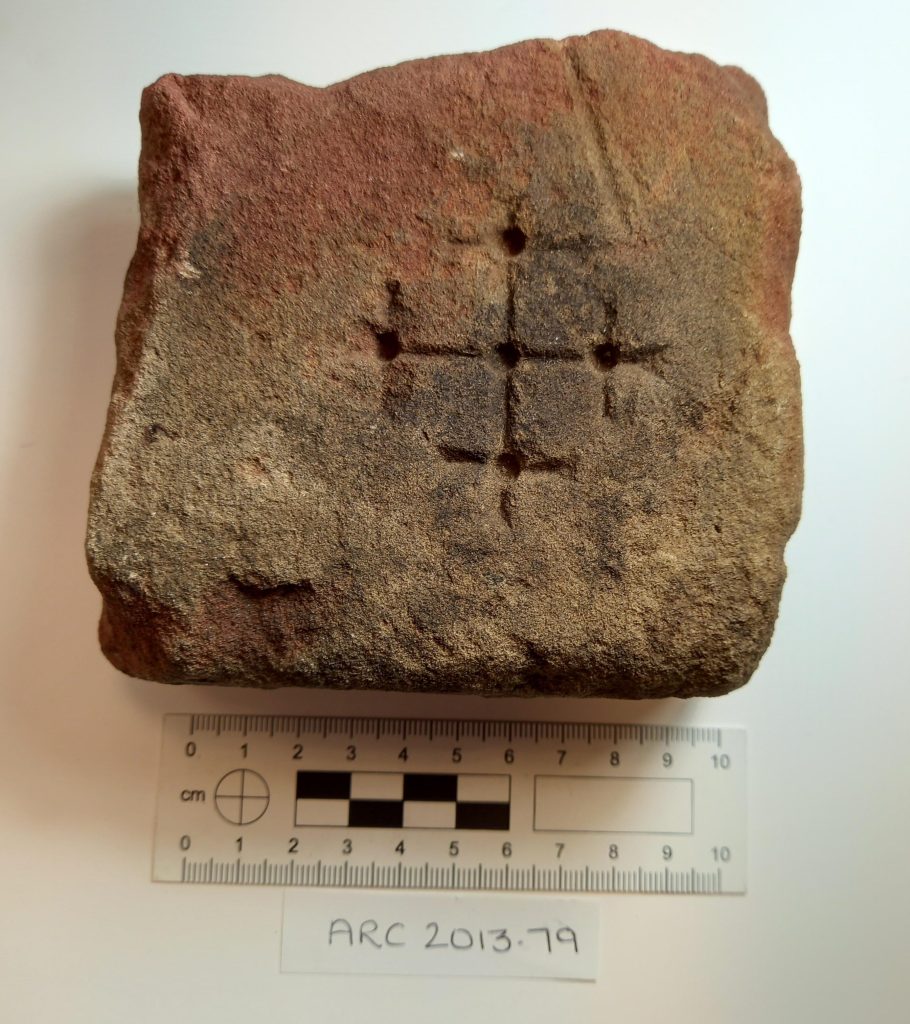
A project funded by Museum Galleries Scotland was developed to help identify further church-related red sandstone within the museum collection and the wider community. The sandstone was believed to be associated with three round-towered churches which were likely constructed in the 12th century. The catholic dedications of these churches survive, including St Laurence in Papil, St Mary’s in Ireland, and St Magnus in Tingwall, Shetland’s main church built on a knoll above the medieval parliament site at Lawtingholm. The outcomes of the Three Kirks project have helped write a new chapter in Shetland’s medieval ecclesiastical history (Fraser and Murray 2019).
Local folklore has preserved a story where the three towered churches were gifted to Shetland by three Norwegian sisters (Leigh 1684, quoted in Bruce 1908, Edmondston 1809). An account written by Sibbald says that St Laurence church in Papil was built ‘by the mid-most of the three Norwegian Sisters, the eldest having built the Church of Tingwall and the youngest sister the Church of Ireland’ (1711, 55). Unfortunately, none of these churches survive today. However, the buildings have an interesting association with the colour red in their fabric and a suggested link to Orcadian influence in their creation (Nelson 1965, Taylor 2004).
St Magnus Church (Tingwall) appears to have been the most impressive of three, and it is to Orkney that we must look to realise its scale. The only surviving church of the towered genre in Orkney and Shetland stands on the island of Egilsay. Documents record that the nave of Tingwall church measured 15 x 5.5m, compared to that in Egilsay which is 9.2 x 4.7m, an impressive 42% larger (Cant 1975, Nelson 1965). The surviving tower on Egilsay is 16m tall. Its original height, according to Samuel Hibbert’s drawings, was believed to have been 19.2m (1822). In keeping with their architectural cousin in Egilsay, the towers of the Tingwall and Papil churches were described as being ‘of hewn stone, between sixty and seventy feet high’, (Edmondston 1809, 124). The tower of St Laurence, described by Sibbald, ‘… will be five or six stories high’ (1711, 55).
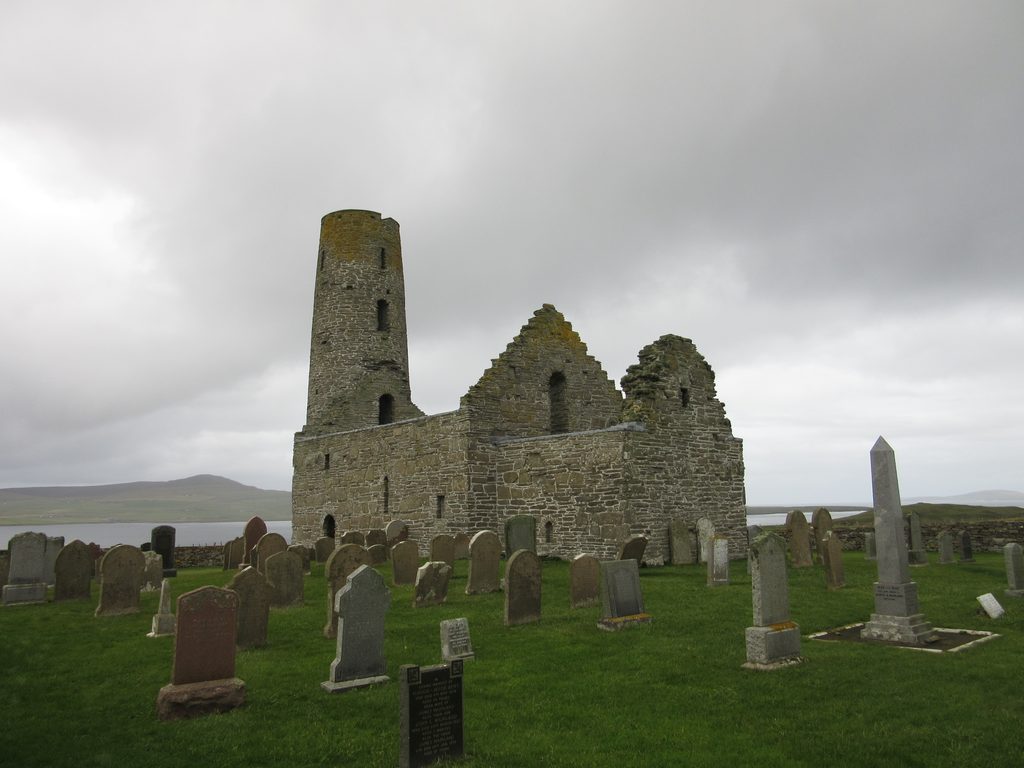
Following a survey of all three sites, numerous rubble blocks of red sandstone were identified in the 18th century churches that were built to replace their medieval predecessors, in both Tingwall and Papil. To prove the links between the red sandstone blocks and the possible source quarries in Orkney, petrographic analysis was undertaken by the British Geological Survey (Everett 2019). Core samples were taken from rubble blocks at all three sites with permissions from Historic Environment Scotland, as well as a cut stone block, believed to be the capstone from the tower in Ireland which is curated in Shetland Museum (REL 65405).
The microscopic examination demonstrated that all of the samples were virtually identical in characteristics to that from Orkney quarries, including the presence of iron oxide minerals that coat the sand grains giving rise to the characteristic red colour (Everett 2019). This close similarity suggests that the sandstone from all Shetland samples was derived from a similar sediment source and deposited in a similar environment – the Eday Sandstone Group from the Head of Holland bedrock. The quarry used to supply the building blocks of St Magnus Cathedral in Orkney was a match for these samples (Everett 2019).
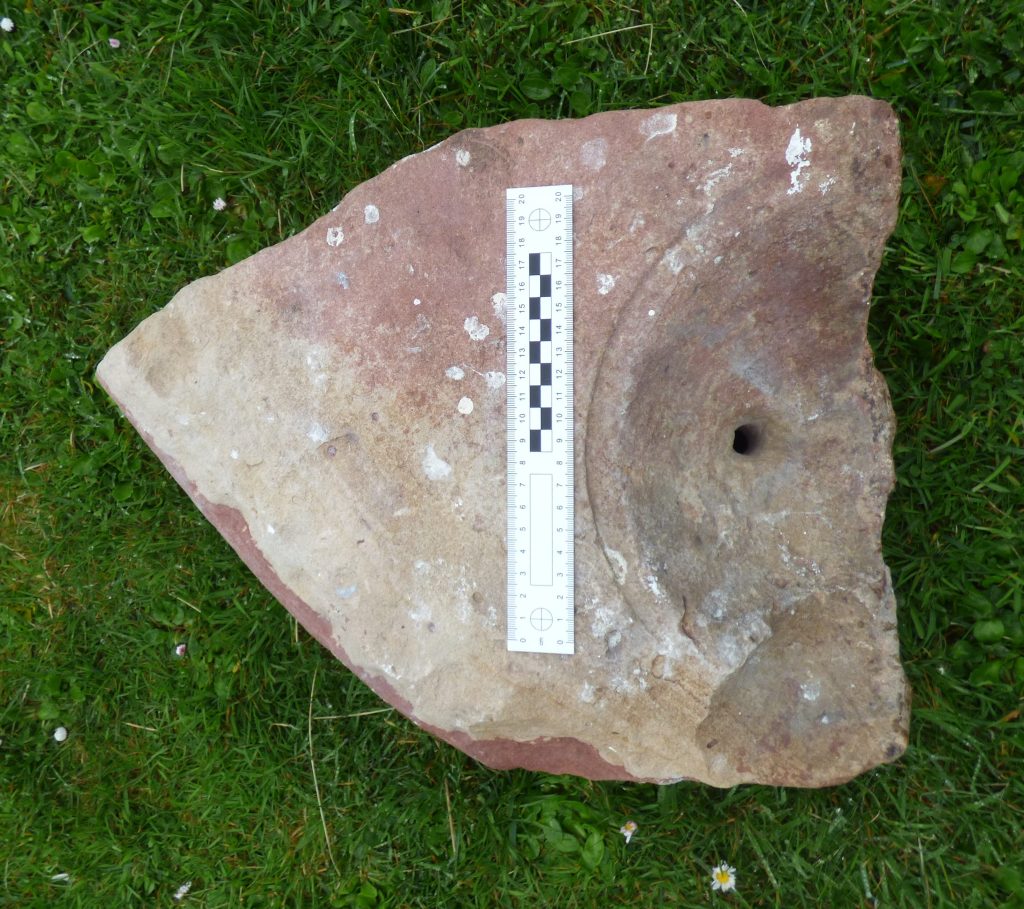
The scientific evidence now proved that red sandstone blocks were being imported into Shetland sites to build or refurbish previous churches in the area during the same period as St Magnus Cathedral, consecrated during the 1150s, was being constructed (Crawford 1988). Proof of another tangible link with Orkney was identified when someone in the community made us aware of a carved ‘bowl’ from Papil, said to have been retrieved from the old church. On inspection, it was identified as a broken piscina, carved from the same bright-red stone. Comparisons to the two surviving piscinas in St Magnus Cathedral was remarkable as they are almost identical in style to the Papil example, with only 2cm difference in size. They are so similar, one wonders if the same stonemason produced all three. This led to further enquiries as to the links between the three towered churches and the cathedral built for St Magnus.
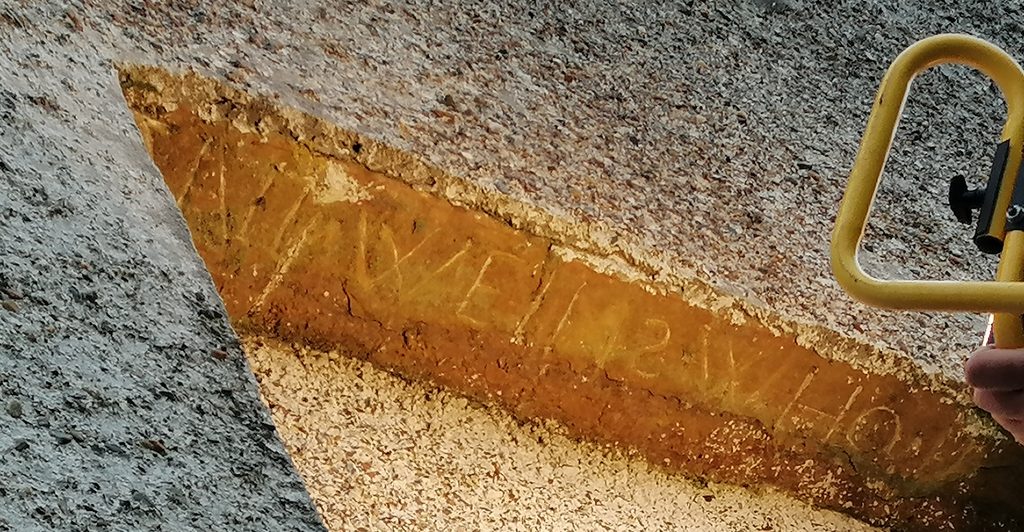
Research by Gibbon and Murray has identified the presence of red sandstone in other Orcadian churches in areas where the stone is not native, such as St Mary’s 12th century chapel on the island of Wyre (Gibbon 2006, 31-32). With more unanswered questions as to the possible ecclesiastical links with red sandstone in the Northern Isles during this period, the author applied for funding for PhD study to investigate this further. This research is ongoing and has identified further examples of red sandstone use in churches, including an inscribed lintel in St Magnus, Tingwall.
In an interview with Michael and David Leask, the brothers suggested that the ‘three sisters’ churches in Shetland may have been built by the Orkney Earl, Rognvald Kali Kolson (c AD 1103-1158) who had much to gain from promoting the cult of his uncle (Taylor 2004, 18-20). This hypothesis was worth investigating. Rognvald was a nephew of the martyred Magnus Erlandsson, Earl of Orkney from c AD 1106, until his murder on Egilsay by his treacherous cousin around 1117. Following his murder, various miraculous things began to happen by his grave. A barren spot, where the grass now began to grow lush and green, and a heavenly smell began to emanate from the ground (Antonsson 2007, 70). His sanctity was now well underway.
Earl Magnus’ family began a mission to regain his land, especially his sister Gunnhildr Erlandsdottir, her ambitious husband Kolr Kalisson and their son Kali Kolsson, who had taken the title of Rognvald. Following an acknowledgement from the King of Norway, the family continued to assert their political rights to the Earldom, gathering support from the islanders. This included Shetlanders, where Earl Magnus had found his greatest loyalty and support (Crawford 1984, 71). During this period, the church also held great sway in the political arena. Realising this, Rognvald was advised by his father to promise the people he would build a cathedral church for the remains of his uncle Magnus. This created further support in the burgeoning cult, and the wealth and power that came with it. Devotees of the cult came in numbers and a succession of Shetlanders made their way to Orkney to be cured at the grave of Earl Magnus, the stories chronicled in the Book of Miracles (Orkneyinga Saga, Chapter 57). Rognvald did indeed gain back the Earldom, which he ruled until his death in AD 1158.
Were the Shetland churches a reward for the island’s support? The red masonry of the towers would have been striking in the landscape, providing a visual and spiritual beacon, and conformation of a new order. Political and ecclesiastical change was happening throughout Europe during the 12th century. Landowner’s private chapels were being enlarged, and parish churches established, creating a new sense of Christian community (Gibbon 2006, Crawford 2013, 232). With his power base in Kirkwall, Rognvald was now taking more control, Shetland’s three towered churches may have played a major role in this change.
Ongoing research will add an important dimension to the history of the medieval church in Shetland and Orkney during the 12th century. Science has proven without a doubt that stone used to build or refurbish the Shetland churches was Orcadian. The building blocks and associated church furniture, including the piscina and Eshaness altar, were most likely shaped by the masons building St Magnus Cathedral in Kirkwall.
The round-towers of Shetland would dominate the skyline for six centuries, so it is no surprise that stories of their origin were passed down within the community. The exact identity of the three Norwegian sisters remains a mystery to this day.
Bibliography
Anderson, J (ed) 1873 The Orkneyinga Saga, Edinburgh: James Thin, The Mercat Press, 1981.
Antonsson, H 2007 St. Magnús of Orkney, A Scandinavian Martyr-Cult in Context, Leiden: Brill.
Cant, R G 1976 The Medieval Churches and Chapels of Shetland, Lerwick: Shetland Archaeological and Historical Society.
Crawford, B E 1984 ‘The Cult of St Magnus in Shetland’, in Crawford, B (ed) Essays in Shetland History: Heiðurlsrit to Dr T. Mortimer Manson , Lerwick: The Shetland Times, 65-81.
Crawford, B E 1988 St Magnus Cathedral and Orkney’s Twelfth-century Renaissance. Aberdeen: Aberdeen University Press.
Crawford, B E 2013 The Northern Earldoms: Orkney and Shetland from AD 870-1470, Edinburgh: John Donald.
Edmondston, A 1809 A View of the Ancient and Present State of the Zetland Islands, Volume 1, Edinburgh: John Ballantine & Co.
Everett, P A 2019 A petrological examination of the provenance of stone masonry from three medieval churches in Shetland, Nottingham: British Geological Survey, (OR/19/014). https://nora.nerc.ac.uk/id/eprint/526097/
Fraser, A and Murray, J 2019 ‘Three Kirks and a Cathedral’, in The New Shetlander (Hairst Edition), Lerwick: The Shetland Times, 5-14.
Gibbon, S J 2006 The Origin and Early Development of the Parochial System in the Earldom of Orkney, unpublished PhD thesis, University of the Highlands and Islands.
Leigh, H 1654 ‘A Geographical Description of the Island of Burray, 1654’ in Bruce, J (ed) Description of Ye Countrey of Zetland, published for private circulation, 1908.
Nelson, G M 1965 The Story of Tingwall Kirk, Lerwick: The Kirk Session of Tingwall.
Scott, I and Ritchie, A 2015 ‘Pictish symbol stones and early cross-slabs from Orkney’, Proceedings of the Society of Antiquaries of Scotland 144, 169-204. http://journals.socantscot.org/index.php/psas/article/view/9813
Sibbald, R 1711 Description of the Isles of Orknay and Zetland, Edinburgh: Thomas G. Stevenson.
Taylor, M 2004 ‘Tracing the Kirks’, Shetland Life, Lerwick: Shetland Times, 18-20.