
George Geddes
There was no ‘Saint Kilda’, and the archipelago that takes his name is properly known as Hiort, a cluster of four principal islands – Hirte, Dùn, Sòthaigh (Soay) and Boraraigh (Boreray) – that lie some 45 miles off the Outer Hebrides. As with so much in St Kilda studies, the origin of the name lies in the dominance of an anglophone and peripheral vantage bolstered by a traveller’s fascination with St Kilda.
The islands present the post-medieval archaeologist with a historic landscape that has achieved the ultimate accolade as a World Heritage Site while remaining difficult to reach and ripe for further research. Early archaeologies looked to St Kilda as a simulacrum for prehistoric communities in Scotland as a whole, and notable works of the 19th century by F W L Thomas, T S Muir and even Joseph Anderson touched on the island for its vernacular architecture – perceived as long-standing and archaic – thus imbuing the islanders as somehow conservative too. This pattern of exceptionalism continued into the 20th century, with the identification of ‘a forgotten people’, cenotaphs to those lost at sea, and cellular buildings akin to those in Cornwall (Williamson and Boyd 1960, Pollard 1999, Cottam 1979). Even the Ordnance Survey found prehistoric huts in 1967, some still designated, that are probably best understood as much later footings.
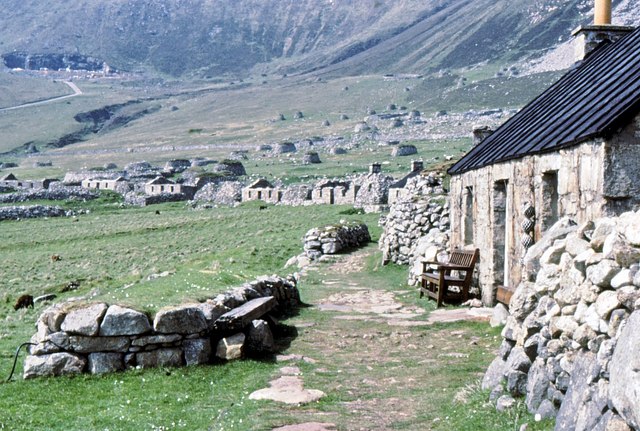
The abandonment of St Kilda in 1930, cast as a tragedy in Tom Steel’s Life and Death, brought with it a very particular research context where both animals and archaeological sites are preserved in aspic, a laboratory for studies as wide ranging as sheep genetics, seabird predation and soil pollution. Though almost uniquely rich in secondary literature, St Kilda is poor in primary documentation and a lack of estate records in the late 18th and 19th centuries in particular opens up the field to the archaeologist. In contrast to this paucity of documentary material, there is an enormous wealth of physical evidence from the post-medieval period that indicates, not a harmonious interaction with the natural world, but an intensive exploitation of resources, often for export, that had profound effects on the landscape and soils of the island.

Despite its remoteness, the crofting landscape here is perhaps the most closely studied in Scotland, with extensive landscape and building surveys by RCAHMS published in 1988 and 2015, two programmes of archaeological research and the important contributions of one of the UK’s leading landscape archaeologists (Emery 1986, Harman and Lelong 2011, Fleming 2005). These studies have amply demonstrated that the majority of the post-medieval archaeological features on St Kilda are perfectly normal – crofts divided by low walls of turf and stone, a head dyke encircling the in-field, blackhouses for families and their cattle, a kiln-barn, and estate buildings such as a church, schoolroom, factor’s house. Their construction, use and abandonment can be readily compared to other offshore islands such as North Rona, or closer parallels such as Pabbay (Harris) or Mingulay. But there are elements of St Kilda’s archaeological landscape that are peculiar, and they include the features that are related to the exploitation of seabirds, limited grazings and peat (bothies, cleitean, shieing huts etc), and those that reflect the need for medium to long term storage on the islands themselves (the storehouse, the sheer number and distribution of cleitean, peat stands etc). These elements, combined perhaps by the extraordinary landscape setting, do speak to a cultural adaptation that is different, while still an important part of a wider Gaelic-speaking milieu.

There is much research still to be done – we know little of the early church up until the abandonment of a series of chapels in the early part of our period, while the origins and development of the field systems in Village Bay and Gleann Mor are equally obscure. Though evidence is emerging, we know little either about the precise nature of the economy of the island in the period of agricultural improvements, and we cannot yet be certain as to why St Kilda was not abandoned in the middle of the 19th century along with so many other Hebridean islands. Both the military occupation of the island in 1957, and the role of St Kilda as icon and emblem in Scottish tourism and identity are also important threads that have yet to be unravelled. Emerging evidence from recent doctoral research suggests that St Kilda can be usefully studied with comparative landscapes (such as Pabbay or South Uist) and that this comparative approach could provide a deeper understanding of the isalnd from a new perspective (Grant 2016, Geddes 2015).