Jaqui Mulville
Introduction
Over time, islands and coastal regions have been recognised for exploiting a broader spectrum of resources compared to inland sites, encompassing food, materials, and more from land, sea, and air (Bailey and Parkington 2009). Within the extensive and well-preserved faunal assemblages of the Western and Northern Isles, unique evidence emerges regarding the movement and management of both domestic and wild terrestrial animals. Specifically, the Scottish island communities offer exceptional insights into distinct human-deer interactions not found elsewhere in Britain (Carter 1998, Serjeantson 2011).
Migratory Mammals
Following the last glacial maximum, the outer Scottish islands witnessed a scarcity of large animals, and only smaller mammals capable of “rafting” on marine litter—such as pygmy shrews, voles/mice, and mountain hares—managed to traverse the expansive sea channels from the mainland (Serjeantson 1990, Fairnell and Barrett 2007, Church et al 2011). These natural barriers prevented the spread of larger land mammals until the arrival of people and livestock, leading to the establishment of red deer herds on all outer Scottish islands except the Shetland Isles (Mulville 2010). While the importation of wild animals alongside domestic stock is noted in other island groups, the significance of the Scottish islands lies in the nature and longevity of this relationship, contrasting with much of Britain (eg Neolithic fallow deer in Cyprus, Vigne et al 2016, and Bronze Age red deer to the Isles of Scilly, Cornwall et al 1996).
Early Arrivals
Evidence for a breeding population of deer is absent in the few recorded insular gatherer-hunter assemblages. Materials suggest that, as in the Inner Isles (eg Oronsay) and beyond, deer, particularly their antlers, were utilized during the Mesolithic. However, the few antler fragments found at Rubh’ an Teampaill, Harris, may have originated from imported artefacts (Grigson and Mellars 1987, Kitchener et al 2004, Church et al 2011, Bishop et al 2015, 67-68).
The first evidence of established deer populations emerges in the Neolithic, indicating their capture and importation to the islands alongside domestic cattle and sheep (Mulville 2010). Once present, deer had the potential to disperse, with some capable of crossing short sea channels; historical records even note a stag traveling from Lewis to Barra and back again (Whitehead 1964). Genetic data from these early outer isle populations suggests few connections to other insular deer (Inner Hebrides) or Scottish mainland deer, implying longer-distance transport mechanisms or relic sources (Bruford et al 2016). In Orkney (Links of Nortland) and the Western Isles (Udal and Northton), red deer remains constitute a substantial portion of some assemblages, with evidence of locally breeding herds (Fraiser 2015, Armour-Chelu 1992, Finlay 1984).
Once established, red deer populations persist on all island groups into the Iron Age, but their trajectories differ. The proportion of deer in zooarchaeological assemblages is greater in Lewis and Harris than in Uist, and on Orkney, they disappear by the later Iron Age (Mulville 2010).
This trajectory of animal exploitation on the islands sharply contrasts with that of the rest of Britain (Serjeantson and Field 2015). As farming spread across most of Britain, there was a rapid decline in the exploitation of wild animals (Serjeantson 2011). This universal shift from hunting to farming resulted in the dominance of domestic stock as a food source. On the Scottish islands, the rich coastal ecotones continued to provide a wide range of accessible wild resources, with marine mammals being exploited in small quantities. However, terrestrial species were only occasionally targeted, such as for fur (Fairnell and Barrett 2007). Deer stood as the sole exception, integral to island life and central to practices that allowed herds to thrive alongside domestic stock and crops for millennia.
Exploitation and Management
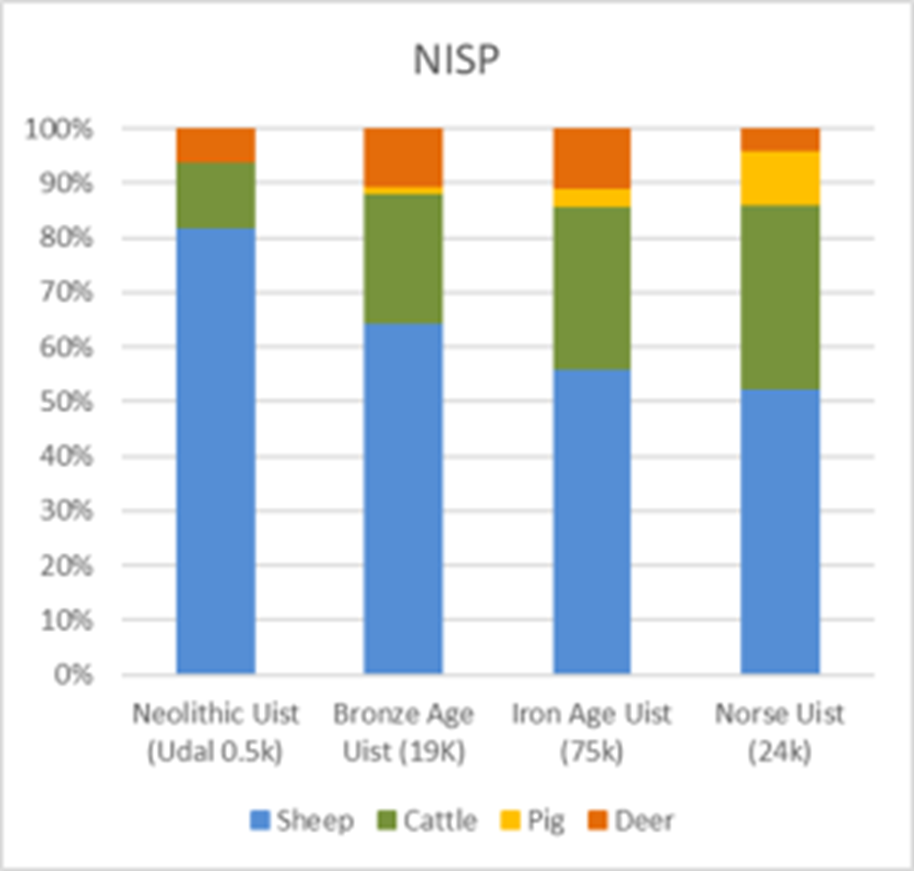
A detailed examination of the evidence for deer exploitation can offer insights into this unique relationship. The proportion of deer hunted varied between islands and over time. For instance, on Uist, the substantial assemblages chronicle the arrival of deer. Deer comprises about one twentieth of the very small (Udal) Neolithic assemblage, and a similar proportion of the Norse food animals, while during the Bronze and Iron Age, they make up one-tenth (Mulville 2010, 2016, 2020).
Uist’s deer served as a significant source of food, skins, and tools. Abundant evidence of body parts and butchery suggests that complete deer carcasses were returned to sites, rather than just selected elements. Their bones and antlers continued to play a crucial role in artefact production, with shed antlers providing an easily collected and renewable resource. An example of the value of antler in prehistory is evident at Cladh Hallan, where the number of picks recovered is as numerous as those from major Neolithic monumental sites (Mulville 2024, Worley et al 2014, see SIRFA Case Study: Cladh Hallan).
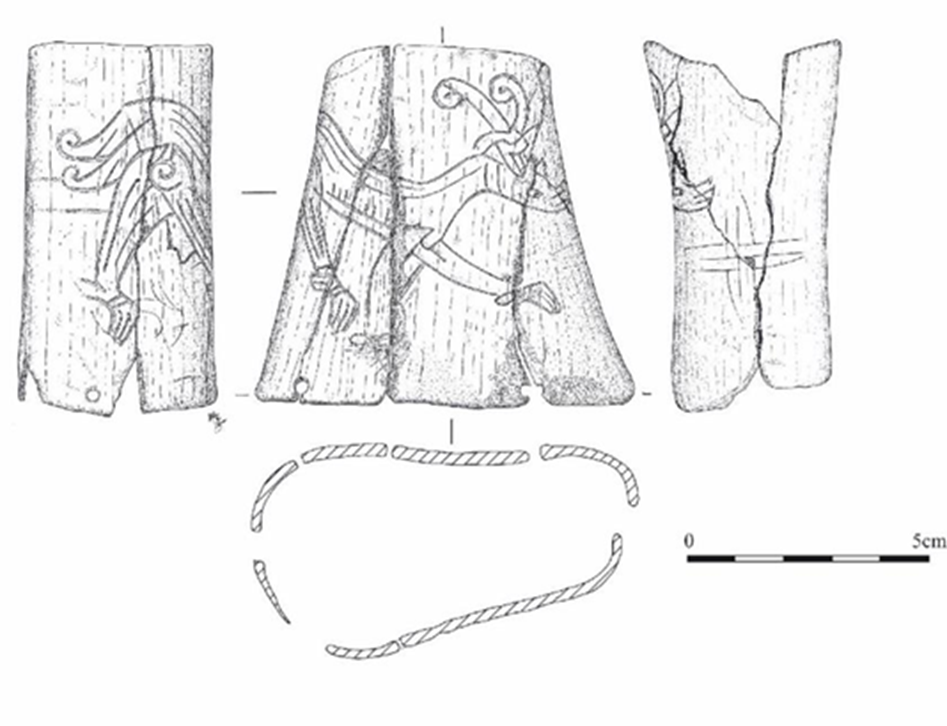
Later, the availability of antler appears to underpin the development of a Norse period antler comb workshop at Bornais (Sharples and Dennis 2016), the only one outside York and Dublin. Additionally, the significance of deer, alongside livestock, is demonstrated by the placement of their remains in settlements and depictions of deer in art across time (Mulville and Thoms 2005, Mulville 2016).
In-depth age data obtained from Uist illustrates that a diverse range of ages, spanning from newborn calves to mature adults, were hunted throughout all periods. Mature animals held value for their capacity to yield sustenance from less fertile lands, serve as a safeguard during crop or livestock failures, and provide essential materials. Newly born calves, while offering less meat, were prized for their soft hides and ease of capture. Being adept at hiding in long grass or heather and freezing in response to danger, targeting calves eliminated the need for stalking, driving, or the use of projectiles such as spears or arrows.
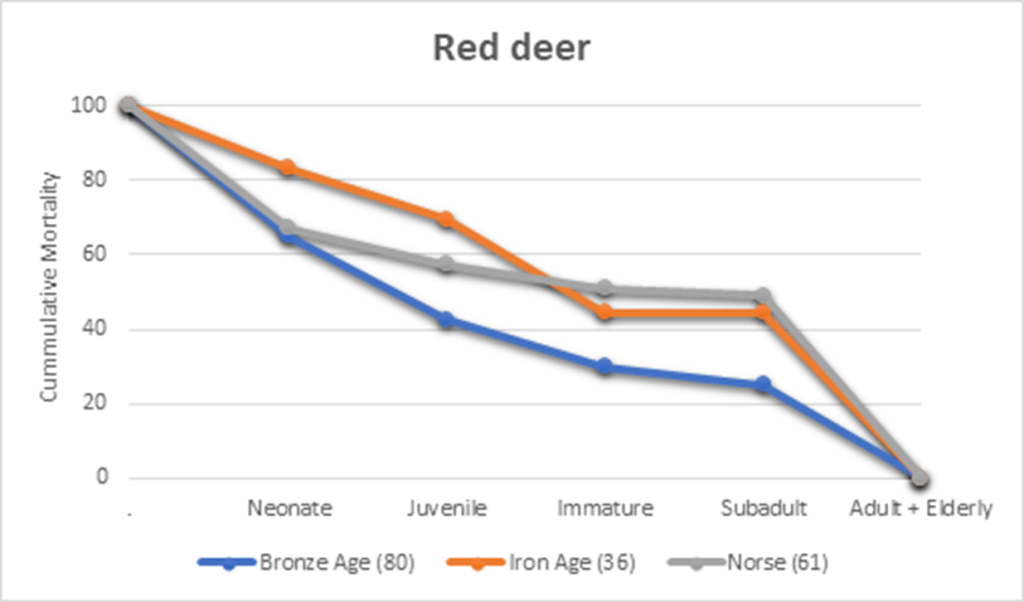
Calf capture is absent in assemblages from Lewis and Harris (eg Bostadh and Berie, Thoms 2005) but reported from Orcadian sites (eg Howe, Smith 1994). This broad hunting strategy, with a significant proportion of very young deer, is highly unusual beyond the Scottish islands; paralleled only in a few European Mesolithic sites (Magnell et al 2020). Whilst unusual as a hunting strategy, this culling of young animals is identical to that employed across the islands in the management of cattle (Cramp et al 2014, Mulville et al 2005). For example, on Uist, a high level of newborn cattle calves is present in assemblages and linked to the control of herd size in the light of limited resources (Mulville 2020, 2024). The culling of young deer may be and comparable strategy, focused on managing the population to reducing competition with domestic stock and crops. These parallels between red deer exploitation and cattle suggest a similar and close relationship with both species (Mulville 2010, 2016, 2020, Mulville et al 2024).
This relationship with deer persisted for millennia across the Northern and Western Isles; from the Neolithic to Bronze Age (although evidence is sparse on Orkney) with deer remaining common on both island groups during the Iron Age. Deer continue to be hunted and managed. Red deer numbers fall on Orkney during the Later Iron Age, and they eventually become extinct. By the 13th century the Earls of Orkney had to cross over the sea to Caithness to hunt red deer and reindeer (Whiteread 1964). The impetus for this decline and extinction of Orcadian deer, compared to their persistence on the Western Isles, has yet to be determined, but may relate to differences in size (Orkney Isles 990km2, Western Isles 3,071 km2) and land type.
What is clear is that in the Hebrides, even with the arrival of the Norse, established hunting strategies continued. On Lewis and Harris mature deer continued to be targeted (eg Bostadh), but on Uist deer calves were procured (Thoms 2005, Mulville 2020). The Norse adoption of local strategies for red deer, and the parallel strategies for cattle, suggests a degree of integration and an appreciation of indigenous sustainable strategies by these incomers.
After the Norse period there is a lack of later medieval sites or detailed historic accounts to shed light on subsequent human:deer interactions on the Western Isles. Deer were reported as common across Uist, and particularly abundant on Harris and Lewis, up to the 19th century in estate and hunting reports (Whitehead 1964). They are variously described as protected by high-status individuals or estates, and hunted by ‘peasants’ and ‘poachers’ reflecting a change in their ownership.
Presently, the Western Isles, much like many regions in Scotland, boast expansive and expanding deer populations primarily overseen for recreational hunting. However, the presence of deer remains a significant hurdle for agricultural systems, causing harm to gardens, contributing to Road Traffic Accidents, and serving as hosts for ticks carrying Lyme disease. On South Uist, the challenges posed by deer have prompted discussions regarding their eradication, accompanied by inquiries into the origins of the current-day deer population. Achieving clarity on this matter necessitates further research, given the existence of evidence supporting both introductions and the sustained presence of deer in the area (Whiteread 1964, Pérez-Espona 2009).
The Western Isles’ deer population stands as the vestiges of an ancient mixed management system established millennia ago. The task at hand is to modernize this relationship for the 21st century. Ongoing efforts to coexist with deer involve the exploration of innovative approaches, with archaeological evidence serving as a means to reintroduce the public to the pivotal economic, social, and cultural roles these animals have historically fulfilled. Our research carries the potential to exert a positive impact on current deer management and utilization practices, addressing urgent concerns related to sustainability and resilience (Mulville 2023).
References
Bailey, G and Parkington, J 1988 The archaeology of prehistoric coastlines; an introduction’, in Bailey, G and Parkington, J (eds) The archaeology of prehistoric coastlines, Cambridge: Cambridge University Press.
Carter, R J 1998 ‘Reassessment of seasonality at the Early Mesolithic site of Star Carr, Yorkshire based on radiographs of mandibular tooth development in red deer (Cervus elaphus)’, Journal of Archaeological Science 25(9), 851-856.
Field, D and Serjeantson, D 2015 Animals in the Neolithic of Britain and Europe, Oxford: Oxbow Books.
Magnell, O, Gummesson, S, Molin, F, Zetterlund, P and Storå, J 2020 ‘Mesolithic deer hunting – Prey choice of red deer (Cervus elaphus) based on age and sex distributions’, Journal of Archaeological Science: Reports.
Pemberton, J M 2009 ‘Genetic diversity and population structure of Scottish Highland red deer (Cervus elaphus) populations: a mitochondrial survey’, Heredity 102, 199-210. https://doi.org/10.1038/hdy.2008.111
Ratcliffe, J and Straker, V R 1996 The Early Environment of Scilly, Cornwall County Council.
Serjeantson, D 2011 Review of Animal Remains from the Neolithic and Early Bronze Age of Southern Britain (400 BC – 1500 BC), Research Department Report Series 29–2011, Portsmouth: English Heritage.
Vigne, J D, Daujat, J and Monchot, H 2016 ‘First introduction and early exploitation of the Persian fallow deer on Cyprus (8000–6000 cal. BC)’, International Journal of Osteoarchaeology 26(5), 853-866.
Whitehead, G K 1964 The Deer of Great Britain and Ireland: An account of their history, status and distribution, London: Routledge and K Paul.
Worley, F, Serjeantson, D, Baker, K, Carden, R and Madgwick, R 2014 ‘Red deer antlers in Neolithic Britain and their use in the construction of monuments’, in O’Connor, T and Sykes, N (eds) Deer and People, Cheshire: Windgather Press, 119-131.