
Rosie R Bishop
Introduction
The Mesolithic site at Northton (Taobh Tuath), Toe Head peninsula, Harris is the first Mesolithic site identified in the Western Isles of Scotland. Although palynologists had argued for a human presence in the Outer Hebrides based on indicators of human impacts in the pollen record since the 1980s (see Edwards 2009), this evidence remained contentious due to the absence of archaeological evidence for Mesolithic human settlement. The discovery of the first Mesolithic archaeological site at Northton in 2001 was therefore of considerable international research significance and represented the most north-westerly Mesolithic site in Europe (Gregory et al 2005, Simpson et al 2006). This case study focuses on the plant remains recovered from the site and their importance for understanding the nature of hunter-gatherer subsistence.
Site description
The site is located just above the present-day beach at Northton in an eroding section. It underlies a series of later Neolithic and Bronze Age midden deposits and stone-built structures which were excavated in the 1960s (Simpson 1976). The Mesolithic phase was first identified in 2001, following the radiocarbon dating of charred hazel nutshell from layers which had previously been interpreted as Neolithic in date (Gregory et al 2005, Simpson et al 2006). After the initial dating of the site, a small-scale excavation of the eroding layers was later undertaken in 2010-2011 by a team from Durham University lead by Mike Church and Rosie Bishop, as part of an investigation into Mesolithic settlement in the Western Isles (Bishop et al 2010, 2011a, 2011b, 2012).
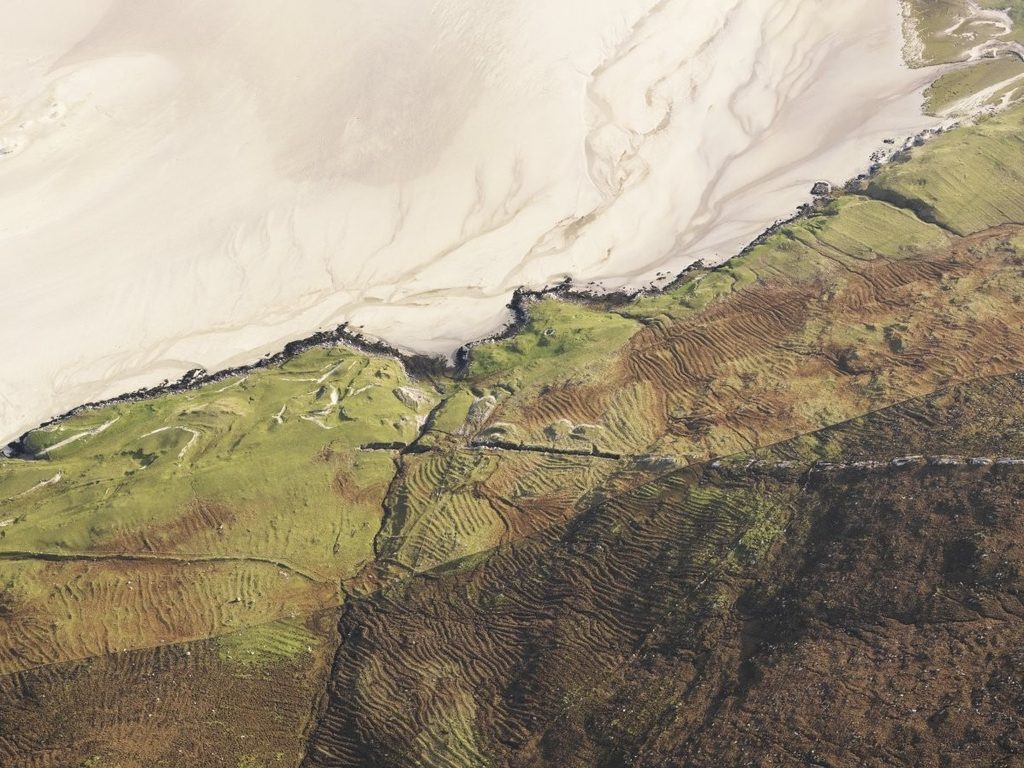
The excavations revealed a series of old ground surfaces, which incorporated flint, quartz and chert lithic tool-making waste and the remains of hearth waste containing remnants of fuel (charcoal) and food remains (plant remains, animal bones, fish bones, marine shells). The site consisted of 3 main phases, with the two lowermost phases representing the main Mesolithic phases of occupation. The upper horizon was radiocarbon dated to c 6416-6090 cal BC and contained small quantities of redeposited Neolithic material as well as in situ Mesolithic remains (Ascough et al 2017). The middle horizon was radiocarbon dated to c 6569-6088 cal BC, whilst the lowermost horizons were dated to c 7050-6652 cal BC (Bishop et al 2023, Gregory et al 2005, Simpson et al 2006). The discovery of sealed layers of Mesolithic archaeology provided an excellent opportunity to undertake extensive sampling for plant and animal remains, and in order to maximise the information produced from the site, 100% of the in situ archaeological layers were sampled and processed by flotation to retrieve ecofacts and artefacts. The plant remains were analysed by Rosie Bishop and a full discussion of the methods and results can be found in Bishop et al (2023).
Plant gathering and cooking in the Mesolithic
The sampling of the site uncovered a concentration of charred edible root tubers including Lesser Celandine (Ficaria verna) and Bitter-vetch (Lathyrus linifolius), as well as extensive hazelnut remains, and sporadic finds of seeds from edible wild plants. Both Lesser celandine and Bitter-Vetch root tubers were used historically for food in Scotland when other foods were scarce (Bishop et al 2023). Lesser Celandine and Bitter-vetch are rich in carbohydrates and high in energy (Bishop 2021) and the discovery of these remains highlights the importance of carbohydrate-rich foods, such as roots and tubers, in the Mesolithic diet. These finds challenge traditional assumptions about the nature of hunter-gatherer subsistence, which have portrayed Mesolithic people primarily as hunters rather than gatherers, and have downplayed the role of plant foods in Mesolithic diets (see Bishop et al 2013, 2015 for further discussion).
The remains of the charred root tubers of Lesser Celandine were particularly abundant, and it is likely that they were charred accidentally during processing to make them edible, as the roots contain low levels of a poisonous toxin called protoanemonin, which can be removed by cooking or drying. Together with the quantity of edible plant remains recovered, the need for cooking or drying highlights the fact that plant gathering was systematic rather than opportunistic, suggesting a greater degree of active interaction with plants than has often been supposed for the Mesolithic period.
The analysis has also produced intriguing evidence about the way the plant foods might have been cooked at the site. The samples contained abundant charred herbaceous stem fragments, which are inedible, and were likely preserved during the cooking of other foods. These stem remains are very fragile and would only preserve in low temperature and low oxygen conditions, without being in direct contact with fire. One possibility is that these well-preserved herbaceous stems may be the remnants of vegetation that was used in a steaming pit or smoking shelter, which would have allowed the stems to be charred without direct contact with fire. The excavations also uncovered extensive remains of fire cracked rocks and burnt fish bones, suggesting steaming or roasting was taking place on site. Ethnographic evidence from the west coast of North America describes the steaming or roasting of edible roots and tubers over heated rocks in pits sealed with layers of vegetation and earth, and our evidence suggests that this might have been how food was cooked at Northton.
The plant remains also add to our understanding about the seasonality of resource use and the time of year the site was in use. The plant food remains suggest gathering in the summer and autumn, when the roots were largest and had the highest energy content and were therefore best for gathering, and when the nuts and seeds were available for collection. Intriguingly, this also corresponds with the evidence from the fish bones recovered from the site. The fish bones were mainly young fish from the cod family which migrate in shore in the summer and autumn, which supports a summer and/or autumn occupation at the site at least (if not beyond).
Acknowledgements
The researchwas supported by an AHRC (UK) Doctoral Studentship and an IRC (Ireland) Post-doctoral Fellowship awarded to Rosie Bishop. The SEM analyses were funded by a University College Dublin Seed Fund grant. The excavations were funded by US National Science Foundation grant, Hunter Trust, Historic Environment Scotland and Durham University.
Bibliography
Ascough P L, Church M J, Cook G T 2017 ‘Marine radiocarbon reservoir effects for the Mesolithic and Medieval periods in the Western Isles of Scotland’, Radiocarbon 59, 17-31. https://doi.org/10.1017/RDC.2016.99
Bishop, R R, Church, M J and Rowley-Conwy, P A 2010 ‘Northton, Harris’, Discovery and Excavation in Scotland 11, 178. https://www.archaeologyscotland.org.uk/about-us/publications/discovery-and-excavation-in-scotland-des/
Bishop, R R, Church, M J and Rowley-Conwy, P A 2011 ‘Northton, Harris’, Discovery and Excavation in Scotland 12, 185-186. https://www.archaeologyscotland.org.uk/about-us/publications/discovery-and-excavation-in-scotland-des/
Bishop, R R, Church, M J and Nesbitt, C 2012 Archaeological investigations at Northton, Harris, Western Isles, 2011, Data Structure Report, Department of Archaeology, Durham University. https://durham-repository.worktribe.com/output/1607325
Bishop, R R, Church, M J and Rowley-Conwy, P A 2011 Excavations at Northton, Western Isles of Scotland, 2010, Unpublished Data Structure Report, Department of Archaeology, Durham University. https://durham-repository.worktribe.com/output/1606549/
Bishop, R R, Church, M J and Rowley-Conwy, P A 2013 ‘Seeds, fruits and nuts in the Scottish Mesolithic’, Proceedings of the Society of Antiquaries of Scotland 143, 9-71. http://journals.socantscot.org/index.php/psas/article/view/9799
Bishop, R R, Church, M J and Rowley-Conwy, P A 2015 ‘Firewood, food and niche construction: the potential role of Mesolithic hunter-gatherers in actively structuring Scotland’s woodlands’, Quaternary Science Reviews 108, 51-75. https://doi.org/10.1016/j.quascirev.2014.11.004
Bishop, R R 2021 ‘Hunter-gatherer carbohydrate consumption: plant roots and rhizomes as staple foods in Mesolithic Europe’, World Archaeology 53 (2), 175-199. DOI:10.1080/00438243.2021.2002715
Bishop, R R, Kubiak-Martens, L, Warren, G M, and Church, M J 2023 ‘Getting to the root of the problem: new evidence for the use of plant root foods in Mesolithic hunter-gatherer subsistence in Europe’, Vegetation History and Archaeobotany 32, 65-83. https://doi.org/10.1007/s00334-022-00882-1
Edwards, K J 2009 ‘The development and historiography of pollen studies in the Mesolithic of the Scottish islands’, in McCartan, S, Schulting, R G W and Woodman, P (eds) Mesolithic Horizons: papers presented at the Seventh International Conference on the Mesolithic in Europe, Belfast 2005, Oxford: Oxbow Books, 900-906.
Gregory R A, Murphy E M, Church M J, Edwards K J, Guttmann E B and Simpson, D D A 2005 ‘Archaeological evidence for the first Mesolithic occupation of the Western Isles of Scotland’, Holocene 15, 944-950. https://doi.org/10.1191/0959683605hl868ft
Simpson D D A 1976 ‘The later Neolithic and beaker settlement of Northton, Isle of Harris’, in Burgess C B and Miket R (eds) Settlement and economy in the third and second millennia BC, BAR British Series 33, Oxford: Archaeopress, 221-226.
Simpson D D A, Murphy E M and Gregory R A 2006 Excavation at Northton, Isle of Harris, BAR British Series, Oxford: Archaeopress, 408.