
Rachel Barrowman
Dùn Èistean is a small island (or cliff stack) situated in the district of Ness at the north end of the Isle of Lewis. It has traditionally been considered as the stronghold of the Clan Morrison. In fact, in 2000 the clan commissioned a survey and trial excavation on the site before building a footbridge over to it in time for a clan gathering in July 2002. From these initial investigations the Dùn Èistean Archaeology Project (DEAP) was born. The project was managed by GUARD at Glasgow University but was led and situated in the Ness community. From the results of this first phase of work it was obvious that Dùn Èistean was an exceptional site in its complexity, its extent, and its medieval date. This was intensified by the fact that this period of history in Lewis and Harris is not well documented and had been subject to little archaeological research.
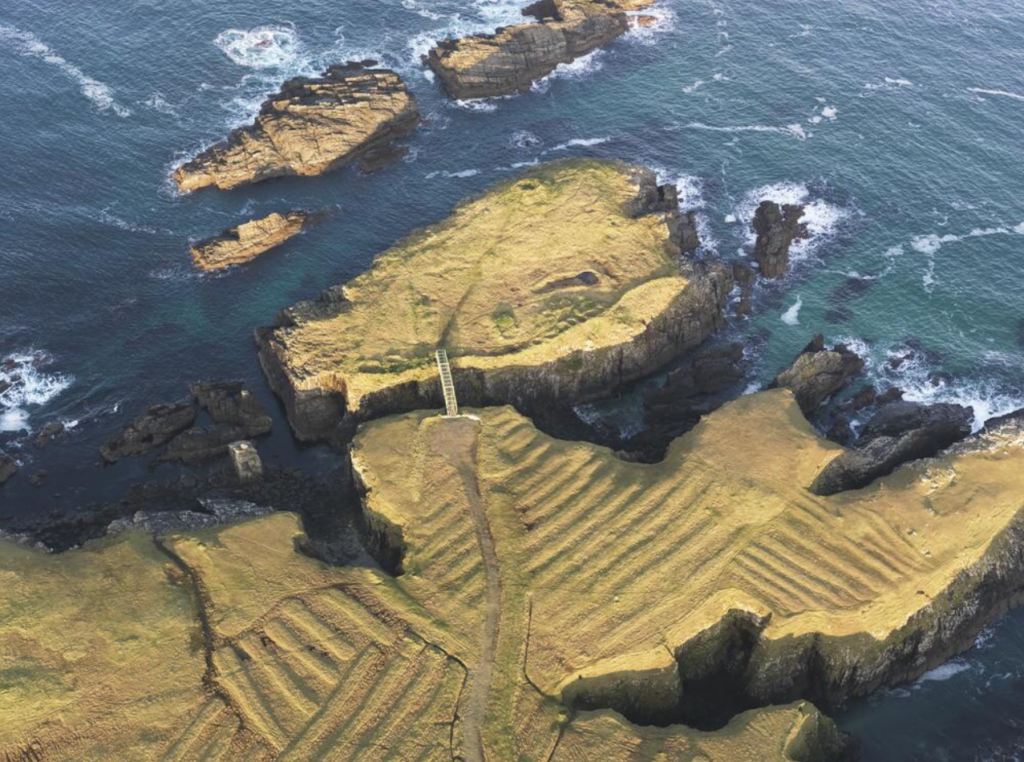
In 2005, the project moved to more extensive survey, excavations, and research in Ness, with the aim of promoting the scholarly investigation and public interpretation of Dùn Èistean and the surrounding Ness landscape. Dùn Èistean became the heart of a multi-disciplinary project which included the DEAP and a Ness Archaeological Landscape Survey (NALS). Both aspects of the project were managed by GUARD and funded by the Heritage Lottery Fund, Historic Scotland, Comhairle nan Eilean Siar (Western Isles Council) and Comunn na Ghàidhlig. From the start one of the fundamental principles of the Dùn Èistean project was to integrate archaeological and historical research, and to work through the medium of Gaelic where possible in Ness, which was still a strong Gaelic-speaking area. To this end, prior to the excavations in 2005, the Dùn Èistean History Project, managed by the Commun Eachdraidh Nis and the Western Isles archaeologist, Dr Mary MacLeod, and directed by Dr Dòmhnall Uilleam Stiùbhart took place across the Ness district, interviewing residents and collecting place-names and local stories through the medium of Gaelic (Stiùbhart 2015, Comunn Eachdraidh Nis 2020). Meanwhile, the DEAP excavations and Ness survey were completed in 2007 and published in 2015 (CS Barrowman 2015, RC Barrowman 2015).
An extensive radiocarbon dating programme produced a date range of the mid-15th to mid-17th centuries AD at the outside (Outram and Batt 2015) for the Dùn Èistean building fabric and occupation. This sets the site at the end of a long tradition of clan strongholds, galley castles and small towers that are found throughout the west Highlands, Hebrides, and Ireland (see Martin 2017; Oram 2017, 271–2; Miket & Roberts 1990). The location of Dùn Èistean on the coast of the Ness peninsula thrust out into the North Atlantic meant that it was situated in the busy sea routes operating around northern Britain and Europe at this time. With views along the Lewis coast and across to the Scottish mainland, it would have been highly visible in a maritime world. Indeed, a small assemblage of imported ceramics and coins recovered from the site emphasize its links with the wider world in the late medieval and early modern periods. The concurrent survey work in Ness, and the recent survey of chapel-sites in Lewis, have also identified and recorded a rich contemporary landscape of sites (CS Barrowman 2015, 2020, Comunn Eachdraidh Nis 2020, see discussion in RC Barrowman 2015, 416-422).
The excavations on Dùn Èistean revealed the remains of a settlement comprising a defensive perimeter wall, a lookout tower, communal quarters and ancillary buildings, and a corn-drying kiln built from turf and stone. The site was repeatedly inhabited for short bursts of time, and everything that was needed for occupation on the small cliff stack was provided – a man-made pond dug out to collect fresh water, a corn- drying kiln and barn to store grain and possibly peat, and several groups of shelters with peat hearths. Post-excavation analyses revealed dietary indications in the form of barley, oats, fish and mammal bone, plus an assemblage of locally hand-made coarse pottery that is the largest recovered from a late/post-medieval site in the Hebrides, and the first large stratified and radiocarbon dated assemblage of this date to be published (Campbell 2015). Campbell identifies that this pottery, or craggan ware, is not, as previously thought, a late form of earlier Iron Age pottery traditions, but a unique local development of a construction technique widespread in the Hebrides.
Whilst it is not possible to confirm that the population that lived periodically on Dùn Èistean were the Clan Morrison, despite the strong oral tradition that it was a refuge for the clan, the archaeological evidence does indicate that the site was caught up in conflict at a time of political struggle between the Scottish Crown and the Hebridean clans, and of infighting between the clans themselves, in the period that followed the collapse of the Lordship of the Isles in 1493 (MacCoinnich 2015). Evidence for the deliberate demolition of buildings indicates that there was unrest on the site. The study of collapsed stonework around the tower building and soil micromorphological analysis from a shelter on the east side of the site suggest that these buildings may have been deliberately slighted (Barrowman 2015, 204-5, 2019, 40). Dùn Èistean is also situated at the end not only of the use of the galley, but also the archer (Caldwell 2017, 143), belonging instead to the time when the bow was being replaced by firearms. The recovery of musket balls, pistol shot and gunflints from the site, as well as evidence for their production at the hearths in the buildings, suggest conflict on site (the gun flint assemblage being the earliest so far discovered in Britain, Ballin 2015, Ferguson 2015).
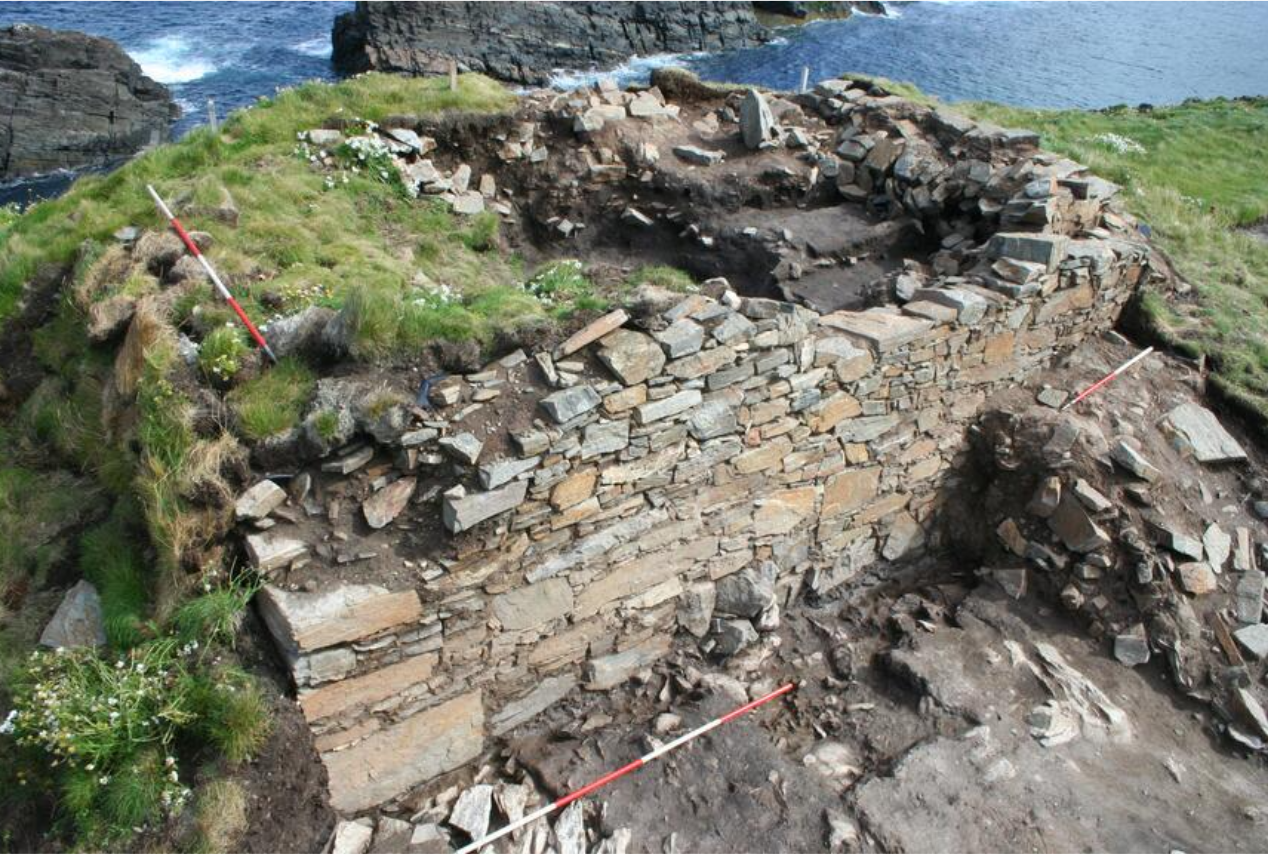
The work at Dùn Èistean has shown that the local, vernacular architecture and culture of the area is the most relevant when analysing the built architecture. Examples elsewhere along the western seaboard of small, coastal towers were built from lime-mortared masonry, often with slate roofs, whereas the Dùn Èistean tower is built from turf and stone, with a stone or thatch roof (Barrowman, R C 2015, 414–6; 2019, 36–7). The upper storey was also built not from mortared masonry, but from clay-bonded stonework, and soils analysis demonstrated that the lower storey walls were built by tamping clay and midden material down between two outer courses of stonework, a technique seen in later blackhouses in Lewis (McKenna & Simpson 2015; Walker & Macgregor 1996).
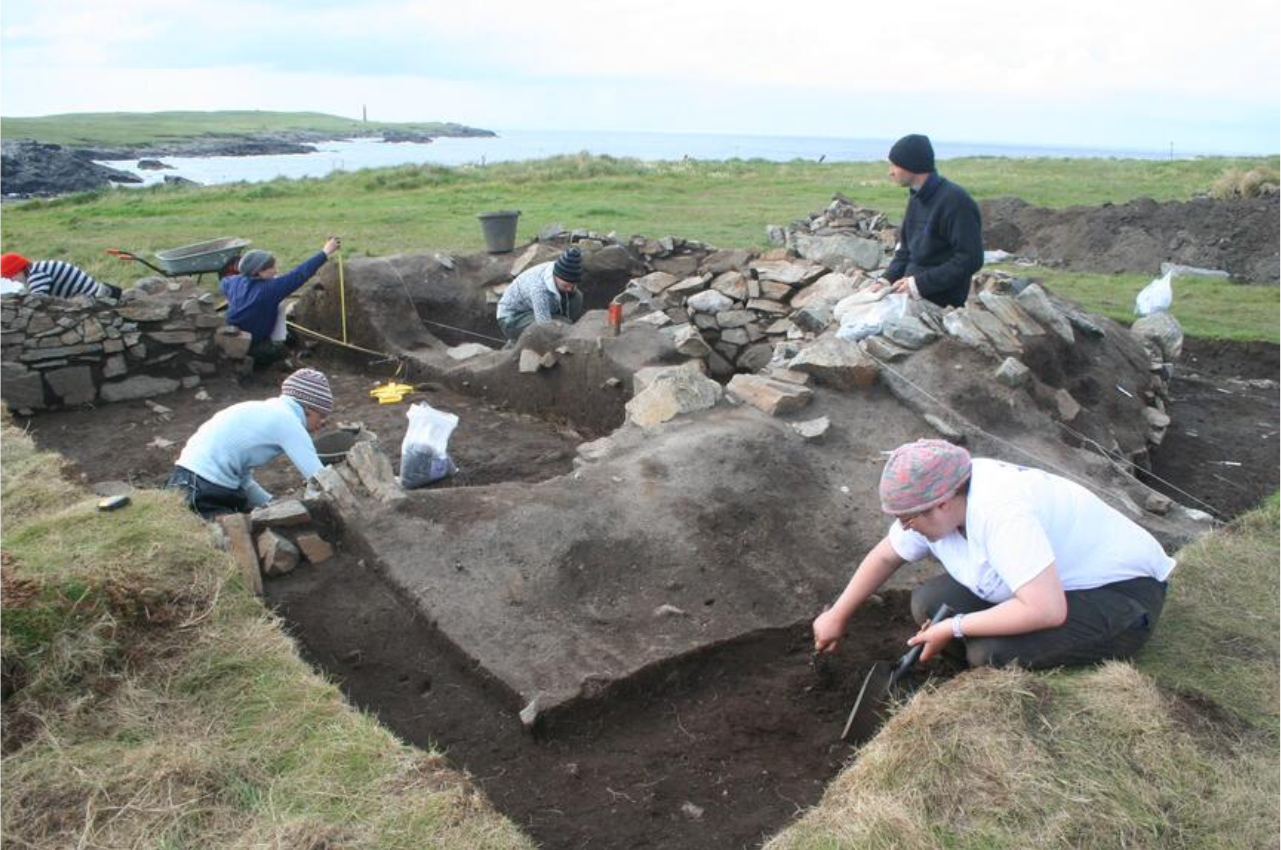
Similarly, the ancillary structures were more akin to those found in a late medieval rural settlement in the Hebrides, being built from low stone and earth or turf walls covered in a roof of thatch or turf over driftwood timbers (Armit 1997, Armit et al 2008, Parker Pearson et al 2004, Sharples 2019). For this reason, the term ‘defended medieval settlement’ has been sometimes used to describe Dùn Èistean, as it appears more like a settlement than a castle or defensive site in its architecture. Soils analysis work also showed that the sandy soils from the island were the main component in the wall cores of the structures on the site, and that different mixes of material were used between buildings and phases, suggesting that re-building and repairing of walls and buildings was an ongoing activity. Two groups of buildings resemble small, interconnecting cellular huts like those seen in later shieling settlements in Lewis (CS Barrowman 2015, 98-100, 254-272, Comunn Eachdraidh Nis 2020, 333-384). Like these shielings, it is very likely that Dùn Èistean was occupied on a seasonal basis, probably during the better weather of the spring, summer, and autumn, as this was when trade and military expeditions took place (see McWhannell 2017).
Unlike the majority of ‘galley-castles’ in the Hebrides, which can be shown to be built on earlier sites (Raven 2017, 132–3; Macniven 2017, 70), no earlier material was identified at Dùn Èistean despite the extensive excavations down to bedrock on several different areas of the site. Indeed, other than a small residual assemblage of flaked quartz (Ballin 2015, 248–9), no material earlier than the late medieval period was identified. The site appears not to have been chosen to capitalise on any forerunning prestige but was built on new ground. The inhabitants had a strong local identity, using their own traditional building techniques, adapting to available raw materials, and drawing on the resources of the surrounding environment to support and defend the population on the stack in the face of incoming attack.
References
Armit, I 1997 ‘Excavation of a post-medieval settlement at Druim nan Dearcag, and related sites around Loch Olabhat, North Uist’, Proceedings of the Society of Antiquaries of Scotland 127, 899-919.
Armit, I, Campbell, E and Dunwell, A 2008 ‘Excavation of an Iron Age, early historic and medieval settlement and metalworking site at Eilean Olabhat, North Uist’, Proceedings of the Society of Antiquaries of Scotland 138, 27-104.
Ballin, T 2015 ‘Lithics’, in Barrowman, R C (ed) Dùn Èistean, Ness: The Excavation of a Clan Stronghold, Stornoway: Acair Ltd, 247-262.
Barrowman, C S 2015 The Archaeology of Ness: The results of the Ness Archaeological Landscape Survey, Stornoway: Acair Ltd.
Barrowman, R C 2015 Dùn Èistean, Ness: The Excavation of a Clan Stronghold, Stornoway: Acair Ltd.
Barrowman, R C 2019 ‘“A Cultural Backwater”: the “Localness” of Dùn Èistean, Ness and its Place in the Wider Maritime World of Northwest Scotland’, Journal of the North Atlantic 12, 32-43.
Barrowman, R C 2020 ‘Chapel-sites on the Isle of Lewis: Results of the Lewis Coastal Chapel-sites Survey’, Scottish Archaeological Internet Reports 88, Edinburgh: Society of Antiquaries of Scotland. https://doi.org/10.9750/issn.2056-7421.2020.88
Caldwell, D H 2017 ‘Galley-Castles by Land and Sea’, in Martin, P (ed) Castles and Galleys. A Reassessment of the Historic Galley-Castles of the Norse-Gaelic Seaways, Laxay, Isle of Lewis: Islands Books Trust, 141-156.
Comunn Eachdraidh Nis 2020 Eachdraidh le Càirdeas is Cridhe: Ainmean-àite Ceann a Tuath Leòdhais Nis Gu Baile an Truiseil (History with Heart and Soul: The Place-names of North Lewis Ness to Ballantrushal), Stornoway: Acair Ltd.
Ferguson, N 2015 ‘Lead projectiles’, in Barrowman, R C (ed) Dùn Èistean, Ness: The Excavation of a Clan Stronghold, Stornoway: Acair Ltd, 242-247.
MacCoinnich, A 2015 ‘Dùn Èistean and the “Morrisons” of Ness in the lordship of Lewis. The historical background, c. 1493–c. 1700’, in Barrowman, R C (ed) Dùn Èistean, Ness: The Excavation of a Clan Stronghold, Stornoway: Acair Ltd, 41–68.
Macniven A 2017 ‘The Ruins of Danish Forts? Exploring the Scandinavian Heritage of Hebridean Galley-Castles’, in Martin, P (ed) Castles and Galleys. A Reassessment of the Historic Galley-Castles of the Norse-Gaelic Seaways, Laxay, Isle of Lewis: Islands Books Trust, 59-92.
Martin, P 2017 Castles and Galleys. A Reassessment of the Historic Galley-Castles of the Norse-Gaelic Seaways, Laxay, Isle of Lewis: Islands Books Trust.
McKenna, L E and Simpson, I A 2015 ‘Soils thin section micromorphology’, in Barrowman, R C (ed) Dùn Èistean, Ness: The Excavation of a Clan Stronghold, Stornoway: Acair Ltd, 320-339.
McWhannell, D 2017 ‘Sailing-Times in the Norse-Gaelic Seaways’, in Martin, P (ed) Castles and Galleys. A Reassessment of the Historic Galley-Castles of the Norse-Gaelic Seaways, Laxay, Isle of Lewis: Islands Books Trust, 44-58.
Miket, R and Roberts, D L 1990 The mediaeval castles of Skye and Lochalsh, Portree: MacLean Press.
Oram, R 2017 ‘Western Seaboard Castles: Historical and Environmental Perspectives’, in Martin, P (ed) Castles and Galleys. A Reassessment of the Historic Galley-Castles of the Norse-Gaelic Seaways, Laxay, Isle of Lewis: Islands Books Trust, 249-265.
Outram, Z and Batt, C 2015 ‘The dating evidence’, in Barrowman, R C (ed) Dùn Èistean, Ness: The Excavation of a Clan Stronghold, Stornoway: Acair Ltd, 355-375.
Parker Pearson, M, Sharples, N and Symonds, J 2004 South Uist: Archaeology and History of a Hebridean Island, Stroud: Tempus.
Raven, J 2017 ‘Norse Period Hebridean Dun Re-occupation and Castle-Building’, in Martin, P (ed) Castles and Galleys. A Reassessment of the Historic Galley-Castles of the Norse-Gaelic Seaways, Laxay, Isle of Lewis: Islands Books Trust, 127-140.
Sharples, N 2019 A Norse Settlement in the Outer Hebrides: Excavations on Mounds 2 and 2A, Bornais, South Uist: Bornais Volume 3, Oxford: Oxbow books.
Stiùbhart, D U 2015 ‘Local traditions concerning the late medieval history and topography of Sgìre Nis’, in Barrowman, R (ed) Dùn Èistean, Ness: The Excavation of a Clan Stronghold, Stornoway: Acair Ltd, 69-86.
Walker, B and MacGregor, C 1996 The Hebridean blackhouse. A guide to materials, construction and maintenance, Edinburgh: Historic Scotland Technical Advice Note 5.