
Val Turner
The prehistoric landscapes of Shetland survive exceptionally well although absolute dating evidence is currently in short supply. A mapping project, which formed part of the author’s PhD, established that differing field shapes and sizes have a clear topographic link to building remains of specific styles. Due to this work, it is possible to assign broad periods to distinctive field systems. The study then explored various aspects of the field systems, building on topographical survey using Shape Analysis, GIS, soil survey and micromorphology in order to investigate location, form and function in Shetland’s prehistoric field systems (Turner 2012). One of the avenues explored sheds light on the economy and subsistence of the inhabitants of the Neolithic/Bronze Age Multiple Field Systems which are so abundant on the west side of Shetland mainland and the apparently similarly dated Homestead Enclosures, more commonly found on the east side.
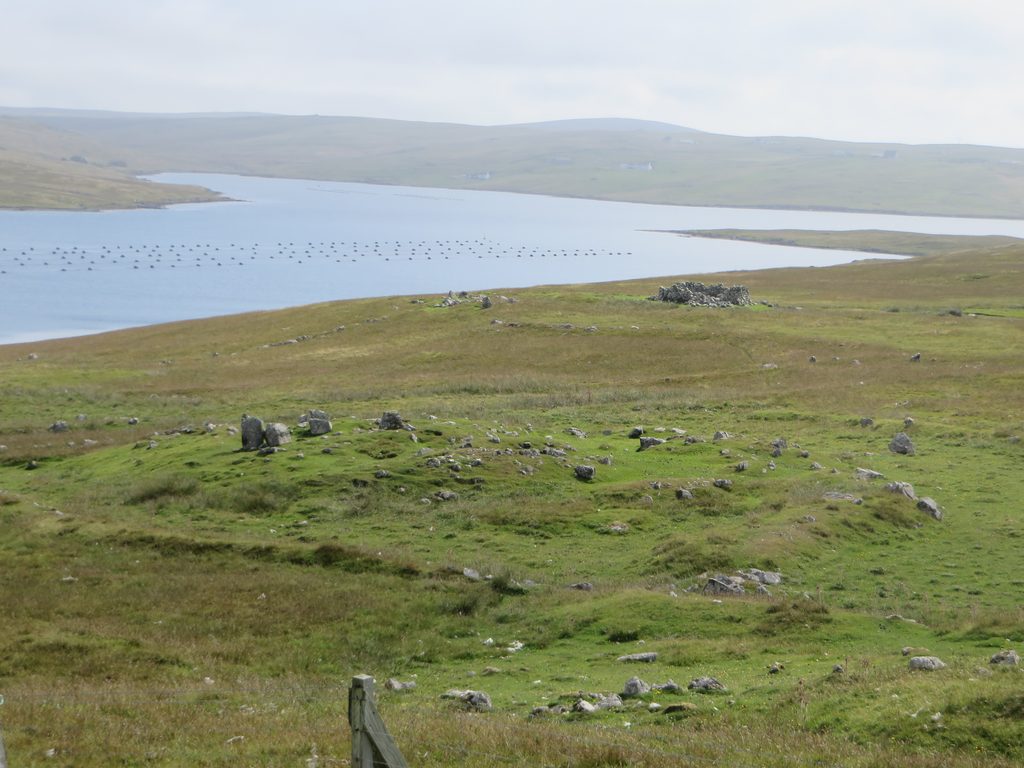
Three previous models had been proposed for the use of the Multiple Field Systems: an arable nucleus of barley, with limited cattle, sheep and deer (Whittle 1986), short episodic agriculture (Fowler 1971), and grazings (Edwards and Whittington 1998).
The field systems studies are characterised by terraces and lynchets. Terraces probably supported crops, where lynchets demarcated the lower edges of terraces or were a by-product of now-absent boundaries against which soil built up. Had the fields been used exclusively for grazing, these features would be unlikely to form. Small numbers of animals could have been tethered with less effort than was required to create and maintain boundaries. Examples of tether posts were identified at the Sumburgh runway (Downes and Lamb 2000). However, small fallow fields may have served as animal pens, providing manure whilst supplementing the available grazing.
Different types of outfield vegetation benefits from different styles of management. Woodland regeneration and heather are vulnerable to damage in winter when more palatable foods are in short supply (Chapman 2007). Blanket bog is more vulnerable to erosion through trampling in winter. Managing the outfield would be as important to successful farming as managing the infield: protecting the outfield would provide good reason for containing animals within the arable fields in winter.
Types of animals husbanded might be determined by the quality of the land. Cattle favour quantity over quality, sheep eat more selectively. Cattle trampling causes greater damage but their dung contains greater levels of nutrient enrichment (Chapman 2007). Sheep were therefore more suited to grazing the Multiple Field Systems, including fragile boggy areas and steep slopes.
Agriculture economics sheds further light on farming in early prehistoric Shetland. Fleming’s study on Medieval England, concluded that each adult required 1.5 acres worth of grain, plus another 0.5 acres required for seed corn (1971). Fojut used figures quoted by Fenton to calculate that in pre-improvement 18th century Orkney the yield per hectare would be approximately 1000kg/ha for human consumption, having also set aside the seed corn (1978, 336). Fojut claimed that the Iron Age Shetland yield would have been comparable with, or better than, this. He also determined the requirement of an adult on a cereal-based diet as approximately 210kg per year. Thus, an arable hectare in early 18th century Orkney would have almost been sufficient to feed five people. There are significant differences between Shetland and Orkney, both in terms of latitude (and therefore climate) and the availability of flat, easily cultivable land. Light sandy soils are prevalent in Orkney but less so in Shetland (with concentrations in the South Mainland and the east coast of Unst).
Kemp calculated that a dairy herd of six cows and a bull, with a maintenance level of immature animals, would supply the daily energy requirement for 9.1 people during lactation (2001). The Scottish Agricultural College Technical Note 586 (Chapman 2007) defines the quantity of stock which can be supported by one hectare of grazing per annum as 1 Livestock Unit (LU). Today, a suckler cow and calf represent 1 livestock unit (LU). Beef cattle over 24 months old are 0.8 LU and so can be kept at a slightly higher density. Sheep can be kept more intensively, a ewe rated at 0.12 LU (or 0.15 LU with a lamb).
The Technical Note guideline for annual average stocking rates includes the unimproved upland grassland (eg Nardus) rated at 0.15-0.25 LU/ha/yr; young heather at 0.2 LU/ha/yr; intermediate heather (20-40cm) at 0.05 LU/ha/yr; old heather at 0.02 LU/ha/yr and blanket bog at 0.06 LU/ha/yr. Early prehistoric Shetland’s light woodland would be classified as Moderate (woodland) fertility, rated at 0.07 LU/ha/yr. These figures can vary by 20-40% depending on soil fertility; and over or under grazing (Chapman 2007).
Fleming argued that woodland browsing was nutritious and that the level of effort required to clear land was not justified if the land was solely grazed (1971). However, the stocking rates recommended by the Scottish Agricultural College contradict this – even the ‘high fertility, lowland broadleaves’ woodland have a value of 0.15 LU/ha/yr.
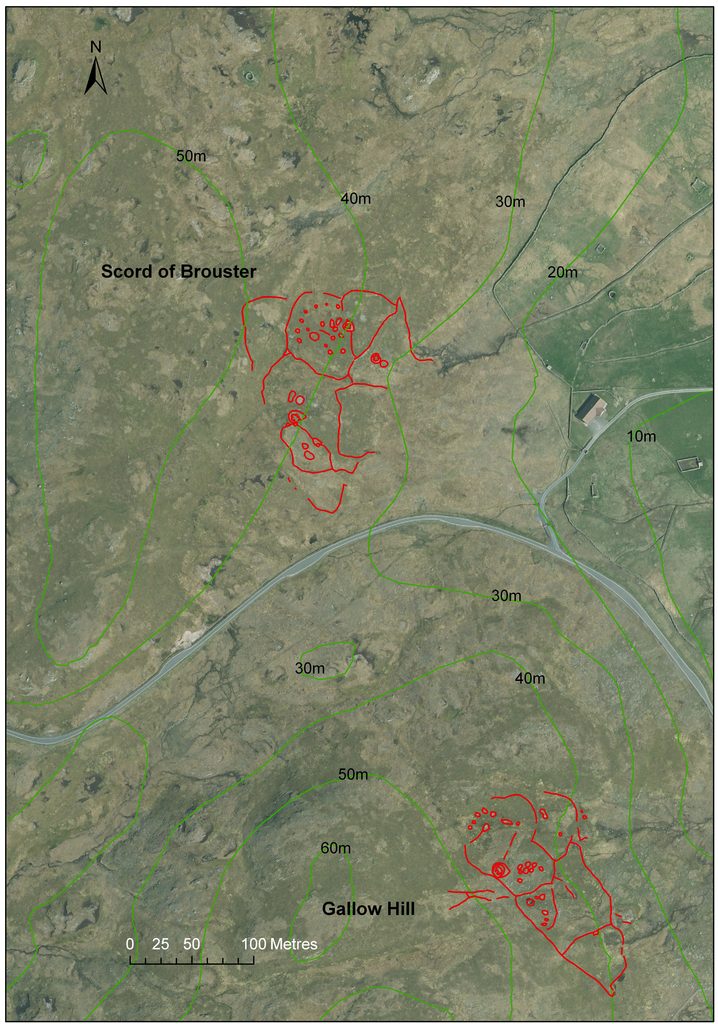
This study calculated the areas of both the Homestead Enclosures and Multiple Field Systems (Turner 2012). If apparently stand-alone Homestead Enclosures were used for agriculture, and produced high quality fodder. they could either have either supported a single ewe and lamb for a year or, based on Fojut’s calculations, grown sufficient grain for between 0.6 and 1.25 people. However, usually a house reduced the available land. In either model, the Enclosures themselves were clearly not the primary supply of food for their occupants. There is some evidence that people grew crops and kept animals outside the Homestead Enclosures (S Nesting, Dockrill 1993). Or they may lived a more hunter-gatherer lifestyle, perhaps with seasonal movement, although the size and solidity of the houses suggests that settlement was permanent.
None of the Homestead Enclosures are far from the sea and a study of viewsheds indicated the importance of coastal resources: fish (including shellfish), seabirds and their eggs, supplemented by the occasional seal or cetacean, must have formed a significant part of the diet (Turner 2012).
Isotope analysis of human bone across the UK has suggested that by 5400BP people had abandoned marine derived food (Richards and Hedges 1999, 892) possibly the result of a taboo (Thomas 2003, 70). However, a more gradual move towards a terrestrial diet has been proposed for Southern Britain and Wales (Milner et al 2003, 12). In a Shetland context, a seafood taboo would appear self-destructive. This study indicates that the ubiquitous resources of the sea made Neolithic and Bronze Age Shetland agricultural communities economically viable. The only early skeletal remains from Shetland come from the Sumburgh cist, located in some of the most fertile of Shetland’s agricultural land. Isotope analysis of dentine samples suggests that even here, the inhabitants relied on marine resources, periodically. interspersed with periods of a terrestrial diet (Montgomery et al 2013). It would therefore be unsurprising that the inhabitants of harsher areas in Shetland would rely more heavily on marine resources. The absence of skeletal /dental material makes this hard to prove.
Many individual fields within the Multiple Field Systems are smaller than the Enclosures; their areas frequently reduced further by clearance cairns. The smaller fields were too small to support a single animal for a year and, even if kept fertile, would supply as little as 14% of the grain required for one adult individual eating a cereal-based diet for a year.
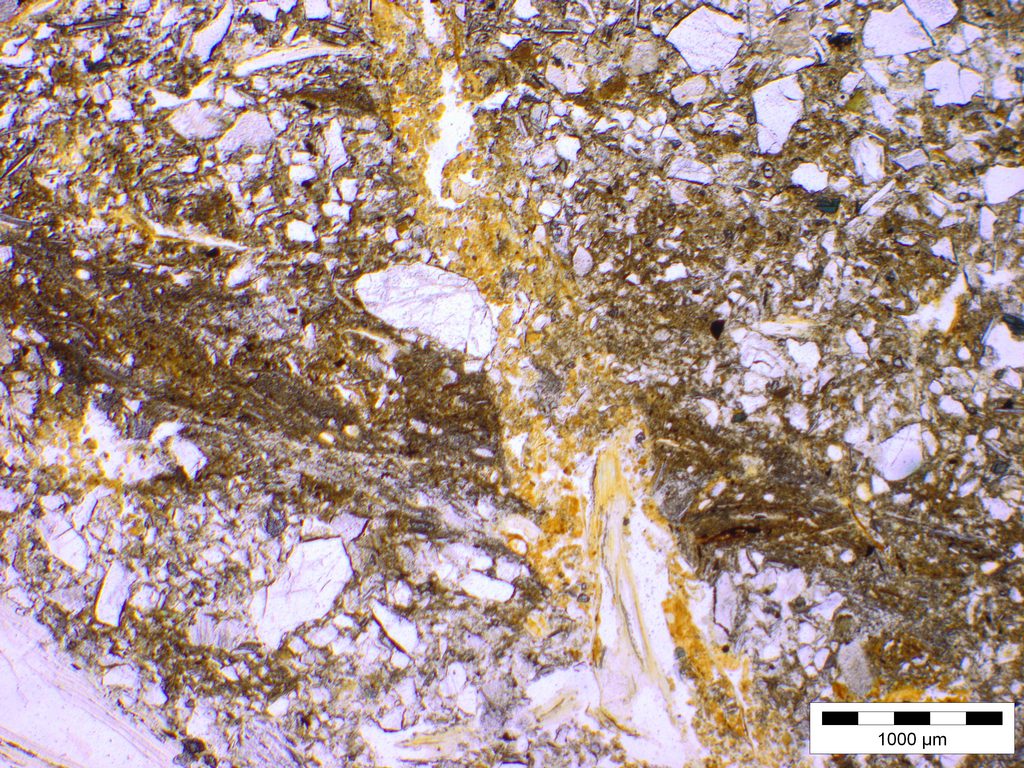
Based on the visible field boundaries, if the fields were kept fertile and in constant use, then four of the six Multiple Field systems in the study could have supported four (at two sites), six and eight adults eating a cereal-based diet. However, micromorphology demonstrates sporadic cultivation, interspersed with periods of grazing, indicating that the contribution of cereal to the diet could only be relatively low (Turner 2012).
The total areas enclosed by Multiple Field Systems at Sumburgh Head and the Ness of Gruting are far smaller (although, at the Ness of Gruting, the total area in the field system was probably larger than the sum of the fields which could be measured; some boundaries were too fragmentary to estimate the enclosed area with any degree of certainty). On the upland at Sumburgh Head farming appears to have been more difficult: every small terrace or flat area of land was brought in to use. The field systems indicate arable use, animals could have roamed the hillside without them.
Based on these calculations, the amount of grain grown in any of the field systems under consideration, or the animals grazed in them, contributed only a limited proportion of the diet of the community. Mahler described domestic animals in Norse Faroe as comprising a ‘safe food-bank’, which contributed calves, lambs and dairy produce as well as grain, to the community (2007). He observed that while growing small amounts of grain was time consuming, cereals nevertheless played a central role in the economy of Viking/Norse Faroe.
Another facet of the Multiple Field System economy is the relationship between the field systems and the stone dykes which project from them, which can be traced for considerable distances into the hill. These are a feature of the Multiple Field Systems of the West Side of Shetland, the projecting boundaries often being aligned with hill top burial cairns and ridges. Fojut suggested that these are territorial boundaries created in response to the expected arrival of ‘as many as ten thousand persons’, representing sophisticated land organisation (Mahler 2007).
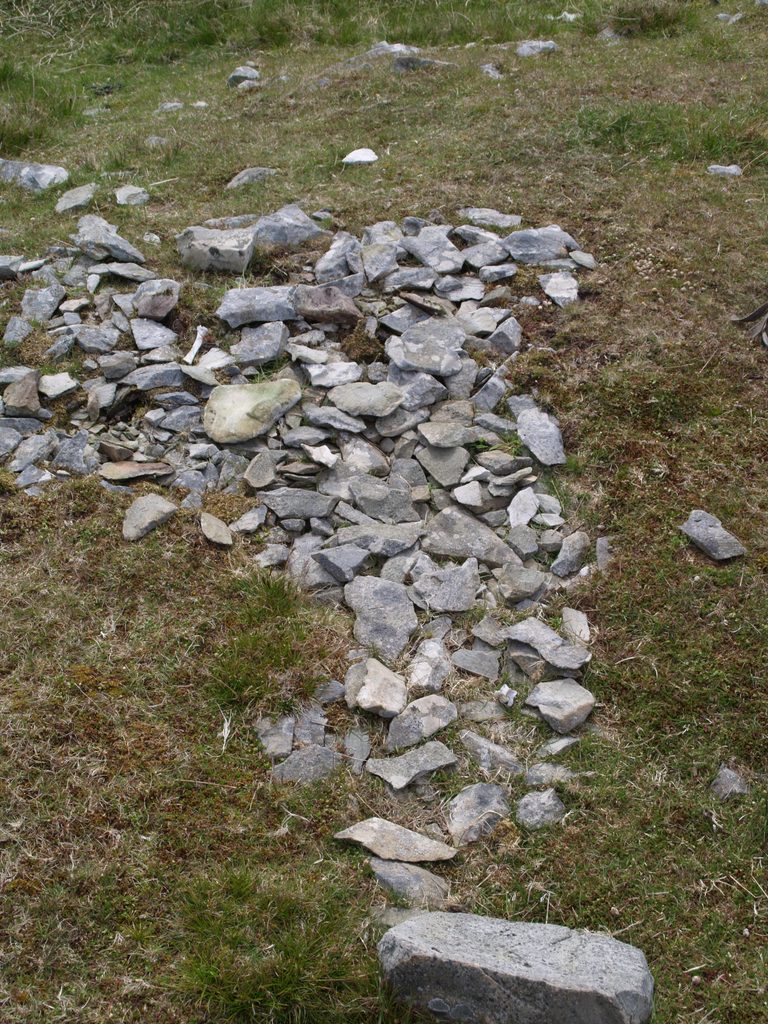
However, they may have had a utilitarian function. The importance of the hill land between the settlements may have exceeded its value as summer grazing: it provided a supply of tools, timber, fuel and wild food resources and may have been as important to the inhabitants as were the fields themselves. Quarries above the Sumburgh Head field system and within the sub-divided hill land on the West Side demonstrate their clear economic value to the settlements. Rights to the hill may even have determined ownership of coastal resources of the sea: fish, whales, driftwood, seaweed and seabirds, all contributing to the wellbeing of the community. The Homestead Enclosure residents, lacking visible projecting boundaries, seemed to require a view of the sea, perhaps because the ownership of resources here was a matter for dispute.
Conclusions
This study of the field boundaries of Neolithic and Bronze Age field systems in Shetland, supported by the micromorphological evidence, indicates that Shetland’s early farmers were practicing mixed farming, but that this was insufficient to supply all their dietary requirements. Given the paucity of native wild animals in the islands, and the harsh growing environment, together with the view shed evidence, it is clear that marine resources must have comprised a vital component of the diet for inhabitants on less fertile ground.
The Faroese Sheep Letter demonstrates that keeping sheep in the outfield, held in common by several people, was central to the Norse economy there. Rights in the outfield included peat cutting and were linked with rights to the coastline (Mahler 2007). It is possible that similar rules were in existence in Shetland as much as 3,000 years earlier and that the dykes projecting from the field systems are evidence of this.
Bibliography
Ashmore, P J 1999 ‘Radiocarbon Dates for Archaeological Sites in Shetland’, in Owen, O and Lowe, C (eds) Kebister: the four-thousand-year-old story of one Shetland township, Edinburgh: Society of Antiquaries of Scotland Monograph Series 14, 308-320.
Bradley, R J 1978 The Prehistoric Settlement of Britain, London: Routeledge and Kegan and Paul.
Calder, C S T 1960-61 ‘Excavations in Whalsay, Shetland, 1954-5’, Proceedings of the Society of Antiquaries of Scotland 94, 28-45. https://doi.org/10.9750/PSAS.094.28.45
Chapman, P 2007 Conservation Grazing of Semi-Natural Habitats, Scottish Agricultural College, Technical Note 586, March 2007, Edinburgh: SEERAD.
Dockrill, S J, Bond, J M and O’Connor, T P 1998 ‘Beyond the Burnt Mound. The South Nesting Palaeolandscape Project’, in Turner, V E (ed) The Shaping of Shetland Lerwick: Shetland Times Ltd, 61-82.
Downes, J and Lamb, R 2000 Prehistoric Houses at Sumburgh in Shetland. Excavations at Sumburgh Airport 1967-74, Oxford: Oxbow Books.
Edwards, KJ and Whittington, G 1998 ‘Landscape and Environment in Prehistoric West Mainland, Shetland’, Landscape History 20, 5-17.
Fenton, A 1978 The Northern Isles: Orkney and Shetland, Edinburgh: John Donald.
Flemming, A 1971 ‘Bronze Age Agriculture in Marginal Lands of North-east Yorkshire’, British Agricultural History Review, 19, 1-24.
Fojut, N 1983 ‘Towards a Geography of Shetland Brochs’, Glasgow Archaeological Journal 9, 38-59.
Fojut, N 2005 ‘Any Closer Towards a Geography of Shetland Brochs’, in Turner, V E, Nicholson, R, Dockrill, S J and Bond, J M (eds) Tall Stories: 2 millennia of Brochs, Lerwick: Shetland Amenity Trust, 166-171.
Fowler, P J 1971 ‘Early prehistoric agriculture in Western Europe: some archaeological evidence’, in Simpson D D A (ed) Economy and Settlement in Neolithic and Early Bronze Age Britain, Leicester, 153-182.
Kemp, L 2001 Preliminary Assessment of Iron Age Cattle Farming associated with the Brochs of Shetland, unpublished undergraduate dissertation, Department of Archaeological Sciences, University of Bradford.
Mahler, D L 2007 Sæteren ved Argisbrekka, Torshavn: Faroe University Press.
Milner, N, Craig O E, Bailey G N, Pedersen K and Andersen S H 2004 ‘Something fishy in the Neolithic? A re-evaluation of stable isotope analysis of Mesolithic and Neolithic coastal populations’, Antiquity 78, 9-22.
Montgomery, J, Beaumont, J, Jay, M, Keefe, K, Gledhill, A R, Cook, G T, Dockrill S J and Melton M D 2013 ‘Strategic and sporadic marine consumption at the onset of the Neolithic: increasing temporal resolution in the isotope evidence’, Antiquity 87 1060-1072.
Richards, M P and Hedges, R E M 1999 ‘A Neolithic revolution? New evidence of diet in the British’, Antiquity 73, 891-897.
Thomas, J 2003 ‘Thoughts on the “repacked” Neolithic Revolution’, Antiquity 77 (295), 67-75.
Turner, V E 2008 ‘Foreword’, in Stewart, J An Outline of Shetland Archaeology: A reprint of the series of articles first published in August and September, 1956 in ‘The Shetland Times‘, Lerwick: Shetland Amenity Trust.
Turner, V E 2012 Location, Form and Function in Shetland’s Prehistoric Field Systems, unpublished PhD thesis, University of Stirling.
Whittle A, Keith-Lucas M, Millies A, Noddle B, Rees S and Romans J C C 1986 Scord of Brouster: An Early Agricultural Settlement on Shetland, Oxford: Oxford University Committee for Archaeology Monograph 9.