
Meldon Bridge timber enclosure consists of two curving lines of massive oak timber uprights, each up to 60 cm in diameter, running for 600 metres (Burgess 1976; Speak and Burgess 1999). These cut off a flattish promontory bounded by two small rivers, the Lyne Water and its tributary, the Meldon Burn. An entrance at the north west is defined by a long parallel line of timber posts, sometimes referred to as a ‘rifle barrel’ entrance. The area enclosed is 8 hectares in extent. The excavator, Colin Burgess, argued that the uprights were connected by planking to create an impenetrable timber wall, and he originally interpreted the structure as a defensive enclosure within which people lived, carried out rituals and buried their dead (Burgess 1976). The final publication on the excavations, written after a suite of radiocarbon dates had been obtained, clarified the sequence of activities (Speak and Burgess 1999). The occupation activity, associated with Impressed Ware pottery, took place during the Middle Neolithic, before the enclosure was built. Speak and Burgess gave the enclosure’s construction date as the early to mid-third millennium BC, although radiocarbon dating evidence is lacking. The deposition of cremated human remains is the only documented activity that also falls within this period (SESARF Funerary Practices 4.6.1.3). A series of later activities, from the Early Bronze Age onwards, was also documented.
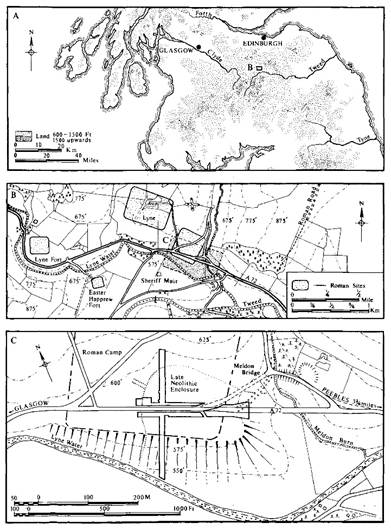
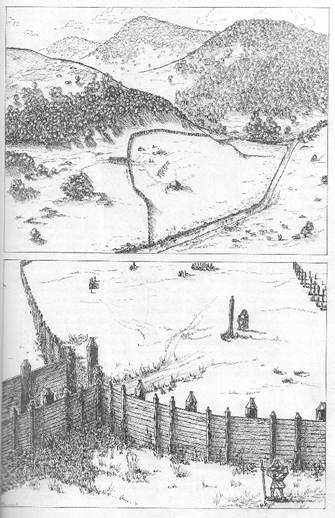
Meldon Bridge has since been reassessed in the light of excavations of similar large timber enclosures at Dunragit, Dumfries and Galloway (Thomas 2015) and at Leadketty and Forteviot, Perth and Kinross (Brophy and Noble 2020, 90). Kenny Brophy and Gordon Noble have argued that they, as well as a large embanked enclosure at Blackshouse Burn, South Lanarkshire (Lelong and Pollard 1998) are all likely to have been constructed at some time between the 29th and 26th centuries BC. All will have involved a huge investment of effort. Speak and Burgess (1999, 109) have estimated that 280 tons of oak wood, or over 1.5 hectares of oak forest, would have been used to construct Meldon Bridge. The weight of the largest Meldon Bridge post has been estimated at around 2 tonnes, and it would have required at least 32 people to shift it using rollers and a sled (Speak and Burgess 1999, 109). Building the whole enclosure would thus have required planning, co-ordination and management of the project and the co-operation of hundreds of people – perhaps this was an activity at the scale of a tribe. Opinions differ as to whether the builders belonged to an hierarchically-organised or egalitarian society, with Thomas (2015) favouring the latter scenario. Some degree of social differentiation is suspected, however, and given the evidence for social differentiation in Orkney at the time (Sheridan 2024), it seems most likely that these massive enclosures were not built by egalitarian communities. The function/s of these large enclosures are still poorly understood, although it is not thought that they were defended permanent settlements. They could have been communal centres for periodic gatherings of large numbers of people, with perhaps exchanges and feasting taking place and, as seen at Meldon Bridge, some burial of the dead. They may have symbolised the identity of the ‘tribe’; they will have served to strengthen links between its members. While these enclosures appear to have been built at a period when Grooved Ware pottery was in use over parts of Scotland, and while this type of pottery has been found at Dunragit and Leadketty, no Grooved Ware pottery was found at Meldon Bridge.
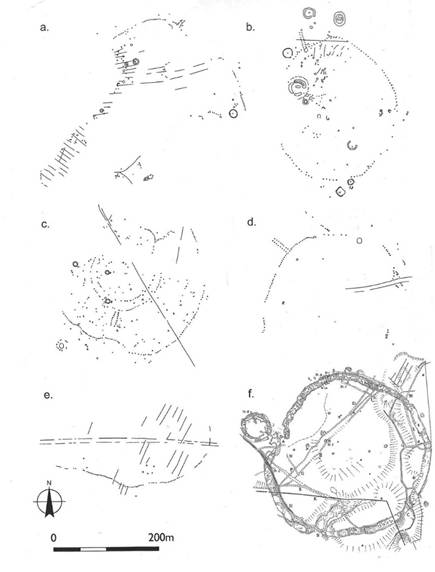
These sites have also been described as ‘palisaded enclosures’ (for example Millican 2016) but the size of the timbers involved suggests that ‘stockaded’ could be a more appropriate term, given the breadth of the uprights in question. The more neutral term ‘large timber enclosure’ is preferred here.