
There is no unequivocal evidence for inter-personal or inter-group conflict dating to the Neolithic period in south-east Scotland. That is not to say that conflict did not occur, just that the evidence that does exist for weaponry, for enclosure and for the burning of structures can all be interpreted in ways other than in terms of conflict.
Weaponry
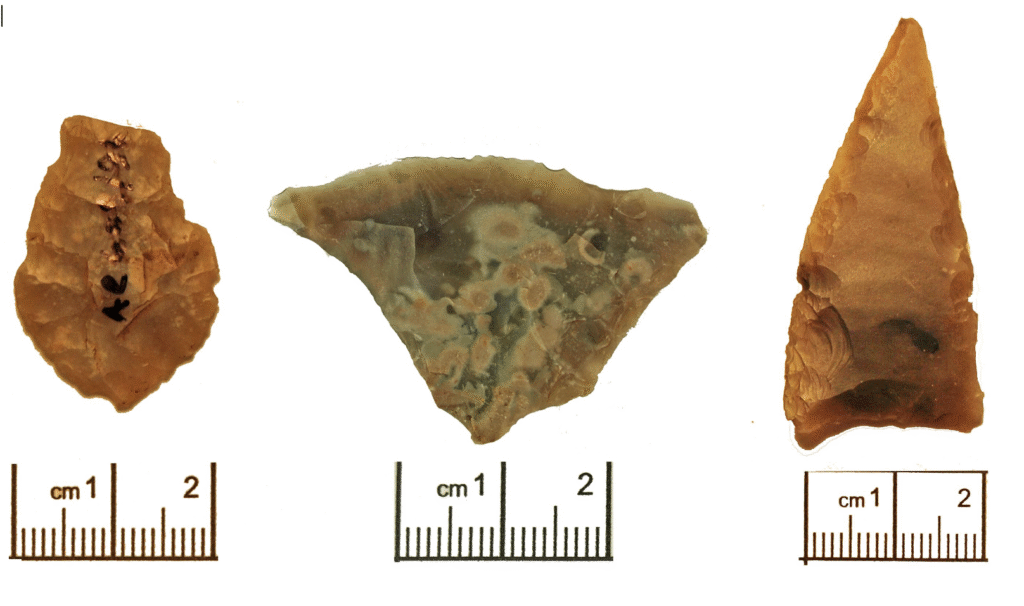
In south-east Scotland there are arrowheads, dating to several points during the Neolithic period. There is evidence from Tulloch, Highlands that one was used to kill a person (Corcoran 1966, HighARF Chapter 5.8), but the extreme paucity of Neolithic non-cremated human remains in south-east Scotland makes it impossible to tell whether bows and arrows were used for any purpose other than hunting animals in this part of Scotland.
Enclosures
Two Neolithic enclosures have been excavated in south-east Scotland, but in neither case has a defensive function been proven beyond doubt.
During the Early Neolithic, one was constructed at Doon Hill, East Lothian. It surrounds the remains of two superimposed Early Neolithic large houses or halls. Sherds of Early and Middle Neolithic pottery, and charcoal radiocarbon-dated to the early to mid-fourth millennium BC have been found in its ditch. The enclosure consists of upright timbers set within a continuous ditch. The excavator, Brian Hope-Taylor, described it as a ‘palisade’ enclosure, with wattlework or horizontal timbers between D-shaped uprights and claimed that two phases of the enclosure existed (Hope-Taylor 1980). However, this enclosure was not as angular as the published plan drawing suggests, nor was it as eccentric to the ‘hall’ structures as it is shown there (Ralston 2019a; 2019b; in press). Moreover, the presence of wattlework or planking remains hypothetical. There is no evidence to prove that this enclosure had necessarily been designed as a defensive structure – although it could have been – or that it had been attacked. It seems too sturdy to have been used as a way of corralling the occupants’ animals and keeping them safe, however. If it was constructed when the second of the two ‘halls’ was erected it could theoretically have served to underline the status of the residential group, marking a boundary between these people’s space and the outside world. The construction and function of the various components of the Doon Hill Early Neolithic site are currently being investigated by Ian Ralston (forthcoming, SESARF 4.4.2.1 Early Neolithic Settlement).
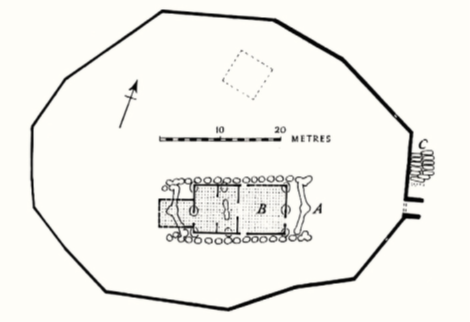
The second example is the massive timber perimeter wall, delimiting an area of 8 ha, with a narrow, ‘gun-barrel’ entrance, that was constructed at Meldon Bridge, Scottish Borders, during the Late Neolithic, probably between around 2900 BC and 2600 BC (Burgess 1976; Speak and Burgess 1999). This consists of sturdy timber posts with evidence suggesting timber cladding in between them, making a solid wall, some 3.5m high over part of its length and about 4m high elsewhere (Speak and Burgess 1999, 106, 107). The narrowness of the entrance ‘avenue’ means that access could easily be controlled. In short, this was a monumental construction, requiring the co-ordinated input of a large labour force to construct, and constructed in such a way that access could be controlled. Its duration was estimated at 50 to 100 years, and the evidence indicates that most of it rotted in situ, while some of the posts were pulled out. It was not burnt down (Speak and Burgess 1999, 109-110). In 1976 Colin Burgess was convinced that its function was defensive, describing it as ‘a Neolithic defended promontory complex’ and arguing: ‘That the barrier was defensive in intent there can be little doubt’ (Burgess 1976, 178). He acknowledged, however, that the site also served ‘ceremonial or ritual’ roles. In 1999, when Meldon Bridge was re-evaluated by Steve Speak and Colin Burgess in the light of radiocarbon dating, its defensive function was still put forward, but the idea that it may have served as a ‘political centre’ for a ‘territorial unit’ was stressed. It was pointed out that there was no evidence that it had been attacked. There is certainly no evidence that it was a defended settlement and the settlement evidence found at Meldon Bridge pre-dates the construction of the timber wall. It appears to have been a place to which large numbers of people from surrounding areas came, perhaps for periodic festivities and to exchange news, desirable items, and perhaps partners for procreation. It could have been regarded as expressing a ‘tribal’-level identity. Discussion of the functions of Meldon Bridge and its Scottish comparanda continues.

Burning of structures
At Doon Hill, East Lothian, there is evidence for the construction, during the Early Neolithic, of a massive house (‘hall) followed by its burning down and replacement, in situ, by a marginally smaller ‘hall’ which, in turn, burnt (or was burnt) down.

Deliberate burning down of each of these structures by attackers is only one possible explanation. Accidental conflagration, and deliberate burning down by the occupants as a ‘closing’ ritual are others. Had the ‘halls’ been burnt down by attackers, or caught fire accidentally, one might have expected there to be more artefactual finds than the small number that were found.
As set out in the SESARF 4.4.2.1 Early Neolithic Settlement, it may be that the first ‘hall’ was built to house several extended families of pioneering immigrant farmers, who lived together until they felt sufficiently well established to ‘bud off’ into individual farmsteads, taking their possessions with them. Its burning down was a way of marking that momentous, ‘no going back’ decision.
The construction of the slightly smaller ‘hall’ on the same footprint is harder to account for, unless there had been one extended family that regarded itself as dominant in the community, and felt that ‘deserved’ to have a monumental-sized house built for it on the ashes of the initial ‘hall’. What motivated its occupants to move out and burn that down (if that is what happened) – and presumably to ‘downsize’ – is open to debate, however. Houses can become uninhabitable over time, and again the act of burning could be a performative statement, signalling that the occupants were moving on.