
Stone circles, timber circles and single standing stones
A very small number of examples of each of these monument types is present in the SESARF area and there is no conclusive proof that any of them date to the Neolithic period rather than the later Bronze Age period.
Stone circles
These are a very rare feature of the archaeology of south-east Scotland. Aubrey Burl’s The Stone Circles of Britain, Ireland and Brittany (2000) lists no examples from this part of Scotland. In their recent guide to the stone circles of Britain, Colin Richard and Vicki Cummings list just four examples, all in upland locations in Scottish Borders (Richards and Cummings, 2024). None are dated.
Borrowston Rigg was recorded as having 32 stones in situ in 1884 and, according to Richards and Cummings, these stones form a circle about 41 m in diameter. Burgh Hill, south of Hawick, consists of 25 stones in an ovoid setting, its longest axis measuring about 16 metres. Ninestane Rigg, also south of Hawick, comprises eight stones in a circle of 7m in diameter. Five Stanes, near Oxnam, comprises five low stones forming a small circle approximately 6 m across; Richards and Cummings speculate that this could be a kerb for an Early Bronze Age burial cairn, and this does indeed seem a possibility.
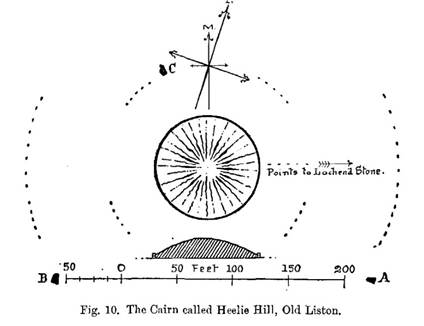
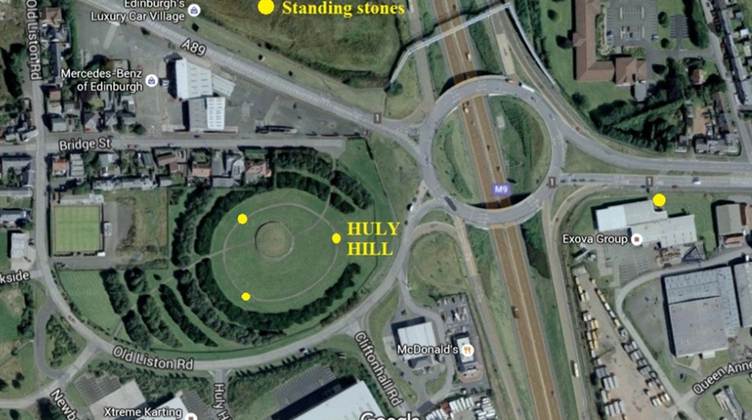
Another plausible candidate for a Late Neolithic stone circle is at Huly Hill to the west of Edinburgh. This is a possible double ring, now represented by just three orthostats, surrounding an Early Bronze Age round barrow. The barrow is off-centre to their presumed circuits. It was surveyed by Frederick Coles (1903, 201-4), who cited the 1794 Old Statistical Account that referred to “a circular mound of earth, surrounded with large unpolished stones at a considerable distance from each other” (vol. 10, p.69)’. The Early Bronze Age date of the barrow is confirmed by the discovery of a dagger grave during an exploration in 1830. Had the circle/s post-dated the barrow, one would have expected them to be placed with the barrow centrally positioned. That they are not suggests that the circle/s are likely to have predated the barrow. Late Neolithic stone circles are known from elsewhere in Scotland, with the Stones of Stenness dating to the 30th century BC, if they are contemporary with their surrounding henge, and with Balbirnie having been dated to around the same time (Gibson 2010). Given that on Cairnpapple Hill in West Lothian, just a few kilometres to the west of Huly Hill, it appears that a stone circle was dismantled to form a massive Beaker grave and the revetment of a large Early Bronze Age cairn (Richard Bradley pers comm; Gibson 2010, 69, 70), then it is quite possible that the Huly Hill circle/s were contemporary with that stone circle.
Also missing from Burl’s and Richards and Cummings’ gazetteers is the small stone circle, called ‘The Harestanes’, on high ground near Kirkurd (Coles 1903, 199-201). Coles recorded six stones, forming a rough circle around 5 m in diameter. There are no clues as to the age of this monument, however.
Timber circles
Kirsty Millican’s nationwide review of this class of monument, based mostly on aerial photography, covers a wide variety of sizes and shapes; not all circular (2016). Very few sites from the SESARF area are in her gazetteer (pp. 105-117). Of the ones that are, several, including the excavated example from Eweford East, and two associated with possible Bronze Age barrows at Orchard Field, East Lothian, clearly post-date the Neolithic. None are definitely Neolithic. Even the two very small circles found within the large timber enclosure at Meldon Bridge (Millican 2016, Cat. Nos 96 and 97) are not guaranteed to be Late Neolithic. One, just 2.5 metres in diameter, which surrounds pit K26 containing cremated human remains, has not been radiocarbon dated and could be considerably later than the dated Late Neolithic grave K21 that is adjacent to it.
Single standing stones
None of the several single standing stones in the SESARF area (cf. Coles 1903) have been scientifically dated, and it remains a pressing question as to how many such stones in Scotland overall were erected during the Neolithic period. Single standing stones tend to fall through the chronological gaps in any narrative of prehistoric monuments, but the possibility that some standing stones could have been erected during the Neolithic period cannot be ruled out. Until dating evidence is obtained through excavation, the question must remain open.