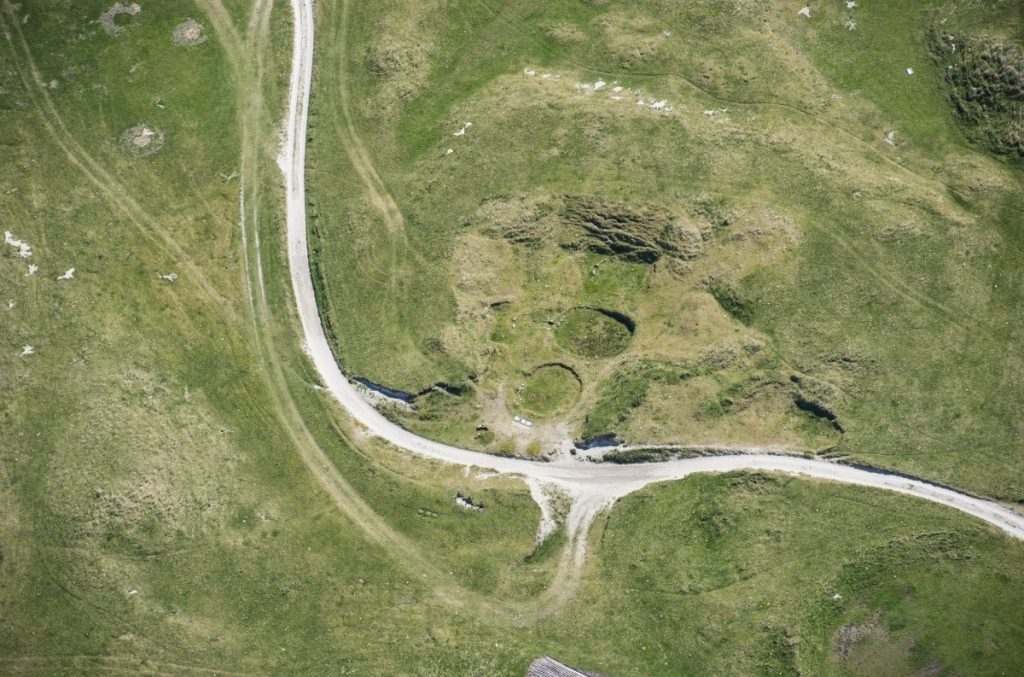
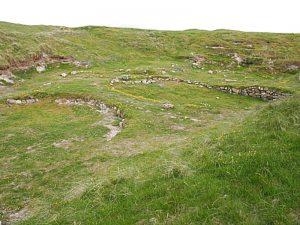
For the wider Bronze Age, Outer Hebridean narratives are dominated by the University of Sheffield and Cardiff University’s research at Cladh Hallan, South Uist – the site contributes to almost 36% of all Bronze Age c-14 dates for the region and has generated two monographs (Parker Pearson et al 2024,forthcoming), as well as wide range of peer-reviewed papers in Antiquity and the Journal of Archaeological Sciences, amongst others, and multiple articles in specialist magazines, regional, national and international newspapers (Parker Pearson et al 2005,2007, Hanna et al 2012, Booth et al 2015, Parker Pearson 2023). The appearance, form and use of space within later prehistoric roundhouses, animal husbandry, and the distinctive treatment of the dead evidenced at this site have emerged as particularly important contributions to our understanding (see for example Parker Pearson et al 2005,2007, Hanna et al 2012, Booth et al 2015, Parker Pearson 2023).
Although Cladh Hallan is undoubtably the best known and most significant Bronze Age site from the region, perhaps one of the most important outcomes of the wider SEARCH project for this period was the identification, through survey work, of a range of likely Early Bronze Age sites across the South Uist machair. None of these sites have been fully investigated and there remains an excellent opportunity here to better understand early settlement of the machair. This is further enhanced by the observation that Beaker settlement and the Early Bronze Age/Chalcolithic material are unusually well evidenced across the Outer Hebrides. The potential for Hebridean sites and material to contribute to national and European debates for this period is well recognized and emphasized in the National ScARF (Downes 2012).
Key sites with Beaker material include Allt Chrisal (Barra), Sligeanach, Cill Donnain and Cladh Hallan (South Uist), Roisinis (Benbecula), Taobh Tuath (Northton) (Harris), and Cnip, Barabhas (Barvas), Olcote, and Dail More (or Dalmore) (Lewis) (Sharples, 2009). Most of these sites were identified during the 1990s, or earlier, and Beaker and Early Bronze Age studies across the Outer Hebrides have developed little since then. Thus, the potential identified in the National ScARF for better understanding the Neolithic-Bronze Age transition periods, and the socio-economic changes which prompted and accompanied them, remains largely unchanged. The recent publication of the excavations at Cladh Hallan has been an important milestone on this, and other Bronze Age topics for this region (Parker Pearson et al 2021, forthcoming). However, there are still outstanding publications of key Beaker and Early Bronze Age sites, specifically Roisinis, Coileagan an Udail (Udal) and Dail More (Dalmore), which are needed to further our understanding of this important transition period (see Armit 1996, 105).
Alongside themes of transition are those of population movement and mobility. The potential for stable isotope and aDNA analyses of human remains to contribute to our understanding of population movement into and during the Bronze Age has been well demonstrated elsewhere (see Armit and Recih 2021, Dullias et al 2022, Moore et al 2022) but has yet to be fully explored in an Outer Hebridean context (but see MacLean forthcoming).
Bronze Age funerary evidence is well represented across the Outer Hebrides. There are approximately 50 known sites across the Outer Hebrides where activity can be dated to the Bronze Age with reasonable confidence. Of these, almost half are funerary sites of a variety of types; inhumations, cremations, cists and burial cairns, including those with and without grave goods. Developer-funded and rescue excavation work has played a very significant role in recovering and recording Bronze Age funerary evidence, together responsible for much of the dating and knowledge about Bronze Age burial practices across the Outer Hebrides (Dunwell et al 1996b, Lelong 2018). The topic and this material, however, requires further synthesis, although the Grave Goods Project and Barabhas (Barvas) Machair publications have made considerable headway here (Cooper et al 2020, Cowie and Macleod Rivet 2015, Macleod Rivet 2018).
Another area where desk-based research and synthesis has the potential to yield impactful and meaningful results is in the reappraisal of Bronze Age artefacts. There are 19 seemingly isolated findspots of Bronze Age artefacts recorded across the CnES HER and NMS database, with further material undoubtably sitting within local and national museum collections and archives. A thorough review and update of finds and finds records is needed for all periods of the Outer Hebrides, however, it is likely that this will be particularly useful in terms of our understanding and knowledge of the Bronze Age. The Grave Goods Project and Scotland’s Rock Art Project are two recent Scottish-wide research initiatives, with a predominantly Bronze Age remit, which have successfully contextualised and reintroduced material from the Outer Hebrides back into wider debates (see Barnett et al 2022; Anderson-Whymark et al 2024).
The Bronze Age has previously been identified as an important period for studying the effects of climate and environmental change on prehistoric societies (Downes 2012; National ScARF) For the Outer Hebrides, the earlier Bronze Age appears to be the period during which the machair stabilises and coastal settlements begin to flourish. However, there is much more to understand about human-environment interactions in Scottish islands, particularly the role of windblown sand in the formation of archaeological sites and landscapes and its impact on settlement. Again, the potential for sites and material from across the Outer Hebrides to address wider thematic and period-based questions about human-environment relationships during the Bronze Age is exciting.
You can download the datasheet for more information on the Bronze Age sites and c14 dates from the Outer Hebrides.
Outer Hebrides Bronze Age Research Questions
Did new or different populations arrive and settle in the Outer Hebrides into and during the Bronze Age?
Is it possible to detect the arrival of new people associated with the Beaker Culture and the beginning of a recognisable Bronze Age through the use of stable isotope and aDNA analysis? Can these scientific techniques be better deployed to expand our understanding of population influxes to the Outer Hebrides and to evidence the arrival of new or different people during this period? The exploration of this topic is reliant on the increased ability to retrieve Early Bronze Age skeletal remains (human and animal) – identifying, excavating and dating human remains of this period is therefore a first crucial step towards addressing these questions. Thereafter, programmes of radiocarbon dating, alongside stable isotope analysis and ancient DNA studies are considered to be fruitful ways forward. In a developer-funded context, the significance of any potential Bronze Age human remains should be emphasised, as well as the need for funded post-excavation work.
Status:
Active
Date accepted:
26/08/2026
Date of next review:
26/08/2031
How did land-use change with the arrival of new people during the Hebridean Bronze Age?
Are the social dynamics between the arriving and established populations during the Bronze Age reflected in land use? Is this possible to determine through the archaeological record? It is likely that these questions will be partly addressed via new survey work and data, with a potential later focus on long-term excavation efforts. Strategic excavation strategies, as well as continued analysis of existing assemblages is also likely to be important. Within a developer-funded context the significance and value of retaining and analysing faunal remains and environmental evidence needs emphasis.
Status:
Active
Date accepted:
26/08/2026
Date of next review:
26/08/2031
How did the Beaker ‘package’/culture present in the Outer Hebrides?
Currently the Beaker culture appears to differ across the Outer Hebrides when compared to that of either Shetland or Orkney (for example, the lack of double houses). The extent of this difference is not fully understood. The current lack of known Beaker burials in the Outer Hebrides contrasts, for example, with what is understood of the Inner Hebridean (and Scottish mainland) Beaker period and raises questions of whether this is due to lack of evidence or a strongly regional identity. These are broad questions, and it is unlikely that they will be answered via a single research project; it is encouraged that a series of projects (or PhDs) are designed to tackle this. It is likely that these questions will be addressed partly through collation, reassessment and reanalysis of existing material and literature. New survey work and data, with a potential later focus on long-term excavation efforts.
Status:
Active
Date accepted:
26/08/2026
Date of next review:
26/08/2031
How were earlier sites and settlements reused during the Hebridean Bronze Age?
Across the Hebrides – as with the western coastline of mainland Scotland – there is a clear trend of reusing and reoccupying earlier sites during and throughout the Bronze Age. Cladh Hallan provides compelling evidence for this (Marshall et al 2024). How extensive were these patterns of reuse/alteration of earlier material? Additionally, is there a difference in how different types of sites were reused/altered? These are broad questions, and it is unlikely that they will be answered via a single research project; it is encouraged that a series of projects (or PhDs) are designed to tackle this. It is likely that these questions will be addressed partly through collation, reassessment and reanalysis of existing material and literature. New survey work and data, with a potential later focus on long-term excavation efforts.
Evidence for burnt mounds across the Outer Hebrides exists but is currently limited in comparison with other regions in Scotland. Is this due to a misunderstanding of how these monuments look and survive in the Hebrides? Or is this key Bronze Age site type simply not as prevalent in the Hebrides as elsewhere? Elsewhere, burnt mounds are frequently associated with water sources, but perhaps in the Outer Hebrides they were associated with different locales. Where we do have evidence for burnt mounds, what do we know about their significance and function in a Hebridean context? Does this differ from other areas within Scotland? It is likely that these questions will be partly addressed via new survey work and data, with a potential later focus on long-term excavation efforts. Strategic excavation strategies, as well as continued analysis of existing assemblages is also likely to be important. In a developer-funded context, the renewables industry has the potential to shine a light on peatland landscapes which may reveal hitherto unknown burnt mound sites.
Status:
Active
Date accepted:
26/08/2026
Date of next review:
26/08/2031
Is there an identifiable Chalcolithic in Outer Hebrides?
The presence of the chalcolithic in Scotland has been somewhat debated, however, this has been largely framed by mainland evidence. What does the Chalcolithic look like across the Outer Hebrides? Is there an identifiable Chalcolithic in Outer Hebrides? Current evidence suggests that Early Beaker culture manifested in a distinct way across the Outer Hebrides. How do we further understand this period within a Hebridean context and how does it compare with evidence from the mainland and the Northern Isles? These are broad questions and it is unlikely that they will be answered via a single research project; it is encouraged that a series of projects (or PhDs) are designed to tackle this. It is likely that these questions will be addressed partly through collation, reassessment and reanalysis of existing material and literature. New survey work and data, with a potential later focus on long-term excavation efforts.
Status:
Active
Date accepted:
26/08/2026
Date of next review:
26/08/2031
Was there a shift to the machair during the Outer Hebridean Early Bronze Age, and if so, why?
Current evidence points to a shift from settlements on the peatlands to the machair during the Early Bronze Age. However, there is still more to understand about these apparent patterns. How extensive was this shift in settlement? Over what period did it take place? What motivated these changes – were they driven primarily by cultural or environmental changes? Our limited understanding of Neolithic settlement patterns and of prehistoric environmental changes are key challenges. Alternatively, were both areas of the wider island landscape used during this period? If so, how did these different areas articulate within Early Bronze Age society? were they used in different ways and for different things? A better understanding of Late Neolithic settlements, their location and palaeoenvironmental context at the junction of this period will be crucial here. These are broad questions, and it is unlikely that they will be answered via a single research project; it is encouraged that a series of projects (or PhDs) are designed to tackle this. It is likely that these questions will be partly addressed via new survey work and data, with a potential later focus on long-term excavation efforts. Researchers are encouraged to look in all areas equally, avoiding a machair focus. In a developer-funded context, the research potential of walk-over survey and opportunistic discoveries via evaluations and monitoring for enhancing datasets for this period needs emphasising.
Status:
Active
Date accepted:
26/08/2026
Date of next review:
26/08/2031
Were the Hebridean, oval-shaped Beaker houses an external import?
There is still a lot more to understand about early Beaker domestic settlements. The construction and use of oval-shaped houses in the Outer Hebrides during the Early Beaker period appears distinctive. Were these oval-houses the standard early Beaker settlement type? Were these types of houses introduced from elsewhere? And if so, where? Or do they represent a regional variation of a wider settlement theme? These are broad questions, and it is unlikely that they will be answered via a single research project; it is encouraged that a series of projects (or PhDs) are designed to tackle this. It is likely that these questions will be partly addressed via new survey work and data, with a potential later focus on long-term excavation efforts. Researchers are encouraged to look in all areas equally, avoiding a machair focus. In a developer-funded context, the research potential of walk-over survey and opportunistic discoveries via evaluations and monitoring for enhancing datasets for this period needs emphasising.
Status:
Active
Date accepted:
26/08/2026
Date of next review:
26/08/2031
What did Bronze Age agricultural practices look like across the Outer Hebrides?
There is still more to understand about Bronze Age agricultural practices of this time looked like in terms of technology and animal husbandry. Closely tied to this is the matter of diet. Further, what potential impact did social changes have on these aspects of life? It is likely that this will be best answered through strategic excavation strategies as well as continued analysis of existing assemblages, specifically coarse stone tools. Within a developer-funded context the significance and value of retaining and analysing faunal remains and environmental evidence needs emphasis.
Status:
Active
Date accepted:
26/08/2026
Date of next review:
26/08/2031
What drove the environmental changes during the Hebridean Bronze Age?
The Bronze Age saw the stabilisation of machair; however, it is as yet unclear whether this took place uniformly across the Outer Hebrides (or even across individual islands). Similarly, the spreading of peat formation is not yet fully understood. A better chronology and understanding of these processes would be invaluable to interpreting the Hebridean Bronze Age. Additionally, could finds from within the peat (such as those discovered when peat cutting) contribute to this chronology? It is unlikely that these questions will be addressed via a single project. A series of well-funded projects, almost certainly interdisciplinary and multi-proxy in nature, are likely ways forward. Existing palaeoecology and palaeoenvironmental studies may be relevant here but need to be synthesised with the archaeological evidence. We also need an understanding of localised environmental dynamics as well as high precision environmental proxies on a broader NW European scale to understand possible drivers. Within a developer-funded context, the importance of retaining faunal assemblages and environmental data for post-excavation work needs emphasis.
Status:
Active
Date accepted:
26/08/2026
Date of next review:
26/08/2031
What happened to Neolithic settlements across the Outer Hebrides during the Bronze Age?
Across the Outer Hebrides, as elsewhere in Scotland, the Neolithic – Bronze Age transition is associated with identifiable changes in settlement patterns and domestic architecture. However, it remains unclear what happened to the Neolithic settlements themselves during the Bronze Age. Are they under Bronze Age settlements, or were they deconstructed as part of a pattern of material reuse during this period? What does the treatment of earlier settlements tell us about Bronze Age communities in the Outer Hebrides? These are broad questions and it is unlikely that they will be answered via a single research project; it is encouraged that a series of projects (or PhDs) are designed to tackle this. It is likely that these questions will be addressed partly through collation, reassessment and reanalysis of existing material and literature. A better understanding of Bronze Age settlements and distribution is also needed. This is likely to require new survey work and data, with a potential later focus on long-term excavation efforts.
Status:
Active
Date accepted:
26/08/2026
Date of next review:
26/08/2031
What is the earliest date for Bronze Age colonization of the machair across the Outer Hebrides?
Today the Hebridean machair is a hugely important ecosystem, representing the most fertile land across the islands. But when were the machair zones across the Outer Hebrides first occupied? How did occupation of the machair relate to process of machair stabilisation? It is likely that these questions will be partly addressed via new survey work and data, with a potential later focus on long-term excavation efforts alongside a detailed programme of dating. A landscape wide approach will be beneficial. As will understanding localised landscape dynamics with a focus specifically on local dune and machair formation and stabilisation processes in the direct vicinity of relevant sites. In a developer-funded context, the research potential of walk-over survey and opportunistic discoveries via evaluations and monitoring for enhancing datasets for this period needs emphasising as well as approaches that aid our chronological framework.
Status:
Active
Date accepted:
26/08/2026
Date of next review:
26/08/2031
What was Early Bronze Age settlement on the machair like?
Today the Hebridean machair is a hugely important ecosystem, representing the most fertile land across the islands. But what was it like when it was first settled? What form did early agricultural practices take on the newly stabilised machair? When were settlements and farms established on this landform? Is there evidence of a learning curve as the occupants acquired the knowledge to maintain and fertilise these soils? Was there a social difference between those occupying the machair and those occupying peat soils? Is there evidence for a difference in farming practices between these two soil landforms? These are broad questions, and it is unlikely that they will be answered via a single research project; it is encouraged that a series of projects (or PhDs) are designed to tackle this. It is likely that these questions will be partly addressed via new survey work and data, with a potential later focus on long-term excavation efforts. A landscape wide approach will be beneficial. As will understanding localised landscape dynamics with a focus specifically on local dune and machair formation and stabilisation processes in the direct vicinity of relevant sites. In a developer-funded context, the research potential of walk-over survey and opportunistic discoveries via evaluations and monitoring for enhancing datasets for this period needs emphasising as well as approaches that aid our chronological framework.
Status:
Active
Date accepted:
26/08/2026
Date of next review:
26/08/2031
What were the social dynamics between arriving and established populations in the Outer Hebrides during the Bronze Age?
Immigrant communities are well-known to influence the culture and society of communities they move into. Is it possible to trace this in the archaeological record for the Hebridean Bronze Age? Can we determine elements of interaction between incoming and established communities for this period? Additionally, are differences in population, culture and society reflected in land use & farming techniques? It is likely that these questions will be addressed partly through collation, reassessment and reanalysis of existing material and literature. Ancient DNA and stable isotope analysis have a potential role, although currently there is a lack of data and appropriate samples. Expanding Bronze datasets for the Hebrides are therefore likely to be fundamental for unlocking the value of these potential approaches towards addressing these questions.
Status:
Active
Date accepted:
26/08/2026
Date of next review:
26/08/2031
Why is there an apparent gap in islet settlement/crannog use during the Bronze Age?
It is well established that islets/crannogs within freshwater lochs were an important part of the Iron Age landscape across the Outer Hebrides (Lenflet 2012, Rennell 2010). Recent research has also shown that many islets/crannogs were established and used much earlier during the Neolithic period (Blankshein, Gannon, Garrow and Sturt 2024). However, there is currently an absence of evidence for Bronze Age islet/crannog occupation or usage. Did these places fall into disuse during the Bronze Age, seemingly to be ‘rediscovered’ by prehistoric communities several thousand years later? Or are we still missing the evidence for Bronze Age activity in these areas of the Hebridean landscape? If absence of evidence is, in this case, evidence of absence, how do we explain and understand this phenomenon? Are we observing a deliberate shift away from islets during the Bronze Age and if so was this driven by social or environmental factors? These are broad questions and it is unlikely that they will be answered via a single research project; it is encouraged that a series of projects (or PhDs) are designed to tackle this. It is likely that these questions will be partly addressed via new survey work and data, with a potential later focus on long-term excavation efforts. Researchers are encouraged to look in all areas equally, avoiding a machair focus. In a developer-funded context, the research potential of walk-over survey and opportunistic discoveries via evaluations and monitoring for enhancing datasets for this period needs emphasising.
Status:
Active
Date accepted:
26/08/2026
Date of next review:
26/08/2031
Why is there such variation across the Outer Hebrides during the Bronze Age?
Bronze Age material culture from across the Outer Hebrides varies notably from island to island. Whilst some areas appear to have vast quantities of flint tools from this period, others have almost none. Similarly, there is a difference in the type and quantity of domestic structures across the archipelago. What this variation looks like and what does this tell us about Hebridean Bronze Age society? These are broad questions, and it is unlikely that they will be answered via a single research project; it is encouraged that a series of projects (or PhDs) are designed to tackle this. It is likely that these questions will be addressed partly through collation, reassessment and reanalysis of existing material and literature. New survey work and data, with a potential later focus on long-term excavation efforts.
If you have answered a research question, or have an update to add about a specific site or period, you can use our inline comments to flag the change and keep the frameworks up to date.
Register for an account, or login now to add updates and comments to our existing frameworks.