
Introduction to the Outer Hebrides
Innse Gall (Outer Hebrides), also known as Na h-Eileanan Siar (Western Isles), is a chain of islands some 200 km long, located off the north-west coast of Scotland. Today, the largest islands include Leodhas (Lewis) and Na Hearadh (Harris) in the north and what are known locally as the Southern Isles including the larger islands of Uibhist a Tuath Uibhist and Uibhist a Deas (North and South Uist), Beinn na Faoghla (Benbecula) and Bharraigh (Barra). In addition, several smaller islands connected by causeways or bridges including Beàrnaraigh Mòr (Great Bernera), Sgalpaigh na Hearadh (Scalpay), Beàrnaraigh (Berneray), Baile Sear (Baleshare), Griomasaigh (Grimsay), Èirisgeigh (Eriskay) and Bhatarsaigh (Vatersay). The Outer Hebrides also includes many smaller, uninhabited islands as well as the outlying islands of Hiort (St Kilda), Rònaigh an Taibh (North Rona), Na h-Eileanan Seunta (the Shiants), Miùghalaigh (Mingulay) and Berneray.
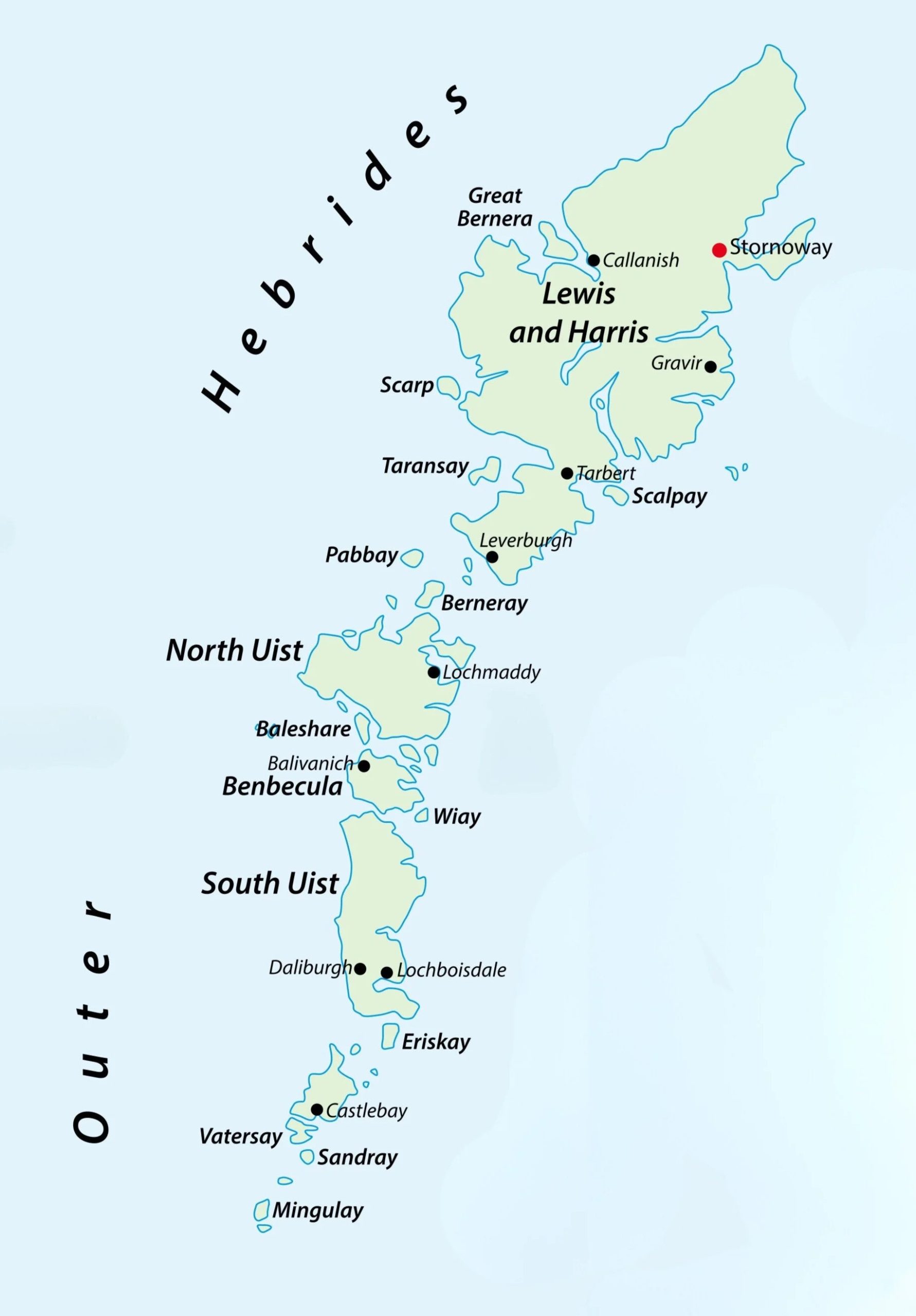
The Outer Hebrides fall within the local authority region of Comhairle nan Eilean Siar. Collectively, a landmass of some 3071 km2, the Outer Hebrides are the largest group of islands in Scotland; more than three times the landmass of Orkney and twice the size of the Shetland islands. Today, 15 islands with the Outer Hebridean archipelago are permanently inhabited. However, there are approximately 50 individual islands where archaeological remains have been recorded, pointing to human habitation or exploitation in one form or another.
Today, the islands of the Outer Hebrides are home to the highest proportion of Gaelic speakers in Scotland. Beyond just language, for most parts of the Outer Hebrides Gaelic culture and heritage remains inseparable from local communities’ sense of identity and place. Whilst Gaelic is recognised as minority language today, for at least the last 1,000 years, possibly longer, Gaelic has been the principal language of resident communities across the Outer Hebrides. Gaelic is embedded in the island landscape through placenames and toponymy is a well-established, inter-disciplinary research tool for archaeologists working across the region. Gaelic community knowledge and information is another hugely valuable research tool for archaeologists working across this region.
SIRFA supports the delivery of the National Gaelic Plan 2023-2028, Comhairle nan Eilean Siar’s Gaelic Language Plan 2023-2028 and Historic Environment Scotland’s Gaelic Language Plan 2023-2026. The core position here is that archaeological research relating to Gaelic speaking areas cannot be fully contextualised without acknowledging and incorporating Gaelic language and the wider culture and heritage. See SIRFA’s Gàidhlig page for recommendations and further guidance.