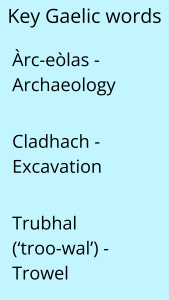
A community archaeology session was held as part of the Outer Hebrides SIRFA symposium in January 2019. At this meeting, local residents, including many native Gaelic speakers, expressed concerns, identified challenges and pointed to missed opportunities to-date for the inclusion and acknowledgement of Gaelic within archaeological research. These ideas have been discussed with a range of stakeholders to formulate a series of recommendations for archaeologists and archaeological researchers working across the Outer Hebrides and other Gaelic speaking areas of Scotland.
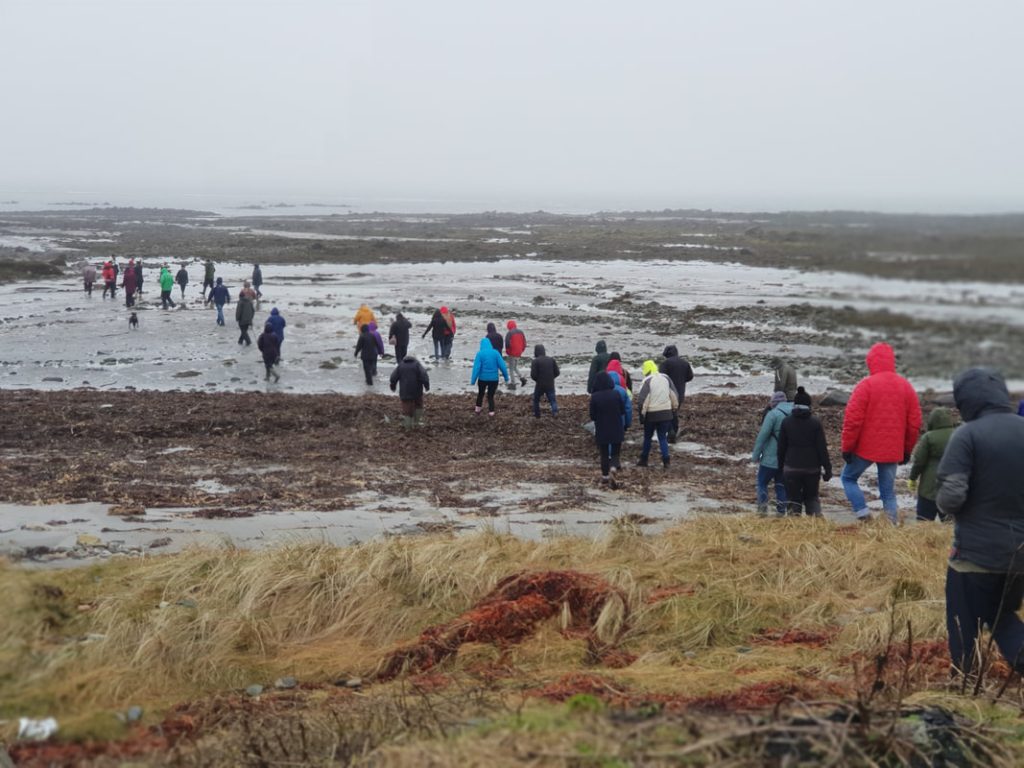
The Outer Hebrides are home to the highest proportion of Gaelic speakers in Scotland. According to the 2022 census, almost 60% of residents across the Outer Hebrides have some form of Gaelic, compared with 1% of the national population. Significantly, more than half of the islands’ primary age children enrol in Gaelic Medium Education (GME), which has a huge bearing on the future trajectory of Gaelic speakers across the region. In 2023, Duolingo’s Gaelic course achieved 1.8 million leaners, highlighting the exponential rise in Gaelic learners online, with more and more people looking to the Outer Hebrides as the resource where Gaelic is spoken as community language on a daily basis. Beyond just language, for most parts of the Outer Hebrides Gaelic culture remains inseparable from local communities’ sense of identity and place. Whilst Gaelic is recognised as minority language today, for at least the last 1,000 years, possibly longer, Gaelic has been the principal language of resident communities across the Outer Hebrides.
The value of Gaelic as an archaeological research resource is widely accepted. However, the full research potential of Gaelic language and culture studies for broader archaeological research has not yet been fully realised. Gaelic is embedded in the island landscape through placenames and toponymy is a well-established, albeit under-utilised, inter-disciplinary research tool for archaeologists working across the region. However, more work is required to better understand and utilise the relevance of Gaelic for archaeological research. Key here is recognising that the value of Gaelic extends beyond just place-name studies. Trace of the islands’ past exist within Gaelic vocabulary, oral histories, communal memory, local folklore and other forms of intangible heritage. Currently, however, Gaelic and archaeological researchers infrequently work collaboratively. To help progress beyond the current siloed situation, where Gaelic and archaeology exist largely as separate areas of research, SIRFA supports and encourages interdisciplinary projects and research that puts Gaelic resources and community knowledge at the heart of the methodology.
With the increased interest in Gaelic globally there is also an opportunity for Gaelic language to be better acknowledged and utilised in the presentation of archaeological information. Beyond bilingual information panels, to-date there has been limited inclusion of Gaelic as a medium for communicating or presenting archaeological research (although notable exceptions include Braby et al 2022, Gal and Rennell 2025). Importantly, there are huge opportunities via the rise in Gaelic media, as well as the forthcoming Scots and Gaelic Language Bill, to address this.
There are increasing examples of good practice with regard to Gaelic inclusion and acknowledgement (see Grant 2016, 2019, MacLeod 2024) and the aim is that SIRFA will further encourage this positive direction of travel as well as supporting delivery of the National Gaelic Plan 2023-2028, Comhairle nan Eilean Siar’s Gaelic Language Plan 2023-2028, and Historic Environment Scotland’s Gaelic Language Plan 2023-2026. The core position here is that archaeological research relating to Gaelic speaking areas cannot be fully contextualised without acknowledging and incorporating Gaelic language and the wider culture and heritage. The SIRFA resources on this website use modern Gaelic spellings in common usage for all archaeological sites and other place names, with alternative and anglicised names in brackets when first mentioned. To avoid confusion, where archaeological sites are well established and published in the anglicised form this is included in brackets for all subsequent citations. Island names are given their Gaelic spelling at first mention, and are thereafter written in English, as in most cases anglicised island names are now in widespread and accepted use.
Resources for archaeological researchers interested in Gaelic