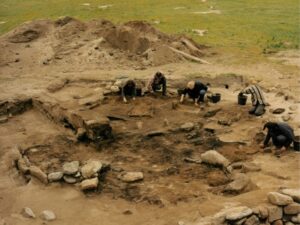
What we refer to here as the Early Historic period crosses over with what others have termed the ‘late’ or ‘later’ Iron Age (see Gilmour 2000a, Harding 2004), or the ‘Pictish Period’ (Parker Pearson et al 2004). In the National ScARF, this period sits in the first part of the medieval chapter. This period is treated separately in the SIRFA framework because there are distinct research gaps and opportunities relating to our understanding of the Outer Hebrides during the 5th through to the 11th centuries AD that warrant more focused consideration. Furthermore, the evidence from this region does not fit coherently into the above period titles and their definitions. There are few archaeological sites across the region that can be confidently dated to this period. In fact, in terms of known sites, after the Mesolithic, the Early Historic period is the most poorly represented, with less than 60 sites confidently identified in the SIRFA resource assessment.
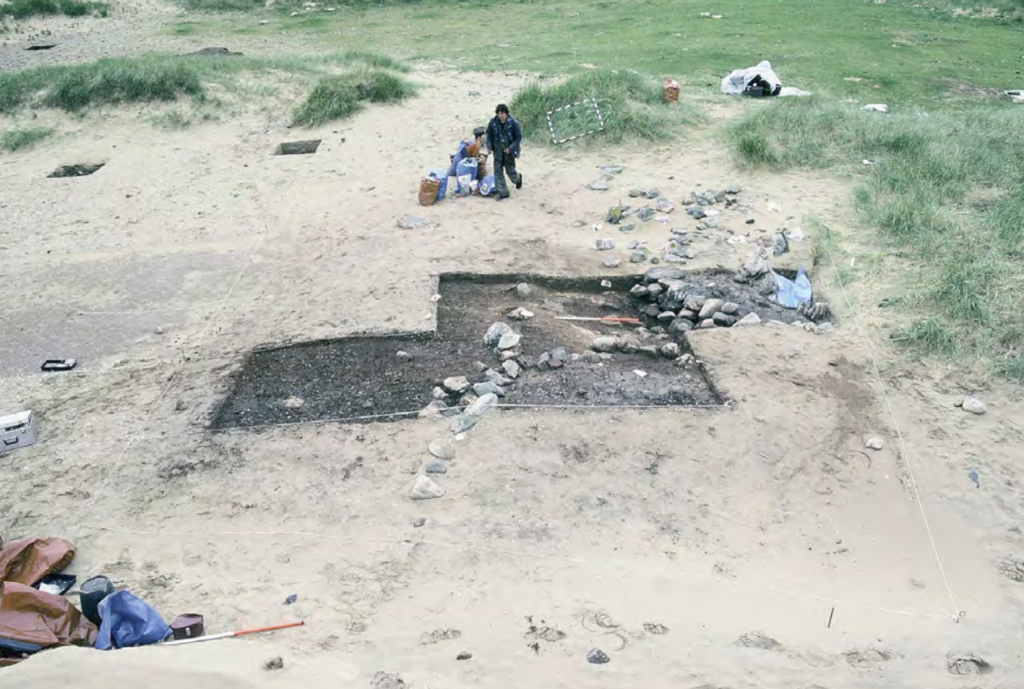
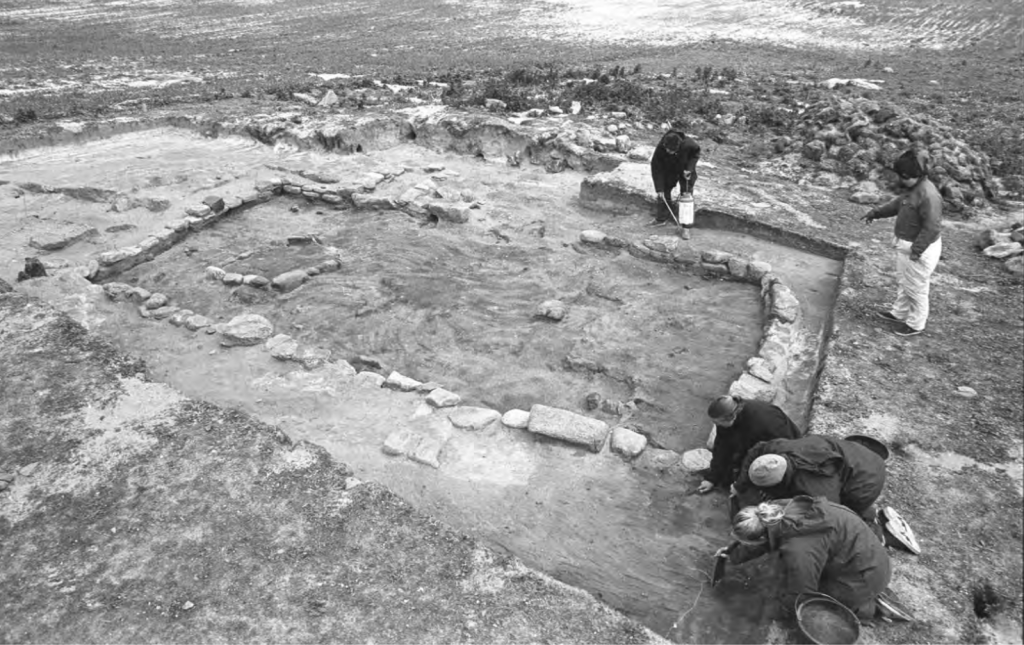
This small site database is matched by a similarly limited number of radiocarbon dates that fall within this period. Of the 103 radiocarbon dates that fall between the 5th and 11th centuries AD, almost 80% derive from just two excavation projects: the SEARCH project excavations at Bornais, and Cille Pheadair, both in South Uist. The contribution these few research projects have made to the overall dataset for this period is self-evident. In addition to the settlements at Bornais and Cille Pheadair, the only other major Norse settlement that has been identified across the Outer Hebrides is at Barabhas (Barvas) in Lewis (Rivet and Cowie 2023).
However, beyond South Uist and the northern part of the Isle of Lewis, there are clearly some geographic gaps in our understanding of Scandinavian settlements. Furthermore, the key research projects for this period were mostly carried out during the 1990s and early 2000s and there has been very little research relevant to this period since the National ScARF. That said, the full publication of several key sites since 2012, including Cille Pheadair (Parker Pearson et al 2018) and Bornais (Sharples and Parker Pearson 1999, Sharples et al 2016, Sharples 2020, 2021), as well as the settlement at Barabhas (Rivet and Cowie 2023), and two broader synthesis volumes (Horne et al 2023, Sharples 2025) have helped moved debates forward.
The interface between the Iron Age ‘proper’ and the early historic period is still poorly understood, especially regarding the nature and extent of Pictish influences. The most compelling evidence in the Outer Hebrides for direct contact with Pictish kingdoms across Scotland comes from just five square burial cairns, only two of which have been excavated. The first of these sites to be discovered in the Outer Hebrides was at Cille Pheadair, South Uist, (Parker Pearson et al 2004). Scientific analysis of the human remains, a notably early example of the application of stable isotope analysis within a Scottish context, suggested that the interred individual likely relocated to the islands from the Scottish mainland at some point in childhood (Mulville et al 2003). The other excavated example of a Pictish style square cairn is from North Uist, revealed in advance of the Berneray causeway at Aird Ma-Ruibne and excavated by ARCUS (Downes and Badcock 1998).
Pictish influence is also evidenced through the presence of two known Pictish symbol stones, one from Benbecula now in National Museum Scotland, and one on the small island of Pabbay to the south of Barra. Artefacts of a characteristically Pictish style, such as penannular brooches, are also represented within late Iron Age settlement assemblages, but there is a clear need for synthesis and renewed interpretation. There are a number of early Christian sites across the Outer Hebrides, however, few of these have been investigated archaeologically in the modern period (although see Flemming and Woolf 1992). Of note is the Uist Saints project, which appealed for further interdisciplinary approaches to our study of this period (Clancy 2018, 2023).
Until the SEARCH project excavations across South Uist, direct archaeological evidence for Norse settlement across the Outer Hebrides remained surprisingly limited. This was especially peculiar given that place-name evidence, along with the few historical sources, overwhelmingly supported the view of a substantial, long-term and influential Norse presence across the islands. The excavation of a large Norse settlement at Bornais (Sharples 2019, 2020), and the Norse farmstead at Cille Pheadair (Parker Pearson et al 2018) therefore transformed knowledge and understanding of this period.
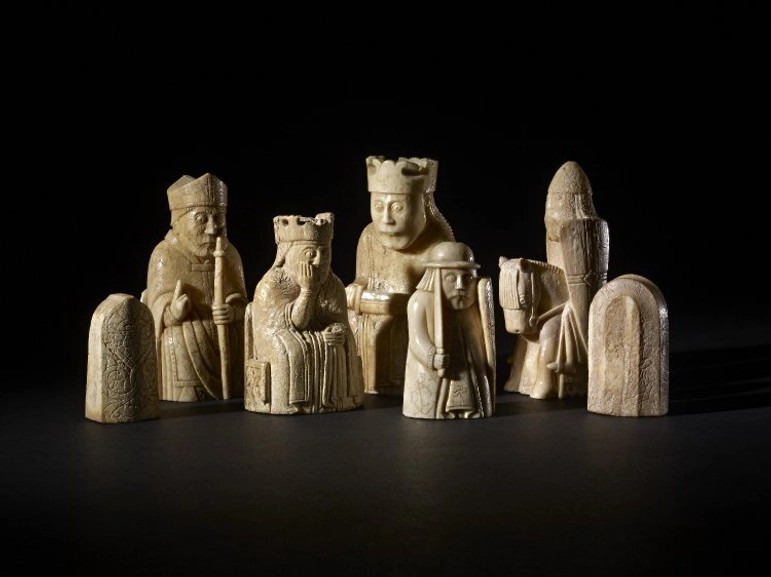
Nevertheless, there is still no direct evidence for Viking settlement prior to the 10th century and our understanding of when Scandinavians first settled in the Outer Hebrides, and what this early period of contact and settlement looked like remains unclear. What we do have for this earlier period, however, is funerary evidence. On the headland at Cnip, in Lewis, excavations in the 1970s and 1990s revealed the remains of a Viking cemetery, including seven burials spanning the 9th and 10th centuries (Dunwell et al 1996a). Other key sources for Scandinavian presence across the Outer Hebrides are of course isolated finds such as the Lewis Chessmen (Hall and Caldwell 2023) and the silver hoards from Nis (Ness) (Edwards 1939), Caisteal Leòdhais (Lews Castle) in Steòrnabhagh (Stornoway) and Moss of Dhibadail in Lewis (Graham Campbell 1995, 147-152). Beyond that, however, many of the research gaps and questions identified in the National ScARF still require attention.
Pictish stones have been found amongst the Outer Hebrides, however, these are exceptionally few. Is this due to recycling of material? Or should this be taken as a sign of the nature of the regions relationship with Pictland? It is not clear what the island cultural identity was during the height of Pictish power; were the Outer Hebrides ‘Pictish’? Were they under a Pictish polity/governance? Did ‘Pictishness’ manifest differently here? Further, if the Outer Hebrides could not be called ‘Pictish’, then why? How should the culture be classified? It is recommended that this area of research is approached with a multi-disciplinary and holistic view, primarily focusing on the presence of ‘classical’ Pictish architecture and material culture. It is likely that this work will require survey work and long-term excavation. These questions would benefit from new theoretical and more holistic approaches. Reanalysis and synthesis of existing datasets will be key, including reanalysis of museums and archive collections. However, continued recording of new material from both developer-funded and research targeted survey and excavation, has the potential to expand knowledge around these broad research gaps.
Status:
Active
Date accepted:
26/08/2026
Date of next review:
26/08/2031
Do we know the earliest date of Scandinavian contact with the Outer Hebrides?
What was the nature and impact of it? There is still no direct evidence for Viking settlement prior to the 10th century and our understanding of when Scandinavians first settled in the Outer Hebrides, and what this early period of contact and settlement looked like remains unclear. As such we do not have secure dates or a clear understanding of the earliest phase of Scandinavian contact with the Outer Hebrides. As with SIRFA64, more fieldwork is required to further enhance known sites for the wider Viking and Norse period. It is likely that these questions will benefit from international collaborations, with Scottish researchers working with European colleagues based outwith of the UK.
Status:
Active
Date accepted:
26/08/2026
Date of next review:
26/08/2031
Why are there still so few Norse sites known across the Outer Hebrides?
Despite a number of substantial, high-status Norse settlement sites across the Outer Hebrides, namely Bornais (SIRFA Case Study 5; Sharples 2020;2021) and Cille Pheadear (Parker Pearson et al 2018), there are still few known Norse sites across the Outer Hebrides. This is especially peculiar given that place-name evidence, along with the few historical sources, overwhelmingly supports the view of a substantial, long-term and influential Norse presence across the islands. More targeted walk-over and geophysics survey is required, perhaps in conjunction with historical records, place name studies and oral histories, to identify further likely Norse settlements across the islands. Mapping work, aerial photography and LiDAR data analysis may also be fruitful. Developer funded work is also a likely to reveal Norse settlement. This area of research is necessarily multi-disciplinary in nature, and will likely revolve around the combined use of ethnography, anthropology, historical records, oral histories, as well as archaeological data. In a developer-funded context, the value of carrying out archaeological surveys across previously uninvestigated landscape needs emphasis.
Status:
Active
Date accepted:
26/08/2026
Date of next review:
26/08/2031
What were the social dynamics between the Viking settlers and the pre-Norse population?
There is still a lot more to understand about the interactions between incoming Norse settlers and pre-existing populations across the Outer Hebrides. There is still no direct evidence for Viking settlement prior to the 10th century and our understanding of when Scandinavians first settled in the Outer Hebrides, and what this early period of contact and settlement looked like remains unclear. What were the social dynamics? Were Norse settlers welcomed peacefully and gradually, or were new settlements alternatively established with local resistance and incomer aggression? What evidence should we be looking for to support these interpretations? Once Norse settlements were established, did these populations maintain distinct identities? Did these populations co-exist or intermingle and if so, over what period of time did these social and cultural transformations take place? Did Norse settlers reused pre-Norse structures? If so, how extensive was this practice? Did some pre-Norse settlements retain their separate identity into the Norse period? Additionally, can we identify accompanying changes in technology, subsistence practices and construction techniques that enable us to better understand the social dynamics between existing and incoming populations during this period? These questions are by no means new. Yet, it is likely that these research gaps would be greatly enhanced with new data and reinvigorated with the development of new approaches – both methodological and theoretical. Targeted survey and excavation of late Iron Age, Norse and multiperiod/reuse sites are likely to be key, alongside new and multidisciplinary approaches. For example, what can researchers learn from further integrating placename studies with archaeological evidence? Why were some ‘Pictish’ placenames seemingly replaced with Norse-origin names, whilst others were retained? Within a developer-funded context, the research potential of multi-period sites that span this transition period should be emphasised. Alongside this, the importance of post-excavation and dating work.
Status:
Active
Date accepted:
26/08/2026
Date of next review:
26/08/2031
Where and how were people buried in the Outer Hebrides during the Norse period?
As with previous periods, it has been difficult to identify formal burials and locations of human remains for the Norse period, prior to the establishment of Christian burial practices. Where did Shetland’s pre-Christian Norse populations dispose of their dead? What rites/practices were carried out when community members died? Is the lack of burial evidence due to poor preservation conditions, or researchers bias – have we been looking in the wrong places? There is evidence on the headland at Cnip, in Lewis where excavations in the 1970s and 1990s revealed the remains of a Viking cemetery, including seven burials spanning the 9th and 10th centuries (Dunwell et al 1996). But evidence for Norse burials is by comparison thin on the ground. It is likely that reassessment and evaluation of existing survey work, perhaps incorporating the digital analysis of a range of environmental and landscape data to perform predictive models, might help highlight potential locations. The value of opportunistic discoveries, as a result of coastal erosion or developer-funded work in previously under-explored areas, should not be underestimated. Working closely with local communities, including metal detectorists, may also lead to new information. In a developer-funded context, the research significance of burials and surviving human remains needs to be emphasised.
Status:
Active
Date accepted:
26/08/2026
Date of next review:
26/08/2031
Is there evidence of an extended co-existence between the Norse and pre-Norse populations?
There is still a lot more to understand about the interactions between incoming Norse settlers and pre-existing populations across the Outer Hebrides. There is still no direct evidence for Viking settlement prior to the 10th century and our understanding of when Scandinavians first settled in the Outer Hebrides, and what this early period of contact and settlement looked like remains unclear. What were the social dynamics? Were Norse settlers welcomed peacefully and gradually, or were new settlements alternatively established with local resistance and incomer aggression? What evidence should we be looking for to support these interpretations? Once Norse settlements were established, did these populations maintain distinct identities? Did these populations co-exist or intermingle and if so, over what period of time did these social and cultural transformations take place? Did Norse settlers reused pre-Norse structures? If so, how extensive was this practice? Did some pre-Norse settlements retain their separate identity into the Norse period? Additionally, can we identify accompanying changes in technology, subsistence practices and construction techniques that enable us to better understand the social dynamics between existing and incoming populations during this period?
Status:
Active
Date accepted:
26/08/2026
Date of next review:
26/08/2031
How were monumental Iron Age buildings used and perceived during the Norse period?
Reevaluating existing survey and excavation records is likely an important first step. New data from targeted excavations and survey is also likely to move these questions forward. In a developer-funded context, the importance of recording and funding post-excavation work on multi-period and reuse sites that span the broch and Norse settlements, needs emphasis. In addition the value of carrying out archaeological surveys across previously uninvestigated landscapes.
Status:
Active
Date accepted:
26/08/2026
Date of next review:
26/08/2031
Where were the centres of Norse power in Outer Hebrides?
Currently there is no direct evidence for Viking settlement prior to the 10th century. When did Scandinavian raiders first arrive in the Outer Hebrides? What was the nature of initial contact and can this be evidenced archaeologically? And when did Scandinavian’s first settle in the Outer Hebrides.
Status:
Active
Date accepted:
26/08/2026
Date of next review:
26/08/2031
When did the Outer Hebrides convert to Christianity?
It is still not known when conversion to Christianity took place in the Outer Hebrides nor how this happened. The Papar Project has indicated placename evidence for holy sites among the Outer Hebridean islands. Were these the first of their kind or were they constructed on top of previous ‘holy’ (albeit pagan) sites? What is the overall chronology for the emergence and expansion of early Christian sites across the Outer Hebrides? When does Christian iconography and material start to appear in other settings? At what point did Christian sites dominate and begin to define the structure of the Hebridean landscape?
Status:
Active
Date accepted:
26/08/2026
Date of next review:
26/08/2031
What characterised early Christianity in the Outer Hebrides?
Pre-reformation Christianity in the Outer Hebrides is not well understood. Did it resemble more closely what we see in Ireland, or mainland Scotland? What role and significance did monasticism, pilgrimages, holy wells and parish churches have in early medieval Hebridean society?
Status:
Active
Date accepted:
26/08/2026
Date of next review:
26/08/2031
What is the chronology of the earliest Christian sites across the Outer Hebrides?
The arrival of Christianity is understood to have originated from Ireland, however, there has thus far been little to no evidence of these early sites found. Can this traditional narrative be further supported with archaeological evidence? Did Christianity in the Hebrides originate from the south, or from the Picts in the east? Building a chronology of early Christian sites will help us to further understand Iron Age connectivity, insularity and social links.
If you have answered a research question, or have an update to add about a specific site or period, you can use our inline comments to flag the change and keep the frameworks up to date.
Register for an account, or login now to add updates and comments to our existing frameworks.