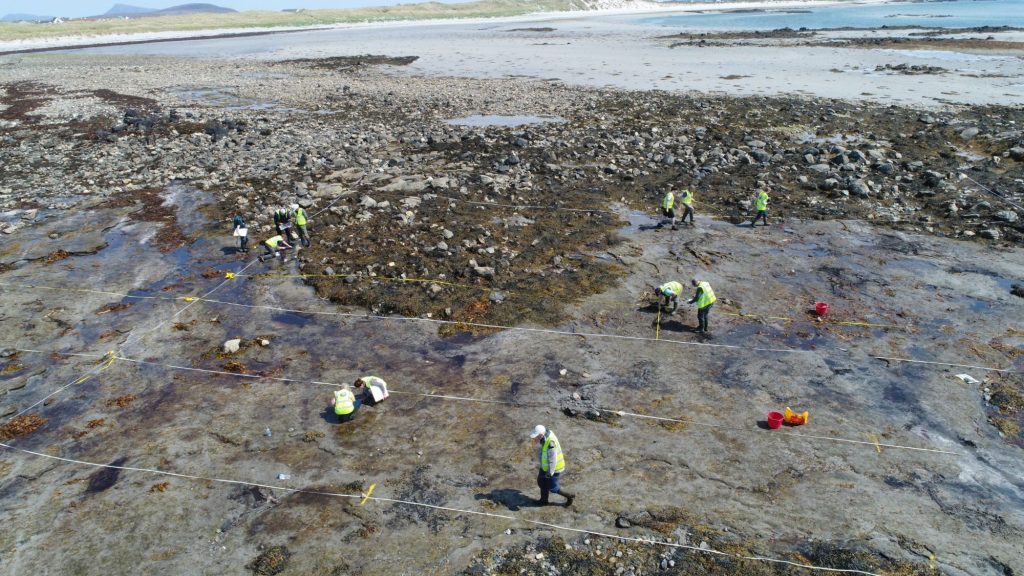
Although there is currently no evidence for Palaeolithic activity for the Outer Hebrides, there is Late Upper Palaeolithic evidence from at least two sites in An t-Eilean Sgitheanach (Skye) at South Cuidrach (Hardy and Wickham-Jones 2002; Hardy and Ballin 2024; Hardy et al 2025) and An Corran (Saville et al 2012), Rubha Port an t-Seilich, Ìle (Islay) (Mithen et al 2015; Berghansen et al 2019), as well as An Sithean, Kilmelford (Kilmelfort Cave) near An t-Òban (Oban). The existence of these sites offer the prospect of similar Upper Palaeolithic material emerging from the Outer Hebrides in the future. For now, however, research gaps focus primarily on identifying direct and indirect evidence for Upper Palaeolithic activity. More detailed questions will undoubtedly emerge if and when more material surfaces.
The Mesolithic period is a promising, yet currently comparatively poorly understood topic of study for the Outer Hebrides where there is real potential for new discoveries to substantially improve knowledge and understanding of the archipelago’s earliest prehistoric communities. Understanding how Mesolithic populations colonised and exploited the Outer Hebrides remains central to our understanding of hunter-fisher-gatherer communities in Scotland and beyond. The Inner Hebrides and Scotland’s north-west coast provide some of our most important evidence to date. This reinforces the view that islands and environments around Scotland’s north-west coast were foci for Mesolithic activity, with island-hopping an established strategy amongst Scotland’s early prehistoric communities (Bell 2007). The existing evidence highlights the further likelihood that Mesolithic communities were more present and active across the Outer Hebrides than can currently be evidenced.
There are currently only five known Mesolithic sites identified across the Outer Hebrides, four of which are shell midden sites not fully investigated (SIRFA Table 7). The key site for the region and period is Taobh Tuath (Northton) in Harris (Gregory et al 2005). There are no known Mesolithic sites from the Southern Isles (North Uist, Benbecula, South Uist and Barra). However, there are more than 175 radiocarbon dates from the Outer Hebrides that fall between the 13th and 5th millennium BC (Table 6). Most from isolated environmental samples, including peat deposits, loch sediment deposits, offshore marine and continental shelf deposits. Less than 15% of these dates are directly associated with anthropogenic activity; of this group, dates have been mainly sourced from carbonised hazelnut shells and charcoal.
Enhancing and refining understanding of the contemporary coastline and broader landscape and environmental context is one key step in identifying additional Mesolithic sites in the Outer Hebrides. Recent discoveries, such as the preserved Mesolithic and Neolithic woodland at Lionacleit (Hambly and Timpany 2019) reinforce earlier pollen studies that demonstrated the presence of substantial prehistoric wooded environments (Edwards and Whittington 1994; Pyatt et al 1995; Fossit 1996; Gilbertson et al 1996; Gearey and Gilbertson 1997; Brayshay et al 2000; Ritchie et al 2001; Church 2005; Edwards and Sugden 2003; Jordan et al 2010; Piper et al 2018). The suggestion that Mesolithic communities had more profound and lasting impacts on the island’s vegetation than previously appreciated (Edwards et al 2005). However, there is much more to understand about the vegetational history of the Hebrides as well as regional gaps in this picture to fill.
Addressing these ‘big’ questions will be the building blocks for unlocking more aspirational questions about the environment, landscape, and the nature of Mesolithic settlement here; how did Hebridean populations during this period respond to environmental and climatic change? What did the Hebridean landscape look like during the Mesolithic and where might be the most fruitful locations for identifying additional Mesolithic activity?
You can download the datasheet for more information on the Palaeolithic and Mesolithic sites and c14 dates from the Outer Hebrides.
Outer Hebrides Palaeolithic and Mesolithic Research Questions
What was the character of pre-Neolithic activity in the Outer Hebrides?
The identification of pre-Neolithic activity sites across the Outer Hebrides is difficult, largely as it is not understood what pre-Neolithic archaeology looks like here. How do these earlier sites differ from those of the Neolithic? Further, the extent and location of sites is currently unpredictable. Where are these sites located? It is very likely that this lack of knowledge will not be rectified until the pre-Neolithic coastline, climate, and landscape are better understood (SIRFA4). However, the potential for sites to be revealed inland should not be overlooked, especially given evidence from elsewhere in Northern Scotland.
Status:
Active
Date accepted:
13/08/2026
Date of next review:
13/08/2029
How did Mesolithic communities respond to environmental change across the Outer Hebrides?
This is an aspirational question. Currently, there is a lack of information, data and sites to address this question in earnest. Nevertheless, this is the level of knowledge and understanding that researchers should aspire to. With more sites and data, a better understanding of the structure of the Mesolithic landscape alongside a better understanding of the palaeoenvironment, it should be possible to address these questions. It is unlikely that these questions will be addressed via a single project. A series of well-funded projects, almost certainly interdisciplinary and multi-proxy in nature, are likely ways forward. Within a developer-funded context, the importance of retaining faunal assemblages and environmental data for this period and funding post-excavation work needs emphasis.
Status:
Active
Date accepted:
26/08/2026
Date of next review:
26/08/2031
How did the Outer Hebrides’ palaeoenvironmental change between the LUP and Mesolithic?
There are still large gaps in our knowledge and understanding of the Outer Hebrides paleoenvironment, specifically with regard to the LUP and Mesolithic period. What was the nature of vegetation cover and how did this change over time? How did vegetation cover vary across and between islands? Where was the coastline and how did this change into the Mesolithic period? Were changes to the environment gradual or sudden? Can we identify periods of acceleration? And were rates of change regionally uniform or locally specific? It is unlikely that these questions will be addressed via a single project. A series of well-funded projects, almost certainly interdisciplinary and multi-proxy in nature, are likely ways forward. More data will lead to increasing refinement of our picture of the LUP and Mesolithic palaeoenviroment. Moreover, existing datasets (pollen, intertidal peats, dune building, etc.) undertaken mostly by palaeoecologist, would benefit from being rationalised and brought together within an archaeological context. Development-led mitigation works will be a beneficial addition to the existing resource. Within this context, the importance of palaeoenvironmental data needs emphasising.
Status:
Active
Date accepted:
26/08/2026
Date of next review:
26/08/2031
How large were the pre-Neolithic populations active across the Outer Hebrides?
This is an aspirational question. Currently, there is a lack of information, data and sites to address this question in earnest. Nevertheless, it is recommended that future researchers consider ways of gauging the likely size of the Outer Hebrides’ Mesolithic population. Is it possible to estimate how large a population might have been active across the Outer Hebrides during the Mesolithic? A significant factor in understanding population movements, dynamics, and resource usage during the Mesolithic, is in grasping the size of the population in question. Is it possible to determine how large a population might have been active across the Outer Hebrides during the Mesolithic? And if so, what does this tell us about Mesolithic communities and about the Outer Hebrides during this period?
Status:
Active
Date accepted:
26/08/2026
Date of next review:
26/08/2031
How was the Hebridean landscape used and structured across the Mesolithic period?
This is an aspirational question. Currently, there is a lack of information, data and sites to address this question in earnest. Nevertheless, this is the level of knowledge and understanding that researchers should aspire to. With more sites and data is should be possible to better characterise the landscape and seascape, its structure, how it was used and, crucially, how this changed over time. This question is likely to be best addressed through more consistent and focused field surveys, alongside multi-pronged, inter-disciplinary methods of data collection and a dedicated program of radiocarbon dating. Developer-funded work is likely to play an important role; trial trench evaluations and archaeological monitoring provide scope for identify sites and material across large, previously uninvestigated areas and landscapes. Opportunistic discoveries of potential Mesolithic remains should be considered a priority in this context.
Status:
Active
Date accepted:
26/08/2026
Date of next review:
26/08/2031
Were pre-Neolithic Hebridean populations inter-connected across the islands?
This is an aspirational question and will require more research around questions SIRFA1, SIRFA 2, SIRFA3, SIRFA 4 before we can begin to address this. Future researchers, however, should aspire to understand how pre-Neolithic populations across the Outer Hebrides were connected. Did the first Hebridean populations consisted of several independent groups (or extended familial groups) or did a single group arrive and spread out from an origin point? Is it possible to determine the connectivity across the Hebridean population(s), and does this give us any insight into how the Outer Hebrides were initially colonised? It is likely that these questions will be addressed partly through collation, reassessment and reanalysis of existing material and literature. More consistent and focused field surveys, alongside multi-pronged, inter-disciplinary methods of data collection and a dedicated program of radiocarbon dating will undoubtedly expand the dataset needed to address wider connections across the archipelago. Developer-funded work is likely to play an important role; trial trench evaluations and archaeological monitoring provide scope for identifying sites and material across large, previously uninvestigated areas and landscapes. Opportunistic discoveries of potential Mesolithic remains should be considered a priority in this context.
Status:
Active
Date accepted:
26/08/2026
Date of next review:
26/08/2031
What did boats look like during the Hebridean Mesolithic?
Even if pre-Neolithic populations were not permanently based in the Outer Hebrides, they would nonetheless require some form of boat technology to reach these islands. There is no physical evidence for early Hebridean boats thus far. However, is it possible to determine what they may have looked like? What available resources are likely to have been used? Additionally, is there any reason for researchers to believe there could have been differentiation in this technology between the Hebrides and the Northern Isles? It is likely that further dedicated survey work, as well as opportunities discoveries and those via developer-funded work, will enhance datasets. The use of experimental archaeology for this area of research is highly encouraged. Public engagement through such work is also recommended. In a developer-funded context, opportunistic discoveries of remains potentially related to seafaring should be considered a priority. Proxy data from Later Prehistoric periods and from other international studies can provide potential insight on this topic.
Status:
Active
Date accepted:
26/08/2026
Date of next review:
26/08/2031
What did pre-Neolithic resource usage look like across the Outer Hebrides?
What resources were available during this early stage of the Outer Hebrides occupation? What would have been considered the key resources? Is it possible to identify them and their usage in the archaeological record? Further, what factors would have impacted on their usage? Were these seasonal? Were there social restrictions/requirements? How should these be explored? It is expected that addressing these questions will rely on palaeoenvironmental research and data, as well as osteoarchaeological or zooarchaeological research if any skeletal remains are recovered. Work at Northton has progressed this topic substantially (SIRFA Case Study 1; Bishop et al 2021). Reassessment of existing datasets, reports, archives and collections, alongside new programmes of material analysis are likely ways forward. In a developer-funded context, the research significance of faunal and environmental data needs to be emphasised.
Status:
Active
Date accepted:
26/08/2026
Date of next review:
26/08/2031
What did the pre-Neolithic coastline look like across the Outer Hebrides?
Shifts in climate and sea levels have led to substantial changes in the Hebridean coastline (Jordon et al 2010; Ritchie, 1985; Ritchie et al, 2001); understanding the pre-Neolithic coastline will help in the search for sites prior to c. 4,000 BC. The complex matter of isostatic rebound (Firth and Stewart 2000), is not fully understood in the context of the Outer Hebrides and exploration of this would be a great help. How different was the pre-Neolithic coastline? Did pre-Neolithic populations have greater land mass available to them? Further, how many of today’s islands were originally joined together as a larger singular island? This undoubtedly will impact our understanding of how pre-Neolithic populations viewed and moved through the landscape. It is expected that this research will require long-term projects, initially focusing on targeted survey work and data. Opportunistic discoveries as a result of coastal erosion also have the potential to yield significant evidence. Geoarchaeological data from offshore development also has huge potential.
Status:
Active
Date accepted:
26/08/2026
Date of next review:
26/08/2031
What did the pre-Neolithic Hebridean environment look like?
The development of the machair in later centuries buried palaeo-land surfaces, leaving it unclear the extent to which lochs, bogs and forests existed in the Hebrides prior to the Neolithic. The presence of these environments – in addition to the species of plants – undoubtedly informed pre-Neolithic land use. Additionally, understanding the landscape prior to c. 4,000 BC will help in the search for sites dating to those periods. In essence, how different did the pre-Neolithic environment look? There is a considerable body of existing research on which to base further work, see; (Bishop et al 2018; Brayshay et al 2000; Church 2005; Edwards 1996; Edwards and Sugden 2003; Edwards and Whittington 1994; Fossit 1996; Gearey and Gilbertson 1997; Gilbertonson et al 1996; Jordan 2005; Piper et al 2018; Pyatt et al 1995; Ritchie et al 2001). The questions here are substantial requiring more data and wider coverage in order to more fully understand the pre-Neolithic environment. It is expected that this research will require long-term projects, initially focusing on targeted survey work and data. These questions will also likely benefit from interdisciplinary research. Preservation of paleoenvironmental data from a range of sources will be important and should be prioritised in a developer-funded setting.
Status:
Active
Date accepted:
26/08/2026
Date of next review:
26/08/2031
What is the earliest evidence for human habitation or activity in the Outer Hebrides?
There has been no evidence found thus far for Palaeolithic activity among the Outer Hebrides. However, it is not clear whether the lack of evidence is evidence of absence, a result of destruction of Palaeolithic sites in the ensuing centuries, or simply that their character and location are just unclear/unknown so have not been identified yet. The presence of Palaeolithic sites in Skye (Hardy and Ballin 2024) and Islay (Mithen et al 2015) may indicate that they also exist in the Outer Hebrides. This type of evidence is likely to survive in areas not directly impacted by ice sheets, such as caves, gulleys and at the bottoms of protected bays. It is likely that theseis questions will be addressed via a combination of targeted survey and opportunistic discoveries via walk-over surveys, archaeological monitoring or evaluation within a developer-funded context and as a result of coastal erosion. Within a developer-funded context, the research significance of any potential palaeolithic evidence information should be emphasised. The potential for discoveries as a result of offshore developer-funded work is potentially significant. Another approach could be the careful appraisal of existing lithic assemblages, where these exist, with reference to mainland and other west coast assemblages.
Status:
Active
Date accepted:
26/08/2026
Date of next review:
26/08/2031
What natural stone resources were utilised by pre-Neolithic populations across the Outer Hebrides?
Whilst it is understood that flint and quartz were widely used by early populations in Scotland, it is not entirely known whether other lithic resources were utilised in the same way. The origins of the flint and quartz used in the Outer Hebrides are not fully known; this is especially important with respect to flint resource exploitation and trade networks. Exploring the use and availability of these resources will provide a better understanding of social networks, mobility, and land use. It is likely that these questions will be addressed through analysis of materials and collections already held in institutions and museums, as well as materials emerging from new excavations. Interdisciplinary approaches will also be important, as well as archaeological survey.
Status:
Active
Date accepted:
26/08/2026
Date of next review:
26/08/2031
What types of structures did Mesolithic populations active across the Outer Hebrides use?
Given the limited evidence of Mesolithic activity across the Outer Hebrides, there is still much more to discover about Mesolithic structures. It remains unclear to what degree these early populations were mobile. If itinerant populations were present in substantial numbers across the Hebrides, did they build and use portable structures? Can we identify campsites? Did they return to sites seasonally? What did their buildings look like, how were they constructed and what were they made of? Developer-funded work is likely to play an important role; trial trench evaluations and archaeological monitoring provide scope for identify sites and material across large, previously uninvestigated areas and landscapes. Opportunistic discoveries of potential Mesolithic remains should be considered a priority in this context.
Status:
Active
Date accepted:
26/08/2026
Date of next review:
26/08/2031
What was the chronology of the Mesolithic-Neolithic transition across the Outer Hebrides?
Transitionary periods are notoriously tricky to pin down. The Hebridean Mesolithic-Neolithic transition is especially so, given how few known Mesolithic sites have been identified across these islands. When did this transition begin? What were the mechanisms and processes? How do they compare with other areas such as Orkney, Shetland and the Scottish mainland? Additionally, what did this transitionary period look like? Reassessment and reanalysis of existing datasets, reports, archives and collections, alongside new programmes of meaningful scientific dating, are likely ways forward. In a developer-funded context, the research significance of dating and other post-excavation work needs to be emphasised.
Status:
Active
Date accepted:
26/08/2026
Date of next review:
26/08/2031
What was the extent of Mesolithic activity in the Outer Hebrides?
There are relatively few Mesolithic sites identified in the Outer Hebrides – the most notable being Northton, Harris (Simpson et al 2006) – and none positively identified from the Southern Isles. It is unclear whether the lack of sites represents absence of evidence, or evidence of absence. What was the extent of activity across the Hebrides during this period? What was the nature of this activity? Does the evidence indicate a permanent population, albeit mobile within the Hebrides? Or does the evidence instead point to groups periodically visiting the islands from elsewhere? It is expected that this research will require long-term projects, initially focusing on survey work and data. It is expected that this research will require long-term projects, initially focusing on survey work and data. This question is likely to also be addressed as a result of opportunistic discoveries, via walk-over surveys, archaeological monitoring or evaluation within a developer-funded context and as a result of coastal erosion. Within a developer-funded context, the research significance of any potential palaeolithic evidence should be emphasised and considered high priority.
Status:
Active
Date accepted:
26/08/2026
Date of next review:
26/08/2031
What was the land and seascape like at the time of Mesolithic settlement across the Outer Hebrides?
To understand Mesolithic populations’ lives and impacts across the Outer Hebrides, it is crucial to understand the environment they existed in and moved through. What is the extent of current knowledge on the environment during this period? What is known about the land and seascape during colonisation and initial settlement? How should researchers synthesise this data? This area of research will rely on inter-disciplinary work, particularly focusing on palaeoenvironmental data and palaeoclimatology. It is unlikely that these questions will be addressed via a single project. It is likely that in response to this question researchers will need to take a multi-disciplinary and holistic approach. In a developer-funded context, the research significance of environmental data needs to be emphasised.
Status:
Active
Date accepted:
26/08/2026
Date of next review:
26/08/2031
What was the Outer Hebrides’ pre-Neolithic climate like?
The climate prior to c. 4,000 BC in the Outer Hebrides is not yet understood in any real detail (although see Dawson et al 2011). Understanding the climate and overall weather patterns could help in understanding land use and movements through the landscape. Did the climate/climate shifts contribute to the development of Hebridean prehistoric cultures? In what specific ways can we see this? Did it impact what areas were initially colonised? It is expected that this research will require long-term projects, likely benefiting from interdisciplinary approaches. Proxy data from palaeoenvironmental analysis will also be important.
Status:
Active
Date accepted:
26/08/2026
Date of next review:
26/08/2031
What was the relationship between Outer Hebrides and mainland Britain, Ireland and continental Europe during the Mesolithic?
Did Mesolithic communities across the Outer Hebrides have a relationship with the populations of these wider areas? Can this be determined from material culture found across the Outer Hebrides? What methodologies would be best utilised for exploring this question? It is likely that in response to this question researchers will need to take a multi-disciplinary and holistic approach, as well as working in conjunction with colleagues in England and elsewhere in Europe. In a developer-funded context, the research significance of Mesolithic remains needs to be emphasised.
If you have answered a research question, or have an update to add about a specific site or period, you can use our inline comments to flag the change and keep the frameworks up to date.
Register for an account, or login now to add updates and comments to our existing frameworks.