1980s to 2000s
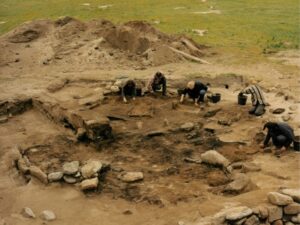
Since the 1980’s, work across South Uist, and to an extent Barra and other Southern Isles, has been particularly dominant with the development of the large-scale SEARCH (Sheffield Environmental and Archaeological Research Campaign in the Hebrides) project, a collaboration between the University of Sheffield and Cardiff University alongside other contributors. It was this project, along with the University of Edinburgh’s research across Lewis and North Uist, that was to have a most significant impact on our understanding of the Outer Hebrides’ prehistoric landscapes. The SEARCH project held a number of aims, although it is best known for its in-depth study of human-environment relationships and the nature of monumental drystone architecture, revealing notable patterns of settlement location and resource use (Branigan and Foster 2000, 2002, Parker Pearson et al 2004, Parker Pearson 2012). The work fed into the wider context of post-processual debate themes, including the house as a symbolic cultural artefact (Parker Pearson and Richards 1994, Oswald 1997, Parker Pearson et al 1999a).
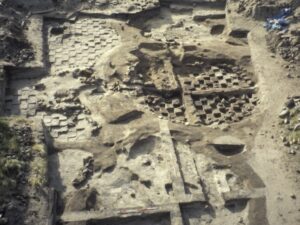
Landscape-scale surveys were undertaken across South Uist, which located several earlier prehistoric sites, as well as several large-scale, multi-period excavations at Cladh Hallan (SIRFA Case Study: Cladh Hallan, Parker Pearson et al 2021), Dùn Mhùlan (Dun Vulan) (Parker Pearson, Sharples and Mulville 1999), and Bornais (Bornish) (SIRFA Case Study: Bornais, Sharples 2012, 2020, 2021), amongst others. The excavations at Cladh Hallan require particular consideration here, given the exceptional impact and reach of the findings that extended well-beyond the Hebridean context. The findings from Cladh Hallan have had a huge impact on British prehistory and how we understand and investigate treatment of the dead (Parker Pearson et al 2005, Hanna et al 2012, Parker Pearson 2023). Related to these large-scale excavations were a series of smaller fieldwork projects, which generated numerous postgraduate and doctoral theses (Allan 1988, Ul-Haq 1989, Smith 1988, Rutherford 1989, McLaughlin 1990, Pratt 1991, Alldritt 1992, Brayshay 1992, Gearey 1992, Mulder 1992, Pelling 1992, Hutchens 1993, Mulville 1993, Bertzeletos 1994, Cummins 1994, Smith, 1994, Dalton 1995, Ballantyne 1998, Hastie 1998, Kaplan 1998, Lloyd 1999, Mulder 1999, Roper 1999, Ward 1999, Scales 2001, Henley 2005).
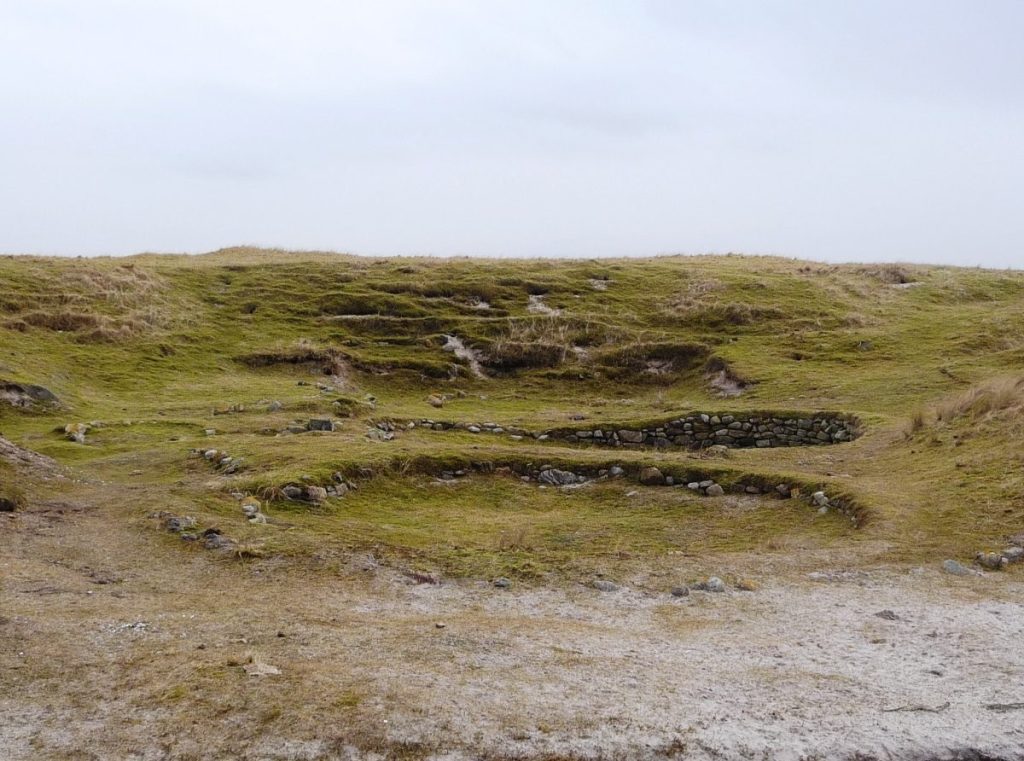
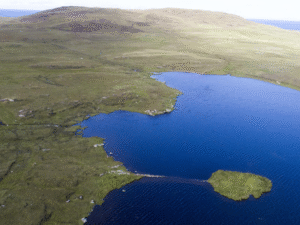
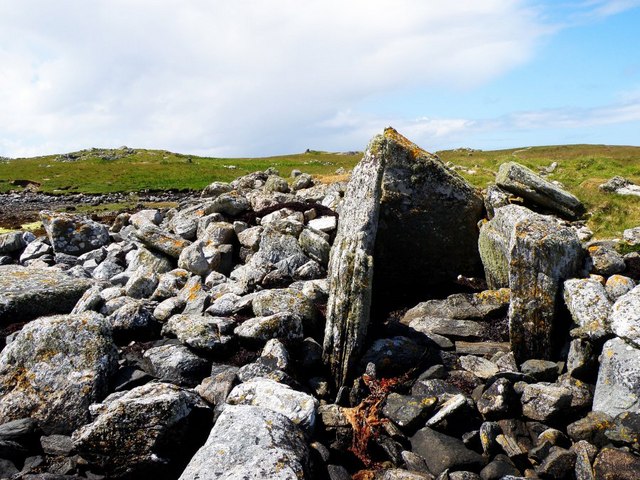
At around the same time, the University of Edinburgh were research active across Lewis and North Uist, establishing the Calanais (Callanish) Archaeological Research Centre in Lewis in 1985. As part of this initiative the team carried out a series of smaller excavations and surveys, experimental work in and around Calanais, as well as larger-scale excavations primarily focusing on later prehistoric settlements across the Bhaltos Peninsula (Harding and Armit 1990, Armit 1994, Armit et al 1995). The latter included Iron Age roundhouses at Dun Bharabhat (Harding and Dixon 2000) and Loch na Bheirigh (Loch na Berie) (Harding and Gilmour 2000) and Cnip (Kneep) wheelhouse (Armit 2006). In Uist, Edinburgh University’s activity within the islands also kickstarted a series of excavation projects around the tidal island of Bhàlaigh (Vallay) and associated Tràigh Bhàlaigh (the Vallay Strand) which included the excavations of an Iron Age wheelhouse at Eilean Maleit (Armit et al 1999), a burnt mound at Ceann nan Clachan (Armit et al 2003), the Neolithic settlement at Eilean Dòmhnuill (SIRFA Case Study: Eilean Dòmhnuill, Armit 2003) and a Neolithic chambered tomb at Geiriscleit (Geirisclett) (Dunwell et al 2004).
Like the SEARCH Project, Edinburgh University’s research activity also generated a significant number of individual postgraduate theses between 1985 and 2005 (Finlay 1984, Topping, 1985, Armit 1991a, Cook 1995, Suddaby 1995, Johnson 1996, Gilmour 2000b, Burgess 2002, Cerón-Carrasco 2002, Church 2002, Tams 2003, Heald 2005, Johnson 2005, Thomas 2005). These two university-led research initiatives, working on material of similar periods but in different islands within the wider Outer Hebridean archipelago, famously fuelled competing interpretations of later prehistoric domestic architecture which resonated with wider Atlantic Iron Age studies (see Parker Pearson, Sharples and Mulville 1996, Armit 1997a). In terms of the wider impact of the Outer Hebrides on the development of Scottish Archaeology, it is perhaps also of note that many, now senior, individuals within Scottish archaeology were students on one or more of these projects. It would be hard to overstate the reach and impact of this era of archaeological research across the Outer Hebrides.
Continue reading: 2000an – an-diugh (2000s to present)