
Raju Subedi and Dr Quazi Mahtab Zaman, Robert Gordon University
Introduction
This case study discusses the impacts of climate change on Scotland’s vernacular architectural heritage, examining both the physical degradation of these structures and the cultural transformation, making it challenging to create wider community attention. Using Orkney as an example, we will explore the inadequacies of existing conservation frameworks. We propose adaptive, community-based strategies that merge traditional practices with contemporary climate resilience science and argue for a paradigm shift, from static preservation to dynamic resilience, in how we value, protect, and sustain vernacular heritage in a warming world.

The threat of climate change
Scotland’s vernacular architecture, grounded in local materials, climatic responsiveness, and cultural traditions, represents a cumulative body of place-based knowledge developed over centuries. Yet, these historic structures are increasingly threatened by the accelerating impacts of climate change, including coastal erosion, flooding, and extreme weather. There are clear limitations of conventional conservation approaches in addressing the dynamic vulnerabilities of these buildings and advocates for climate-adaptive strategies grounded in the principles of vernacular resilience. By integrating architectural analysis, community-based heritage practices, and climate science, our research emphasises that safeguarding vernacular architecture is about preserving the past and sustaining cultural identity and environmental stewardship.
In Scotland, both the increasing frequency of storms and rising sea levels are causing physical damage to historic buildings and endangering the intangible cultural practices embedded within them. These buildings, ranging from stone-built crofts to turf-roofed blackhouses, reflect the deep-rooted relationships between people and their place. Still, they are frequently overlooked in national conservation strategies, leaving them highly vulnerable to environmental change.
The volume of annual rainfall has increased over the last decade due to climate change and has had significant negative impacts on Scotland´s buildings. While water damage destroys masonry and encourages the decay of timber, it also promotes the growth of moss and ivy, which can lead to further issues. Through retrofitting and effective maintenance, Scotland´s traditional buildings are better equipped to cope with the changing climate (Stirling City Heritage Trust 2024).
While cultural heritage is often associated with tangible remnants of the past, the growing threat of climate change underscores the increasing importance of intangible heritage in preserving the memories, traditions, and narratives embedded within these physical remains. It is widely recognised that that the changing temperature in the ocean, rising sea level, coastal erosion, and weather events induced by climate change impact cultural heritage globally, and this can be seen in the difficulty of maintaining historical buildings and exposed archaeological sites in Scotland (Harkin et al 2020).
Barriers to conserving vernacular buildings in Orkney
Scholarly research highlights several enduring gaps in conserving Orkney’s historic built environment. The most pressing challenge is climate vulnerability, as Orkney’s Neolithic and coastal sites face escalating threats from erosion, storm surges, and sea-level rise (Dawson et al 2020; Downes and Gibson 2019; Dawson 2013). While specific adaptation initiatives have been trialled, comprehensive and long-term strategies remain limited. There are significant monitoring deficiencies, particularly for vernacular farmsteads and minor archaeological sites, which often deteriorate before being properly recorded (Jones and Yarrow 2013).
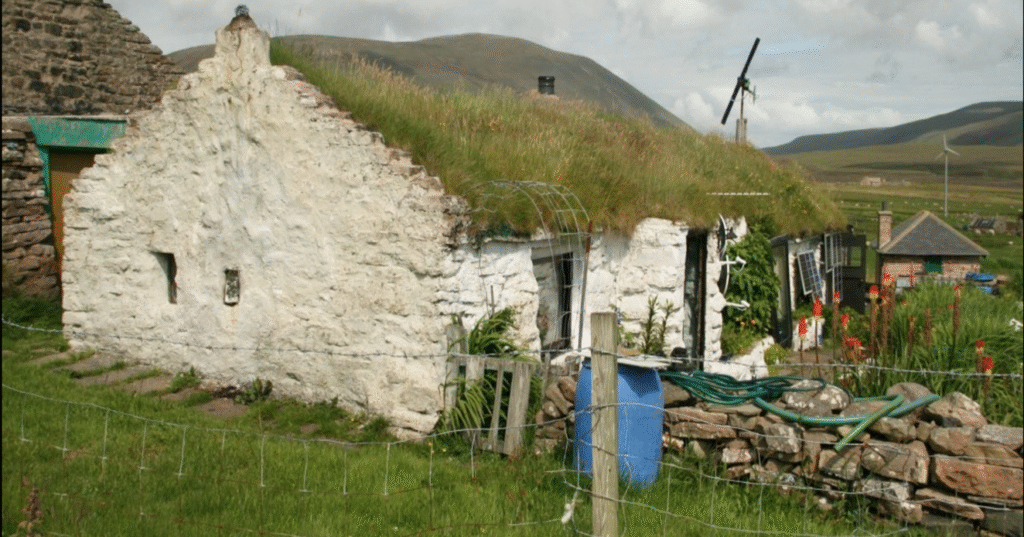
Buildings from the pre-agricultural improvement era that preserve their traditional form are now rare, even in rural areas like Orkney. Thatched-roof structures using materials like heather and turf are also scarce. According to HES, climate change influenced the design of building construction, roofing methods, and locally applied materials in Orkney during the 18th and 19th centuries. Due to this adaptability, Crow´s Nest (Craa Nest), an 18th century croft which retains its original features, is of interest to many architects but presents a real challenge to maintain without dramatically modifying the structure. As such, there are now only a few thatched-roof buildings upstanding in Orkney, many of which can be found at Rackwick Bay on Hoy (Historic Environment Scotland 2017). The capacity to respond to the degradation of these important structures is weakened by a lack of traditional conservation knowledge, constraining authentic repair and raising the risk of inappropriate interventions (Yarrow 2019).
Intangible heritage and community voices remain insufficiently integrated into conservation decisions, despite their importance to identity and place-making (McClanahan 2006). These gaps are compounded by limited applied conservation science, particularly regarding the performance of sandstone and peatland archaeology in maritime climates (Brimblecombe, Grossi and Harris 2011). Collectively, the literature underscores an urgent need for integrated, interdisciplinary, and community-engaged approaches to secure Orkney’s cultural heritage for the future.
References
Brimblecombe, P, Grossi, C and Harris, I 2011 Climate Change, Critical to Cultural Heritage’, in Gokcekus et al (eds) Survival and sustainability, Environmental concerns in the 21st Century, Springer: Berlin, 195-205.
Dawson, T 2013 ‘Erosion and coastal archaeology: Evaluating the threat and prioritising action’, in Daire, M-Y, Dupont, C, Baudry, A, Billard, C, Large, J-M, Lespez, L, Normand, E and Scarre, C (eds) Ancient Maritime Communities and the Relationship between People and Environment along the European Atlantic Coasts, Proceedings of the HOMER 2011 Conference, Vannes, France, BAR International Series 2570, Archeopress: Oxford, 77-83.
Dawson, T et al 2020 ‘Coastal heritage, global climate change, public engagement, and citizen science’, Proceedings of the National Academy of Sciences 117 (15), 8280–8286.
Downes, J and Gibson, J 2019 Climate Risk Assessment for Heart of Neolithic Orkney World Heritage property.
Guest, K, Marchetti, C, More, L, Lankester, P, Hedley, C, Foster, T, Lyte, B and England, H 2024 Climate Change Adaptation Report, English Heritage: Portsmouth.
Harkin, D V et al 2020 ‘Impacts of climate change on cultural heritage’, MCCIP Science Review 16, 24–39.
Historic Environment Scotland 2017 Short Guide 11, Climate change adaptation for traditional buildings, Historic Environment Scotland: Edinburgh.
Jones, S and Yarrow, T 2013 ‘Crafting authenticity: An ethnography of conservation practice’, Journal of Material Culture 18 (1), 3-26.
McClanahan, A 2006 ‘Histories, identity, and ownership: an ethnographic case study in archaeological heritage management in the Orkney Islands’, in Edgeworth, M (ed) Ethnographies of archaeological practice: cultural encounters, material transformations, AltaMira Press: California, 126–136.
Phillips, H 2015 ‘The capacity to adapt to climate change at heritage sites—The development of a conceptual framework’, Environmental Science & Policy 47, 118-125.
Sesana, E et al 2021 ‘Climate change impacts on cultural heritage: A literature review’, Wiley Interdisciplinary Reviews: Climate Change 12 (4), 710.
Stirling City Heritage Trust 2024 Retrofitting Traditional Buildings: Climatic Adaptation, Stirling City Heritage Trust: Stirling.
Yarrow, T 2019 ‘How conservation matters: Ethnographic explorations of historic building renovation’, Journal of Material Culture 24 (1), 3–21.