
Other Neolithic coarse stone tools are relatively scarce in south-east Scotland, largely because almost all of the settlement sites have been so truncated by post-Neolithic activities that most of their original contents will have been dispersed or destroyed. There may be examples among the stray finds from south-east Scotland but in such cases, without any archaeological context information, it can be hard to attribute them with confidence to the Neolithic period.
At Upper Dalhousie Quarry, Midlothian, in a pit where Middle Neolithic Impressed Ware pottery was found (Pit 4-070), a sandstone quern rubber used for grinding grain had been reused as a hammerstone, and was then damaged by heat (Clarke in Francis in press).
At Meldon Bridge, Scottish Borders, a broken quartzite pounder was found in pit S14, along with a fragment of a greenstone axehead (Speak and Burgess 1999, 12).
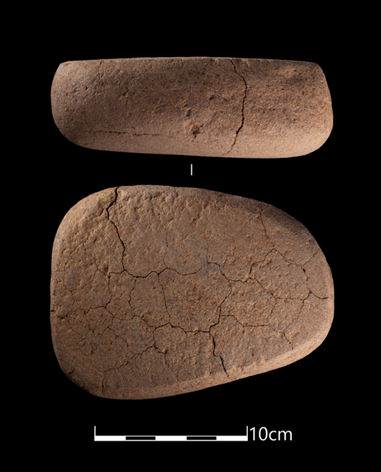
At Archerfield, Gullane, East Lothian, a portable polissoir of sandstone, used for smoothing axe- or adze-heads, was found among ‘midden’ material (Curle 1908, fig. 1). Even though the findspot contained Chalcolithic/Early Bronze Age artefacts as well as Neolithic pottery, it is likely that this object belongs to the Neolithic phase of activity at this coastal site.
