
Monster bead
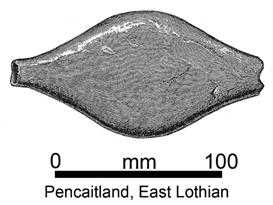
A particularly large example of a so-called ‘monster bead’, of oil shale or cannel coal, was found in Pencaitland parish in the 19th century (Anon. 1879, 127). Beads of this type, made from jet and similar-looking materials and dating to the centuries around 3500 BC, are widespread in Britain, and they will have been precious possessions, worn by only a minority of people (Sheridan 2007a).
In Aberdeenshire, a necklace comprising a dozen such beads, along with four amber beads, was found at Greenbrae, along with a blade-polished flint axehead (Kenworthy 1976). All of the necklace beads and the axehead appear to have originated in Yorkshire.

The Pencaitland bead was made from shale or cannel coal which could have originated in south-east Scotland. However, the distinctive shape of the bead shows that its maker must have seen other examples of this jewellery, probably in north-east England. It therefore offers additional proof that the Neolithic inhabitants of south-east Scotland were in contact with people outside this region.
Belt sliders
These are a rare Middle Neolithic artefact type, once again made from jet and similar-looking materials, and with a wide distribution across Britain. Most are elliptical or sub-rectangular, with a central perforation. They are believed to be belt fittings, possibly used to keep the loose end of a belt from dangling. The fact that three examples, from Whitegrounds and Painsthorpe round barrows, North Yorkshire and from Barrow Hills, Radley, Oxfordshire oval barrow, were found beside the hips of adult skeletons lends support to this interpretation. In her study of this class of artefact, Isla McInnes (1968) noted that the perforations do not show signs of wear, and remarked that the sliders cannot have been worn for long before being buried.
The available radiocarbon dates indicate a currency within the time-frame 3350-2900 cal BC, although one, from Linch Hill, Oxfordshire, is associated with a skeleton that produced an earlier date of 3640-3380 cal BC (SUERC-26192, 4760±30 BP; reviewed in Sheridan 2012a).
Three are known from the SESARF area: one from Balgone, North Berwick, East Lothian; one from Halmyre, Newmains, Scottish Borders; and a fragment, which is likely to have had a south-east Scottish findspot, from the collection of Walter Mason of Selkirk. The Balgone example, of cannel coal or shale, measures 76 x 25 mm and was discovered around 1865, in deep peat, during drainage operations at the northern base of the crags at Balgone (Struthers 1866; McInnes 1968; Sheridan 2012a). It was associated with both animal and human bones, and deer antlers. The current whereabouts of the animal and human remains is not known, but Struthers reported that the two well preserved human skulls were sent down to a Professor Owen in London.

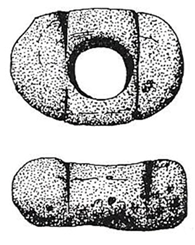
The Halmyre example, of jet, is relatively crudely made in comparison to most other sliders. It is squatter than other sliders; has a circular, rather than an elliptical hole; and has two grooves flanking the hole. It measures 53 x 29 x 21 mm. There are no details of its findspot context, and it is assumed to have been a stray find; it comes from the collection of A Henderson Bishop (Callander 1916, 221; McInnes 1968; Sheridan 2012a).
Little can be said about the fragment of a third slider, from the Walter Mason collection (NMS X.1998.1), other than that compositional analysis using X-ray fluorescence spectrometry revealed that the raw material is shale or cannel coal.
When Isla McInnes published her synthesis of Neolithic belt sliders in 1968, seventeen were known (McInnes 1968); now that total has risen to 31 (Sheridan 2012a; 2023b), with an incomplete example from West Amesbury, Wiltshire, being the latest find (inf. Wessex Archaeology). Several have been found in funerary contexts, and where the sex of the deceased has been identified, it is consistently male. Belt sliders therefore appear to be male symbols of power. They have been found in association with other precious possessions, underlining the status of the deceased: a flint Seamer-type axehead at Whitegrounds, North Yorkshire and an edge-polished knife at Linch Hill, Oxfordshire.


The presence of belt sliders in south-east Scotland provides yet more evidence demonstrating that the Neolithic inhabitants were in contact with communities elsewhere – most probably Yorkshire.