
Early Neolithic
This comprises flakes, blades, knives, scrapers, arrowheads and a range of other tool types, made from various kinds of stone, mostly locally obtained flint and chert. Quartz, agate and non-local pitchstone are the other materials represented. With the exception of pitchstone artefacts, there has been no attempt to create a list of all findspots of Early Neolithic flaked stone tools from south-east Scotland. Numerous examples of such items have been found: leaf-shaped flint arrowheads, for example, are fairly abundant the sandhills of East Lothian for example at Hedderwick. A concentration of Early and Middle Neolithic struck lithic artefacts at Craigsford Mains, Scottish Borders was noted by George Black in his review of prehistoric artefacts from south-east Scotland (Black 1894). It would be worth further exploring this area to check whether any cut features relating to domestic activities are present there.

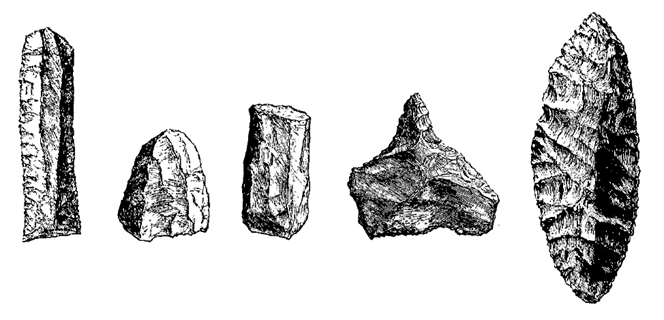
What can be said, however, is that the Early Neolithic flaked stone artefacts conform to a pattern for such assemblages in east Scotland, from Fife upwards (Warren 2006). Technically, and in the choice of raw material, there is a homogeneity that reflects the fact that its makers – immigrant farmers and their descendants – were bringing in a tradition of stone-working from elsewhere that differed from that of the indigenous Mesolithic population. The flint used for these small tools in the Early Neolithic will have been locally obtained from drift deposits; chert and other locally available stone types were also used.
The exploitation of Arran pitchstone from the Isle of Arran, and its widespread circulation around Scotland and beyond during the first half of the fourth millennium, has been studied by Torben Ballin (2009; 2015). Pitchstone is a distinctive, dark-coloured volcanic glass that knaps leaving very sharp edges. Artefacts of pitchstone have been found at a number of Early Neolithic sites in south-east Scotland:
- East Lothian: Doon Hill; Hedderwick; Crichness; West Links, Dirleton; Musselburgh Primary Health Centre, Inveresk;
- Midlothian: Castlelaws Fort; Elginhaugh; Newfarm, Dalkeith Bypass; Upper Dalhousie (where it could well be residual);
- City of Edinburgh: Ratho, West of Gogar Mains and Edmonstone Policies;
- Scottish Borders: over 50 findspots, including Meldon Bridge, Airhouse, Bedrule and Kinegar Sand and Gravel quarry.

Pitchstone was mostly used to make small, narrow blades – at Meldon Bridge, for example, a microblade was found (Speak and Burgess 1999, 83) – and it may have been a special-purpose material. There are ethnohistoric examples, in North America, of its use for surgery. The fact that such a distinctive material has such a wide geographical distribution in Early Neolithic Scotland is characteristic of the behaviour of the early farming communities. They rapidly established extensive networks of contacts between themselves over which desirable objects, materials, ideas and partners circulated, sometimes travelling long distances. This can also be seen in the circulation of some stone axeheads.
Middle and Late Neolithic
Torben Ballin has also studied the use of flint and other materials used for flaked lithics in Middle and Late Neolithic south-east Scotland. He undertook a detailed review of assemblages found near the henge at Overhailes, Scottish Borders (Ballin 2011), where a concentration of artefacts made from mostly dark-coloured, high quality non-local flint had been found. He noted that specific types of artefact were made from it: chisel-shaped and oblique (petit tranchet derivative) arrowheads, and artefacts flaked into shape using the distinctive Levallois flint-knapping technique, including edge-polished knives. An assemblage of artefacts made from this high-quality flint has recently been found in a pit (Pit 10-364), radiocarbon dated to around 3300-2900 cal BC, at Dalhousie Quarry, Midlothian (Francis in press).


Ballin concluded that the most likely source of this high-quality exotic flint was Yorkshire, and that it was being imported to southern Scotland in significant amounts during the late fourth millennium BC and the first half of the third millennium. This is consistent with the results of research on flintworking on the Yorkshire Wolds by Tess Durden (1995). She demonstrated that specialist flint-knappers were producing distinctively-shaped artefacts including ripple-flaked and polished oblique arrowheads, edge-polished discoidal knives and axeheads, using the high-quality nodular flint from the glacial till. This flint can be found, in abundance, eroding from the cliff at Flamborough Head and on the beach below. It appears likely, from the presence of debitage in some of the south-east Scottish assemblages, that Yorkshire flint was being imported both as finished objects and as raw material.
This evidence for strong connections between south-east Scotland and Yorkshire is consistent with the evidence from some of the flint axe- and adzeheads, and from the jewellery and dress accessories of jet and similar-looking materials, found in south-east Scotland.
Ballin’s research, together with the evidence from Dalhousie Quarry and elsewhere, has shown that tranchet (chisel) arrowheads were in use from the Middle Neolithic, between around 3300 and 2900BC, and continued in use into the Late Neolithic, while oblique arrowheads joined the repertoire during the Late Neolithic. The occurrence of this high-quality flint in Scotland, and of the distinctively-shaped oblique arrowheads, has been long recognised. Stevenson (1947) notes that one example from Airhouse, Scottish Borders (NMS X.BMA 86) has a very long barb. Similarly, Grahame Clark noticed, as early as 1929, that several edge-polished discoidal knives had been found in the area now known as Scottish Borders (Clark 1929). A particularly fine, sub-rectangular edge-polished knife found around 1867 at Butterlaw near Coldstream, Scottish Borders. This was illustrated by George Black in his review of prehistoric finds from south-east Scotland (Black 1894).


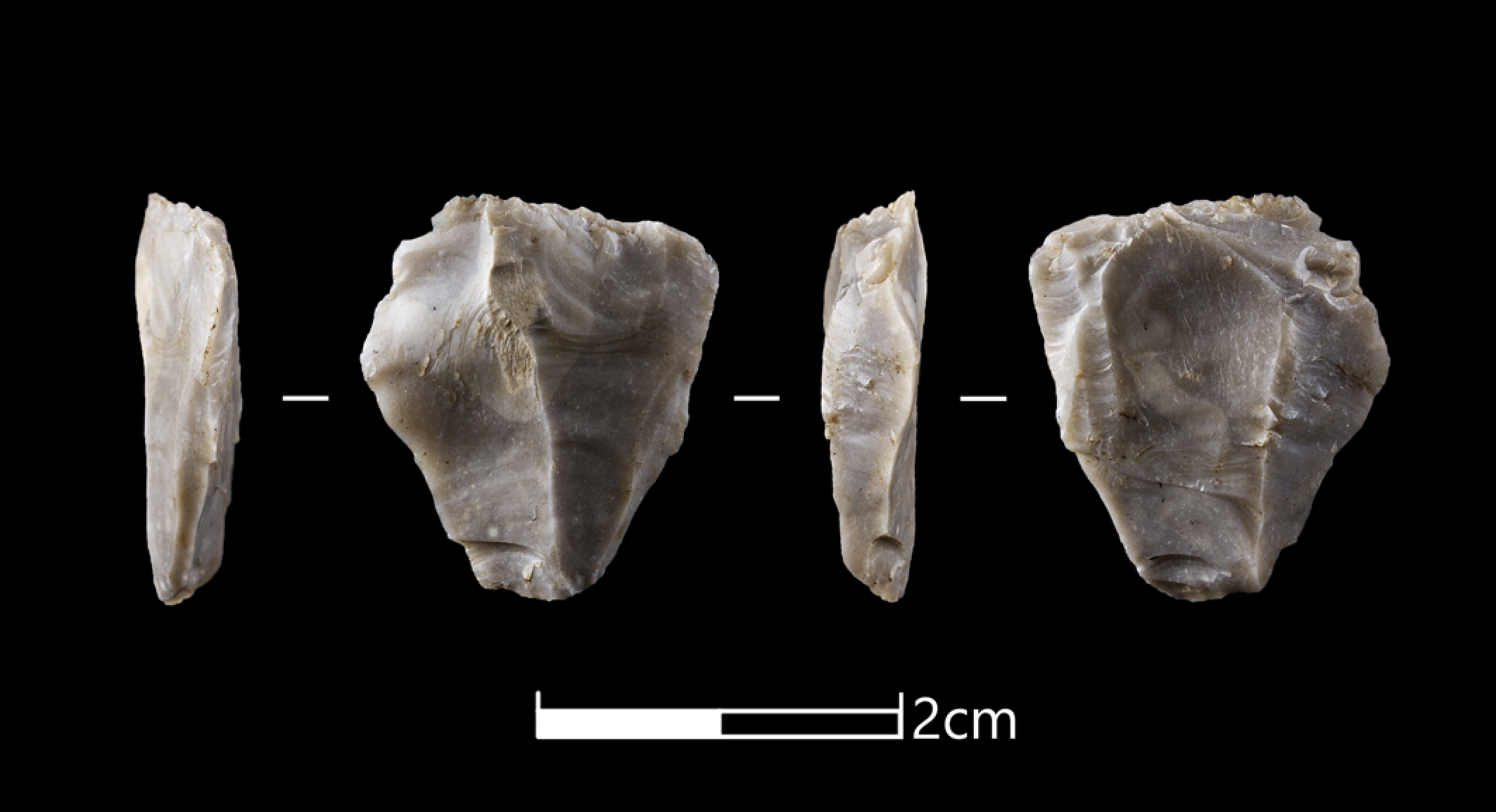
Ballin’s research on the Overhowden and Airhouse assemblages also identified certain implements that had acquired a polished edge through use, rather than being made with a polished edge. He concluded that these are likely to have been used in the processing, but not scraping, of dry animal hide (Ballin 2011, 29). The high gloss can be seen on a close-up of one such implement from Overhowden.

