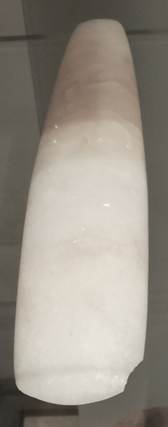
A rapid review of information on the holdings of National Museums Scotland, the Hunterian Museum in Glasgow and museums within the SESARF area has revealed that there are around 300 axeheads known from this part of Scotland, plus a small number of adze heads and chisels. As noted in SESARF 4.4 Neolithic Settlement, it may be that plotting the distribution of these finds will provide clues as to the Neolithic settlement pattern, although not all axeheads will necessarily have been deposited or discarded close to settlements.
Although most of the stone axeheads are undoubtedly Neolithic in date, it is known that axeheads of this material continued to be used after metal examples, first of copper, then of bronze, had appeared. Therefore some examples could be of Chalcolithic or Bronze Age date. This is indeed the case with one distinctively shaped example, found at Hillend, Midlothian, which appears to be a skeuomorph of a metal flat axehead (Clarke et al 1985, fig 4.6).
The axeheads found in south-east Scotland vary not only in the type of stone from which they have been made, but also in their shape, size, surface finish (ground vs. partly or wholly polished), original function and social/ideological significance.
There are plentiful examples of ‘everyday’ axeheads, designed for felling trees and working wood, that have been made of locally-available stone. This may well be the case, for example, with the axehead from Crock Cleugh, Scottish Borders, although the stone type remains to be confirmed. Further evidence supporting the idea that some axeheads were made in south-east Scotland is provided by a polissoir from Archerfield Estate, presented in SESARF 4.5.3.3 Coarse Stone Tools.
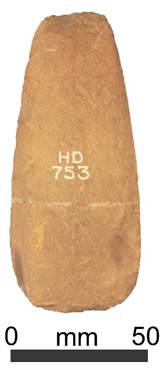
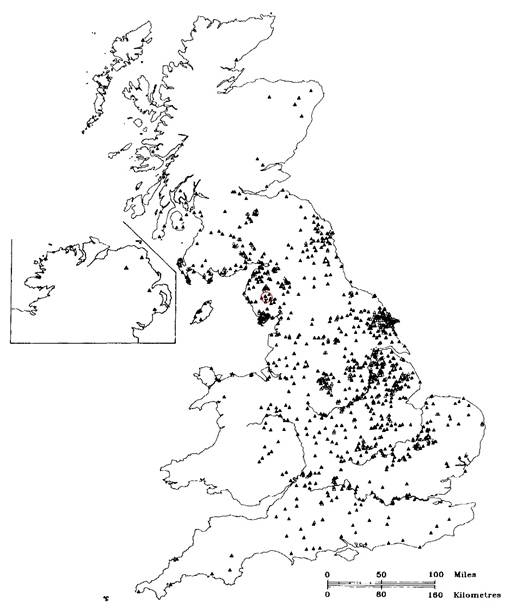
There are also examples of axeheads, made for ‘everyday’ use, that had been imported from elsewhere. Petrological investigation by the Council for British Archaeology’s Implement Petrology Committee (IPC) identified 13 definite and suspected examples of axeheads of Langdale tuff from the Lake District of north-west England (Clough and Cummins 1988), and many more axeheads from south-east Scotland are suspected to be of this rock. The examples that have been petrologically confirmed to be of Langdale tuff, known as ‘Group VI’ in the IPC’s naming system, include two from Traprain Law, East Lothian (NMS X. GVN 6 and 9) and examples from Lyne Water, Scottish Borders (NMS X.AF 242) and Hownam Rings, Scottish Borders (NMS X.HH 516). It is known that many thousands of axeheads were produced from Langdale tuff, and the 1988 distribution map published by Clough and Cummins, below, shows that the products circulated far and wide as they travelled along the networks linking farming communities. Radiocarbon dating in the source areas, plus dates from well-contexted finds of Group VI axeheads, has shown that this rock was being exploited to make axeheads from the early fourth millennium BC, with a floruit during the first half of that millennium (Edinborough et al 2019; see also Shennan et al. 2017).
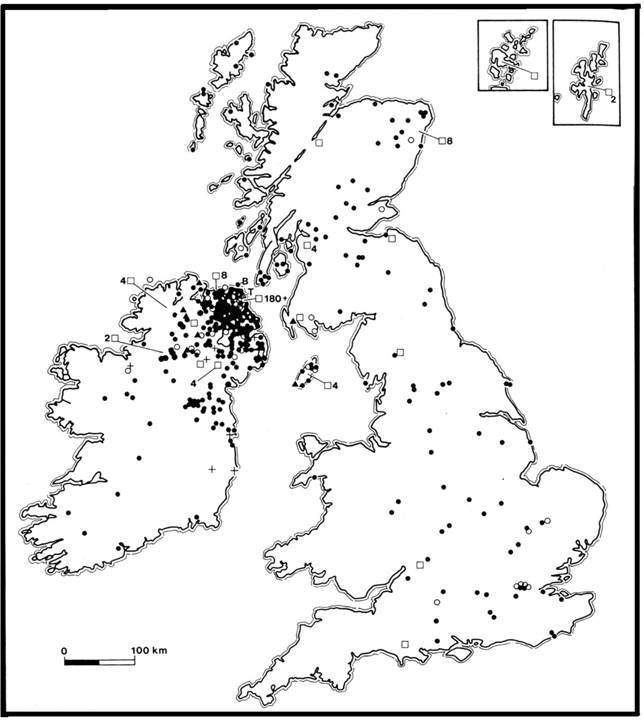
The IPG petrological survey also identified three axeheads made from porcellanite, a distinctive-looking rock that outcrops at Tievebulliagh and at Brackley on Rathlin Island, both in County Antrim, Northern Ireland (Sheridan 1987). These were found at Ratho, City of Edinburgh (NMS X.AF 248), Kippit, Scottish Borders (NMS X.AF 435) and in East Lothian (NMS X.AF 270). In addition to these, a leaf-shaped arrowhead of porcellanite found at Haremoss, Scottish Borders, is likely to have been made from a fragment of a broken porcellanite axehead (Clarke 1968; NMS X.2009.19). As with Langdale tuff, Antrim porcellanite is known to have been exploited from the early fourth millennium BC, and axeheads of this material have an extensive distribution. Research by the Irish Stone Axe Project has shown that it is the dominant rock type used for axeheads in Ireland, with 7294 examples identified macroscopically there (Cooney and Mandal 1998, 58).
A further ‘workaday’ axehead that was petrologically examined by the IPC, from Nisbet Farm, Pencaitland, East Lothian (NMS X.AF 1031), was found to be of riebeckite felsite, and was attributed to the Shetland Group XXII set of axeheads. However, that attribution was incorrect insofar as this is not an example of an export from Shetland. Rather, it is an example of an axehead made from regionally available rock, since riebeckite felsite is known to outcrop on Traprain Law and Bass Rock in East Lothian, and on the Wester and Mid Hills of the Eildon Hills, Scottish Borders (McRobert 1914; see also Geology North).
Not all of the axeheads found in south-east Scotland were utilitarian, ‘workaday’ tools, however, and it is the ‘special’ axeheads that have particularly interesting stories to tell. Such axeheads are distinguishable from ‘workaday’ versions in various ways: they could be larger than normal, or polished to a high sheen, or made with outstanding skill – or they could have all of these properties (Sheridan 2024b). They tend to have travelled a long way from their source, and they may well have been the subject of legends, and believed to possess special powers. There is evidence suggesting that some, at least, were associated with men and with male power. Axeheads would have been a vital tool for farming communities and necessary for creating buildings, tools, containers, boats and other objects. It is therefore easy to see how this class of object could take on a more iconic role in the ideology of Neolithic societies, and be represented by these ‘special’ versions.
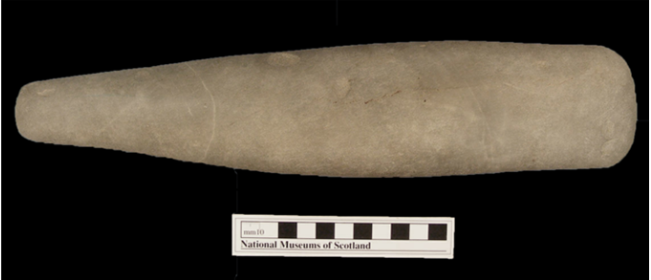
Among the imports made from Langdale tuff is a magnificent, 345 mm-long ‘Cumbrian club’ – the name given to large axeheads of this stone, with faceted sides, that taper towards the butt – found at Upper Hindhope, Scottish Borders (NMS X.AF 1100). These ‘Cumbrian clubs’ were not made for utilitarian use. They could have been used as symbols of power, and as precious possessions to be gifted between high-ranking members of farming communities, or used in other ceremonies. Their value as treasured exotica will have derived not only from the fact that they travelled long distances from the source area in the Lake District mountains. It is also highly likely that mountains were associated with the realm of the gods. Obtaining the rock will have required a hazardous journey. The distinctive shape of these impressive axeheads, as well as their easily-recognisable stone type, which is blue-grey when fresh, but can take on a greenish shade when polished and can change colour further when weathered, act as a kind of ‘signature’. Whether or not people in south-east Scotland knew where Great Langdale is, they would still be able to recognise products from this source area, and to appreciate their importance.
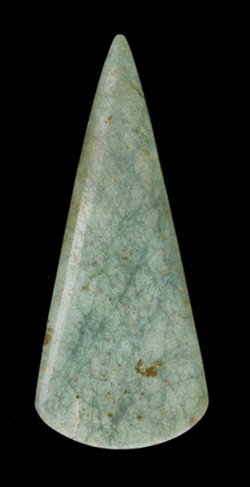
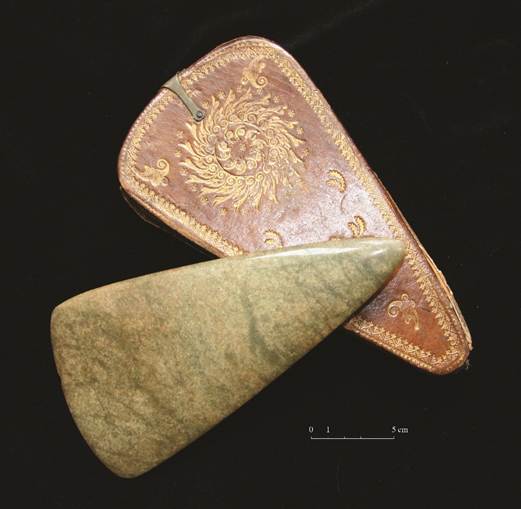
Beliefs about the sacredness of mountains also help to explain the use of jadeitite axeheads from the North Italian Alps during the Early Neolithic. Five such axeheads are known from south-east Scotland (Sheridan et al in press): one found at Greenlawdean; two found on Cunzierton Farm, Oxnam; one found on the Traquair Estate, all Scottish Borders and one, considerably smaller than the others, found at Penicuik, Midlothian. The Traquair Estate one was found around 1700, and an elaborately decorated carrying case was made for it then.
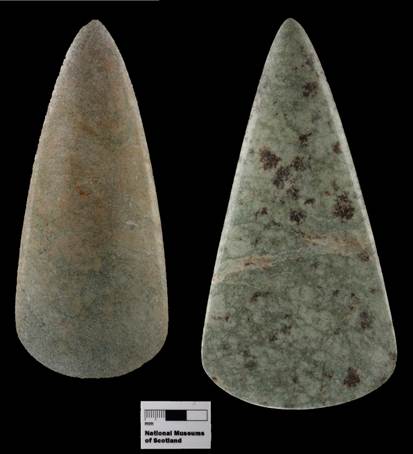
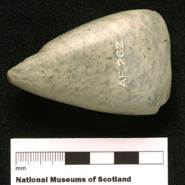
A further axehead, previously thought to have originated in the Alps, is now deemed more likely to be a Caribbean, Taíno culture ‘petaloid’ axehead dating to the second millennium AD. This was found in a blacksmith’s shop in Lauder, Scottish Borders, where it could have been used as a charm to prevent lightning strikes. It is of omphacitite. A surprisingly large number of Taíno axeheads made their way to Europe from the Caribbean during the 18th and 19th centuries AD. Nothing is known about the history of this particular axehead.
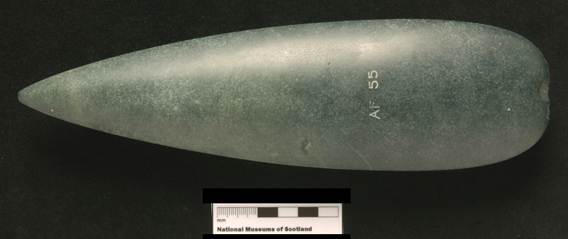
It is thanks to a French-led, international research project called Projet JADE that it is possible to make these and other statements about these axeheads (Pétrequin and Pétrequin 2025). The Alpine ones arrived in south-east Scotland not as objects of exchange but rather as the precious possessions of the farmers who came here from Nord-Pas de Calais around 3800 BC. They may well have been several generations old when they arrived, and treasured as heirlooms. The sources of the jadeitite have been identified as Monte Viso and Monte Beigua, around 1400 and nearly 1500 kilometres away, respectively, as the crow flies.
Making a large jadeitite axehead, and polishing it to a glassy sheen, will have required both skill and patience. It will have taken over 1000 hours’ work to make such an object; jadeitite is a very tough rock. The examples from Greenlawdean, Cunzierton and Traquair Estate will have started their lives in the Alps as differently-shaped axeheads, undergoing thinning, reshaping and repolishing probably in the Paris Basin. The edges of the Greenlawdean axehead are so thin that they allow sunshine to glow through them when the axehead is held up to the light; perhaps this was thought to enhance its supernatural power. It may be that the surface polish of these axeheads was further enhanced before the risky sea crossing from Nord-Pas de Calais was undertaken, from a belief that these objects could protect their owners. Once the farmers had arrived safely and the axeheads had ‘done their duty’, these precious and powerful objects were probably deliberately deposited in the landscape as a way of returning them to the world of the gods from where they were believed to have come.
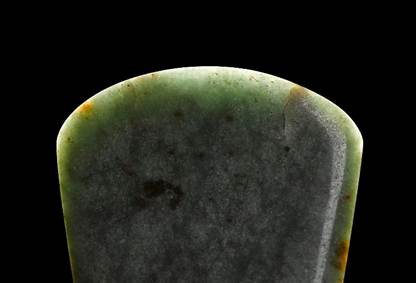
While the farmers who brought these magnificent objects over to south-east Scotland had no idea where the Alps were, nevertheless there will probably have been stories attached to these ‘green treasures from the magic mountains far away’. As pieces of very special mountains they may well have been ascribed magical powers, and their green colour may also have possessed symbolic significance.
It is likely that the practice of exploiting mountainous sources of rock in Britain and Ireland, such as at Great Langdale, was informed by these beliefs attaching to the Alpine axeheads.
This review of Neolithic axeheads in south-east Scotland concludes with the examples made from flint. Fifteen axeheads, plus two adze-heads and a possible chisel have been found and this is a remarkably high incidence, since elsewhere in Scotland flint axeheads are very rare. They vary in shape, size, finish, provenance and date, and must all have been imported, since there is no source of high-quality flint in this part of Scotland. None of the naturally-occurring flint in Scotland is large enough for making axeheads of the size of most of the examples listed here. Most, but not all, of these axe- and adze-heads arguably fall within the category of ‘special’, rather than ‘workaday’.
| Findspot | Museum and Reg. No. | Shape and finish | References/comments |
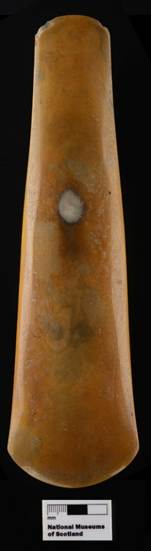
| Craigentinny, City of Edinburgh | NMS X.1992.18 | Slender, faceted sides, thin-butted, all-over-polished, glassy sheen, of marbled grey flint | For discussions of this type of axehead, see Sheridan 1992 and Saville 2016 |
| Gilmerton, Athelstaneford, East Lothian | NMS X.AF 60 | Slender, faceted sides, thin-butted, all-over-polished, glassy sheen, of marbled flint with orange patina | For discussions of this type of axehead, see Sheridan 1992 and Saville 2016 |
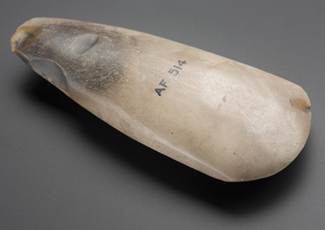
| Greenlaw, Scottish Borders | NMS X.AF 514 | Slightly squatter, fatter, more gently faceted all-over-polished, glassy sheen, of creamy-grey flint | |
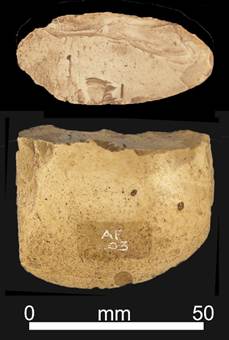
| ‘Roxbughshire’ | NMS X.AF 603 | Blade end of roughly parallel-sided axehead, not markedly faceted, all-over-polished to low sheen, heavily patinated flint | |
| Ruecastle, Jedburgh, Scottish Borders | NMS X.AF 499 | All-over-ground, with faceted sides | |
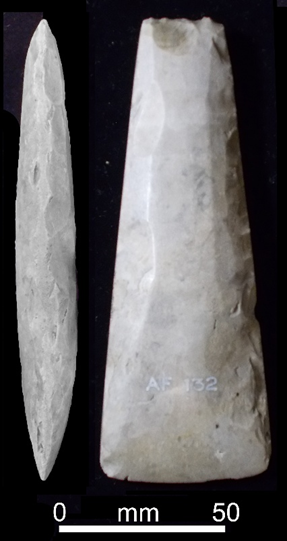
| Roxburgh, Scottish Borders | NMS X.AF 132 | Trapezoidal in plan, with broad, thin butt, sharp sides and virtually all-over ground surface; blade polished | |
| Duns, Scottish Borders | Hunterian Museum GLAHM:B.1914.135 | Sub-trapezoidal in plan, thin broad butt, plump, with broad diffuse facets, ground over most of body | Spelt ‘Dunse’ in Hunterian catalogue |
| Gordon Moss, Scottish Borders | NMS X.AF 646 | Partly ground, grey flint | |
| Reston, Scottish Borders | NMS X.AF 936 | Fragment, low polish on blade. Possibly reworked from larger axehead | |
| Whitriggs Farm, Denholm, Scottish Borders | NMS X.AF 1008 | Fragment, burnt, of an all-over-polished axehead | Old label states ‘Bindon Syke Whitrakes’ |
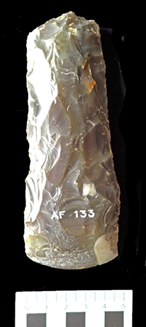
| Slipperfield, West Linton, Scottish Borders | NMS X.AF 133 | Sub-rectangular in plan, sharp sides, blade-ground | |
| Craigsford Mains, Melrose, Scottish Borders | Hunterian Museum GLAHM:B.1914.136 | Sub-rectangular, butt damaged, sharp sides, polish over much of body | |
| Craigsford Mains, Melrose, Scottish Borders | NMS X.AF 901 | Small, blade polished, mottled grey flint | |
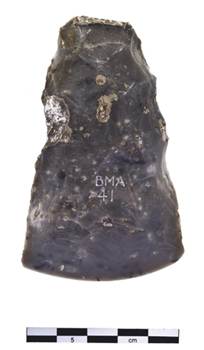
| Airhouse, Lauderdale, Scottish Borders | NMS X.BMA 41 | Small adze-head, blade ground, grey speckled flint with large chalk inclusions | Ballin 2011, 22, fig. 12 |
| Airhouse, Lauderdale, Scottish Borders | Hunterian Museum GLAHM:B.1914.147 | Incomplete, partly ground | |
| Kaeside, Melrose, Scottish Borders | NMS X.AF 879 | Seamer axehead-like, partly ground | |
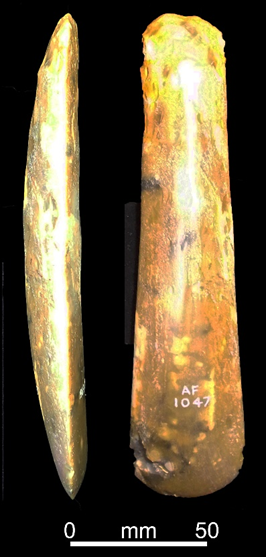
| Castlesteads Park, Dalkeith, Midlothian | NMS X.AF 1047 | Elongated Duggleby adze-head, bright yellow ochreous flint | Kenworthy in Ritchie and Adamson 1981, 191 |
The finest examples are the long, slender, all-over-polished (AOP) axeheads of marbled flint, polished to a glassy sheen, from Craigentinny, City of Edinburgh and Gilmerton, Athelstaneford, East Lothian. These represent a category of flint axehead that is widely distributed in Britain, extending from Folsetter in Orkney to the south of England and extending into Wales, with a markedly east-coastal distribution in Scotland and England (Sheridan 1992; Saville 2016). An example from Helpringham, Lincolnshire, on the edge of the Lincolnshire Fens, was published by Moore in 1979, who attributed it to his ‘Class 7’ in his typology of flint axeheads from that part of England (Moore 1979, fig. 2).
These special axeheads may well date to the Early Neolithic, although no example in Britain has been found in a datable context. They have a superficial similarity to Danish and south Swedish thin-butted axeheads, made from the same marbled flint and dating to the early fourth millennium BC including the Hagelbjerggård and Staby hoards, Denmark (Nielsen 1977). This has led some in the past to suggest that the British finds are imports from Scandinavia, but the Danish and Swedish examples lack the glassy level of polish of the British examples, and also have wider facets. The bed of distinctive marbled flint that was used to make both the Scandinavian and British examples extends from Denmark, under the North Sea, and allegedly can be found on the Lincolnshire coast (pers. comm. the late Terry Manby). Sadly, coastal erosion along Britain’s east coast means that if a Lincolnshire coast production centre had existed, no trace of it will now survive.
The high degree of polish on these axeheads may be a feature borrowed from, or inspired by, Alpine jadeitite axeheads. If that is the case, then it is reasonable to assume that these AOP flint axeheads belong to the early fourth millennium BC. That these had been special objects is clear from the absence of signs of use. The damage to the blade and butt of the Craigentinny axehead is recent, and was caused by its finders ‘trying it out’. More needs to be understood about this fascinating type of axehead, and a Britain-wide distribution map needs to be created.
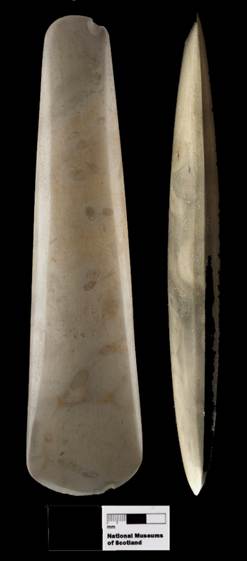
One other flint axehead from Greenlaw has the same glossy all-over-polish, although the axehead itself is less slender, tapers more markedly and has wider facets.
The other flint axe- (and adze-) heads from south-east Scotland can also be paralleled elsewhere in eastern Britain, and most are likely to have been imported from Yorkshire. The fragment of a, probably, all-over-ground axehead from ‘Roxburghshire’ (NMS X.AF 603) may belong to Moore’s ‘Class 6’ (Moore 1979), known from the East Midlands of England. However it also resembles Manby’s ‘completely ground, thin broad butt’ category of flint axehead known from Yorkshire (Manby 1979, fig. 2, B2).
The trapezoidal and sub-trapezoidal axeheads from Roxburgh and Duns, both Scottish Borders (NMS X.AF 132 and GLAHM:B.1914.135), ground over most of their body, can also be attributed to Manby’s ‘completely ground, thin broad butt’ class (Manby 1979, fig.2, B1).
The blade-ground, roughly rectangular axehead from Slipperfield, West Linton, Scottish Borders, NMS X.AF 133, can arguably be attributed to Moore’s Class 1 (Moore 1979); it could have been made from Yorkshire flint.
A Middle Neolithic date can be attributed to two flint items that may well have been imported from Yorkshire: a partly-ground, slightly waisted axehead that resembles Manby’s Seamer-type axeheads, found at Kaeside, Melrose, Scottish Borders (NMS X.AF 879), and an elongated example of a ‘Duggleby adze’ found at Castlesteads Park, Dalkeith, Midlothian (NMS X.AF 1047). Both of these artefact types are associated with dated funerary contexts in Yorkshire, and both appear to have been male symbols of power (Sheridan 2024b). They were produced by specialist flintworkers in Yorkshire, and at Duggleby Howe a Bayesian-modelled date of 3345-3210 cal BC was obtained for male human remains associated with a ‘Duggleby adze’ (Gibson and Bayliss 2009).
Another flint adze-head that may well be of Middle Neolithic date, but is not of ‘Duggleby’ type, was found at Airhouse, not far from Overhowden henge, Scottish Borders (Ballin 2011). This is fairly small, and is ground only at its blade. It is not certain whether it had been imported from Yorkshire.
Finally, as for chisels, there is a magnificent example of an all-over-ground quartz chisel from Ladyflat, Duns, Scottish Borders (NMS X.AF 681) and a butt-end fragment of what may have been a flint chisel from Gordon, Scottish Borders (NMS X.AB 1714). There are a couple of other examples, including one of quartzite from East Gordon, Greenlaw, Scottish Borders (NMS X.AF 880). None is from a datable context, but a Neolithic date seems highly likely for all of these.