
Carved Stone Balls from the Late Neolithic are very rare in south-east Scotland.
According to the most up-to-date catalogue , just five examples are known from this part of Scotland (Stewart-Moffitt 2022). A sixth was found just over the border at Hatton North Farm, Lowick, Berwick-upon-Tweed, Northumberland.
One, with four knobs, was found ‘in or near’ the Water of Leith ‘a good many years ago’ and was presented to the then-named National Museum of Antiquities of Scotland in 1878, by John Henderson (Anon 1878, 614). Originally described as being of ‘clay ironstone’, it has more recently been identified by Dr John Faithfull as being made from felstone. The original note of its acquisition states that ‘…this is the only specimen of the kind known to have been found in the district’, but Stewart-Moffitt’s Catalogue records another ball with ‘Edinburgh’ as its stated provenance; this is in Clifton Park Museum, Rotherham, and it has six knobs (2022).
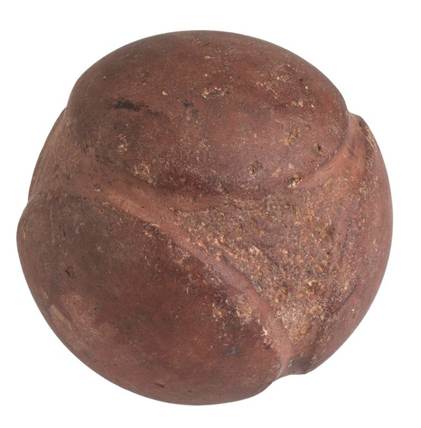
The list of known finds of carved stone balls, according to Stewart-Moffitt’s Catalogue is shown in table 4.9.
| Findspot and Trove ID | No of knobs | Other decor-ation? | Diameter (mm, average) | Stewart-Moffitt Cat No CSB… | Type of stone (where identified); Current location and Reg. No |
| In or near the Water of Leith, City of Edinburgh 51930 | 4 | No | 64.22 | 290 | Felstone. National Museums Scotland NMS X.AS 16 |
| ‘Edinburgh’ No Canmore ID | 6 | No | 73.73 | 243 | Clifton Park Museum, Rotherham ROTMG. 218/571 |
| Kirkton, Hawick, Scottish Borders 55360 | ‘Many’ (incomplete) | No | 65.9 | 037 | Gabbro or amphibolite. Hunterian Museum, GLAHM A.145 |
| Possibly Wilton Lodge, Hawick, Scottish Borders 54160 | 6 | Yes | 67.6 | 001 | Hawick Museum 4055; cast in NMS, NMS X.AS 207 (CSB 437) |
| Hawick, not far from Hawick Museum, Scottish Borders No Canmore ID | 6 | Yes | 67.63 | 437 | Hawick Museum; cast in NMS, NMS X.AS 209 |
The overall distribution of carved stone balls has a huge concentration in Aberdeenshire (Marshall 1977, figs 10-14; Stewart-Moffitt 2022, map 5.1), and appreciable numbers have also been found in Angus, Fife and Orkney. Virtually all have been stray finds, but the discovery of examples at the sites at Ness of Brodgar, Skara Brae and Links of Noltland in Orkney demonstrates that they were in use during the early third millennium BC. Their function has endlessly been debated for example by Edmonds (1992) Marshall (1977) and Stewart-Moffitt (2022) but it seems most likely that they were both symbols of power and weapons. Some skulls in Orkney have holes whose shape and size are consistent with a heavy blow from a carved stone ball, a macehead, or one of the other carved stone objects that were in use in Orkney at that time. The presence of a few carved stone balls in south-east Scotland offers further evidence for external contacts during the Late Neolithic, and also suggests a degree of social differentiation in this part of Scotland at that time. Whether the inhabitants of south-east Scotland obtained them through contacts with people in north-east Scotland or with the elite in Orkney is impossible to determine, however.