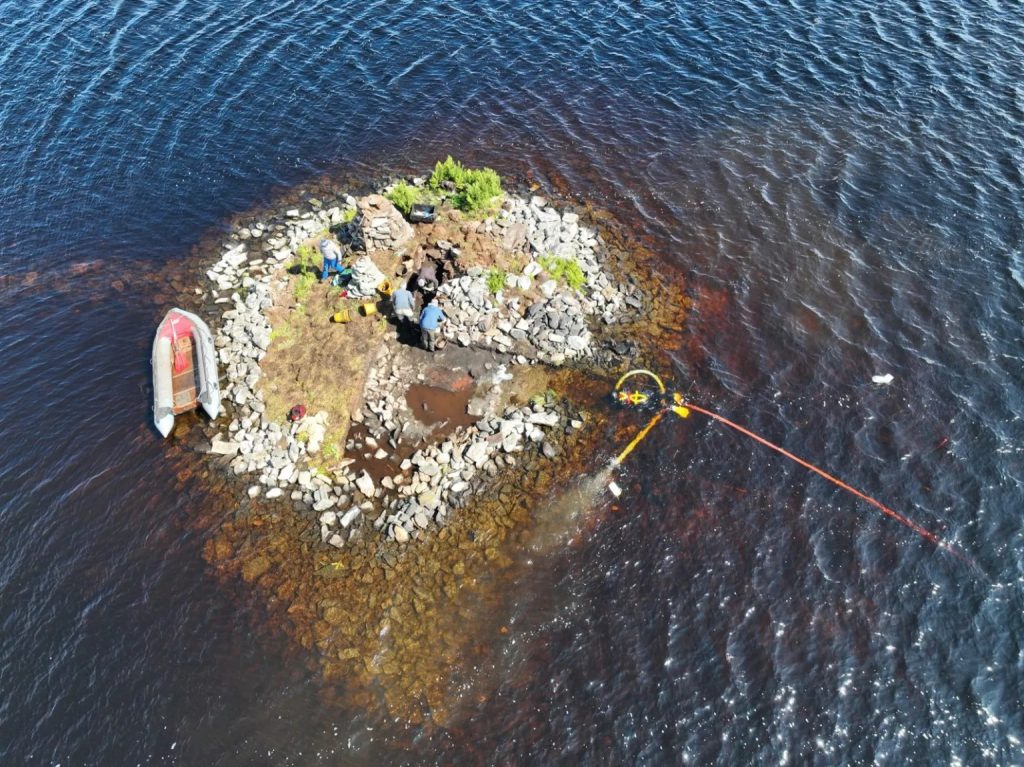
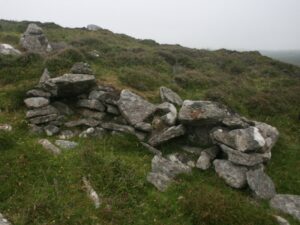
The degree to which historic and prehistoric communities across the Outer Hebrides were connected to, or distinctive from, broader regions across Scotland, Britain and Europe are recurring research themes. This includes questions about the movement of people, about physical connections between communities inter-and intra-island, as well as island-mainland, about material and cultural connections, shared and distinct identities, as well as economic links and trade connections or the lack thereof. Whilst it is tempting to view these questions as specifically important to islands, the reality is that they are relevant questions in all archaeological contexts. The challenge for researchers of Outer Hebridean material is to better understand the mechanisms for physical and cultural interactions in this specific island-setting. This means addressing modern assumptions about Outer Hebridean island insularity and peripherality, engaging more effectively with the nature of island and marine travel, and questioning the appropriate region and scale of island case studies – more often a connected archipelago than an individual island.
Assumptions about the insularity of island communities, past and present, proliferate within many traditional archaeological narratives for the Outer Hebrides. Preconceived assumptions on the inherent insularity and remoteness of the Outer Hebrides continue to impact archaeological research. Yet, for much of the past these islands were clearly not ‘remote’, as we might now perceive them, but instead optimally located for marine-based travel that placed the islands at the centre of a busy network of island and coastal communities connected via the Atlantic, Irish Sea, Minch, North Sea, and beyond. Conversely, however, there are periods where archaeological evidence points to some distinct traditions and practices across the Outer Hebrides perhaps suggestive of more insular-identities and regionally specific systems of cultural meaning and value. Integrating Gaelic language and culture into studies on this theme can greatly enhance researcher knowledge and understanding of connectivity in the past and present, as well providing insight into how island communities have considered their role in the wider world.
Arguably, the archaeology of the Outer Hebrides is too frequently viewed as an area of specific, and therefore of insular study. Although most archaeological research addresses connectivity themes in one form or another, comparison with wider or alternative narratives for example (Parker Pearson 2004, Sharples 2021), there are surprising few recent research projects concerned primarily with wider Hebridean connections. For early prehistory, the Stepping Stones Project is an excellent example of a research project with a particularly focus on how evidence from the Outer Hebrides articulates with wider patterns of Neolithic expansion (SIRFA Case Study: Islands of Stone). The Boyne to Brodgar project has a similar connectivity theme, setting out to enhance understanding of the cultural connections between the Outer Hebrides and other parts of Scotland and Northern Ireland via Neolithic monument construction, a topic that will be further enhanced with the results of the forthcoming Scotland’s Earliest Megalithic Monuments project. Another notable example here is the Scottish Grave Goods project (Cooper et al 2020).
The strength of these research initiatives is the focused consideration of Outer Hebridean material within a broader prehistoric context and recognition that Hebridean material has relevance to wider prehistoric narratives. However, like all good research, one of the outcomes of these research initiatives has been the emergence of new questions and research avenues on this theme. We still lack an adequate explanation for why the Neolithic across the Outer Hebrides looks so different from the Neolithic in Orkney, from mainland Scotland and from Ireland, in terms of settlement types and locales, and monumental expressions. Furthermore, what these differences suggest about the extent and depth of contact and connections between these different communities and about Outer Hebridean identities? To what extent were Neolithic communities within the Outer Hebrides connected? Perhaps more fundamentally, it is still unclear whether the first farming communities in the Outer Hebrides developed culturally from indigenous island populations or if they arrived from elsewhere.
Whilst a wider perspective to the Hebridean Neolithic has been relatively well explored, by comparison later periods are less frequently integrated into broader research projects. For the Iron Age, despite decades of focused research, we still lack an adequate explanation for apparent similarities and difference in monumental architecture between the Western and Northern Isles (although see Sharples 2021). We still do not fully understand why wheelhouses became a distinctive feature in both the Outer Hebrides and Shetland, but have yet to be identified in Orkney. The early historic period is characterised by a series of complex off-island connections – with evidence pointing to a mixture of new people, new languages, new cultural norms and practices, new belief systems that imply a series of complex inter and intra-island networks. Yet the mechanisms for these connections and the relationship between these varying off-island influences is still poorly understood. For the medieval and post-medieval period, the archaeological narrative is viewed as one where cultural insularity deepens as a result of external influences that inflict increasing economic and political marginality (Barrowman 2019). However, there is clearly scope for bringing later prehistoric and historic period material from the Outer Hebrides into wider comparative research projects.
Many key research gaps on these topics stem from a poor understanding of prehistoric and early historic seafaring and boat technology. There is clear need for more research that directly tackles these knowledge gaps for all periods. We know very little about prehistoric and early historic period boats that were used by Outer Hebridean communities. Likewise, knowledge of the marine and seafaring landscape is poor: Where were boats launched from? Which natural harbours were utilised in the past? What routes from, to and between the Outer Hebridean islands were likely exploited given available technology, weather systems, currents etc? How were inland waterways connected? As Blankshein has argued, we need a better understanding of maritime spaces and a more nuanced and holistic perspective on past seafaring and maritime movement (2021, see also McWhannell 2017, Angus 2020).
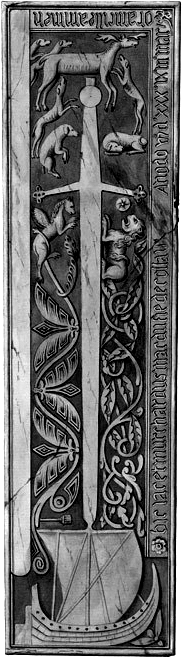
To aid these research questions, and to counter the likely lack of physical evidence, experimental work is highly recommended. Gaelic research is also of huge relevance here. The birlinn, a distinctive type of wooden galley ship propelled by oar and sail, is a well-known symbol of Hebridean power and navel prowess which features in a range of historical contexts. Although material remains of these vessels are yet to be identified, they are prevalent within Gaelic stories, poetry and song, perhaps most famously Birlinn Chlann Raghnaill (Cland Ranald’s Galley) by Alasdair MacMhaistir. Cheape discusses at length the Gaelic literary evidence for water travel technology, specifically logboats, amongst the west Highlands in lieu of any archaeological or physical evidence (1999). Use of such stories and other Gaelic resources to explore and understand the connections between the islands in the past could be hugely insightful about historic and prehistoric seafaring, marine travel and wider sea-based connections.
The degree to which people moved into and out of the Hebrides over time has become a topic with renewed potential and interest given methodological and theoretical advancements in aDNA and stable isotope analysis over the last few decades. There is huge potential for Outer Hebridean material to contribute to wider British and European debates about population changes during the Neolithic, Bronze Age and the early historic period specifically. However, the lack of human remains continues to be a barrier here. In a commercial and research context, recovery and post-excavation work on human remains needs to be prioritised. The use of isotope and aDNA work is obviously reliant on the collation of skeletal remains. This is difficult and presents issues (as referenced elsewhere) and it is unlikely this area will see development until an increase in the availability of skeletal remains is achieved.
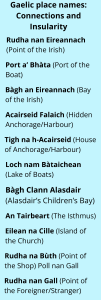
Archaeological questions about cultural and ethnic identity have much to draw from Gaelic language resources that address cultural affiliations, political connections and the impact of incoming populations. Norse-Gaelic place names and Gaelic loan words from Old Norse are prime examples where archaeological and linguistic research are combined to great effect. Likewise, Gaelic-place names continue to be fundamental to discussions about population displacement during the early historic period (Clancy 2024, Whyte 2024). In Ireland, stories of the Tuatha Dé Dannan, aos sídhe, and the Ulster Cycle are often discussed in direct relation to the archaeological evidence (Cunliffe 1999, 25-27, Waddell 2000, 334, 360) and there is great potential within Hebridean archaeology to employ similar approaches and thinking. Further exploration of Cù Chulainn and Finn and his Fianna, for example, potentially informs on cultural links between communities across the Outer Hebrides, Ireland, and the Isle of Man. The potential for using etymological and toponymic evidence to reflect on the relationship between ethnicity, language, cultural identity and population movement suggests research value here that extends beyond historic periods. For example, can our understanding of early historic period population movements, enhanced by linguistics and oral history resources, help us make sense of apparent population and cultural changes during early prehistory?
Connections and Insularity Research Questions
SIRFA OH40: How and why is the Hebridean Neolithic different from the evidence from Scotland’s Northern Isles?
More information on this question
Local framework numbering:
SIRFA OH40
More information:
The Neolithic across the Outer Hebrides looks different from the Neolithic across Scotland’s Northern Isles – both in terms of settlement types and locales and monumental expressions. Did the Hebrides have a distinct identity from Neolithic communities in the Northern Isles? To what extent were there links and connections between these places? Whether there were connections or insularity from the wider island setting –the question remains as to why this was the case? This is a very broad and wide-ranging question and is not likely to be answered with a single research project; it is encouraged that a series of projects (or PhDs) are designed to tackle it. In a developer-funded context, the research significance of dating and other post-excavation work needs to be emphasised, in addition to the accurate and thorough recording of structures and material culture of this period.
SIRFA OH101: How did economic connections outwith the Hebrides fluctuate throughout the modern era?
More information on this question
Local framework numbering:
SIRFA OH101
More information:
The idea that Hebridean communities relied largely on unchanging, insular subsistence lifestyles for much for the modern period still persists. What evidence is there for external connections, commerce and trade throughout this period? Howe extensive were external trade networks and what resources were being traded? Moreover, how and why did these connections change over time? During industrial and economic collapse did people return to earlier subsistence practices or were new approaches found? Our understanding of potential booms and busts of the Hebridean economy is currently limited, along with our knowledge of the resources and extent of any international connections. Furthermore, what was the impact on local communities and landowners? This is a huge topic, currently under explored from an archaeological context. It includes, but is not limited to topics on the Clearances. Other impacts that require attention include the seaweed industry, Leverhulme and fisheries.
SIRFA OH50: How did the Beaker ‘package’/culture present in the Outer Hebrides?
More information on this question
Local framework numbering:
SIRFA OH50
More information:
Currently the Beaker culture appears to differ across the Outer Hebrides when compared to that of either Shetland or Orkney (for example, the lack of double houses). The extent of this difference is not fully understood. The current lack of known Beaker burials in the Outer Hebrides contrasts, for example, with what is understood of the Inner Hebridean (and Scottish mainland) Beaker period and raises questions of whether this is due to lack of evidence or a strongly regional identity. These are broad questions, and it is unlikely that they will be answered via a single research project; it is encouraged that a series of projects (or PhDs) are designed to tackle this. It is likely that these questions will be addressed partly through collation, reassessment and reanalysis of existing material and literature. New survey work and data, with a potential later focus on long-term excavation efforts.
SIRFA OH82: What is the chronology of the earliest Christian sites across the Outer Hebrides?
More information on this question
Local framework numbering:
SIRFA OH82
More information:
The arrival of Christianity is understood to have originated from Ireland, however, there has thus far been little to no evidence of these early sites found. Can this traditional narrative be further supported with archaeological evidence? Did Christianity in the Hebrides originate from the south, or from the Picts in the east? Building a chronology of early Christian sites will help us to further understand Iron Age connectivity, insularity and social links.
SIRFA OH89: What was the effect of international conflict on the Hebrides during the Medieval period?
More information on this question
Local framework numbering:
SIRFA OH89
More information:
The impact of international conflicts – both involving Scotland and not – on the Hebrides is relatively understudied. Undoubtedly events such as the Wars of the Roses and the English occupation of Ireland had far reaching effects, but did they have any noticeable impact on Hebridean life? What were these effects? Interdisciplinary approaches are almost certainly the way forward here. These questions would benefit from new theoretical and more holistic approaches. Reanalysis and synthesis of existing datasets will be key, including reanalysis of museums and archive collections. A more detailed understanding of the Outer Hebrides medieval period more generally will underpin new research. In a developer-funded context, the significance of medieval remains to address questions about Hebridean responses to international conflict needs to be emphasised. Alongside this the importance of dating and post-excavation work.
SIRFA OH81: What was the Outer Hebrides relationship with Pictland & ‘Pictishness’?
More information on this question
Local framework numbering:
SIRFA OH81
More information:
During a period where Pictish identity is clearly emerging in the rest of Scotland, the physical evidence shows that the Outer Hebrides appear to buck the trend. Is this an indication that these islands weren’t under control of Pictland? Were they culturally distinct, or more closely related to Irish culture of the time?
SIRFA OH10: What was the relationship between Outer Hebrides and mainland Britain, Ireland and continental Europe during the Mesolithic?
More information on this question
Local framework numbering:
SIRFA OH10
More information:
Did Mesolithic communities across the Outer Hebrides have a relationship with the populations of these wider areas? Can this be determined from material culture found across the Outer Hebrides? What methodologies would be best utilised for exploring this question? It is likely that in response to this question researchers will need to take a multi-disciplinary and holistic approach, as well as working in conjunction with colleagues in England and elsewhere in Europe. In a developer-funded context, the research significance of Mesolithic remains needs to be emphasised.
SIRFA OH100: What was the social impact of military development during the World Wars, and later the Cold War?
More information on this question
Local framework numbering:
SIRFA OH100
More information:
During conflicts throughout the 20th century, the military developed various parts of the Outer Hebrides and constructed some major infrastructure. The most obvious examples of these are Benbecula and Stornoway airport, as well as the later MoD Hebrides. The construction and utilisation of these military installations also required the construction of (temporary) military accommodation. What was the social impact of the arrival of these personnel & the related developments? Did the personnel integrate with the local communities? Archaeological survey and oral history recording projects will be important here.
SIRFA OH51: What were the social dynamics between arriving and established populations in the Outer Hebrides during the Bronze Age?
More information on this question
Local framework numbering:
SIRFA OH51
More information:
Immigrant communities are well-known to influence the culture and society of communities they move into. Is it possible to trace this in the archaeological record for the Hebridean Bronze Age? Can we determine elements of interaction between incoming and established communities for this period? Additionally, are differences in population, culture and society reflected in land use & farming techniques? It is likely that these questions will be addressed partly through collation, reassessment and reanalysis of existing material and literature. Ancient DNA and stable isotope analysis have a potential role, although currently there is a lack of data and appropriate samples. Expanding Bronze datasets for the Hebrides are therefore likely to be fundamental for unlocking the value of these potential approaches towards addressing these questions.
SIRFA OH103: Where are the locations of the unknown individuals washed ashore during the World Wars?
More information on this question
Local framework numbering:
SIRFA OH103
More information:
Until recently it was customary amongst the islands to bury the unknown bodies of those washed ashore nearby where they were found. This includes those washed ashore during the World Wars. Are the locations of all of these burials known or recorded? Can the tides and currents be used to predict the location of those not recorded? Is it possible to now identify these individuals? Due to their proximity to the shoreline, many are now at risk of being lost to erosion. What is the ethical response to this?
SIRFA OH122: Are the social dynamics between the arriving and established populations during the Bronze Age reflected in land use?
More information on this question
Local framework numbering:
SIRFA OH122
More information:
Are the power and societal dynamics of the Bronze Age populations reflected in the land use of the period? Is this possible to determine through the archaeological record?
SIRFA OH126: How did the intensity & scale of Hebridean connectivity change over time?
More information on this question
Local framework numbering:
SIRFA OH126
More information:
The degree to which Hebridean society was connected to other places clearly fluctuated through time. Whilst we know that through much of human history the Outer Hebrides have had connections to Ireland, the Inner Hebrides, Orkney, etc the scale and nature of these connections is still poorly understanding. Were connections primarily economic links, or more socially driven? What was the frequency of physical connections between these places? Indeed, is there any way to trace this in the archaeological record?
SIRFA OH128: How has boat technology across the Hebrides changed through time – physically, socially, & even in terms of hierarchy?
More information on this question
Local framework numbering:
SIRFA OH128
More information:
For an island archipelago boat technology is of utmost importance, yet we know very little about this aspect of Hebridean life up until the Early Modern Era. It is unknown what prehistoric boats looked like or functioned. Even the famous medieval birlinn is only known from descriptions Gaelic poetry/oral traditions and stone carvings. Little physical evidence of boating technology has yet to be found; why? Without this physical evidence is it possible to determine the importance of boats socially? Is it even possible to truly understand Hebridean connectivity?
SIRFA OH129: How has political power manifested in the Hebrides through time, and what impact has this had on the archipelago’s insularity and wider connections?
More information on this question
Local framework numbering:
SIRFA OH129
More information:
The Hebridean medieval period is defined by the rise and fall of the Lordship of the Isles; is their history typical of political power in the islands? How else has Hebridean political power manifested locally? In what way has this manifestation changed or evolved through time? Undoubtedly, localised power impacts connectivity (or insularity), but in what way? What is the physical evidence for this? This question may be answered on varying levels of scales – for example township, island, islands group, archipelago.
SIRFA OH127: How much of the general Hebridean populace took part in movements/migrations?
More information on this question
Local framework numbering:
SIRFA OH127
More information:
The question of who took part in population movements or migrations is an important aspect of connectivity that is often overlooked. Was this something restricted to a very select few? If so, who and why? Was this ability to travel and move available for all? Did this change through time, and if so, in what ways? Why? How do we utilise the physical record to explore these questions? It is likely that projects looking into these questions will be focused on isotopic or DNA analysis techniques, although material culture and architecture may also be useful.
SIRFA OH118: Were the first Neolithic farmers in the Outer Hebrides indigenous or invaders?
More information on this question
Local framework numbering:
SIRFA OH118
More information:
Archaeological Sciences are increasingly an integral part of archaeological research and work. Extensive isotope has yet to be carried out on Outer Hebridean material; what can this reveal? Did Neolithic Hebridean populations have dietary practices differing from the rest of Scotland (or the other Scottish island groups)? Is there evidence indicating population movements, for example incoming groups? The use of isotope work is reliant on the collation of skeletal remains (both human and animal) and as such this question requires the retrieval of such material. This is difficult and presents issues (as referenced elsewhere); it is unlikely this area will not see development until an increase in availability of skeletal remains is achieved.
SIRFA OH116: What drove and motivated the apparent expansion of hunter-gatherer communities into the Scottish islands between 7,000 and 6,000 BP?
More information on this question
Local framework numbering:
SIRFA OH116
More information:
This question is relevant to the Northern and Western Isles, as well as the Inner Hebrides. Were the motivations, mechanisms and outcomes similar across these island groups or do we see different, more localized narratives? What of the wider scale of early prehistoric patterns of movement – how does Mesolithic exploitation of the Northern and Western Isles compare with those into other island and coastal regions across Britain the Isles?
SIRFA OH124: What impact did the Black Death have on the Outer Hebrides?
More information on this question
Local framework numbering:
SIRFA OH124
More information:
The Black Death had a catastrophic impact across the entirety of Europe, yet it is still unclear how this affected the Outer Hebrides. What archaeological evidence is there for widespread death and disease in the Hebrides during the medieval period?
SIRFA OH117: What is the relationship between monumental Neolithic architecture found across the Outer Hebrides, Orkney and Shetland?
More information on this question
Local framework numbering:
SIRFA OH117
More information:
The three archipelagos have related but clearly divergent traditions of monumental Neolithic architecture. In the first instance, there is a need to better understand how these groups of monuments relate to one another chronologically. Additionally, what is the relationship in terms of construction, use and monument biography.
SIRFA OH125: What was the effect of international conflict on the Hebrides during the Middle Ages?
More information on this question
Local framework numbering:
SIRFA OH125
More information:
The impact of international conflicts – both involving Scotland and not – on the Hebrides is relatively understudied. Undoubtedly events such as the Wars of the Roses and the English occupation of Ireland had far reaching effects, but did they have any noticeable impact on Hebridean life? What were these effects?
If you have answered a research question, or have an update to add about a specific site or period, you can use our inline comments to flag the change and keep the frameworks up to date.
Register for an account, or login now to add updates and comments to our existing frameworks.