
With the exception of the Middle Bronze Age gold bar torc from Slateford, the most spectacular prehistoric finds in south-east Scotland belong to the Late Bronze Age. Hoards and individual finds of bronze artefacts reveal a rich picture of elite society, their activities and their connections, during this period.
This period is interesting for several reasons, not least because the late second millennium BC was a time of climate deterioration. Cooler and wetter conditions led to peat expansion and made it hard to continue cultivating cereals in the uplands. Evidence for this comes from palaeoenvironmental research of the Bowmont Valley and the Cheviot Hills more generally (Tipping 2010, 174-8). During the Middle Bronze Age, people were cultivating cereals, keeping domestic animals and living in unenclosed platform settlements at elevations up to 400 metres above sea level (Tipping 2010, 175). However, ‘Between 1300 cal BC and 1150 cal BC the growing of barley appears to have ceased in the deep set valley at Sourhope, on the higher but better drained plateau of Swindon Hill and on the increasingly peat covered summit ridge at Cocklawhead…’ (Tipping 2010, 177). However, Tipping qualifies this by stating ‘This is not necessarily evidence for settlement abandonment of the Cheviot uplands.’ (Tipping 2010, 177). He suggests that people were still probably using the uplands for grazing, perhaps on a seasonal basis, even though they ceased to grow cereals in the uplands. He also notes that soil erosion became common on the summit ridge of Cocklawhead after about 850 BC. From around 950 BC groundwater levels rose substantially at Sourhope.
Despite this evidence for climatic deterioration and changes in the nature of land use (at least in this part of south-east Scotland), there is evidence that some high places were being used for some kind of settlement during the Late Bronze Age.
A recent community-co-created project on Eildon Hill North, Scottish Borders (Canmore ID 55668) has confirmed that there is ‘a major horizon of Late Bronze Age activity’ on the hilltop. This pre-dated the construction of the Iron Age ramparts. In other words, it was an unenclosed hilltop settlement, with many round houses (O’Driscoll and Noble 2022). Radiocarbon dates of 1014–811 cal BC (GU-2190, 2760±50 BP), 1208–917 cal BC (GU-2370, 2870±50 BP) and 1193–431 cal BC (GU-2197, 2680±130 BP) have been obtained from Late Bronze Age features. A bronze artefact comes from a pre-rampart pit associated with the first two radiocarbon dates (Owen 1992, 61). A similar object was found on Traprain Law, East Lothian, another prominent landmark with evidence for intensive Late Bronze Age occupation (summarised in Haselgrove 2009, 226)
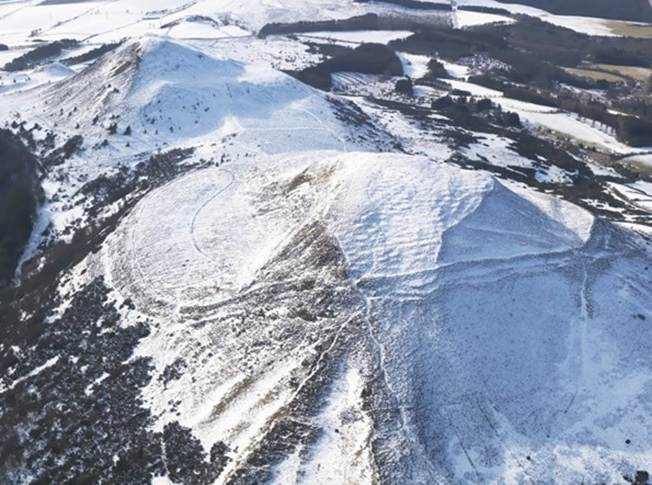
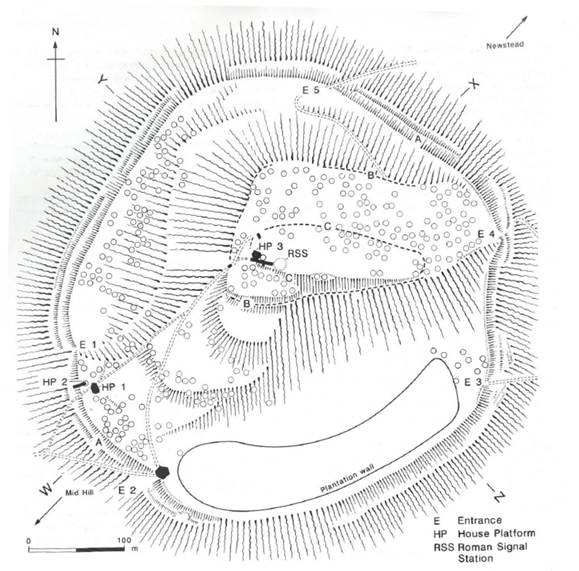
The spectacular, prominent location of this Late Bronze Age settlement invites speculation that it was not a normal settlement, but rather could have been associated with the elite in a highly socially differentiated society.
Other information on Late Bronze Age settlement in south-east Scotland, this time on the fertile East Lothian plain and its hills, comes from the excavations carried out as part of Colin Haselgrove’s Traprain Law Environs Project (Haselgrove 2009). Up to four of the enclosed settlements investigated in this project were found, or suspected, to be of Late Bronze Age date (Haselgrove 2009, 236 and fig. 11.1). At Standingstone, an enclosed settlement on a hill slope overlay an open or semi-enclosed settlement of the late second millennium BC (Haselgrove 2009, 54-61). The palisade has been radiocarbon-dated to 1010-830 cal BC (SUERC-10530 and 10531: Haselgrove 2009, 59-60). It seems likely that it enclosed a single round house.
The palisade and at least one ditch circuit at East Linton are also clearly of Late Bronze Age date, while the Whittinghame enclosure may also belong to this period. The earlier of the two Foster Law enclosures is another contender (Haselgrove 2009, 226). Further evidence for Late Bronze Age domestic activity in East Lothian was provided by the commercial excavations relating to the A1 upgrade: at Howmuir, a post hole produced a radiocarbon date, from willow charcoal, of 900-780 cal BC (SUERC-7530, 2650±35: Lelong and MacGregor 2007, 122, 286).
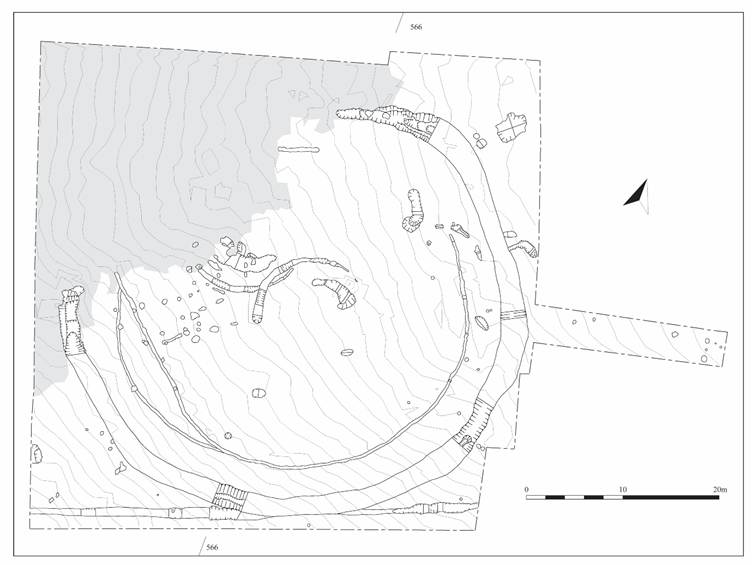
The question of how these relatively small enclosed settlements relate to the denser house-structures found on Traprain Law, dating mainly to the 10th and 9th centuries cal BC, is one of many outstanding research questions. Was there a settlement hierarchy, corresponding to different ranks in Late Bronze Age society, with the elite and their entourage occupying prominent locations, while lower-ranking members of society occupied the lowlands?
As for funerary practices during the Late Bronze Age, very little is known, in contrast with the Iron Age. The skeleton from Grainfoot house, Longniddry, East Lothian (SESARF 5.1.3 Middle Bronze Age) has a radiocarbon date whose calibrated range extends into the Late Bronze Age. It is one of several skeletons found in a cemetery (Dalland 1991).
It is in the material culture of the Late Bronze Age – and particularly in the bronze artefacts – that we get the most vivid picture of a society that was highly socially differentiated. The evidence includes some spectacular weaponry and material associated with elite feasting. Other artefacts point towards the use of horses for transport and display, while others relate to personal adornment, and yet others such as socketed axeheads were tools. The deposition of hoards, in some cases featuring objects that had been deliberately destroyed and deposited in watery locations, reveals aspects of ritual practice that suggest competitive conspicuous consumption of a precious resource.
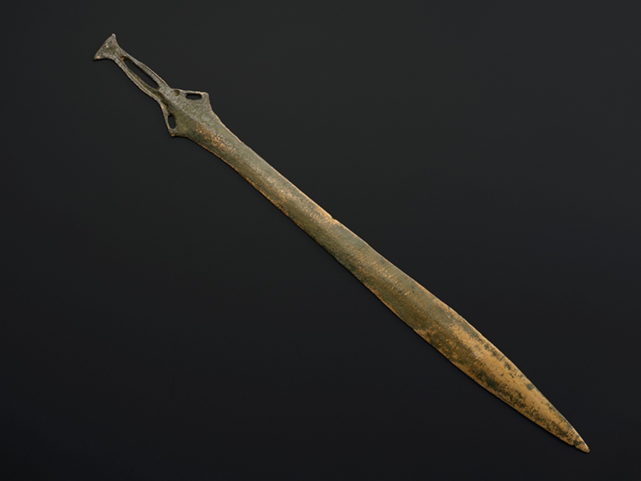
The weaponry includes leaf-shaped swords and spearheads, such as the Wilburton-type sword deposited, probably in its sheath, at Corsbie Moss, Legerwood, Scottish Borders. This is an old find, and it had been claimed that it was associated with a side-looped spearhead (Coles 1964). However, Matt Knight (2019a) has pointed out that the latter dates to around 1500-1400 BC, whereas the sword dates to between 1150-1020 BC. Arguably the most plausible explanation for this apparent co-occurrence of two precious artefacts of widely differing dates is that Corsbie Moss was a watery location to which people returned, at different times, to make votive deposits.
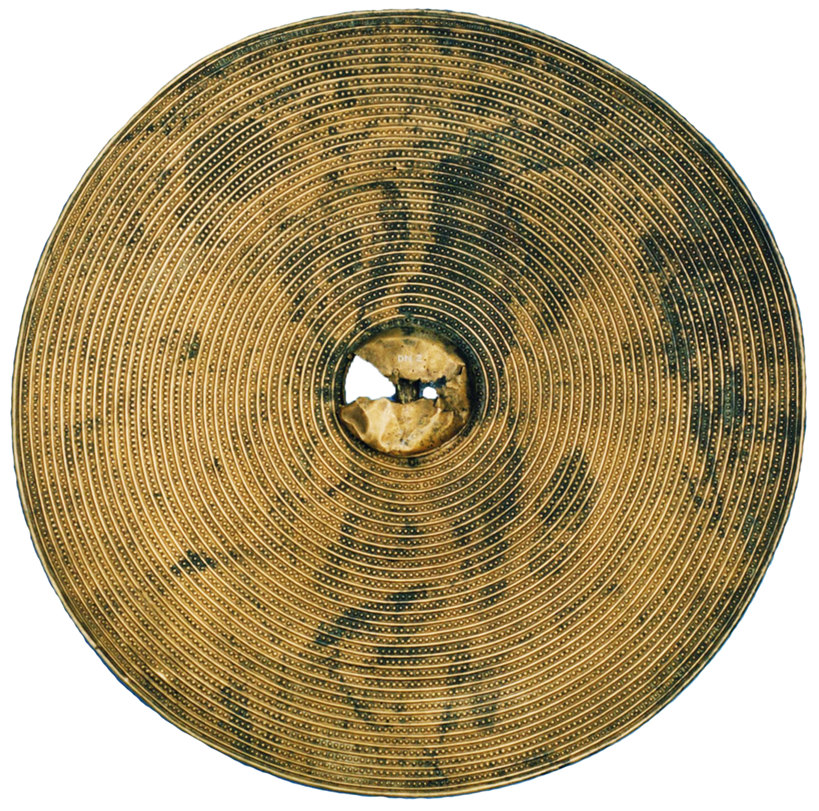
The three Late Bronze Age sheet-bronze shields that were found in a moss at Yetholm, Scottish Borders are masterpieces of the bronzesmith’s craft (Coles 1960, 131-2). John Coles (1962) had suggested, on the basis of experimental work using replicas made from sheet copper that such shields could not have withstood serious blows from a sword or spear. He concluded that they were probably used for ritualised, performative combat between ‘heroes’. Subsequent research by Marion Uckelmann (2011) has, however, shed doubt on the reliability of the experimental work and argued that they would have been serviceable. Nevertheless, there may have been set-piece ‘combat’ between key members of the community.
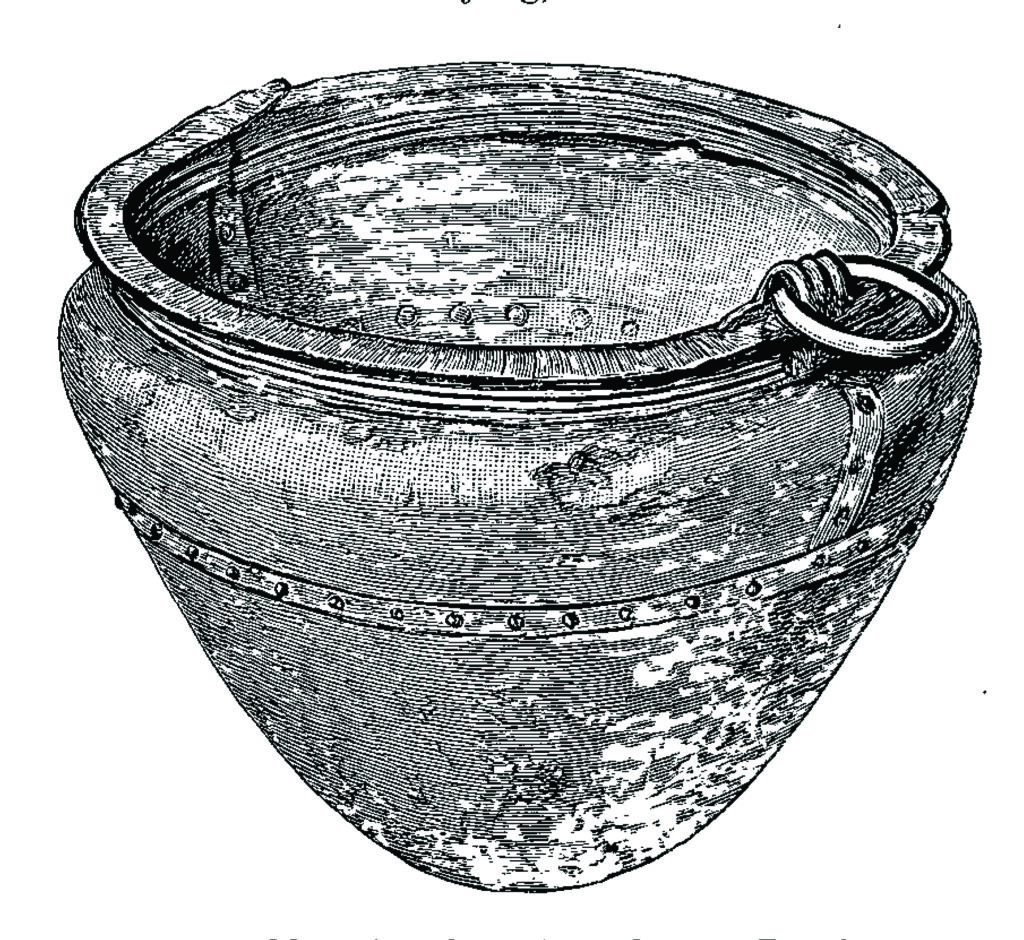
The performative activities of the Late Bronze Age elite clearly involved feasting, as is shown by items such as the sheet-bronze cauldron from Hatton Knowe, Scottish Borders (Buchan 1905). Cauldrons would have been used to boil large amounts of meat stew; the Hatton Knowe one measures approximately 53 cm across by 39 cm top to bottom.
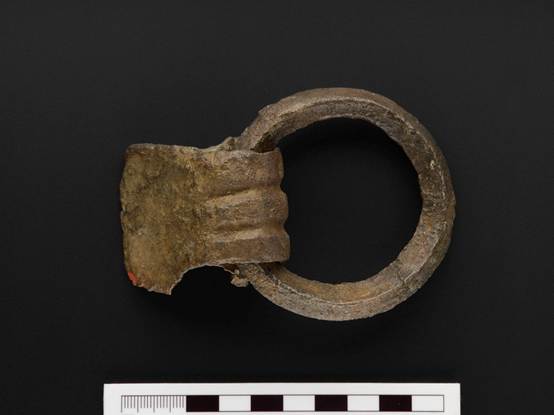
So-called ‘buckets’ were also part of Late Bronze Age feasting equipment, and these would have been used to contain liquid, probably alcoholic. A handle from a bucket was found as part of the hoard in Duddingston Loch, City of Edinburgh (Coles 1960, 88, 117).
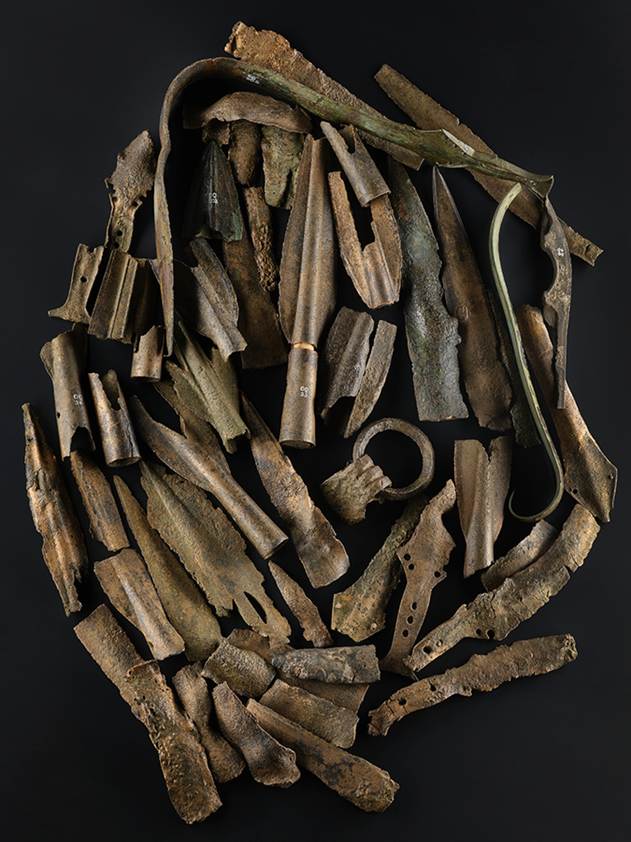
One significant feature of some Late Bronze Age hoards is the presence of horse tack. A recent example, currently being researched by Matt Knight of National Museums Scotland, was found near Peebles, and contains preserved organic elements which help to make sense of how the various ornaments were deployed. It also includes ‘rattle pendants’ (jingle-plates) of tinned bronze, which would probably have been attached to a cheek-piece and would have rattled as the horse moved.
The presence of horse tack indicates that domestic horses were in use at this time; they are known to have been present in Scotland from at least as early as 1100 BC, and in Britain as a whole the evidence indicates introduction from the continent around 1450 BC (Sheridan et al 2025). Horses, which would have been pony-sized, would have been precious and prestigious possessions, and a novel form of transport. While no metal bits are known from this period in Scotland, it would have been possible to ride a horse with some other form of control gear such as a halter, or else bits made from organic material could have been used.
The question arises as to whether horses were used to pull vehicles at this time. It is known that wheeled vehicles existed: a set of block wheels from Blairdrummond Moss, Perth and Kinross, dates to around 1000 BC. However, those wheels were from a heavy cart-like vehicle and it is likely that oxen had been the draught beasts. One object from a hoard containing horse tack at Horsehope, Scottish Borders (Coles 1960, 123-4) was identified by Stuart Piggott as a vehicle fitting (Piggott 1953), but this suggestion has not been universally accepted. More research on the object and its possible use is required.
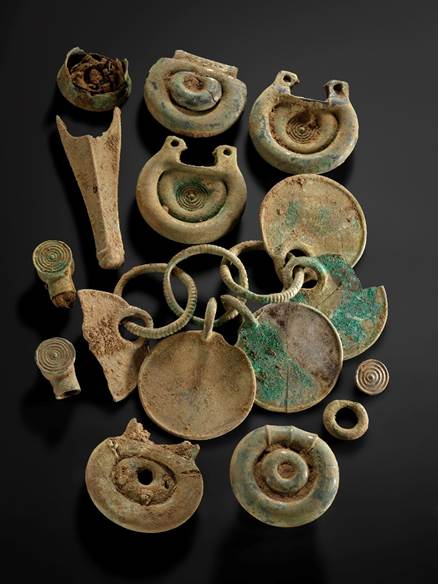
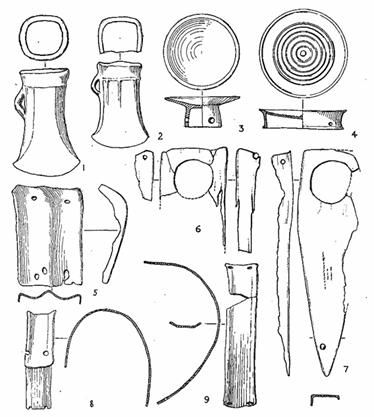
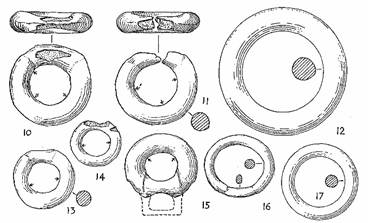
Artefacts from the Horsehope hoard, Scottish Borders. No 7 is the alleged vehicle fitting. From Piggott 1953
The deliberate deposition of valuable possessions, often in watery contexts and sometimes after deliberate breakage, was not just a way of honouring the gods (Knight 2019b). It was an act of demonstrating one’s wealth and power, and there may well have been an element of competitive conspicuous consumption involved.
One way of understanding this behaviour is to consider the wider context in which such acts were taking place. The Late Bronze Age elite was, as Stuart Needham has pointed out, linked in to an extensive network of elite contacts extending over Atlantic Europe (Needham 2007). Similar forms of weaponry and feasting gear were shared across wide areas, and increasing amounts of bronze artefacts were being deposited as votive offerings. Around 800 BC, however, this ceased. This was not just because a new metal, iron, was coming into use. Needham has argued that there was a kind of inflationary spiral had been occurring, whereby it was becoming necessary to dedicate increasing amounts of wealth to the gods. At some point, people decided that this was no longer sustainable, and the whole network experienced a crisis.
Comments 1
For Yetholm, this up-to-date reference is accessible online:https://www.academia.edu/29756517/Yetholm_revisited_old_and_new_finds_of_high_quality_Late_Bronze_Age_metalwork