It is likely that this period witnessed a significant rise in the population and an expansion of settlement into the uplands, to judge from the abundance of unenclosed platform settlements (UPS), particularly in Tweeddale (Halliday 1985; Ward 2013a). The number of identified UPS has risen dramatically, thanks to targeted survey by the Biggar Archaeology Group and Peebles Archaeological Society. In 1967, when the RCAHMS published its Inventory for Peeblesshire (RCAHMS 1967), some 40 examples were known, and they were assumed to be of Iron Age date. In contrast, a review of this site type in Clydesdale and Tweeddale has identified 213 individual platforms from Tweeddale alone, and 627 if those from Clydesdale are added (Ward 2013a, 59). It is highly likely that some were not constructed until the Late Bronze Age, or even possibly the Early Iron Age and further radiocarbon dating of these sites is required. There are however Middle Bronze Age dates from Green Knowe and Fruid Reservoir in Tweeddale (Jobey 1980; Ward 2013a, 41).
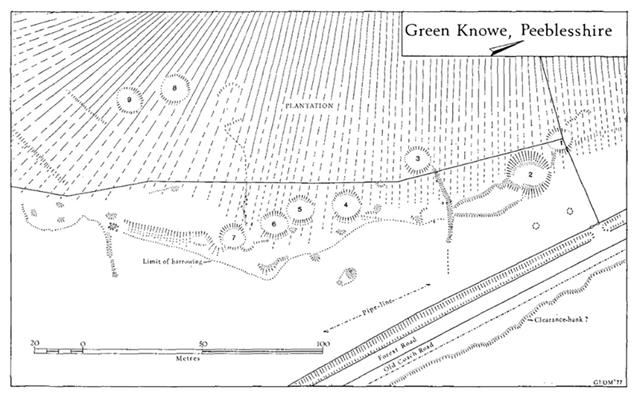
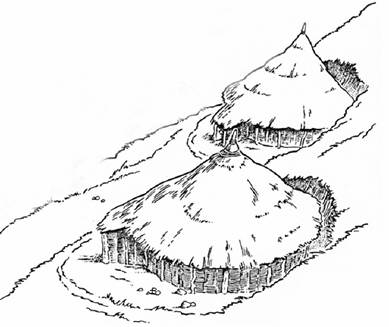
The best-known UPS is at Green Knowe, Scottish Borders (Jobey 1980), located in Upper Tweeddale. Here, on the slopes above the Meldon Burn, were the remains of cut platforms for nine round houses – there may originally have been more. There were also traces of field banks composed of stones that had been cleared from cultivation areas, along with field clearance cairns. The round houses were each large enough to accommodate a family residential group. The house on Platform 1, for example, had a diameter of 8.5 metres. Assuming that most of the round houses were in broadly contemporary use, then it is likely to be a settlement for a small community.
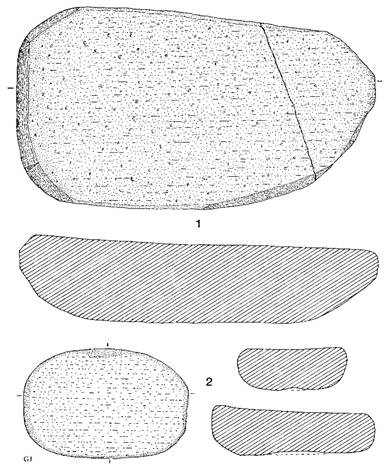
Evidence that the occupants were farming in the immediate vicinity is provided not only by the field banks, but also by saddle querns, grain rubbers and pounders, for the processing of cereals.
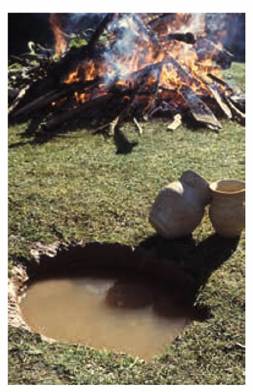
There is evidence from elsewhere in Tweeddale (and Clydesdale) that burnt mounds are likely to have been associated with occupation at UPS (Ward 2013a; see also Halliday 1990). Such structures offered a convenient and effective way of cooking meat, as has been shown by many experiments, including those by the Biggar Archaeology Group (Ward 2013a).
It has also been noted, at Weird Law near Tweedsmuir (McLaren 1966) and at Camps Reservoir in Clydesdale (Ward 2021), that the burial places of the occupants of UPS are not far from the settlements themselves. These have been described as ‘enclosed cremation cemeteries’. The dead were, in most, but not all cases, cremated and their remains were buried in pits, within a cemetery bounded by a ring cairn. This means that, in Tweeddale (and in Clydesdale), traces of entire Middle Bronze Age landscapes of the living and the dead survive. The threats to this precious resource, from afforestation and from reservoirs, have been clearly set out by Tam Ward (2013a) and actions need to be taken to mitigate them.
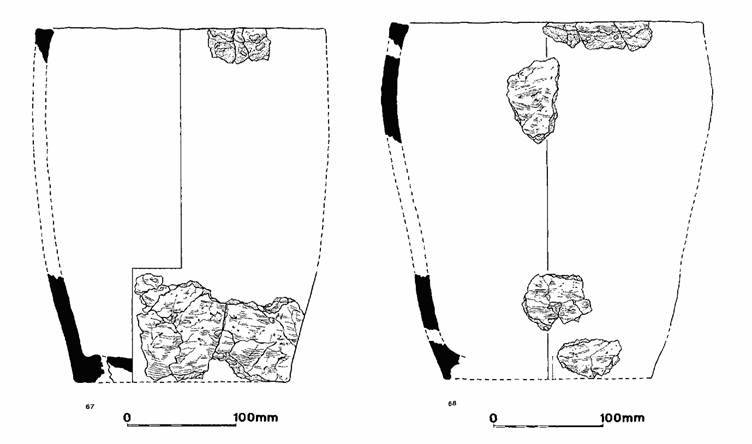
Middle Bronze Age funerary practices are also attested elsewhere in south-east Scotland. Cremation appears to be the norm, but inhumation is also attested. At Meldon Bridge, Scottish Borders, an extensive Middle Bronze Age cemetery was found, seemingly associated with rows of upright posts with cremated remains in some of the postholes (Burgess 1976; Speak and Burgess 1999). Also present, elsewhere at Meldon Bridge, were two graves in which cremated remains had been buried in coarse, undecorated cinerary urns known as Bucket Urns. A calcined bone from one of these graves, which contained two urns, was radiocarbon-dated for the National Museums Scotland Radiocarbon Dating Programme and produced a date of 1420-1120 cal BC (GrA-23406, 3040±50 BP: Sheridan 2007b, 170).
At Doon Hill, East Lothian, small quantities of cremated human remains were found in six pits, and have produced Middle Bronze Age radiocarbon dates (Ralston 2019; in press). The same kind of pottery found at Meldon Bridge was also found at Doon Hill.
Evidence that inhumation was still being practised in the MBA – albeit probably as a minority rite – comes from the radiocarbon dating of one of two individuals whose recently disturbed remains were found in a short cist at ‘Grainfoot’ house, Longniddry, East Lothian (Dalland 1991; Patterson et al 2021). The calibrated date range of 1279-980 cal BC (GU-2762, 2930±50 BP) extends beyond the Middle Bronze Age into the Late Bronze Age.
As far as the construction of non-funerary monuments during the Middle Bronze Age is concerned, there is no clear picture. No timber or stone circle, individual standing stone, or any other kind of monument has, to the author’s knowledge, been radiocarbon-dated to this period.
Middle Bronze Age material culture in south-east Scotland can be summarised as follows:
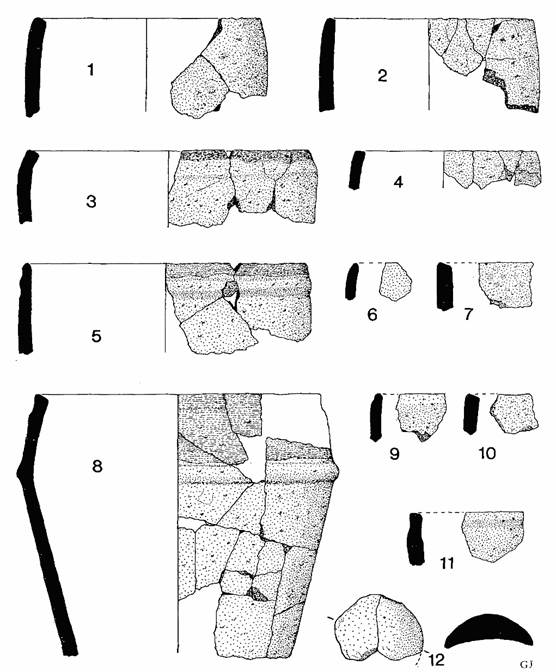
Pottery: The type of pottery in use in funerary and domestic contexts has traditionally been lumped into a general category of ‘flat-rimmed ware’, with the term ‘Bucket Urn’ being used to describe the funerary pottery. It is generally coarse, fairly thick-walled and undecorated, with squared-off, in some cases bevelled rims and flat bases. The domestic assemblage from the Green Knowe UPS includes examples embellished with a single cordon, including one vessel that is bipartite in shape. The relationship of the Green Knowe pottery to other domestic Middle Bronze Age pottery has been discussed by Colin Burgess (1995) and Stratford Halliday (1985).
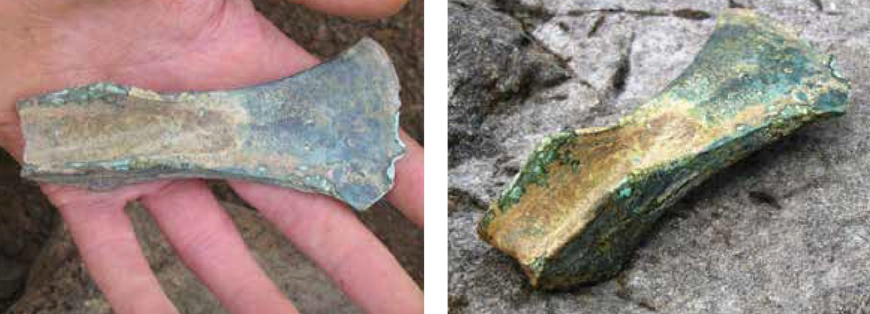
Metalwork: A small but growing amount of Middle Bronze Age bronze metalwork is known from south-east Scotland. Most of the finds are of flanged axeheads, such as the example from Corstorphine, City of Edinburgh, below.
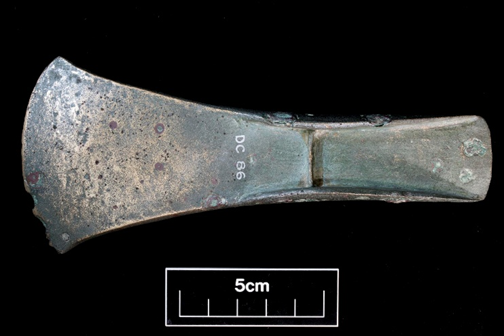
One flanged axehead, found at Fruid Reservoir, Scottish Borders is informative as it is a rare example of a well-contexted find (Ward 2013b). It comes from a UPS which has produced five radiocarbon dates ranging from 1517-1418 cal BC (SUERC-47423) to 1440-1260 (SUERC-17870; BP; Ward 2013b).
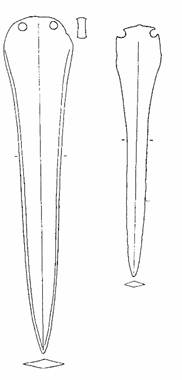
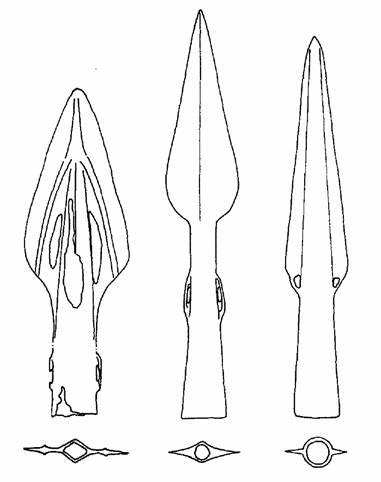
Other types of Middle Bronze Age bronze artefact found in this part of Scotland comprise
a) a few long-bladed weapons, including a dirk-like blade from Bog Park, Newton Don, Kelso, Scottish Borders and a long dagger or short rapier from Turnercleugh Law, Scottish Borders
b) several socketed spearheads
c) a tanged knife from Mid Calder, Midlothian (Coles 1964, 147).
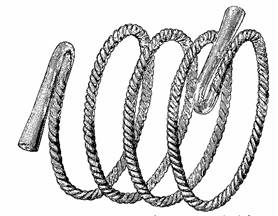
One Middle Bronze Age gold object, a bar torc, was found in 1808 at Slateford when the Caledonian railway was being constructed (Simpson 1862; Anderson 1884, 238; Coles 1964, 124, 147, pl VI). Sadly, like so many objects of precious metal, it was melted down, although there is a cast of it in the National Museums Scotland collections (NMS X.FE 45). It is described as being four feet (nearly 1.22 m) long. This rare and precious object indicates that society at this time was far from egalitarian.
Coarse and flaked stone artefacts: These are known mostly from UPS, and include the saddle querns and grain rubbers, already mentioned, from Green Knowe; various hammerstones; and scrapers, blades and flakes of flint and chert. A barbed-and-tanged flint arrowhead was found near a UPS in Fruid Valley (Ward 2013b, pl 42) but it is unclear whether this dates to the Middle Bronze Age or relates to Early Bronze Age activity in the area.
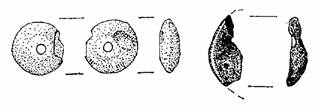
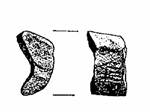
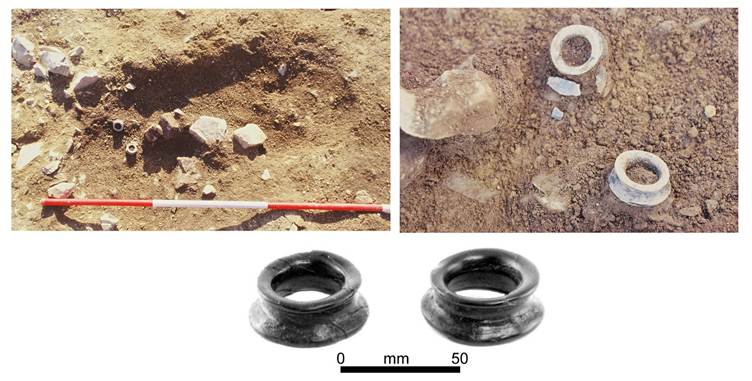
Jewellery (other than the gold bar torc): This is rare, but includes a distinctive type of Middle Bronze Age object known as a ‘napkin ring’ – fragments of which have been found in the UPS at Green Knowe (Jobey 1980, fig. 12.3) and Fruid Reservoir (Ward 2013b, plate 41). Such objects, made from cannel coal and/or oil shale, are almost exclusively found in southern Scotland and northern England (Hunter 2023; Sheridan 2025). A clue to their function is provided by the pair that were found just outside the SESARF region, in a grave at Camps Reservoir, South Lanarkshire (Ward 2021). While the body had decayed, the position of the ‘napkin rings’ strongly indicates that they had acted as ‘eyelets’ for securing a cloak: a thong would have passed through and around them.
Also found at Green Knowe UPS were a single amber bead, and a fragment of a possibly oval pendant, probably of cannel coal or shale. The amber had probably been acquired through exchange, since the nearest source of amber is the North Sea coast (where it is rare north of East Anglia).