
By Elena Borthwick and Anthony Campbell
Introduction
“How can archaeology help us understand drug use as a social issue in Glasgow?” is the research question this case study answers. The primary aim is to understand the role of archaeology in addressing the contemporary social issue of drug use and addiction, and what archaeological methods can contribute to learning about the social context of drug use. Glasgow was chosen for the case study because it has the highest rate of drug misuse deaths in Scotland (National Records of Scotland 2025) and it being home to all researchers involved in this study.
Argument
The argument that drug paraphernalia is material culture and should be accepted in the archaeological record is rooted in both its long ties to human history, and to the social value that results from researching it. Drug use itself predates written history, and material used to consume drugs can be traced back millenia to the Jirzankal cannabis braziers in Western China (Ren et al. 2019). The social value from researching it is the destigmatisation of drugs and drug users, and the inclusion of drug users in the wider
story of contemporary socioeconomics. First, drug paraphernalia as a category of material culture is defined by its reflection of drug subculture, one that practices its own values, ritual habits, and nomenclature. Second, the benefits of keeping paraphernalia
in the archaeological record are that it enables us to expand contemporary archaeology to a demographic of people that usually go unrecognised, or at most, stigmatised (negatively depicted). Third and last, the recording and research of drug paraphernalia supports us in tackling various social issues including drug deaths, deprived areas as a result of drug abuse, and social marginalisation of drug users.
Methodology
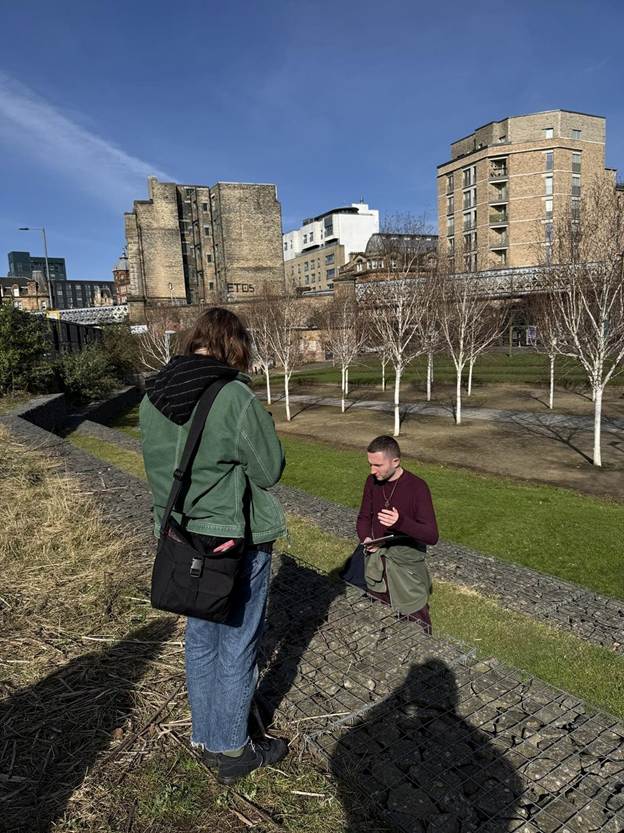
The methodology of this study consists of multiple field surveys of areas around central Glasgow, taking a fine-grain approach. First, a preliminary walking survey of the Barrowlands neighbourhood for reconnaissance. Second, independent field surveys of Garnethill and Glasgow Necropolis to test our GIS mapping and practice interpretation of finds. Finally, a conclusive field survey returning to Barrowlands in order to interpret, document, map gathered data, and observe changes over time. Tools used in this study were a finds camera, QGIS for mapping, and QField for collecting data in the field. The survey was non-interactive, there was no handling of drug paraphernalia.
Case Studies
Typology
The following typology was created for the field survey. Surveys were not exhaustive of all drug paraphernalia. The focus of this study was opioid-related paraphernalia, which was chosen for the survey recording. Primary paraphernalia is used for consuming and containing drugs. Ancillary paraphernalia is necessary for using primary paraphernalia.
| PARAPHERNALIA | |||
| PRIMARY | DESCRIPTION | ANCILLARY | DESCRIPTION |
| Syringe | Used for injecting | Bottle | Plastic bottles for preparation of injectable drugs |
| Bag | For containing drugs | Cap | Caps for syringes |
| Lighter | Used to cook drugs or for smoking | ||
| Packet | Containing acid for dissolving certain drugs | ||
| Spoon / Cooker | For cooking drugs | ||
| Tourniquet | Used for injecting | ||
| Foil | For heating drugs Found at sites but not recorded due to lack of definitive drug association | ||
| Packaging | Packaging for needles, foil, cookers, pipes etc. | ||
| Blades | For cutting substances | ||
Sites surveyed were visited multiple times. For readability, they are condensed into single sections. The chronology of visits were: Preliminary Barrowlands, Preliminary Garnethill, Necropolis, Garnethill, Main Barrowlands.
Independent Case Study: Garnethill (two visits)
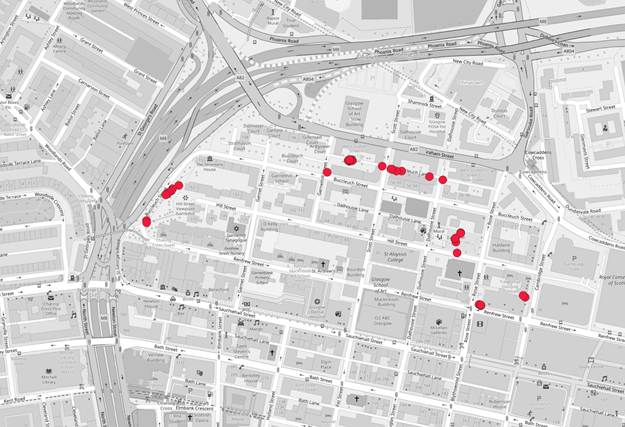
An independent survey of Garnethill was conducted in preparation of the main Barrowlands survey. The first visit was to observe areas for later recording. The second was to test GIS tools and practice interpretation. Found at Garnethill were multiple sites with evidence of repeated drug use including paraphernalia, provisions waste, and a hung tourniquet (fig. 4) – all found on both visits one month apart. The survey was not exhaustive, as not all areas were assessed. The key areas were W Buccleuch Street, Buccleuch Lane, and Garnethill Park. Below is the map of found paraphernalia around Garnethill.
Independent Case Study and some thoughts on lived-in spaces: Glasgow Necropolis
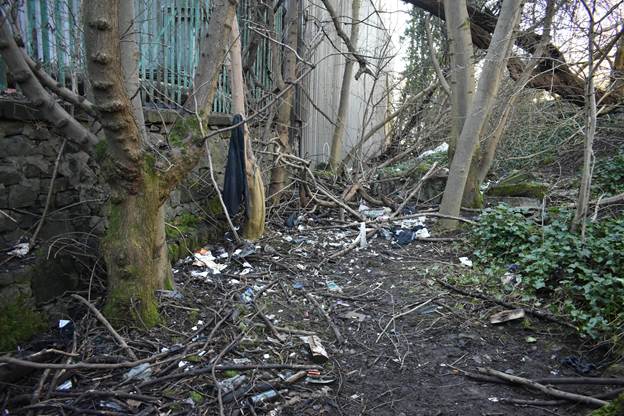
An independent case study of the Necropolis was one of the most significant parts of this research. The aim was to revisit the site that inspired this project upon first discovery of drug paraphernalia during a 2025 excavation. On the revisit we discovered a “drug den” hidden just out of view of the main path. This den had an uncountable number of drug paraphernalia, provisions waste, and other items such as clothing and signage. This site had more paraphernalia than all other sites combined, and was hazardous to explore (fig. 2). What was discovered inspired the concept of “lived-in spaces”, areas that drug users have transformed into a habitable environment. These habitats include furniture, clothing, evidence of long-term dwelling like food consumption and waste, and equipment intended for repeated use like tourniquets.
The Necropolis was the single largest lived-in space discovered in this project. It sits within a mile of the ‘The Thistle’, the UK’s first safer drug consumption facility (HSPC, 2025; NHSGGC, 2026). The important question here is: ‘if there is a facility within close proximity, specifically designed to help drug users consume drugs as safely as possible, why do they choose to continue consuming drugs elsewhere?’ and the answer lies in how these spaces are designed by their inhabitants. Lived-in drug spaces are often found out of public view, but not completely remote. This suggests the desire to hide their activities from society, but not be completely disconnected from it. It is demonstrative of how humans navigate urban spaces, influenced by city planning such as street layouts, public areas, and hostile architecture. This field of study is often Geography, but becomes Contemporary Archaeology when focused on heritage, material culture, and practices. Heritage is the traditions and culture passed down generations that are the foundations of identity formation. In our context, the heritage is that of a drug subculture, with its own material culture, ritual practices, and nomenclature.
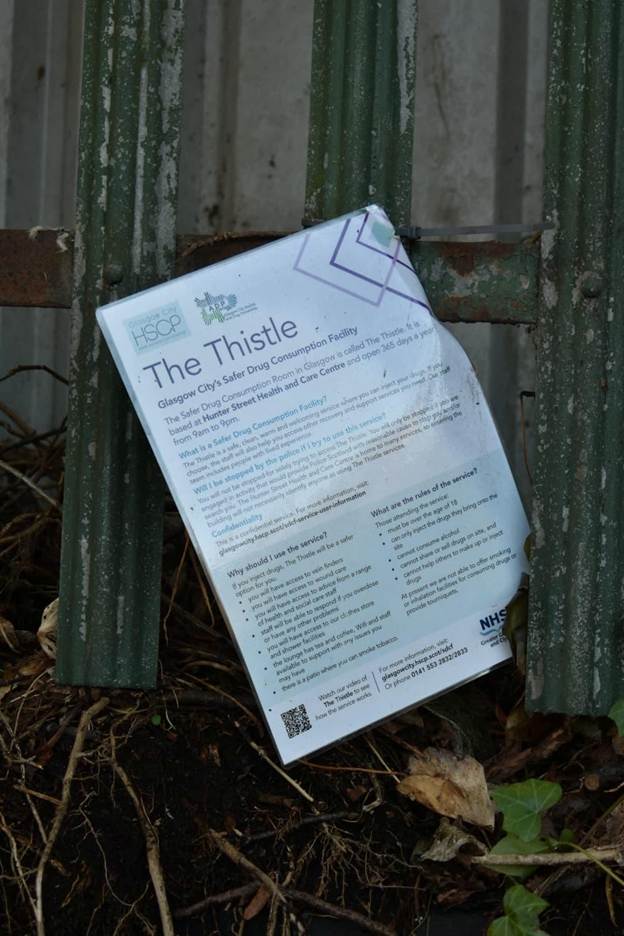
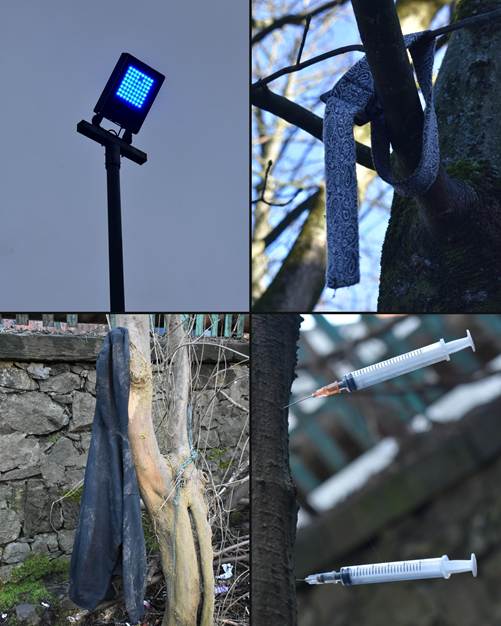
These spaces are filled with material culture, drug related and otherwise. In them we see evidence of ritual practices like the depositing of syringes into trees (fig. 4). A single sign for The Thistle was recorded attached to the fencing. If placed there by the inhabitants, it is more evidence of drug user subculture. If placed by The Thistle, it is evidence they are aware of the site and are encouraging the inhabitants to use it instead. One theory presented for the existence of these sites is that the inhabitants may suffer from unstable housing and return to these sites, or move around them, as needed. The material evidence and cultural context of these spaces tells us why drug users opt to consume drugs there instead of a facility.
Barrowlands Case Study (two visits)
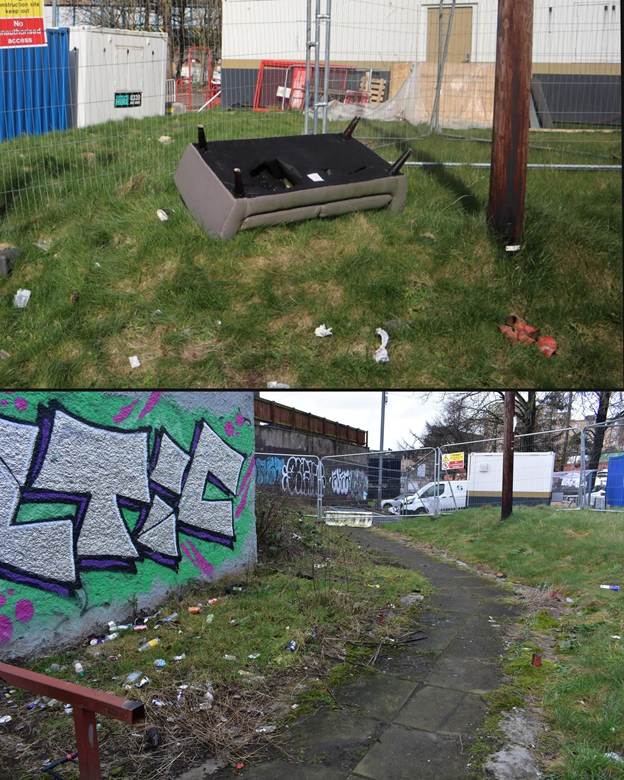
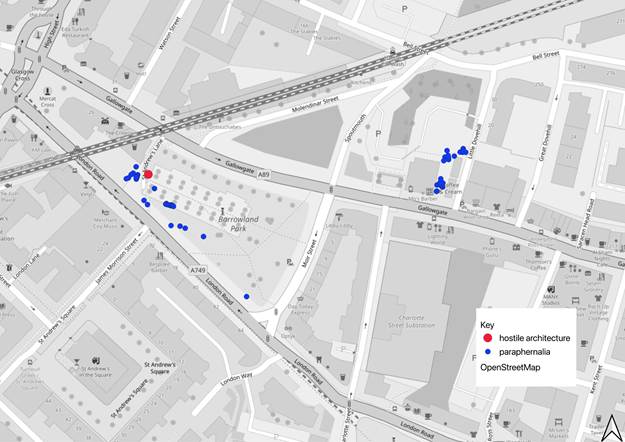
A preliminary Barrowlands survey found a territorial conflict between drug users and the city council centred around the use of Hostile Architecture – a method of anti-anti-social behaviour city planning. The park site included a blue light (fig. 1, 4), designed to make intravenous drug consumption more difficult by making it harder for users to locate their veins. Paraphernalia found at the site was mostly outside the range of the blue light, behind fencing. Observed here is evidence that the city council acknowledges this location as a site of drug use, and made an attempt to discourage it. The degree of effectiveness of this is uncertain as paraphernalia still exists despite the light, but seen later is the possible migration of drug use to another nearby site, the lane. At the park site there is clear practice of responsible discarding of paraphernalia, where users toss them out of bounds or in holes, suggesting a consideration of the safety of others. Noted by Finn Townsley was that users were getting better at removing needles from syringes before discarding them, something we did observe later. At the lane site (fig. 5) the distribution of paraphernalia was less careful, being clearly visible on the ground. This may reflect social awareness of a used community space versus what is effectively a midden. Seen here was a sofa, demonstrating an attempt at making the space liveable. Within the scope of this preliminary survey but outside of the main sites, we found paraphernalia discarded openly on the street.
On the second visit to Barrowlands Park, immediately upon arrival, was a team of Glasgow City Council cleaners litter picking in the park. This presented a perfect opportunity to directly record how much paraphernalia remained directly after a council cleanup. Recorded and mapped (fig. 6) is the paraphernalia that remained. The recorded data shows that even with the park having a blue light and the council doing a cleanup minutes before we started recording, the park still had more paraphernalia overall than the lane. The total paraphernalia count at the park was thirty-two, and twenty-seven at the lane (table 2). The lane is an example of how archaeology can document change in the urban landscape, as the sofa found had been moved by the second visit and the terrain itself had been leveled (but not cleaned) for potential development which impacts how the space is used.
| Barrowlands Park | |
| Bottle | 9 |
| Spoon | 9 |
| Syringe | 6 |
| Needle | 2 |
| Packet | 2 |
| Cap | 1 |
| Bag | 1 |
| Lighter | 0 |
| Tourniquet | 0 |
| Unknown | 2 |
| Total: 32 | |
| Barrowlands Lane | |
| Syringe | 10 |
| Bottle | 5 |
| Lighter | 5 |
| Spoon | 3 |
| Bag | 2 |
| Cap | 1 |
| Packet | 1 |
| Tourniquet | 0 |
| Total: 27 | |
Conclusion
Opioid paraphernalia was the focus of this study and was recorded at every site visited. Glasgow has the highest number of drug use deaths in Scotland, and this is reflected in the surveys finding drug related material in large quantities. Some sites had evidence of repeated use and even habitation by drug users in what was concluded as “lived-in spaces”. The factors influencing the creation of these lived-in spaces are anti-drug architecture (“hostile architecture”), housing status, and social marginalisation of drugs and drug users. Lived-in spaces show evidence of drug material culture, and ritual practices by drug users that indicate subculture.
There is an observed correlation between hostile architecture and the movements of drug users around urban spaces. Cleanup efforts by the Glasgow City Council in public spaces have failed to thoroughly remove all paraphernalia, leaving hazardous material behind – this was observed across two visits one month apart, and recorded in our survey. GIS mapping software proved useful in the recording of data in our research, and has potential for use in similar future projects. The aim of this research was to argue for drug paraphernalia being material culture, that recording of paraphernalia can expand our research capabilities as archaeologists, and that this research can aid us in tackling contemporary social issues. All three aims were achieved in this case study, as we found evidence of drug paraphernalia used in the context of material culture, expanded our own understanding of this topic as archaeologists over the course of our research, and have been able to outline suggestions for future research and actionable measures to tackle social issues (see suggestions section below).
Reflections
To best convey the reflections on this case survey, this section consists of two separate reflective paragraphs, one from each author of this case study, based on what each found most interesting.
Elena Borthwick
Recording drug paraphernalia includes drug users in the wider picture of contemporary archaeology. The stigmatisation of opioid use in Glasgow shapes public perceptions of drug users, perpetuating alienation. In a cycle of alienation, certain people are alienated from public spaces, thus turn to drugs and places they can do drugs. Inclusive archaeological research can reduce social stigma of drugs and drug users. Including paraphernalia in the archaeological record would allow archaeologists to understand drug use in communities. As it becomes more commonly accepted in archaeological research, awareness will be raised about the broader social issue, reducing the stigma of drug addiction.
Since doing this project, the skills gained from the surveys have proven useful in real world scenarios. Identifying hazardous material like drug paraphernalia, being aware of how spaces are used, and where drug paraphernalia is more likely to be found – for example, finding a syringe and spoon at Govan Old – is practical for working on archaeological and heritage sites.
Anthony Campbell
What may be typically referred to as outdoor “drug dens” should be reanalysed under a more inclusive and archaeology-focused idea: lived-in spaces. The creation and use of these spaces are a reflection of a drug subculture, one marginalised by both society and government, intentionally or otherwise. These spaces are makeshift homes and demonstrate some of the most basic human desires: shelter, comfort, provisions, and identity. If we rethink drug use, and accept it as subculture (that’s not to say we should encourage harmful behavior), we can decrease marginalisation, encourage social equality across backgrounds, and include drug users’ views and voices in the wider story of contemporary society. Something for officials like council bodies to consider is the cause and effect relationship between their use of hostile architecture and anti-drug methods, and drug users’ responses to it.
It is unclear how regularly the spaces are used, and how consistently they are used by the same people. There is evidence for a cause and effect relationship between anti-drug measures by authorities and the movements of drug users in the city, and there is potential for future research on the migratory patterns of drug users and the distribution of drug related material culture and waste as a result. At least some drug users prefer to use their own lived-in spaces rather than an official facility. This study’s interpretation of this is that two conclusions are apparent: that drug users would consume openly if not pushed elsewhere, and that drug users feel more comfortable consuming drugs somewhere they consider homely, and where they can consume in their own way, practicing their own rituals and rules, possibly with others if the spaces are shared.
Suggestions
This research is interdisciplinary between Archaeology and Social Care. Future research should align its theory with research on Archaeology as therapy. Research like Homeless Heritage by Rachael Kiddey, and the Applied Heritage approach (including the people studied directly in Archaeology) show promising results.
Evidence of failed cleanup operations in Barrowlands Park flags a health and safety concern for it and other public spaces where hazardous material was not removed. One solution could be the installation of biohazard bins in some public spaces. Witnessed was that some drug users do care about discarding material somewhat safely, so bins may be effective. The ethical consideration here is that it could encourage more drug use. However, if we are to destigmatise drug users and take a non-hostile approach to drug abuse, this could be the way forward, and worth testing in some locations.
Rethink perceptions of drugs, drug paraphernalia, and drug users. Analyse them through a more inclusive process. If this research project were to be expanded, inviting recovering people to assist with field work and research could be archaeologically beneficial and socially impactful. There are ethical concerns, such as a recovering person’s likelihood to relapse – their involvement must be carefully considered in risk assessments and ethics decisions.
Acknowledgements
Researchers involved in this study: Elena Borthwick, Kenny Brophy (Dissertation Supervisor), Anthony Campbell, Finn Townsley (PGR). Thank you to everyone for their contributions to this project.
References
Glasgow City Health and Social Care Partnership. 2025. Safer Drug Consumption Facility. https://glasgowcity.hscp.scot/sdcf
Kiddey, R. 2017. Homeless Heritage: Collaborative Social Archaeology As Therapeutic Practice, Oxford University Press USA.
Ren, Meng. et. al. 2019. The origins of cannabis smoking: Chemical residue evidence from the first millennium BCE in the Pamirs. Science Advances. 5(6). https://www.science.org/doi/10.1126/sciadv.aaw1391. https://doi.org/10.1126/sciadv.aaw1391.
National Health Service Greater Glasgow and Clyde. 2026. Glasgow’s Safer Drug Consumption Facility Records More Than 11,000 Visits In First Year. https://www.nhsggc.scot/glasgows-safer-drug-consumption-facility-records-more-than-1 1000-visits-in-first-year/
National Records of Scotland. 2025. Drug-related deaths in Scotland, 2024. https://www.nrscotland.gov.uk/publications/drug-related-deaths-in-scotland-2024