
By Gala Georgette
Since moving to Glasgow in 2022, I have found myself drawn to the River Clyde. I walk its banks often. There is something about being near water that makes me feel closer to home, despite being several oceans away. Today, it is a typical Glaswegian day – overcast skies, a little bit windy, with a looming scent of rain that threatens to close in as I walk the exposed path along the river. If you weren’t aware of Glasgow’s industrial heritage, you would be forgiven for overlooking the quiet weight of history that clings to this landscape. Little remains of the shipbuilding empire that once defined this stretch of river. Shipyards have since been transformed into museums, apartments, hotels, and office blocks. Yet, as I walk along the river, there is a gentle hum that whispers about the deep heritage of this landscape. It would be easy to miss – even the loudest frequencies sit subtly, buried beneath the distant engine noises from passing cars on the expressway. But it is there: a sonic trace of the past.
As an archaeologist, I enjoy tuning into these moments when the past feels palpable. To me, deep listening reveals layers of the historic environment that are otherwise easy to miss. My PhD project, based at the University of Glasgow and funded by the Scottish Graduate School for Arts and Humanities, explores how listening can be a powerful way of encountering the past, particularly in landscapes with deep colonial legacies. I use sound as both method and medium, exploring how music-making and deep listening can reframe relationships with landscapes while recognising that the historic environment is everywhere. The past lingers in wind, water, and the acoustics of place.
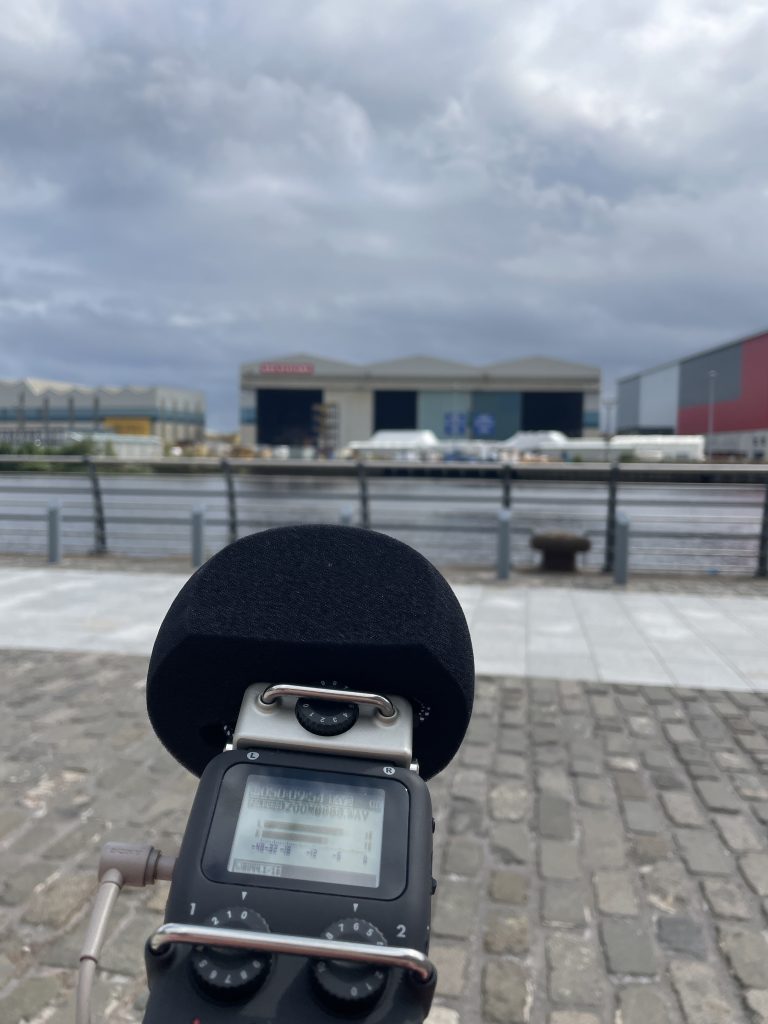
Listening invites us to grasp more than what is visible. It allows us to consider how spaces are shaped not only by what is visible, but by what is felt and sensed. Listening is something we all do, constantly, if we are able. It influences our experience of the world around us in ways that are not often immediately recognised. Likewise, the soundscape of the banks of the Clyde has been shaped by centuries of change. The sonic reverberations that we hear from the width of the Clyde are only possible because of the past few centuries of dredging for industry.
Archaeology is often associated with what is seen, such as artefacts, castles, and stratigraphy. But the discipline is increasingly turning to the sensory, the ephemeral, the experiential. Sound is one such frontier. Deep listening encourages us to understand the historic environment not just with our ears, but with our bodies, memories, and attention. In my research, I draw upon this approach and treat sound as archaeological data, and as evidence of social, political, and ecological processes through time. The Clyde’s post-industrial hum, the absence of certain sounds, and its drastically altered acoustics in recent decades, all speak to histories of extraction, empire, and social transformation. Listening becomes a way of sensing what is no longer visible, and what is still present, in a landscape.
I decide to sit, armed with a handheld microphone, headphones, and a notebook. I crouch behind a concrete wall to shield the mic from the wind. Still, the recording begins with the tell-tale brush of breeze across the receiver. I adjust, reposition, wait. And then, there it is. A low thrum. The river. Machinery in the distance. Layered sonic residue. I’m sitting across from BAE Systems, the British multinational arms and aerospace company. They have occupied the old shipyards of Govan and Scotstoun since 1999. Where thousands of ships were once built, BAE now constructs Type 26 frigates, most recently launching the HMS Cardiff in 2024. It remains one of the last active shipbuilding sites on the Clyde, a solitary trace of an industry that once filled these banks with sounds of steel and life.
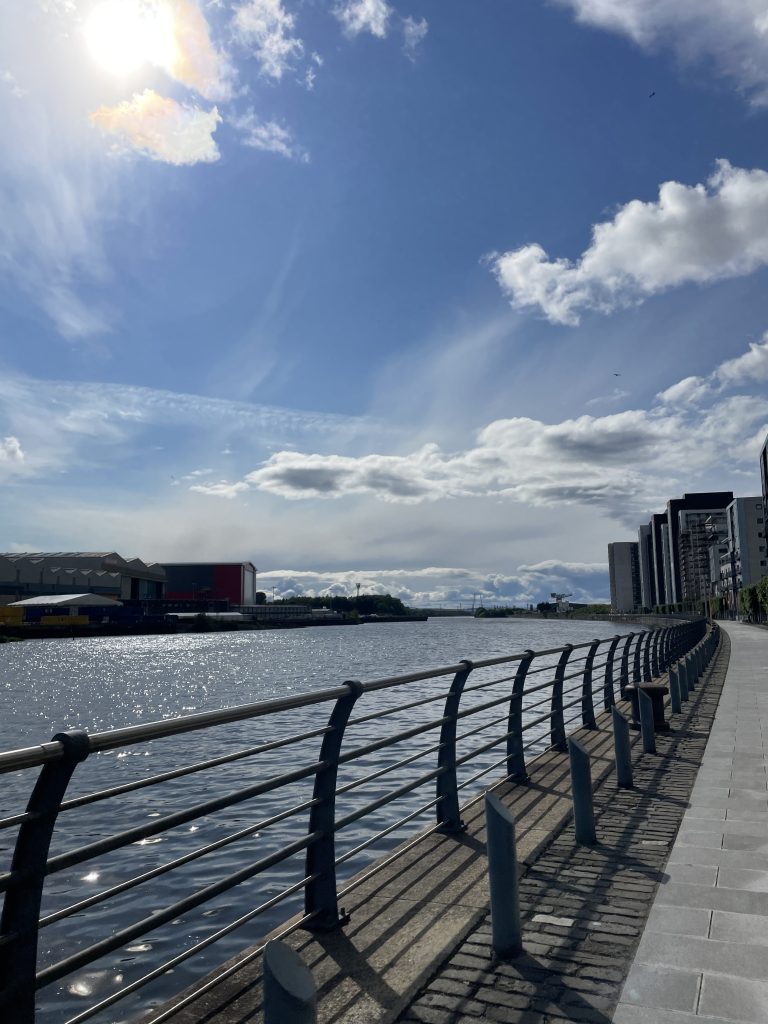
The whispers of history in this soundscape remind me that my own story is entangled with this river’s past. The Clyde’s shipyards once built vessels that travelled across the globe, some of which carried settlers, soldiers, and cargo to the distant lands, such as Aotearoa New Zealand, where I grew up. One of these ships, the Wahine, was launched in 1965 by Fairfield Shipbuilding and Engineering in Govan, right where BAE Systems now builds warships, and opposite where I sit today. Only three years later, it would sink on the opposite side of the world, at the entrance to Wellington Harbour during a violent storm, killing 53 people and becoming one of New Zealand’s worst maritime disasters. These transoceanic entanglements between Glasgow and Aotearoa are not abstract moments in history, but deeply personal. Listening to this soundscape hints at these deep, global, and historic connections through time and space.
As I write this, I keep glancing at a book that I unceremoniously use as a speaker stand on my desk: The Past All Around Us. Indeed, the past is all around us. My PhD project explores the intersection between archaeology, sound, and water. Through the process of undertaking my research, I am increasingly recognising the value of listening. When we listen deeply, we give space to be receptive to these pasts, and to the stories of absence, human interaction, and legacies of heritage around us. It is the past that created the present soundscape – and, if we listen closely, we might hear what it has to say.