
The earliest reference to Shetland’s archaeological sites comes from Rev George Low when writing his Tour of Orkney and Schetland in 1774. Low’s work included drawings, plans and even sections of a collection of archaeological sites which he observed in Shetland. Several of these sites he termed ‘pights castle’ (brochs), but he also included stone tools (‘thunderbolts’) a horizontal mill, and a ‘fort’ which disappeared under Sumburgh Head lighthouse in 1821. Low’s written description of this lighthouse is now the sole record. Hibbert’s tour, compiled in 1821, followed in Low’s footsteps. Although Hibbert offered some alternative theories, and quoted Low, apart from the deterioration in the state of Mousa broch, he included little new information.
During the 19th century, Shetland came under the scrutiny of three notable antiquarians who became friends: Sir Henry Dryden, James Thomas Irvine and Gilbert Goudie. Dryden and Irvine were architects working in England, although Irvine was from Yell, and both drew meticulous plans. Goudie was a banker based in Edinburgh, although born in Clumlie, Dunrossness, and he became the Treasurer of the Society of Antiquaries of Scotland.
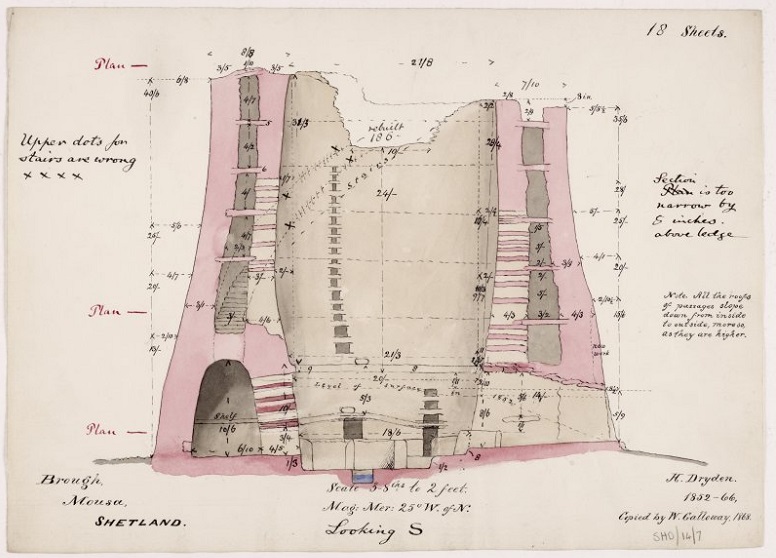
Dryden made thousands of drawings of architectural and archaeological drawings of historic sites and monuments throughout Britain and Europe. These included 96 sketches and views in Shetland (Ritchie 2011). His drawings of Mousa and Clickhimin in particular, provide valuable evidence of the state of those monuments prior to modern intervention.
Irvine focused on the archaeology of North Yell, Unst and Fetlar, although his first publication, in 1866, was about Clickhimin (Ritchie 2011). His last publication concerned his excavations at the Sands of Breckon and a carved stone found during peat digging near Gutcher (1898).
Goudie’s investigations including finding ogham inscribed sties at St Ninian’s Isle, excavation at Clumlie Broch, with the help of local workmen, and the dun in the Loch of Brindister. He used the artefacts to conclude that brochs were either early- or pre- Christian. In addition to publishing his discoveries in the Proceedings of the Society of Antiquaries of Scotland (PSAS), Goudie published a wealth of information in his book The Celtic and Scandinavian Antiquities of Shetland (1904). This was not restricted to archaeology, but included subjects as wide ranging as Udal Law, historical figures, the Rivlin and the Tuskar. He was also the first translator of the Orkneyinga Saga.
When the publication of PSAS began, Shetland was to feature in every volume. A pair of bog bodies, found on a hill named ‘Nosewick‘ in Shetland Mainland, were reported in the Volume 1 (1851-2). The first paper concerning excavation in the islands followed in Volume 2 (1855-6), claiming to report the excavation of a ‘Picts House’ but, in reality, recording the investigation into three mounds at Kergord, initiated by the landowner David Dacres Black (who was to become infamous for initiating the Weisdale Clearances). This was subsequently expanded on in Volume 6 (1865-6).
Multiple finds were also recorded as being donated to the National Museum in the early volumes, as varied as a skeklers costume and a chair allegedly from the Armada wreck of the Gran Griffon (1866-88) to a steatite urn and silver armlets from Unst and the finds from what was clearly a Viking grave at Quendale, although not recognised as such (two tortoise brooches and a trefoil one, silver bracelet and two glass beads) (1872). In some cases, such as the excavations of Abercromby and Munro in Northmavine at the Beorgs of Housetter in 1902 and the Burn of Roerwater in 1904, the sites have only recently been relocated. Their significance is only just beginning to be understood.
In the 1870s, the Ordnance Survey dispatched a small band of military engineers into the Shetland landscape in order to flesh out the details of a basic map. The extent to which antiquities were included depended on the level of interest of the individual recording it and the representation of archaeology was extremely haphazard. The somewhat erratic collection of information was to have long-term consequences, with areas apparently devoid of sites being assumed to be ‘empty’ and therefore not worthy of further investigation for nearly another hundred years (Lamb and Turner 1991, 171-173). At intervals during the antiquarian period, Shetland was to feature in national surveys, including Allen and Andersen’s Early Christian Monuments of Scotland (1903).
Continue reading: Early 20th century