
Massive stone walls appeared above the beach below the Old House at Sumburgh (renamed Jarlshof by Walter Scott in his novel The Pirate in 1822) as the result of violent storms. This prompted the landowner, John Bruce, to investigate. Between 1897 and 1905, he uncovered much of the now-visible Iron Age settlement. In 1925, the site was taken into guardianship, leading to Curle excavating the Bronze Age settlement, and subsequently some of the Norse settlement, between 1931 and 1935. Richardson continued that work. Then, in 1937, VG Childe and Laidler revealed the Neolithic levels. The outbreak of war halted progress, but in 1949 work resumed under the direction of JRC Hamilton. The overarching publication of the site was to set new standards of archaeological reporting (Hamilton 1956).
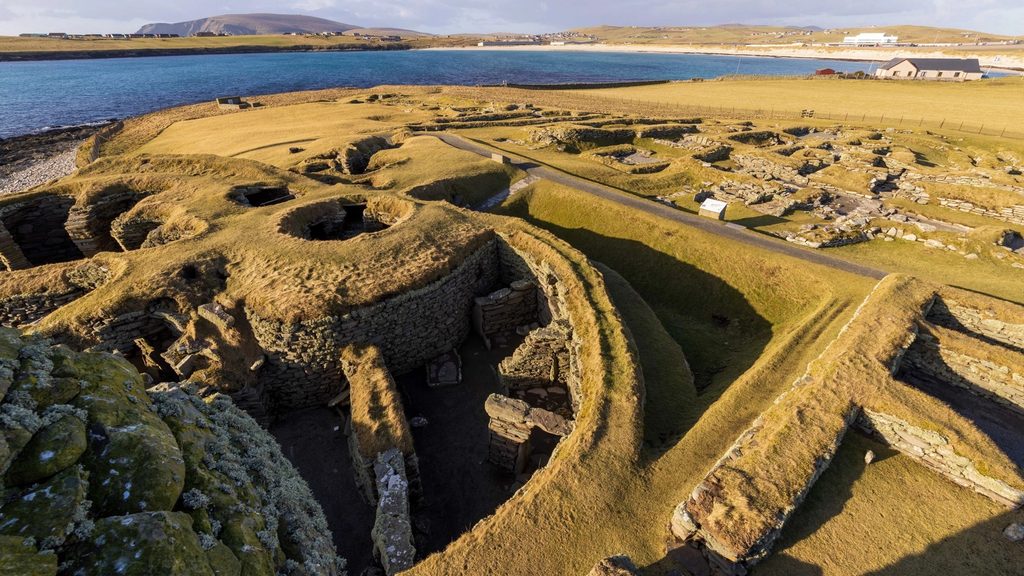
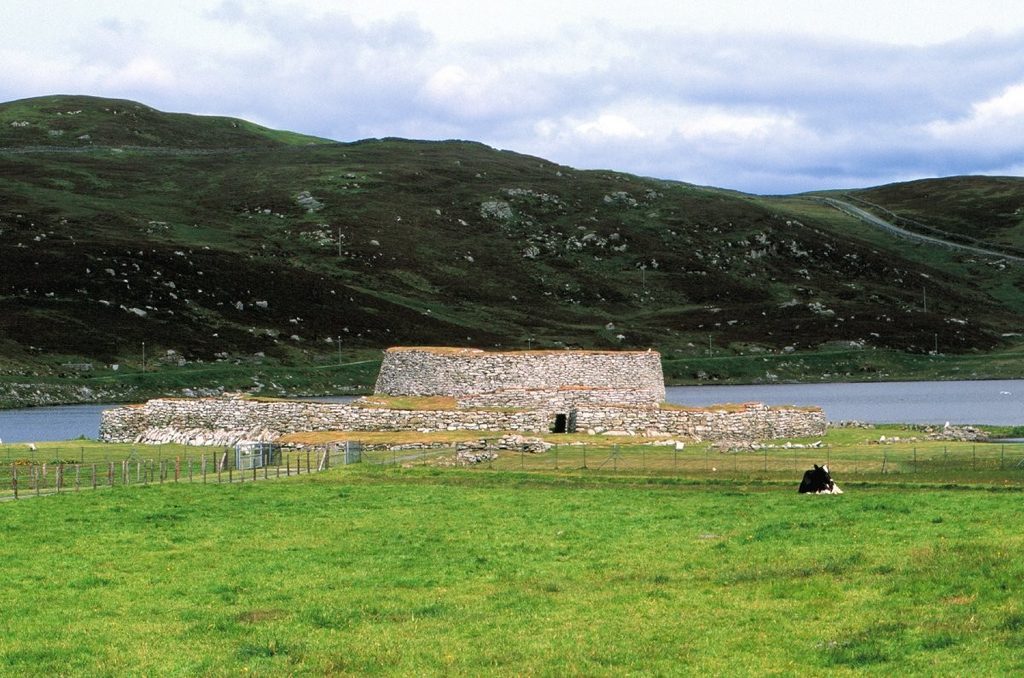
Hamilton was to go on to excavate at Clickhimin, but by then he had a narrative to prove. He was also blissfully unaware of the previous interventions, particularly the extensive rebuilding of the site by Henry Macleod of the Office of Works between 1908-1910 (Smith 2015) and so this publication fell short of his earlier one. Other notable excavations in the first half of the twentieth century included Curle’s excavation (1936) at Wiltrow. Cecil Mowbray, who worked with Curle at Jarlshof, also excavated at the Ness of Burgi in parallel (1936).
In 1928, RCAHMS began their Inventory of Sites in the Northern Isles, starting in Orkney. Charles Calder carried out the bulk of the work in Shetland around 1936. However, the Shetland sites were far more inaccessible than those of Orkney, and the job soon overwhelmed the available resources. The outbreak of war delayed publication until 1946. Calder was well aware that the resulting volume did not do justice to Shetland’s archaeology. As a result, he made several return visits.
Continue reading: 1950s to 1980s