
Clearly the farming communities in south-east Scotland were flourishing and growing during the Early Bronze Age, with settlement spreading into upland areas. There is abundant evidence for funerary and settlement sites, and also evidence for monument-related practices. The material culture suggests that not everyone in society was equal. Bronze objects were in use, as was gold, and the population was well connected with the outside world, especially with north-east England from where jewellery and dress accessories of jet were obtained.
This period saw a shift in funerary practices from inhumation to cremation. Inhumation, in stone cists, was typical between around 2200/2150 and 1950 BC. From as early as the 20th century BC, however, cremation was being practised. A radiocarbon date from cremated bone from a Vase Urn from Dunion, Scottish Borders is dated to this period (Sheridan 2007,181). The cremated remains of individuals, and sometimes of two or three people, were buried, either in a cinerary urn or an organic bag, in cemeteries. This funerary practice gained in popularity until, by around 1900 BC, cremation was the norm. There is, however, evidence that inhumation continued to be practised into the second quarter of the second millennium BC, as shown by the radiocarbon dating of the remains of two women buried in a cist at Merrilees Close, Leith, Edinburgh (Sheridan in Olalde et al 2018).
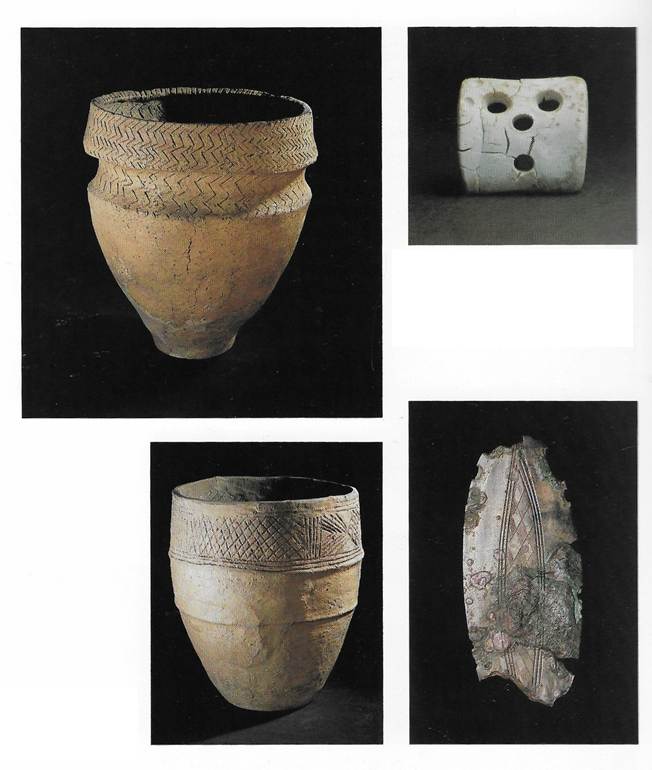
An additional insight into Early Bronze Age funerary practices is provided the evidence from Horsbrugh Castle Farm, Scottish Borders. Here, a cist was found to contain the disarranged and incomplete remains of the unburnt, contracted skeleton of a young adult, possibly male, along with two deposits of cremated bone that had been inserted subsequently (Petersen et al 1974). The first deposit, comprising the remains of an adult female, was deposited in a pit partly dug into the gravel fill of the cist’s pit; the second, comprising the remains of an adult and a child around 6 years old, was banked up against the edge of one of the capstones. Radiocarbon dating, as part of an NMS dating project, in 2008 established that the unburnt body dates to 2121-1885 cal BC (SUERC-18302, 3610±35 BP) whereas the cremated remains date to 1726-1516 cal BC (SUERC-18303, 3325±35 BP) and 1739-1532 cal BC (SUERC-18304, 3355±30 BP respectively – i.e. a number of generations later (Sheridan 2008). It seems likely that whoever inserted the cremated remains also disturbed the by-then ancient remains and removed some bones.
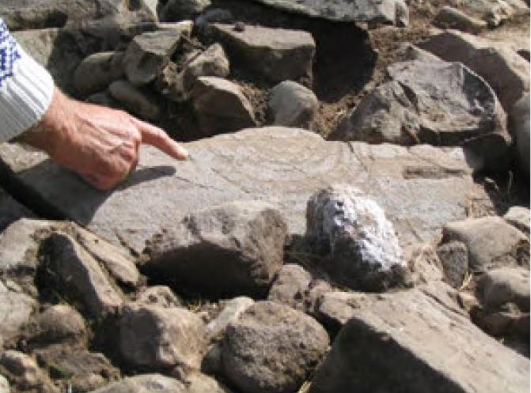
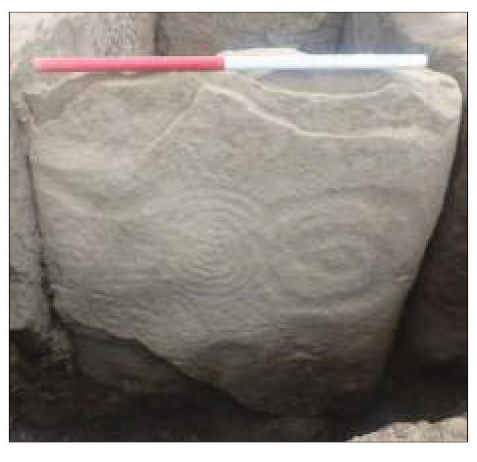
The practice of re-using pre-existing Atlantic rock art as cist slabs, already noted at the Drumelzier cairn (Craw 1931a), is also attested at Woodend (Mossfennan Farm), Scottish Borders (Ward 2008). At Edmonstone Estate, City of Edinburgh, recent excavations by GUARD Archaeology uncovered a short cist with unusual pecked markings on one of its slabs. The designs are not typical of complex Atlantic rock art and it may be that at least some were created during the Early Bronze Age; the outcome of current post-excavation work is required to clarify the nature of the designs. Also present in the cist was a fine bronze-bladed dagger, buried in its sheath or scabbard.
A few Early Bronze Age settlements are known from south-east Scotland: at Howmuir Farm, East Lothian, for example, an enclosure or field system, with pits, has been associated with five radiocarbon dates ranging from 1910-1690 cal BC (SUERC-7532, 3490±35 BP) to 1610-1410 cal BC (SUERC-7533, 3210±35 BP) (McLellan 2007). However, it remains unclear whether the specific type of upland settlement known as the unenclosed platform settlement (UPS) – where one or more roundhouse was built on a levelled terrace – was being used as early as the Early Bronze Age in this part of Scotland. Tam Ward’s review of UPS settlements in Tweeddale and Clydesdale (Ward 2013a) has shown that, to the west of the SESARF area, one UPS does seem to date to the Early Bronze Age, at Lintshie Gutter in Clydesdale (Terry 1995). Within the SESARF area, however, the few dates that do exist for UPS point towards a Middle Bronze Age date. It should be noted that the earliest radiocarbon date for the Green Knowe UPS in Scottish Borders (Jobey 1980), whose calibrated range extends as far back as the Early Bronze Age, has a very large standard deviation. It is unlikely that Green Knowe pre-dates 1500 BC.
Many burnt mounds are also known in upland areas – as documented, for example, by the late Tam Ward and the Biggar Archaeology Group in the area of the Megget Reservoir, Scottish Borders (Ward 2004). The function of these sites has been debated, but it seems likely that outdoor cooking, using hot stones to boil water in a trough, was the main function. One burnt mound from the Manor Valley in former Peeblesshire has a radiocarbon date calibrating to 2196-1890 cal BC while another, from the same valley, has a potentially Chalcolithic date of 2470-2142 cal BC (Ward 2013a, 28).
The roundhouse appears to have been the dominant, or possibly the only, house form in both these and other Early Bronze Age settlements. Associated with several UPSs are field clearance cairns and simple field walls, confirming that agricultural activity was taking place in the immediate vicinity of these settlements. Many burnt mounds are also known in upland areas – as documented, for example, by the late Tam Ward and the Biggar Archaeology Group in the area of the Megget Reservoir, Scottish Borders (Ward 2004). None of these have been radiocarbon-dated, so it is impossible to say whether any are of Early Bronze Age date. The function of these sites has been debated, but it seems likely that outdoor cooking, using hot stones to boil water in a trough, was the main function.
As for ceremonial activity other than funerary practices, evidence from Eweford West shows that Early Bronze Age Beaker pots were being deposited in pits. In one pit a Beaker pot was found along with around 2000 grains of barley and wheat and in another there were around 25,000 grains of the same cereal types. These were found very close to the by-then ancient, Early Neolithic long mound. These may have been votive offerings, perhaps directed at the spirits of the people buried under that mound. As for monuments, it is not known whether any timber or stone circles or individual standing stones were erected during the Early Bronze Age.
In terms of material culture, the ceramic record shows that Beaker pottery continued in use until around 1950 BC, and that Food Vessels – which, in funerary contexts, were used in the same way as Beakers, to provide sustenance for the deceased’s journey into the Otherworld – were in use from around the 22nd century BC (Sheridan 2004). Cinerary urns were in use from the 20th century BC, with Vase Urns being the earliest type, followed by Collared Urns and Bipartite urns, then Cordoned Urns, then flat-rimmed urns, with overlap in the currencies of each of these urn types (Sheridan 2007).
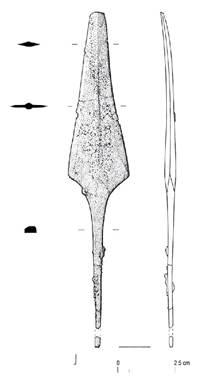
Other aspects of material culture saw various novelties. Early Bronze Age artefacts of bronze include a halberd and a tanged knife-dagger from Eweford West, East Lothian (Lelong and MacGregor 2007, 97, 111, 235). Several examples of Early Bronze Age bronze razors are also known, such as one from a Cordoned Urn in the Magdalen Bridge, Joppa cemetery.
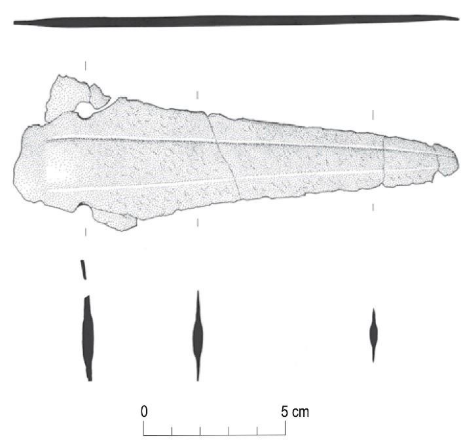
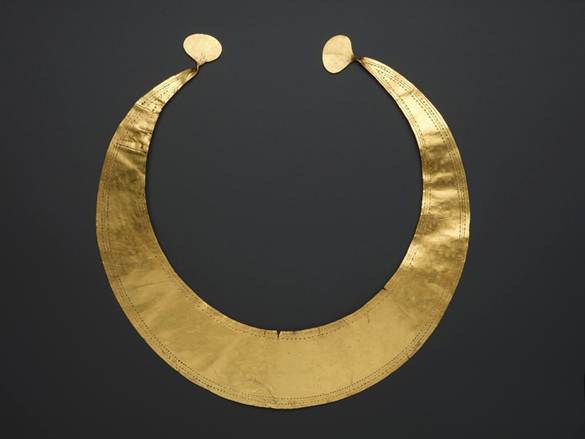
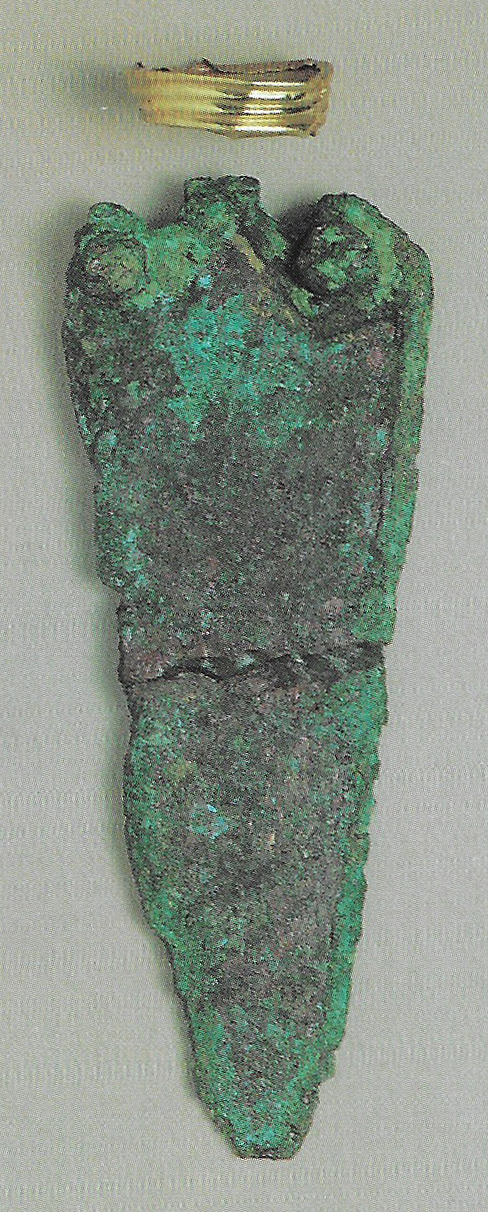
Three Early Bronze Age artefacts made of, or containing, sheet gold are also known from this part of Scotland. Two gold lunulae were found near Coulter, at a location in Scottish Borders, while at Skateraw, East Lothian, a bronze-bladed dagger with a ribbed sheet-gold pommel mount was found in a cist with a skeleton, under a cairn, at some time between 1806 and 1814. The skeleton has not been preserved in a museum (Clarke et al 1985, 286 and fig. 5.28).
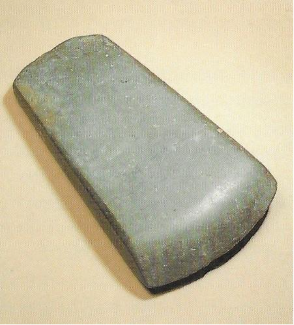
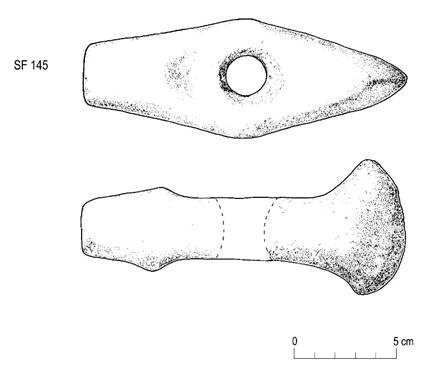
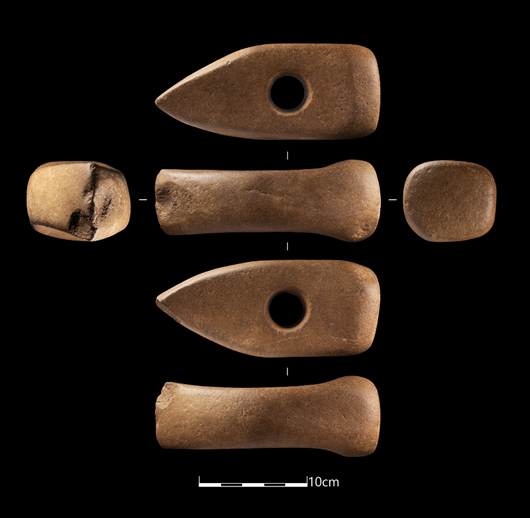
Stone artefacts include an axehead, found at Hillend, Midlothian, that resembles a flat bronze axehead in shape; a fine battle-axehead from Eweford West; and an axe-hammer head from Upper Dalhousie Quarry, Midlothian. The last is of particular importance as it is associated with two 18th-16th century cal BC radiocarbon dates and this kind of artefact is hardly ever found in a datable context.
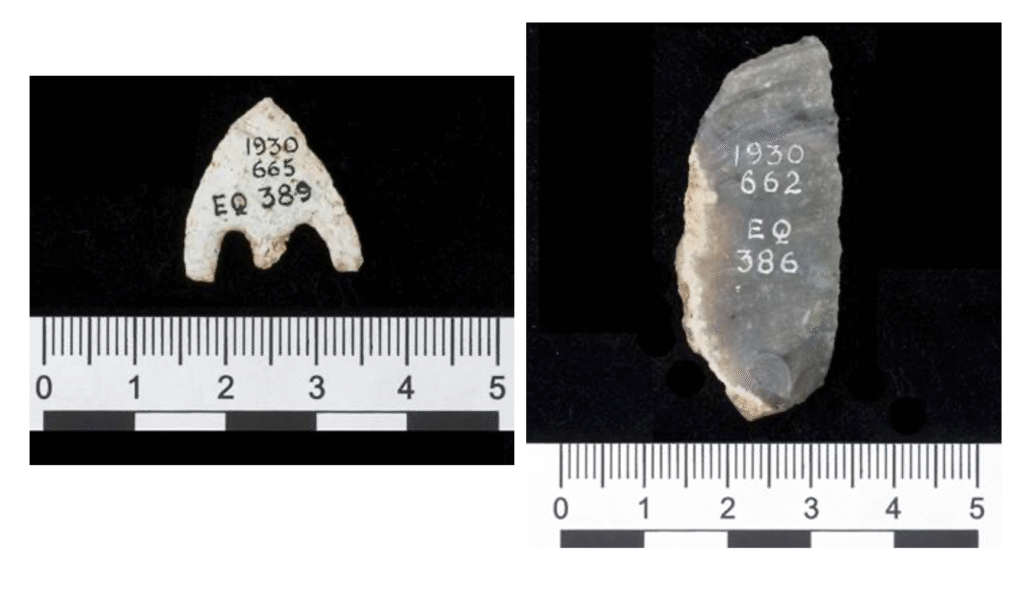
Other Early Bronze Age stone artefact types are the barbed-and-tanged flint arrowhead, and various kinds of flint knife; examples of each were found, for example, in graves under a cairn on Knock Hills, Edgerston, Scottish Borders (Oliver 1929).
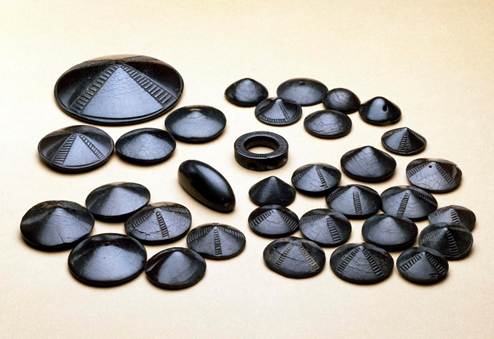
Items of jewellery include V-perforated buttons of jet and similar-looking material, of which a set of 33, including one boat-shaped example, was found, together with a ‘pulley’ belt ring, in a cist under a cairn at Harehope, Scottish Borders (Jobey 1980). By analogy with other finds of similar items elsewhere, associated with sexed skeletons, this is likely to be a man’s set of possessions. The largest button had probably been used to fasten a cloak.
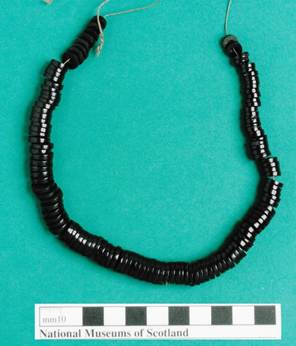
From another cist under the same cairn was found a disc-bead necklace; compositional analysis by Mary Davis showed that this was of cannel coal or oil shale, probably the latter. Such necklaces have a female association, and so it appears that at Harehope, both a high-ranking male and a high-ranking female were buried. Unfortunately the skeletons did not survive.
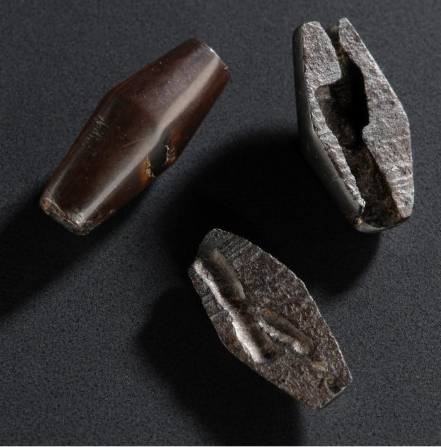
Another kind of Early Bronze Age jewellery, again with female associations, is the spacer-plate necklace. Two fusiform (barrel-shaped) jet beads that had originally belonged to one such necklace were found in a cist at Knock Hills, Edgerston, Scottish Borders (Oliver 1929).
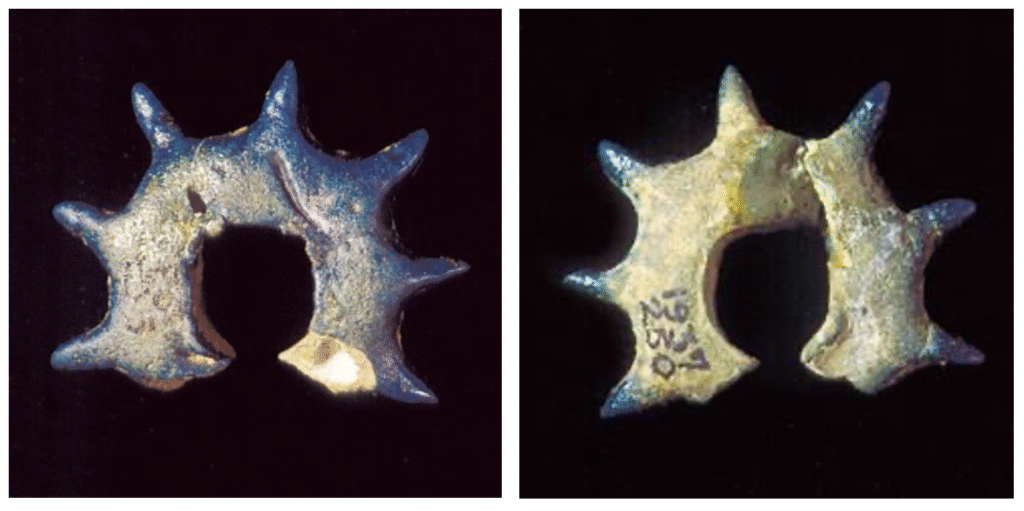
A further Early Bronze Age innovation was in the use of faience – an early vitreous material made by firing a paste of sand mixed with a fluxing agent, and with a glaze containing copper (Sheridan and Shortland 2004). Three faience beads are known from south-east Scotland: a star-shaped bead, glazed only on one side, found at Dryburgh Mains, Scottish Borders, and two from Longniddry, East Lothian one being a quoit-shaped bead and the other a quoit-shaped pendant. While the jet jewellery shows clear connections with Yorkshire, the faience beads demonstrate connections with other communities even further away in Britain.
Comments 1
Magdalen Bridge razor caption. The site is now in the City of Edinburgh rather than Midlothian, as the trove.scot link below indicates.
Coulter lunulae. The trove.scot link is to a gold bracelet instead of the lunulae: https://www.nms.ac.uk/search-our-collections/collection-search-results?entry=133052