
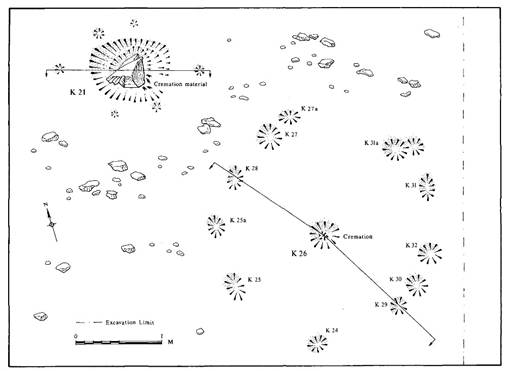
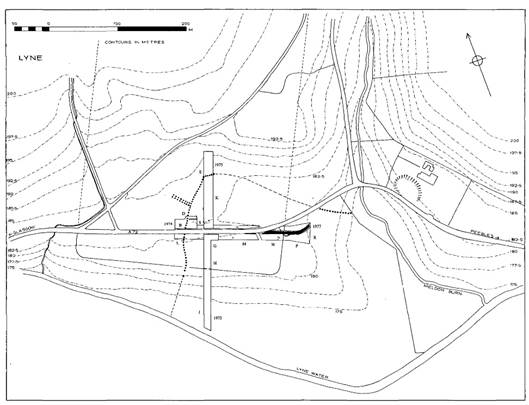
Scarcely more is known about Late Neolithic funerary practices in the SESARF area, than for the Middle Neolithic. The practice of cremation, followed by deposition of the cremated remains in a pit, is attested at Meldon Bridge. A radiocarbon date of 2877–2631 cal BC (SUERC-73285, 4153±29 BP: Sheridan et al 2017) was obtained for a fragment of cremated human bone from a child, about 8 years old. This child had been buried in a large pit (K21), surrounded by stakeholes and with two slightly larger stakeholes outside this. The remains of a stone that could have been a grave marker were found in the fill of the pit. Two other pits in the vicinity of K21 similarly held cremated remains, which could also be Late Neolithic, although they have not been dated. These pits were found within an area enclosed by a substantial timber enclosure. It is not known whether that timber enclosure at Meldon Bridge was already in existence when these graves were dug; it could have been.
One other possible instance of the burial of cremated bone in a pit during the Late Neolithic is known from the A1 excavations by GUARD at Eweford West (Lelong and MacGregor 2007, 83–4). A small pit, cut through a surface with Grooved Ware sherds, was found to contain a very small amount of cremated human bone from an adult and a neonate (newborn baby). Early Grooved Ware in this area has been dated to 3020–2700 cal BC (SUERC-5294, 4275±40 BP). A small quantity of cremated human bone was also found in layer 104. However, this has not been dated and it is unclear whether it is contemporary with, or later than, the Grooved Ware. It would be worth dating the bone in question, as information on Late Neolithic funerary practices is so rare across much of Scotland.