
Antiquarians and early archaeological research
This history of antiquarian research across the Outer Hebrides is well-summarised by Armit (1996), Parker Pearson, Sharples and Symonds (2004) and Sharples (2015) and will not be repeated in any detail here. Antiquarian interest in the Outer Hebrides was minimal compared with other areas of Scotland, such as Orkney. However, there are several key players from the 19th and early 20th century whose work laid the foundation for subsequent generations of archaeological researchers.
Firstly, James Matheson who was responsible for the removal of peat deposits that fully exposed the magnificent Calanais (Callanish) Stones as well as highlighting the potential for buried remains elsewhere across the archipelago’s peat lands. Captain FWL Thomas was the first individual to formally record and excavate archaeological sites across the Outer Hebrides rather than merely expose them. Thomas was particularly interested in later prehistoric, monumental architecture, recording and excavating a number of broch and wheelhouse sites, with a particular focus on Uist and Barra (Thomas 1868, 1890).
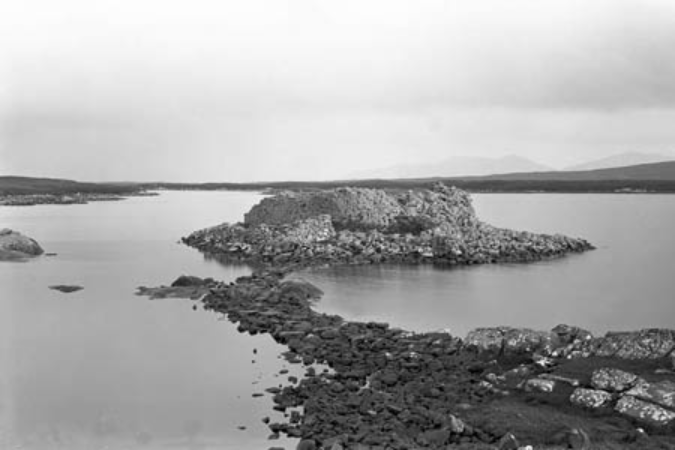
Following on from Thomas, the work of Hebridean landowner Erskine Beveridge, although largely restricted to the island of North Uist, is notable in both quality and quantity. Beveridge investigated a large number of archaeological sites include several Iron Age duns, wheelhouses, Neolithic chambered tombs and the first evidence for Neolithic islet dwelling at Eilean an Tighe (Beveridge 1911). In 1914 the Royal Commission on Ancient and Historic Monuments began their archaeological surveys across the Outer Hebrides, an important piece of work which established a benchmark for future Historic Environment Records as well as marking the beginning of a new era for archaeological research across the islands (RCHAMS 1928).
Sir Lindsay Scott is regarded by many as the first major figure in Hebridean archaeology (Armit 1996, 12). Like Beveridge and Thomas, the monumental architecture of the Neolithic and Iron Age were of particular interest to Scott (1947a, 1947b, 1950). This preoccupation with the monumental over and above the everyday is one of the defining characteristics of antiquarian and early archaeological research across the Outer Hebrides.
Continue reading: 1950an – 1980an (1950s to 1980s)