
The Carinated Bowl tradition of pottery was introduced from Nord-Pas de Calais in northern France by immigrant farmers, who arrived in Britain between about 4200 BC and 3800 BC, bringing a whole new way of life (Sheridan 2007b; 2016). Pottery was a wholly novel technology in Britain and Ireland: the indigenous Mesolithic inhabitants had never used this material, and did not know how to make pottery.
The style emerged in northern France from about 4300 BC, when the Michelsberg tradition was emerging from the Chassey pottery of the Paris Basin (Sheridan 2007b). The kind of Chasséo-Michelsberg pottery that we know as Carinated Bowl pottery is one of several regional groupings that emerged in northern France towards the end of the fifth millennium.
The Carinated Bowl tradition, a Continental, specifically north French, type of pottery is widespread in eastern and southern Scotland, extending as far north as Caithness, although rarer in the west.
The Carinated Bowl (CB) repertoire consists of carinated, S-profiled and uncarinated, round-based pots of various sizes, undecorated except for the occasional use of fingertip fluting or rippling. In the far south of England there are also ceramic ladles, but those have not been found in Scotland. Its makers were skilled potters, whose ancestors had been making pottery for over a millennium. Research by French ceramic specialist Hélène Pioffet into the way in which Carinated Bowl pottery was made has shown that the process of manufacture, as well as the design of the pots, matches that seen in northern France (Pioffet 2014).
In south-east Scotland, as elsewhere in Britain, it is possible to see a process of ‘style drift’ whereby successive generations of potters moved away from the Continental canon. This style drift occurred at different rates in different areas, and varied in style and details of manufacture from place to place. The earliest CB pottery, closest to its Continental forerunners, is called ‘traditional CB’ and the versions that show style drift are referred to as ‘modified CB’.
Examples of traditional CB pottery are known from several findspots in south-east Scotland, including the long rectangular and trapezoidal funerary monuments at Eweford West and Pencraig Hill, East Lothian (MacGregor and McLellan 2007) and from settlements at Newbridge Industrial Estate, City of Edinburgh (Carter et al 2010, 33) and Dalhousie Quarry, Midlothian (Francis in press). These are thin-walled bowls, very well made, and with carefully finished surfaces. One of the Pencraig Hill bowls has decorative fingertip rippling on the top of its rim, and vertical fingertip fluting on the inside of the rim. Radiocarbon dates place these within the first quarter of the fourth millennium cal BC.
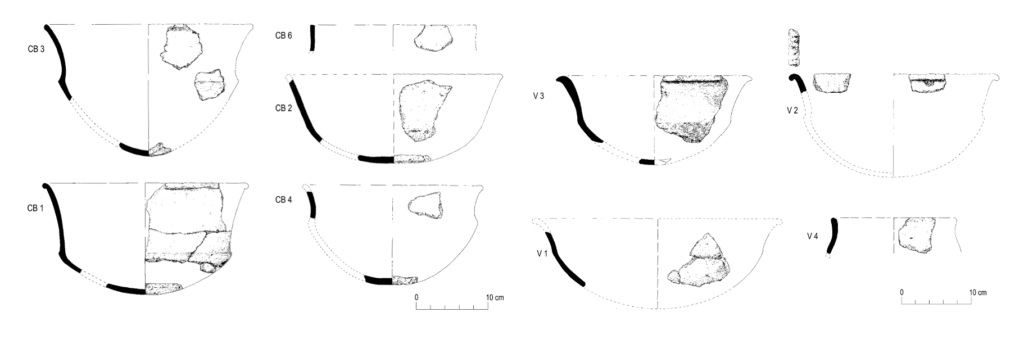
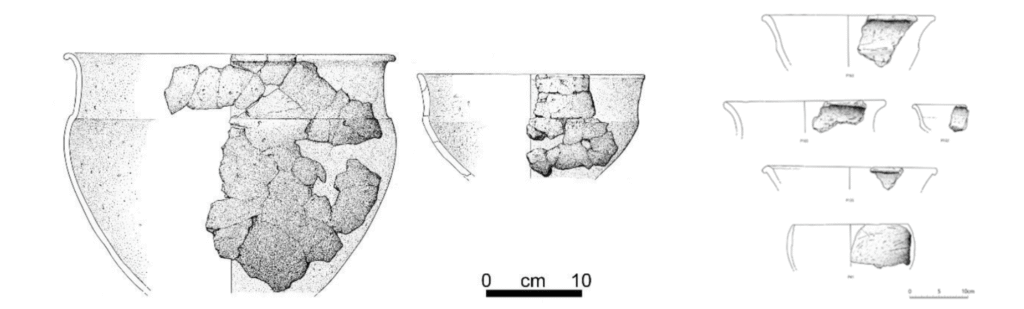
Other pottery from Eweford West, relating to secondary activity after the funerary monument was completed, and from several other findspots in south-east Scotland including The Hirsel, Scottish Borders, is of modified CB type. The modified CB pottery in south-east Scotland differs from traditional CB pottery in several ways:
- It tends to be thicker-walled, and the proportion of ‘coarse’ ware can be higher than that of traditional CB assemblages;
- Surface finish may be less careful than with traditional CB;
- it can have pointed shoulders rather than carinations;
- it can have lugs as seen, for example, in the Edmonstone, City of Edinburgh, assemblage.
However, since researchers are dealing with the evolution of a tradition rather than wholesale change, assemblages of modified CB pottery can also contain vessels of classic ‘traditional CB’ type. This is the case at The Hirsel, for example.
A radiocarbon date, from hazel charcoal, of 3660-3510 cal BC was obtained from the pit at Eweford West where the modified CB pots were found, and a radiocarbon date, from burnt hazelnut shell, of 3640-3380 cal BC was obtained from an isolated pit at Eweford East where the round base of a modified CB pot was found.
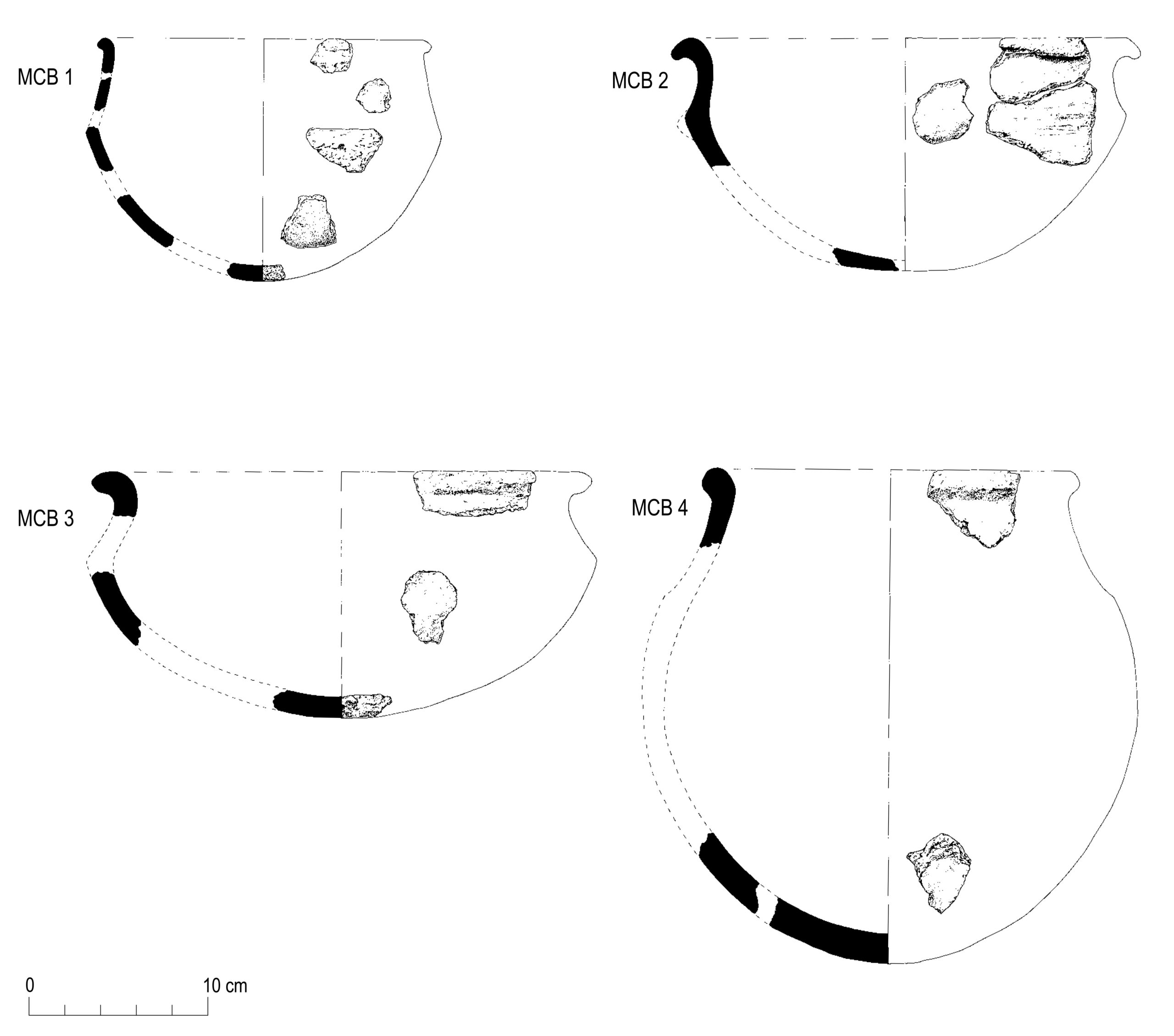
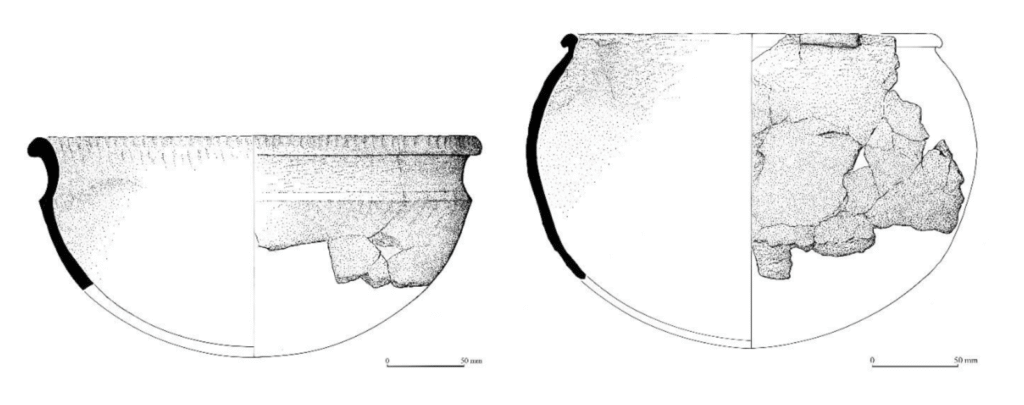
The list of findspots of traditional and/or modified CB pottery in south-east Scotland known to the author as of October 2025 is in the table 4.3 below.
| Location | Trove ID | Site type | References |
| Doon Hill, East Lothian | 57668 | Settlement | Ralston 2019a; 2019b; in press |
| Eweford West, East Lothian | 257432 | Funerary and associated | MacGregor and McLellan 2007 |
| Eweford East, East Lothian | 57600 | Isolated pit | MacGregor and McLellan 2007 |
| Pencraig Hill, East Lothian | 249181 | Funerary | MacGregor and McLellan 2007 |
| Newbridge M8 Industrial Estate, City of Edinburgh | 72543 | Settlement | Carter et al 2010, 33; Sheridan 2007b, 484 |
| Maybury Business Park (now Edinburgh Park), City of Edinburgh | 74679 | Settlement | Moloney and Lawson 2006; Sheridan 2007b, 484 |
| Ratho Quarry | 81323 | Settlement | Smith 1995; Sheridan 2007b, 484 |
| Catstane, City of Edinburgh | 50730 | Settlement | Cowie 1978 |
| West of Gogar Mains, City of Edinburgh | 300203 | Settlement | Will and James 2017 |
| Meadowfield Farm, West Craigs, City of Edinburgh | 369690 | Settlement | Hunter Blair 2019 |
| West Edge, Lang Loan, Gilmerton, City of Edinburgh | 262747 | Settlement | Westgarth 2020 |
| Edmonstone Policies (Estate), City of Edinburgh | No Trove ID found | Settlement | Muir 2024; Beverley Ballin Smith pers. comm. |
| Duns Law Farm, Scottish Borders | 58640 | Pit, also with human remains; settlement? | Anderson 2017 |
| The Hirsel, Coldstream, Scottish Borders | 59631 | Settlement | R Cramp 2014; Sheridan 2007b, 485; 2014 |
| Upper Dalhousie Quarry, Midlothian | 295357 | Settlement | Francis in press |
| Oatslie sand quarry, Roslin | 51814 | Stray find, presumed to be settlement | Stevenson 1948 |
| Kinegar Sand and Gravel Quarry, Cockburnspath, Scottish Borders | 271421 | Settlement | MacSween 2001; 2004; 2005 |