
Finds of Middle Neolithic pottery are less numerous than those of Early Neolithic pottery in south-east Scotland but, as with the latter, the picture has been changing thanks to developer-funded excavations.
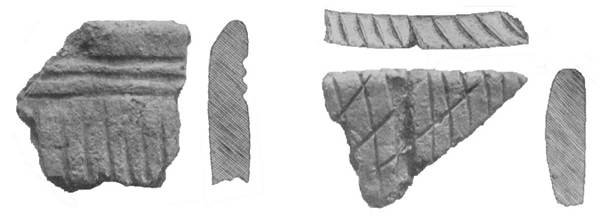
Most of the pottery falls under the broad class known as ‘Impressed Ware’ (MacSween 2025), and the small but growing body of radiocarbon dates places it between between 3350 and 2900 cal BC. However, there is one pot, from a coastal ‘midden’ in the grounds of a house called ‘Tusculum’ in North Berwick, East Lothian (Cree 1908), which cannot be described as ‘Impressed Ware’ and which probably dates around the middle of the fourth millennium. The pot is only represented by a rimsherd but its shape, and its design of horizontal incised lines with vertical incised lines beneath, suggest that it is an Unstan bowl. Sheridan (2016) discusses the evolution and distribution of this particular type of pot. It may be that a second, different pot, with incised and thumbnail-impressed decoration, is also of early Middle Neolithic date.
As for the ‘Impressed Ware’ from this region, this is characterised by coarseware pots of various sizes, with generally heavy rims and flat or flattish bases. Their walls taper to a greater or lesser extent. Decoration, which may cover all of the exterior surface down to the wall-base junction, or else may be limited to the area immediately below the rim, is mostly – but not invariably – impressed using a variety of tools, including finger-/thumbnails.
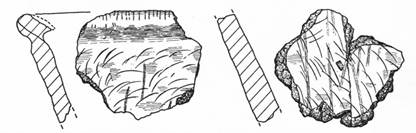
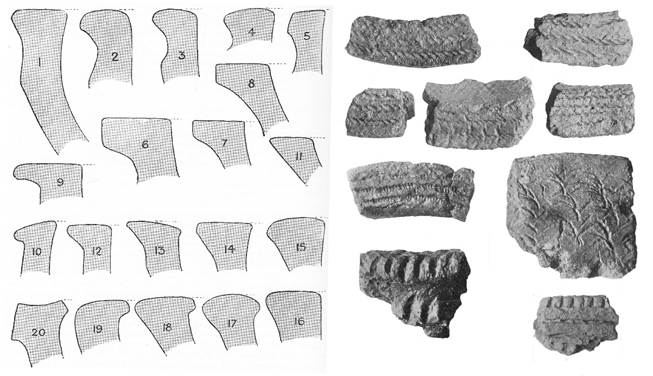
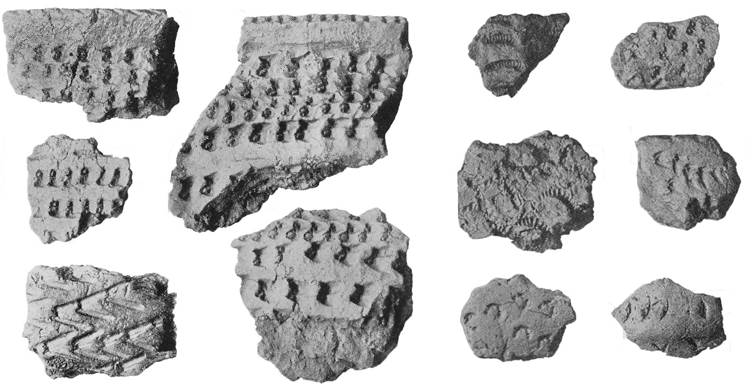
There is an interesting variety of designs, showing connections with various parts of Britain. The decoration on the Dalkeith and Hedderwick sherds finds widespread parallels among the type of Impressed Ware commonly referred to as ‘Mortlake style Peterborough Ware’ in England and Wales. The pottery from Meldon Bridge, Scottish Borders, with its heavy, bevelled rims and trunconic vessel shapes, shows very strong links with the Impressed Ware found in northern Britain, particularly Northumberland (Burgess 1976). This ‘sub-style’ of Impressed Ware differs from the variants conventionally described as ‘Ebbsfleet Ware, Mortlake Ware or Fengate Ware’, and indeed it was Colin Burgess’ discussion of the Meldon Bridge assemblage that prompted a shift from the universal use of ‘Peterborough Ware’ as a covering term, to ‘Impressed Ware/s’, with the type of pottery in use in the Scottish-English border regions being ‘Northern Impressed Ware’. A newly-published book, edited by Alistair Barclay and Alex Gibson, gives an up-to-date review of Middle Neolithic pottery in Britain and Ireland (Barclay and Gibson 2025.)
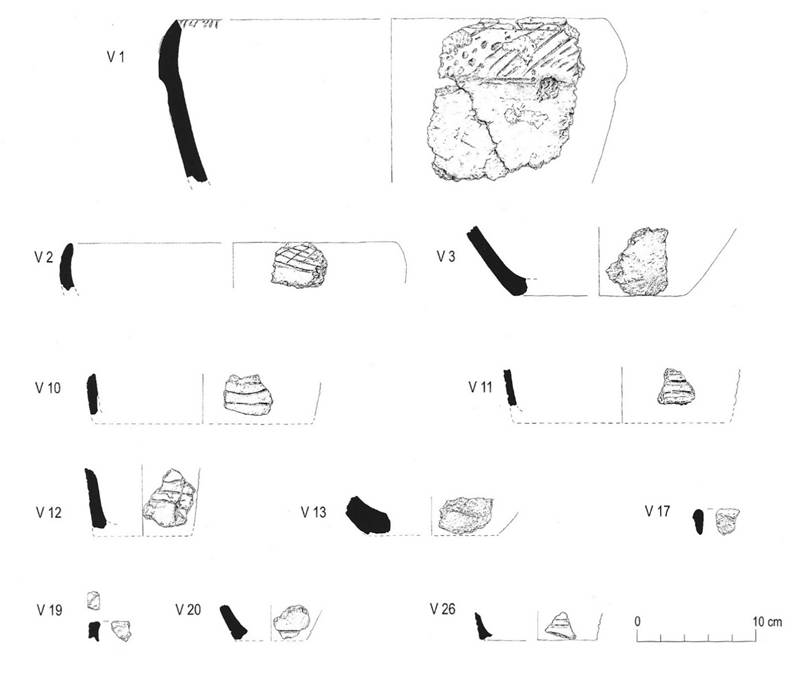
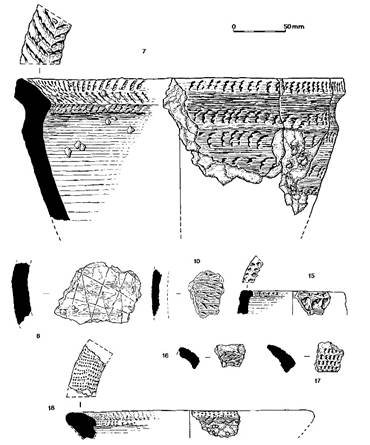
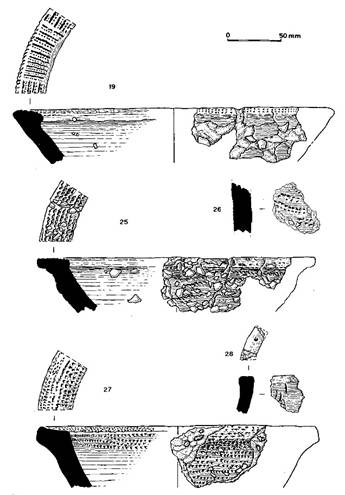
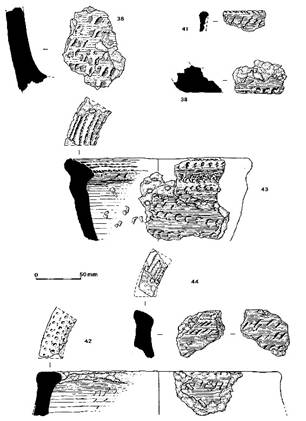
Some hint of stylistic change over time is offered by the dates from Knowes and Overhailes, East Lothian. The Knowes pottery looks to be slightly earlier than that from Overhailes, and it differs in having extensive decoration, whereas the best-preserved pot from Overhailes has decoration limited to its rim. The latter pot shares features in common with so-called ‘Fengate Ware’, which has a wide distribution in England and Wales. The dates from Meldon Bridge are too variable and flawed to give a clear impression of exactly where, in the development of Impressed Ware in south-east Scotland, this assemblage belongs, but it may be that a programme of radiocarbon-dating burnt-on organic residue from the Meldon Bridge pots could clarify the situation.
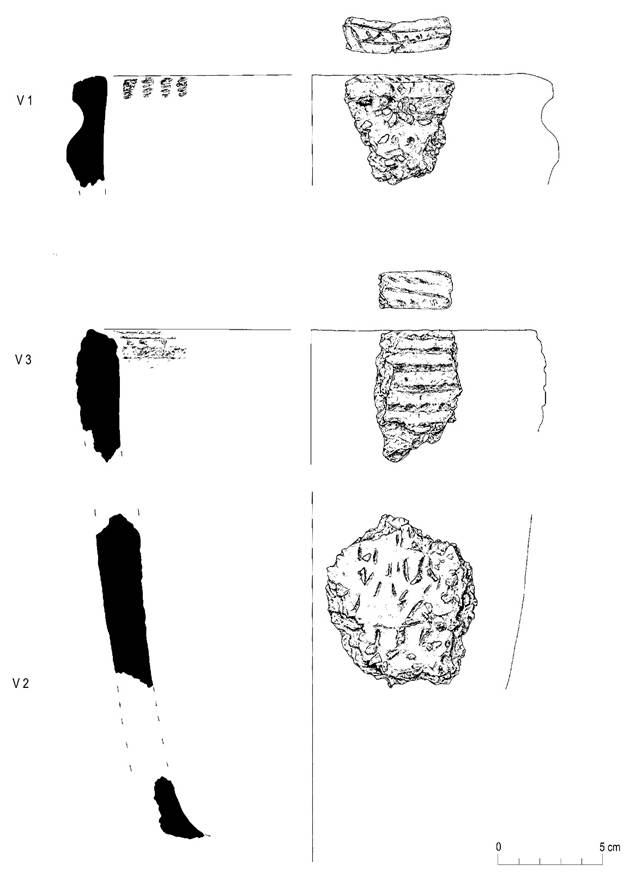
Further probable Impressed Ware pottery is known from Kinegar Sand and Gravel Quarry, Cockburnspath, Scottish Borders (MacSween 2005).
The list of finds of Middle Neolithic pottery from south-east Scotland known to the author as of October 2025 is as follows, table 4.4:
| Location | Trove ID | Site type | References |
| Meldon Bridge, Scottish Borders | 51564 | Settlement | Burgess 1976; Speak and Burgess 1999 |
| Overhailes, East Lothian | 249178 | Settlement | MacGregor and Stuart 2007 |
| Knowes, East Lothian | 249961 | Settlement | Shearer and McLellan 2007 |
| Pencraig Wood (pit 56), East Lothian | Settlement | MacGregor and Stuart 2007 | |
| Doon Hill, East Lothian (upper fill, palisade enclosure) | 57668 | Isolated find in fill of Early Neolithic palisade enclosure trench | Ralston 2019a; 2019b; in press |
| ‘Tusculum’ [grounds of house], North Berwick, East Lothian,’Midden No. 1’ | 56644 | Settlement (coastal ‘midden’) | Cree 1908, 274 and fig. 10.6-7 |
| Hedderwick, East Lothian | 57710 | Settlement (coastal, eroding from sandhills) | Callander 1929, 67-72 |
| Edmonstone Policies (Estate), City of Edinburgh | No Trove ID found | Settlement | Muir 2024; Beverley Ballin Smith pers. comm. |
| Dalkeith, Woodburn Housing Scheme, Midlothian | 53410 | Settlement | Henshall 1966 |
| Upper Dalhousie Quarry, Midlothian | 295357 | Settlement | Francis in press |
| Kinegar sand and Gravel Quarry, Cockburnspath, Scottish Borders | 271421 | Settlement (presumed) | MacSween 2005 |
Note: Tam Ward had claimed that some pottery from Megget Reservoir, Scottish Borders, is Impressed Ware (Ward 2004) but from the published descriptions, the pottery does not appear to belong to this tradition.
The radiocarbon dates associated with Middle Neolithic Impressed Ware pottery in south-east Scotland are as follows:
| Findspot | Dated material | Lab no. | Date BP | Date cal BC at 95.4%, OxCal v.4.4.4 |
| Meldon Bridge, Scottish Borders (Peeblesshire) – pits from Areas B, S and F | (All charcoal, species unspecified, unless stated otherwise) 1.Pit B12: burnt hazelnuts 2.Pit B12: charcoal (oak, hazel, ash) 3. Pit B14: wood charcoal and charred hazelnuts 4. Pit B15 5. Pit B6 6. Pit S13 7. Pit S14 8. Pit S15 9. Pit F40: charred hazelnuts | 1. SRR-646 2. SRR-647 3. SRR-643 4. SRR-644 5. SRR-645 6. GU-1053 7. GU-1054 8. GU-1055 9. GU-1049 | 1. 4286±50 2. 4240±60 3. 4676±180 4. 4686±90 5 4080±80 6. 4505±65 7. 4560±65 8. 4380±65 9. 4570±65 | 1. 3081-2701 2. 3011-2627 3. 3891-2915 4. 3648-3106 5. 2880-2466 6. 3483-2935 7. 3513-3030 8. 3331-2890 9. 3516-3036 Comments: some of the dated material may be residual from earlier activity; use of mixed-species samples reduces reliability of dates; in several cases, the species of charcoal is unspecified; SRR-643 has too large a standard deviation to be of any use |
| Overhailes, East Lothian | 1. Pit 247, upper fill: hazel charcoal 2. Pit 247, upper fill: burnt hazelnut shell 3. Pit 50: hazel charcoal 4. Pit 50: Maloideae charcoal 5. Pit 7: blackthorn charcoal 6. Pit 7: hazel charcoal | 1. SUERC-7504 2 .SUERC-7505 3. SUERC-7509 4.SUERC-7510 5. SUERC-7511 6. SUERC-7512 | 1. 4440±40 2. 4405±35 3. 4455±35 4. 4395±35 5. 4425±35 6. 4450±35 | 1. 3335-2927 2. 3319-2912 3. 3340-2937 4. 3311-2908 5. 3329-2920 6. 3337-2935 |
| Doon Hill, East Lothian | Birch charcoal | SUERC-76357 | Not yet published | [c. 3000 cal BC: date not yet published] |
| Knowes, East Lothian | All charcoal: 1. Pit 26: willow 2. Pit 26: alder 3. Pit 5: birch 4. Pit 5: willow | 1. SUERC-7524 2.SUERC-7525 3.SUERC-7522 4. SUERC-7523 | 1. 4550±35 2. 4660±35 3. 4505±32 4. 4615±35 | 1. 3482-3101 2. 3521-3366 3. 3356-3096 4. 3516-3197 |
| Upper Dalhousie Quarry, Midlothian, Pit 10-364 | Both: burnt hazelnut shell | 1. SUERC-123260 2. SUERC-123261 | 1. 4406±28 2. 4368±28 | 1. 3308-2916 2. 3088-2907 |
Note: it is expected that dates relating to the Edmonstone Policies Impressed Ware will be obtained following post-excavation work. The author does not know whether the context containing IW pottery at Kinger Sand and Gravel Quarry, Cockburnspath, has been radiocarbon-dated.