
It appears that, when Impressed Ware was ceasing to be used, a new style of flat-based pottery – Grooved Ware – began to be used in south-east Scotland. Grooved Ware was invented in Orkney during the 32nd century BC and it was rapidly adopted elsewhere in Britain and Ireland from around the turn of the millennium, continuing in use and evolving, regionally, until around the 25th century BC (Sheridan 2024a).
Mike Copper has undertaken a research project, Tracing the Lines, to improve the dating of, and understand the development of, this distinctive ceramic tradition in Scotland south of Orkney (ScARF Grooved Ware Database; Copper et al 2021; Copper 2024). His work has greatly enhanced our understanding of the typochronological development of this pottery tradition.
There are only a few findspots of Grooved Ware in south-east Scotland and. of these only two have produced pottery that is closely comparable in design to early Orcadian Grooved Ware. One is Eweford West, East Lothian (MacGregor and Stuart 2007). Here, the Grooved Ware sherds come from a pit and a hollow near the Early Neolithic long mound, and from a spread of stone probably taken from that mound. A date of 3020-2700 cal BC was obtained from burnt hazelnut shell from the pit. The other is Archerfield Estate, Gullane, East Lothian, where one of the Grooved Ware sherds (part of NMS X.HR 565, undated) has an incised design of horizontal and sloping lines that can be paralleled in Orkney. This pottery is very important as it demonstrates contact with Orkney at the beginning of the third millennium, and it is part of a pattern, seen elsewhere in Scotland, showing the deliberate adoption of this Orcadian novelty, for example at Balfarg, Fife (Mercer 1981; Barclay and Russell-White 1993). It may well be that people from south-east Scotland sailed up to Orkney, attracted by news of the dynamic and innovative society based around the west-central area of Mainland island (Sheridan 2024a).
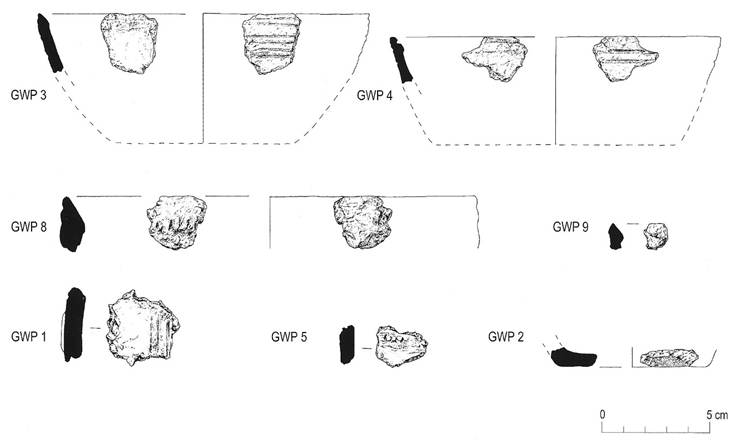
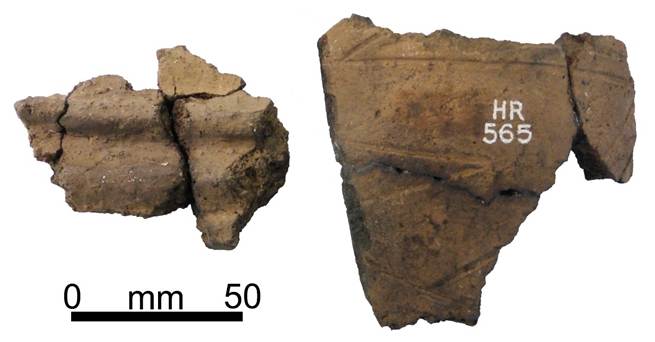
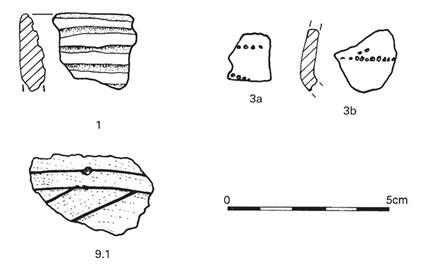
The other Grooved Ware in south-east Scotland deviates from the Orcadian style, following its own, regional course of development over time. At Lamb’s Nursery, Dalkeith, Midlothian, where thin, fine Grooved Ware was found, two pots (Pot 1 and Pot 9.1) have features that are found in Orcadian Grooved Ware, but a third (Pot 3) – with dot-stabbed decoration and an angular change of slope – is unparalleled in Orkney.
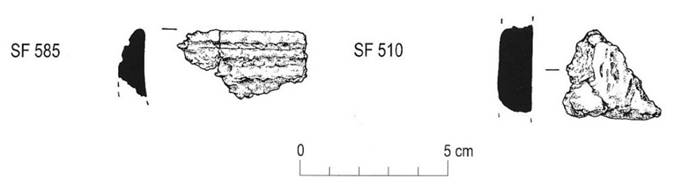
Elsewhere in south-east Scotland, the use of twisted cord impression as a decorative technique is another feature that distinguishes this pottery from Orcadian Grooved Ware. This is present at Eweford East, Monktonhall Junction, Inveresk, and Standingstone, all in East Lothian. At Eweford East it occurs as horizontal lines on the outside immediately below the rim on sherd SF 585. At Monktonhall Junction it is present on the interior of a bucket-shaped pot, which is otherwise undecorated. At Standingstone it occurs as two diagonal lines on the interior of a sherd; another sherd from the same pot has a pedestalled base and a splaying wall (MacSween 2009). Copper et al (2021) claim that twisted cord impression is also present on Grooved Ware at Hedderwick, East Lothian.
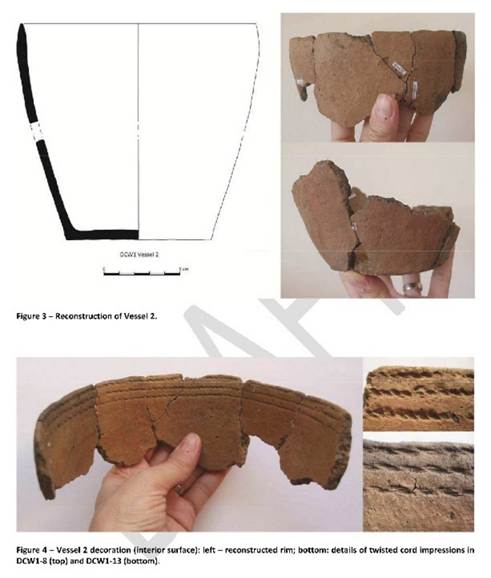
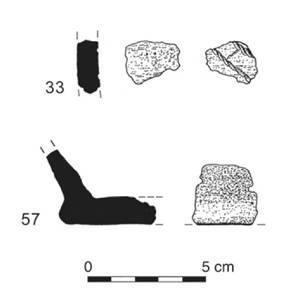
Another pot from Monktonhall Junction has vertical applied decorated cordons that connect it to a widespread variant of Grooved Ware that emerged outside of Orkney and is referred to by some as ‘Durrington Walls’-style Grooved Ware. It has been argued that this type of Grooved Ware was first used in Scotland during the 29th century cal BC (Copper et al 2021, 91).
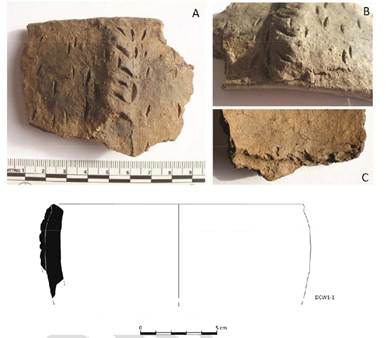
It may be that a tall pot with deep grooves below its rim and vertical ‘columns’ of incised herringbone design found on the Archerfield Estate, Gullane is a variant on this design.
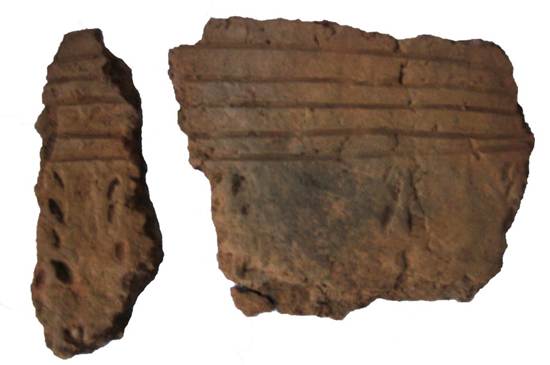
Finally, at Kinegar Sand and Gravel Quarry, Cockburnspath, Scottish Borders, a large Grooved Ware pot was found in a pit. This, too, features a design where a band of horizontal lines immediately below the rim has vertical bands of decoration below, possibly made by pushing in then dragging a thumb- or fingernail, creating unevenly oval impressions.
Overall, not enough finds of Grooved Ware exist in south-east Scotland to enable a detailed account of its development and currency to be created. It remains to be seen whether the recently excavated assemblage from Dalhousie Quarry – from a pit where no radiocarbon-datable material had been found – is capable of being directly dated for example by dating absorbed lipids. It also remains to be seen whether there was any radiocarbon-datable material from the pit at Monktonhall Junction from which the Grooved Ware pots came. There is, however, scope for dating a thick layer of burnt-on organic residue on the inside of a putative Grooved Ware sherd, with deep hollows below its rim, from the Musselburgh Primary Health Care Centre, Inveresk (Johnson 2020). Moreover, if the context from which the large Grooved Ware pot from Kinegar Sand and Gravel Quarry was found has not yet been radiocarbon-dated, it would be worth undertaking lipid analysis and dating absorbed lipid, if possible.
The findspots of Grooved Ware known to the author as of October 2025 are shown in table 4.6:
| Location | Trove ID | Site type | References |
| Eweford West, East Lothian | 257432 | Uncertain: ceremonial deposit at ancient monument? | MacGregor and Stuart 2007 |
| Eweford East, East Lothian | 57600 | Could be ceremonial: mostly found in some postholes on E end of S Alignment | Shearer and McLennan 2007 |
| Monktonhall Junction, Inveresk, East Lothian | Cf. 53866 (no specific Trove ID for the Neolithic pit DCW. For Designation, see SM 3610) | Pit; unclear whether it is from a settlement, but it could be | Jorge 214; Hanson forthcoming https://www.academia.edu/ 36134276/Monktonhall_East_ Lothian_Prehistoric_pottery_report |
| Musselburgh Primary Health Care Centre, Inveresk, East Lothian | 316261 | Stray find in Roman ‘midden’-rich deposit | Johnson 2020 |
| Standingstone, East Lothian, pit F56 | 56477 | Pit, presumably settlement; pit also contained flint flake and blades, charred barley grains and tiny fragments of calcined bone (not identifiable to species) | Haselgrove 2009, 46; MacSween 2009; Hamilton and Haselgrove 2009 |
| Hedderwick, East Lothian | 57710 | Settlement, coastal: sherds eroding from sandhills | Callander 1929, 67-72; Stevenson 1946, 143 and fig. 1.5; and see Mike Copper’s Grooved Ware Catalogue |
| Lamb’s Nursery, Dalkeith, Midlothian | 75750 | Settlement | Cook 2000 |
| Archerfield Estate, Gullane, East Lothian | 55028 | Coastal ‘midden’ | Curle 1908 |
| Hedderwick, East Lothian | 57710 | Stray finds from eroding sand dunes | Callander 1929, 67-72; Stevenson 1946, 143 and fig. 1.5 |
| Upper Dalhousie Quarry, Midlothian | 295357 | Settlement | Francis in press |
| Kinegar sand and Gravel Quarry, Cockburnspath, Scottish Borders | 271421 | Settlement (presumed) | Unpublished |
| South Slipperfield Quarry, West Linton, Scottish Borders | 381394 | Settlement (presumed): fill of pit | Klemen 2019 |
Note: 1. A small number of highly abraded sherds from Doon Hill, decorated with incised, multi-directional lines, have been flagged very tentatively as possible Grooved Ware, but the identification is not confident enough for the sherds to be included here.
Radiocarbon dates relating to Grooved Ware in south-east Scotland are as follows, table 4.7:
| Findspot | Dated material | Lab no. | Date BP | Date cal BC at 95.4%, OxCal v.4.4.4 (except Standingstone dates) |
| Eweford West, East Lothian | Burnt hazelnut shell from pit 101 | SUERC-5294 | 4275±40 | 3011-2706 |
| Eweford East, East Lothian | Willow charcoal from 1114, fill of S Alignment post-hole 1115 | SUERC-5340 | 4140±35 (another date from same context, of 7050±40, must be from residual Mesolithic material) | 2875-2584 |
| Standingstone, East Lothian | Charred barley grains from fill of pit F56: 1. Naked barley; 2. Hulled barley | 1 SUERC-10535 2 SUERC-10536 | 1. 4120±35 2. 4085±35 | Modelled dates (Hamilton and Haselgrove 2009, table 9.2): 1. 2860–2570 2. 2860–2490 |
| Lamb’s Nursery, Dalkeith, Midlothian | 1. From possible external hearth, context 90: mixed-species charcoal (oak, hazel, alder) 2. From Structure A, context 186: oak charcoal 3. From burnt-on organic residue on the interior of sherd from context 236 | 1. GU-8105 2. AA-32604 3. SUERC-84846 | 1. 4070±110 2. 4130±50 3. 4060±22 | 1. 2897-2306 2. 2879-2574 3. 2838-2489 |