
The evidence for Neolithic settlement in south-east Scotland ranges in nature from the two massive, superimposed, roughly rectangular communal houses (so-called ‘halls’), at Doon Hill, East Lothian (Ralston 2019a; 2019b; in press) to a small number of Neolithic lithic finds, assumed to relate to domestic activities, that were found in the same area as an earlier, Late Mesolithic lithic scatter at Musselburgh Primary Care Centre (Kirby 2020; SESARF Mesolithic case study ). Between these two extremes, most of the evidence consists of pits that are assumed to have been related to domestic occupation as, for example, at Maybury Business Park, Edinburgh (Moloney and Lawson 2006). In a few cases such as at The Hirsel, Scottish Borders, traces of structures have been found (Cramp 2014). Almost invariably, the remains are severely truncated by ploughing.
With some sites, it is difficult to assess what kind of activity is attested. For example, the Neolithic pottery from the coastal sites of East Lothian, listed in the table 4.2 below, appear to be associated with ‘midden’ material including seashells, but the ‘middens’ are also associated with Chalcolithic and/or Early Bronze Age Beaker pottery. None of the ‘midden’ material has been radiocarbon-dated to confirm its chronological position.
Furthermore, in the case of lithic scatters, it cannot automatically be assumed that these relate to settlement activity. However, they could constitute the last remaining evidence of settlement when all other traces have been destroyed. There is no overall listing of the Neolithic lithic scatters in south-east Scotland, and so this potential source of information remains to be investigated.
Using distributional data of stray finds of artefacts as an indicator of settlement patterns can potentially be useful, but at the same time slightly risky. Arrowheads could have been lost during hunting expeditions at some distance from a settlement, for example. Similarly, some stone axeheads could have been lost in transit from their places of manufacture, or else deliberately deposited away from settlements – the latter being the likely practice with the Early Neolithic axeheads of jadeitite and other Alpine rocks. However, it is probably safe to assume that most of the approximately 300 stone axeheads that have been found in south-east Scotland were lost or discarded in, or close to, settlements (SESARF 4.5 Material Culture)
What we can say is that there is a tendency for Neolithic settlements to be located close to the coast and along river valleys, mostly but not exclusively, in areas where the best agricultural land is located.
Did Neolithic people live in upland areas of south-east Scotland, on either a permanent or a temporary basis? Researchers have to rely mostly on palaeoenvironmental and aerial photography evidence, since the rarity of ploughed ground makes it virtually impossible to undertake fieldwalking to detect artefact scatters. In some areas, afforestation has made field survey of any kind difficult. The palaeoenvironmental evidence (Tipping 2010; SESARF 2.7 Neolithic Landscape) indicates that, for the Bowmont Valley and the Cheviot Hills, ‘There is no unambiguous evidence [during the Early Neolithic] for settlement, no crops and no use of fire’ (Tipping 2010, 170). Tipping has also argued that transhumance in these areas – the relocation of domesticated animals into upland pastures during the summer – would have been unnecessary during the Early Neolithic. There are, however, indications from pollen evidence for the cultivation of barley on Swindon Hill and on well drained plateaux in the Cheviot Hills from the Late Neolithic (from around 2850 cal BC: Tipping 2010, 171).
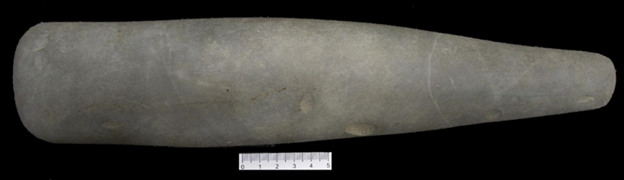
There is, however, some aerial photography evidence for Early Neolithic activity in the highland areas, including a recently-identified cursus monument at Upper Whitfield, Scottish Borders (Halliday 2022). Moreover, some of the Early Neolithic long mounds, such as The Mutiny Stones, Scottish Borders, are in highland locations (Henshall 1972, 404), so we cannot rule out the possibility that parts of the highland areas were indeed occupied. This raises the question of how far from a monument people would have been living. Occasional stray finds, including the large, special-purpose ‘Cumbrian club’ axehead made of Great Langdale tuff found at Upper Hindhope, provide additional evidence for the Early Neolithic presence of people in the highland areas.
It remains to be seen whether any of the many burnt mounds found by field survey in south-east Scotland, for example around the Megget Reservoir, Scottish Borders, are of Neolithic date (Ward 2004).
We do not have enough period-specific data to discern any trends in settlement location over the course of the Neolithic, although the presence of Middle and Late Neolithic pottery on the coastal sites of East Lothian is potentially significant, since it raises the question as to whether short-term occupation on the coast might indicate a shift away from the Early Neolithic aversion to exploiting marine resources.
The settlement evidence is summarised in Table 4.2 and the interactive map below.
| Location | Trove ID | Period | Nature of evidence | References |
| Doon Hill, East Lothian | 57668 | EN | 2 superimposed ‘halls’ within enclosure; Carinated Bowl (CB) pottery; lithics, including pitchstone | Ralston 2019a; 2019b; in press; Ballin 2019, 25 |
| Whitmuirhaugh, Sprouston | 141941 | EN | ‘Hall’, suspected to be EN; AP site | Smith 1991 |
| Newbridge M8 Industrial Estate, City of Edinburgh | 72543 | EN | A scatter of pits, two of which may have been post-holes; CB pottery and lithics | Carter et al. 2010, 33; Sheridan 2007b, 484 |
| Maybury Business Park (now Edinburgh Park), City of Edinburgh | 74679 | EN | Five pits forming slightly curving alignment, with a central pit and H-shaped feature – interpreted as a ‘simple domestic shelter’ beside a ‘trackway’ of putative Neolithic date. CB and lithics from pits | Moloney and Lawson 2006; Sheridan 2007b, 484 |
| Ratho Quarry | 81323 | EN | Pits with CB and lithics, incl. pitchstone. It is unclear whether two rectilinear, artefact-free structures are Neolithic or later | Smith 1995; Sheridan 2007b, 484 |
| Catstane, City of Edinburgh | 50730 | EN | Just 3 sherds of Carinated Bowl pottery, unstratified, plus mostly undiagnostic struck lithic assemblage (but with a Late Neolithic petit tranchet arrowhead) | Cowie 1978 |
| West of Gogar Mains, City of Edinburgh | 300203 | EN | Several small pits or postholes; CB; lithics, incl. pitchstone | Will and James 2017 |
| Meadowfield Farm, West Craigs, City of Edinburgh | 369690 | EN | Shallow gully; CB | Hunter Blair 2019 |
| West Edge, Lang Loan, Gilmerton, City of Edinburgh | 262747 | EN | Pits; CB and lithics | Westgarth 2020 |
| Edmonstone Policies (Estate), City of Edinburgh | No Trove ID found | EN and MN | Pits (2 pit alignments); CB and pitchstone. Also MN Impressed Ware (IW) | Muir 2024; Beverley Ballin Smith pers. comm. |
| Duns Law Farm, Scottish Borders | 58640 | EN | Large pit containing sherds of CB pottery, stone axehead, other lithics, cereal grain and cremated human remains; pit had been re-used subsequently by users of Beaker pottery. The contents (other than the human remains) are typical of EN pits from settlements elsewhere but the small scale of the excavation makes it hard to be certain that this was indeed part of an EN settlement | Anderson 2017 |
| Musselburgh Primary Health Centre, East Lothian | 316261 | EN and LN | Lithic spread, with EN and LN-style lithics and pitchstone, in area also containing Mesolithic lithic material. May be last trace of a settlement (multi-period) | See SEsARF Palaeolithic and Mesolithic, Case study, Clarke and Kirby |
| The Hirsel, Coldstream, Scottish Borders | 59631 | EN | Arc of stakeholes from lightly-built structure, probably with wattle and daub walls; CB, animal bone and lithics | R Cramp 2014; Sheridan 2007b,485; 2014 |
| Upper Dalhousie Quarry | 295357 | EN, MN, LN | Pits and artefact scatters | Francis in press |
| Oatslie sand quarry, Roslin | 51814 | EN | Single CB uncarinated bowl found during sand quarrying; may be last trace of settlement | Stevenson 1948 |
| Meldon Bridge | 51564 | MN | Pits containing Impressed Ware and numerous burnt hazelnut shells; also spreads of IW sherds | Burgess 1976; Speak and Burgess 1999 |
| Overhailes, East Lothian | 249178 | MN | Probable house structures, yard, pits, pottery, lithics | MacGregor and Stuart 2007 |
| Knowes, East Lothian | 249961 | MN | 2 clusters of pits with pit alignment between them; uncertain whether this was a settlement, and could have been a ceremonial site | Shearer and McLellan 2007 |
| Dalkeith, Woodburn Housing Scheme, Midlothian | 53410 | MN | Sherds of Impressed Ware, assumed to be from a settlement; stray find | Henshall 1966 |
| Hedderwick, East Lothian | 57710 | MN, LN | Sherds of Impressed Ware and Grooved Ware, from eroding sand dunes | Callander 1929, 67-72; Stevenson 1946, 143 and fig. 1.5 |
| ‘Tusculum’ [grounds of house], North Berwick, East Lothian | 56644 | Prob MN | Sherds of probably MN pottery in 2 ‘middens’, both of which also contain Beaker pottery, so multi-period activity | Cree 1908 |
| Archerfield Estate, East Lothian | 55028 | LN | Sherds of Grooved Ware pots, found among ‘midden’ material in eroding sandhills | Curle 1908 |
| Lamb’s Nursery, Dalkeith, Midlothian | 75750 | LN | Stake-built structure plus pits, post- and stake-holesand charcoal-rich features, some associated with Grooved Ware pottery | Cook 2000 |
| Monktonhall Junction, Inveresk, East Lothian | Cf. 53866 (no specific Canmore ID for the Neolithic pit. For Designation, see SM 3610) | LN | Pit containing Grooved Ware; unclear whether it is from a settlement, but it could be | Jorge 214; Hanson forthcoming |
| Eweford West, East Lothian | 257432 | LN | Pit and small hollow with Grooved Ware, close to the Early Neolithic long barrow. Not definitely evidence for settlement | MacGregor and Stuart 2007, 83-4 |