
South East Scotland has produced outstanding evidence about medieval urban life. In the capital, modern development has enabled extensive research into the medieval burghs of Edinburgh and Canongate, and their associated port at Leith. This has led to major publications on several Edinburgh excavations, with the last decade alone seeing works on significant sites such as the backland of St Giles’ Cathedral (Roy 2019), the remains of the burgh ditch on East Market Street (Lowther 2018), the remains of 14th century burgh defences on Cowgate (Dalland 2017), and the late medieval expansion into what became Candlemaker Row (Franklin 2017). Recent work at the India Buildings site in Edinburgh also show considerable promise – with the waterlogged soil having preserved an exceptional range of medieval organic finds, including a leather water bottle, wooden bowls, shoes, animal bones, and plant and parasite remains.
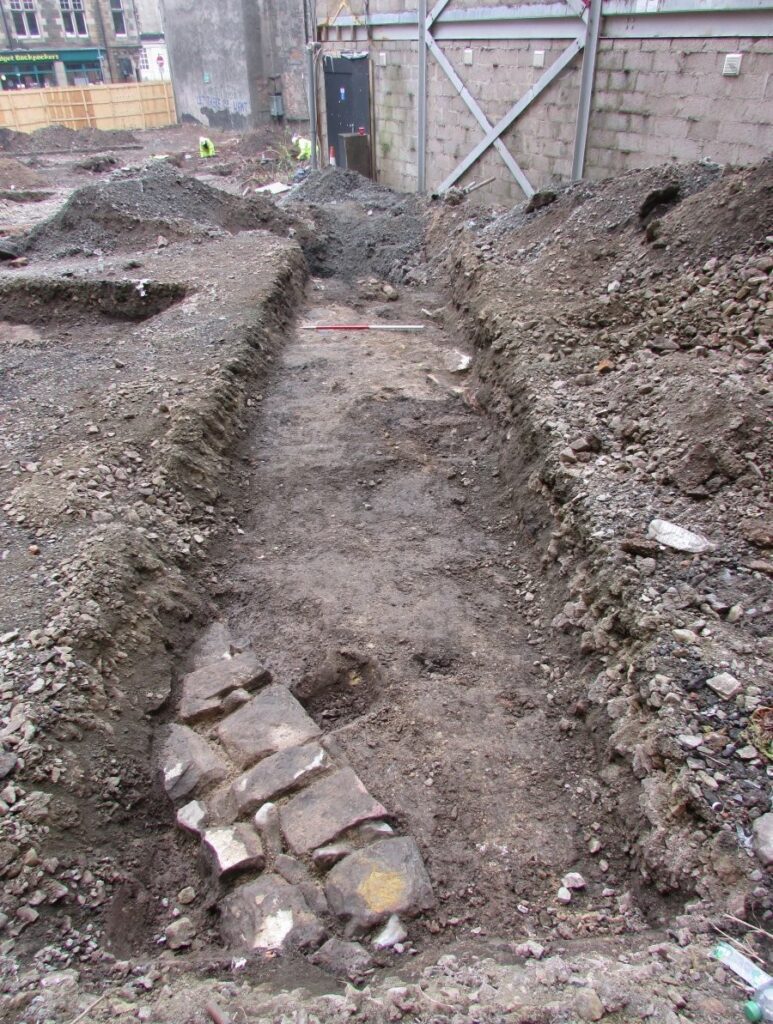
Unfortunately, at some sites restricted funding for post-excavation analysis and publication have restricted our understanding of their medieval use. Significant findings from Edinburgh and other burghs remain in grey literature. In particular, important discoveries from the Water Street area of Leith are only partially analysed and published (Collard and Reed 1994; Lawson pers comm). Improved typologies and methods of scientific analysis also mean that finds from earlier published excavations could perhaps be revisited. Resources should not only be directed to new excavations – valuable insights may still be gleaned from artefacts uncovered during older archaeological interventions.
Burghs outside of Edinburgh hold considerable promise. Greater study of Haddington could be of interest. In the early 1500s Haddington was probably Scotland’s fifth richest burgh. However, the urban settlement experienced major difficulties during the Anglo-Scottish warfare of the 1540s, with disastrous consequences for the local economy. Any physical evidence of sixteenth-century disruption in Haddington would be of considerable interest. The fact that much of the medieval burgh is still covered by historic standing buildings has somewhat restricted opportunities for excavation. Nonetheless, there may be opportunities to look for medieval remains in cellars and backlands, when remodelling or conservation work is undertaken.
Further research into the region’s middle ranking and smaller urban communities should be a priority. In the 1980s and 1990s excavations in North Berwick produced rich evidence regarding industrial activity, as well as providing new insights into the evolution of burgage plots (Hall and Bowler 1997). Excavations at Kelso and Peebles likewise have provided valuable evidence for the development of of medieval urban communities, as well as highlighting the impact of conflict on burghs in the Borders (Perry et al 2003). Meanwhile, survey work and small-scale excavations at the lost burgh of Roxburgh have provided helpful indications of the general plan of this abandoned medieval community (Martin and Oram 2007). However, there is the potential for far more investigation at Roxburgh and many other medieval burgh sites in the region.
The South East of Scotland has a number of older burghs. The relationship between these formal burgh foundations and earlier settlement is a key question for researchers. Excavations at Dunbar indicate that the headland here was an important site during the Northumbrian period, long before the establishment of the medieval burgh and castle (Dennison 2018, 9-10. Dennison et al 2006, 16). Musselburgh also appears to have seen early urban settlement, although the relationship between the officially recognised burgh of the twelfth century and previous activity in the area needs further research (Dennison 2018, 10).
| Burgh | Type of Burgh (in 1430) | Decade of Grant of Burgh Privileges |
| Canongate | Ecclesiastical | 1150 (TAQ) |
| Dalkeith | Baronial | 1400 |
| Dunbar | Baronial | 1370 (TAQ) |
| Edinburgh | Royal | 1120 |
| Haddington | Royal | 1150 (TAQ) |
| Jedburgh | Royal | 1160 (TAQ) |
| Kelso (Wester) | Ecclesiastical | 1320 (TAQ) |
| Lauder | Baronial | 1320 (TAQ) |
| Musselburgh | Ecclesiastical | 1320 (TAQ) |
| North Berwick | Royal | 1420 (TAQ) |
| Peebles | Royal | 1150 (TAQ) |
| Roxburgh (abandoned) | Royal | 1120 |
| Selkirk | Royal | 1360 (TAQ) |
| Seton (abandoned) | Baronial | 1320 |
| South Queensferry | Ecclesiastical | 1320 (TAQ) |
The South East was at the forefront of urban development in medieval Scotland. However, the region was also on the frontline of Anglo-Scottish conflict. From the 1290s onwards South East Scotland faced repeated incursions from English forces, with particularly brutal campaigns being conducted during the Wars of Independence and during the military interventions of Henry VIII of England and Protector Somerset. It is likely that warfare was a factor in the late medieval decline of Border burghs such as at Roxburgh. However, conflict is not the only explanation for the failure of urban centres, and more research is needed into why some communities contracted (or occasionally disappeared altogether) whilst others expanded.
There is a growing recognition of the complex interactions between urban communities and the natural environment. Greater study of how burgh residents managed (or sometimes were overwhelmed by) their surroundings would be desirable. In particular more research into the medieval management of water, both clean and contaminated, and of green spaces in and adjacent to towns could be of interest. It should be noted that many of the burghs in the region are on sites which are not particularly waterlogged – meaning that the preservation of organic matter in South East Scotland has often been less extensive than in wetter parts of the country, such as Perth and Kinross. That being said, some of the lower lying areas of Edinburgh, particularly near the Cowgate are currently providing excellent organic artefacts. Given the restricted survival of organic material in many parts of the region, those places which are productive of this type of evidence are of considerable importance.


Archaeological excavations have proved transformative for our understanding of Scotland’s medieval towns. However, we must not overlook the value of the evidence contained within many standing buildings. Many seemingly later structures hold within them fragments of medieval buildings, which can often be productively studied. The recent recording of the buildings on Abbey Strand at Holyrood showed that even greatly altered structures often preserve significant evidence about their medieval form. It should be stressed that the facades of buildings do not necessarily reflect the extent of the evidence contained inside. Sufficient funding for careful monitoring of interior and exterior building work, as well as disruption to backlands, is vital to ensure the survival and study of South East Scotland’s medieval townscapes.
Urban Settlement Research Questions
- What was the relationship between the new burghs of the 12th and 13th centuries and earlier settlement patterns?
- What can we learn about the processes by which urban settlements were planned and established?
- What factors influenced street plans and property boundaries?
- When were the key periods of urban growth? Were there regional phases of expansion and contraction or were trends more burgh specific?
- In what ways did migration influence urban centres? How stable or unstable were urban populations?
- What can we discover about middle ranking and smaller burghs? How physically different from the surrounding countryside were these smaller urban communities?
- In what ways did coastal and inland burghs differ?
- How were the edges of burghs demarcated? Can we find evidence for walls, ditches or gateways?
- What can we discover about the development of Edinburgh’s urban defences?
- How did urban dwellings evolve during the medieval period? To what extent did houses in burghs differ from dwellings in rural settlements?
- How common were buildings with more than one storey? Do we see a significant rise in the height of urban buildings during the medieval period?
- What were the main building materials in urban areas?
- Were there significant differences between the design of urban dwellings in Edinburgh and in other burghs?
- Were there particular regional characteristics to urban dwellings in South East Scotland?
- When and where do we see the sub-division of burgage plots? What factors appear to have led to burgage plots being divided? Is there evidence for the amalgamation of burgage plots?
- How much variety was there in living standards in urban areas? Is there evidence for particular periods of hardship / growing inequality?
- Is there evidence for waste burgage plots? Were there periods with a particular preponderance of waste properties?
- Is there evidence of fires or other forms of destruction?
- Can we find evidence of the impact of plague or other epidemic diseases in urban areas?
- How did marketplaces develop over the course of the medieval period?
- What can we discover about the development of tolbooths and other civic buildings / spaces?
- Can we identify processional routes and performance spaces in or near urban settlements?
- What can we learn about recreational activities in and around burghs?
- How were water and waste managed in urban areas?
- How did burghs impact their environs? Is there evidence for different patterns of settlement, land use, or pollution in the immediate hinterland of urban settlements?