
A palisade enclosure is essentially a barrier consisting of one or more rows of closely-spaced vertical timbers embedded in a narrow foundation trench (the palisade). Many palisaded enclosures have associated ditches and usually have settlements within them. Indeed, Harding argues that the repeated association of palisaded enclosures with ring-ditch houses and cord rig traces in southern Scotland represents a mid-1st millennium BC phenomenon (2017, 89).
A wide range of palisaded enclosures was erected during the first half of the 1st millennium BC. These palisaded enclosures are often seen as a kind of ‘pioneer’ settlement utilising cleared woodland in its construction. Sixty years ago, based on the ‘Hownam’ sequence (Piggott 1948; Piggott 1966), it was assumed that palisaded enclosures were built first and from here there was a structural progression from palisaded enclosure through univallate enclosure to multivallate defences (that is simple to complex) but this model has been seen to be far too simplistic.
Some sites, such as Braidwood, Midlothian and Broxmouth demonstrably had a palisade enclosure before the construction of earthwork defences. However, a linear sequence from simple to complex is clearly too simplistic where the defensive sequence was more complex with ditched defences, univallate or bivallate, being maintained or neglected in a much more irregular sequence (Stevenson 1949; Piggott 1958; Armit and McKenzie 2013 Harding 2017, 74-77). Indeed, as Harding reminds us, ‘palisading is simply a constructional technique and cannot be regarded as chronologically or culturally diagnostic’ (2017, 77).
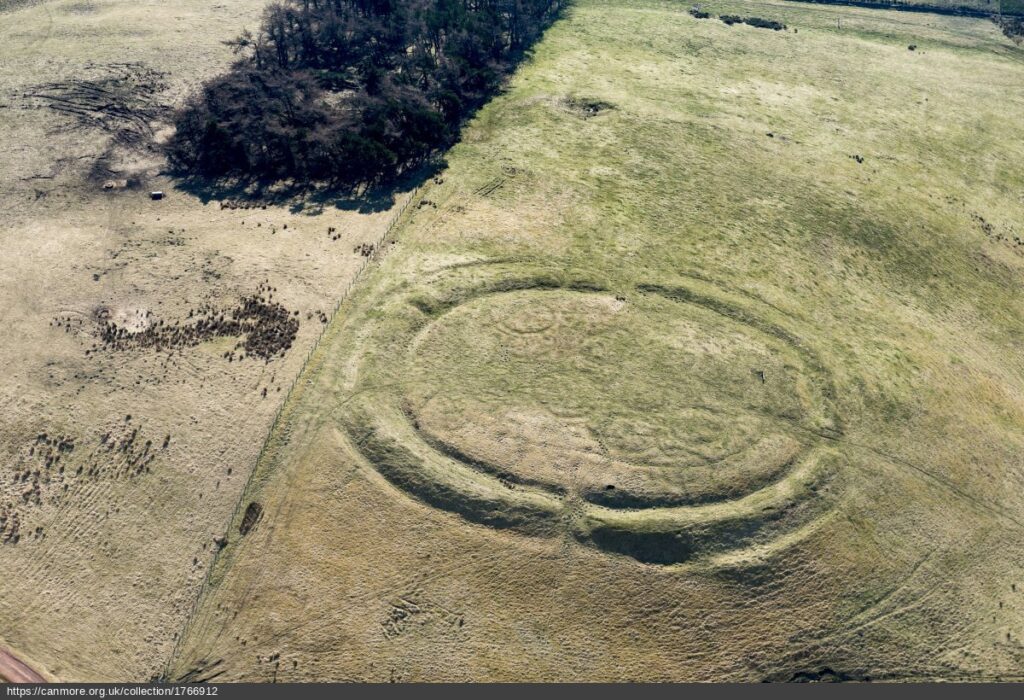
The existence of the palisaded barrier suggests a desire to physically mark the land. The scale of some enclosures suggest that a sizeable community erected them, and presumably lived within them. That said, palisaded enclosures take a variety of forms and sizes and can be found not only as defensive enclosures on sites that become hillforts, but also homesteads. They would have formed communities using sea and land routes to travel within and beyond the area. When first built the inhabitants would have been conscious of the dominating volcanic plugs of Traprain Law and North Berwick; they may even have had traced their genealogies back across the many generations to the Late Bronze Age inhabitants of Traprain Law.
Our understandings of palisaded enclosures has been enhanced by stripping of large areas during developments. For example, excavations in 1978 and 1979 at Dryburn Bridge recovered evidence of an Iron Age settlement and burials, as well as earlier material including Bronze Age cist burials (Dunwell 2007). The site was initially recognised from aerial photographs which suggested the presence of a palisade trench. The palisade trench enclosed an oval area of approximately 85m by 50m and appears to have held squared timbers contained within a continuous, stone-packed slot. It was broken by two entrances on the eastern side, 50m apart, with a third, later blocked, possible entrance midway between the two. There is evidence of large-scale refurbishing of the palisade together with remodelling of the NE entrance.
In May 2003, GUARD undertook archaeological topsoil strip monitoring along the route of the new A1, near Biel Water. The work revealed a palisaded enclosure, 22 x 15m. Inside the enclosure was a large sub-circular pit that contained deposits generally associated with occupation and domestic activity, including stones, unburnt animal bone, and Iron Age pottery. Traces of a second structure, possibly a roundhouse, were identified in the enclosure interior, but was not fully investigated (MacGregor, McLellan and Innes 2003).