
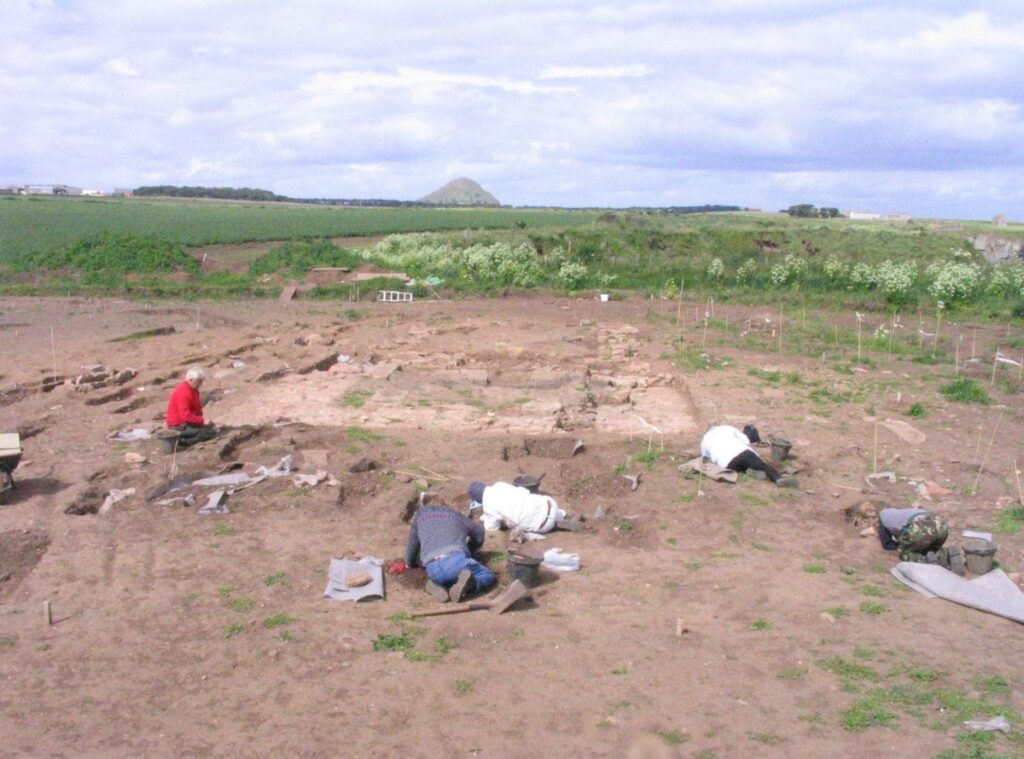
Excavations at urban sites, monasteries, and elite residences have provided important evidence regarding the diet and health of the medieval inhabitants of South East Scotland. However, there is a need for further comparison and analysis of what has been uncovered. We also have significant gaps in our knowledge about the health and food of lower status rural residents. As this group made up the majority of the region’s population, further research into their experiences is vital. Excavations in the 2000s at the abandoned village of Eldbotle in East Lothian highlighted the potential that lower status rural sites can hold for understanding medieval peasant diets, and the impact of periods of dearth on poorer communities (Hindmarch and Oram 2012).
Interdisciplinary collaboration between archaeologists, historians and scientists is essential for building up an overview of medieval diets in South East Scotland. Architectural remains, human and animal bones, botanical evidence and written records can all contribute to the picture of what medieval people ate, and how that affected their lives. Dialogue across disciplines is to be encouraged. Further consideration of how improved recording and sharing of data might enhance comparison of medieval diets both within the region and nationally would be desirable.
More research into medieval strategies for food storage, preservation and preparation is also needed. It is, for instance, striking that despite Lothian’s fame as a centre for grain production, our understanding of medieval grain storage and processing in the region is relatively patchy. Greater research into barns, granaries, mills and drying kilns should be undertaken. Mills in particular are likely to have left some trace in the historical record. The National Library of Scotland, in collaboration with the University of Glasgow and Historic Environment Scotland, has produced a database of pre-1800 mills. Historical and archaeological investigation might identify to what extent these older mills had medieval origins, and reduce the (currently very high) number of these sites which are described as ‘period unassigned’ in regional historic environment records.
South East Scotland has produced a wealth of medieval animal bones – many showing signs of butchery. It is likely that future excavations will continue to produce extensive animal remains, particularly in urban areas. Animal remains hold considerable potential for understanding agricultural practices, trends in consumption, and connections between communities. However, the large quantity of bones and horns poses challenges for storage and study. Some types of scientific analysis (eg genetic studies and stable isotope analysis) are relatively expensive and therefore are often not undertaken on animal remains. Yet animal remains hold the potential to cast light on many different facets of medieval society. They deserve more attention and resources for study.
Traditionally, human remains have been more carefully studied than animal bones, although more work still needs to be done. South East Scotland has seen a number of important excavations of medieval cemeteries, which have cast considerable light on health and mortality in the region. Again, though, the evidence has been tilted towards urban areas and monastic sites. However, work by AOC at Auldhame provided a valuable case study of a late medieval rural burial ground. Any research requiring disturbance to human remains is clearly ethically complicated. However, more work on medieval rural cemeteries would be helpful. It is likely that the next decade will see a number of historic churches being repurposed, which may provide opportunities for greater study of medieval rural burials, particularly those located within church buildings. Comparison of rural human remains with evidence from medieval animal assemblages, pollen analysis and historical sources could prove transformative for our understanding of medieval rural diets.
There is arguably also a need for more research into experiences of health in childhood in the region. Initial research in the 2010s covering Scotland and the wider British Isles suggests that there may have been increases in stressors on children, and an accompanying rise in morbidity around the time of the Reformation (Penny-Mason and Gowland, 2014). However, more work in this area is needed. Potentially study of both the skeletal remains of children and study of the development of the bones of people who survived into adulthood could cast more light on experiences of medieval childhood in the region, and the particular challenges faced by the young.
Health and Diet Research Questions
- How was food stored, prepared and served?
- What can we learn about strategies for preserving food?
- Can we discover more about patterns of spoilage or waste of food?
- Did the amount and type of meat consumed alter significantly over the course of the medieval period?
- To what extent did patterns of meat-eating vary across different localities within South East Scotland? For instance, can we see greater reliance on cattle in some areas as against sheep in other areas?
- Where was meat sourced from? Were livestock raised near to where they were slaughtered? Is there evidence for the movement of livestock across significant distances for example from upland to lowland areas?
- At what sites do we see evidence of consumption of venison? Did the consumption of venison change over time? Was venison primarily associated with sites with parkland?
- Did the amount and types of fish consumed alter significantly over the course of the medieval period?
- How widespread was the consumption of freshwater fish? To what extent did patterns of fish consumption differ in coastal and inland areas?
- What can we discover about fishing practices in South East Scotland during the medieval period?
- What types of vegetables and nuts were consumed?
- How extensive was the importation of food and drink? Was the consumption of imported food and drink concentrated on particular sites (eg urban areas, royal residences)?
- What types of grains were cultivated and consumed? Can we see differences in the grains consumed in different localities or by different ranks in society?
- How prevalent were rats and mice in South East Scotland during the Middle Ages? Can we find evidence for a notable difference in the number of murids in rural and urban areas? Did the presence of rats and mice trigger different strategies for food storage?
- What was the relationship between social status and the consumption of particular types of food and drink?
- How common was malnutrition? Can we identify particular periods of hardship?
- What diseases and injuries were prevalent? Did these change over time?
- Were certain injuries or illnesses associated with particular occupations?
- Was there a notable difference between the health of urban and rural communities?
- Were there particular points in the medieval period when health declined?
- What parasites were common in the region?
- Can we discover more about epidemic diseases in the region?
- How were the sick and disabled cared for? What can we learn about medieval medical practices in South East Scotland? Did care for the sick differ significantly in rural and urban areas? What role did the Church play in care for the sick and disabled?
- When did leprosy arrive in South East Scotland?
- What was typical life expectancy for people who reached adulthood?
- How common was death during infancy and childhood?
- What can we learn about childhood illnesses and injuries?