
By AD 1600 South East Scotland was already severely deforested. This was recognised as a problem by contemporaries, and efforts were made during the post-medieval period to establish new plantations and to replant existing woodlands. There is textual evidence for early 17th century efforts to expand woodland at Ancrum and at Seton Palace (Brown 2012, 170, 195). Meanwhile, dendrochronological work has confirmed that significant numbers of oaks were planted at Dalkeith Park during the late 17th century (Mills, 2022). The 18th century saw far-reaching tree planting schemes on a large number of estates in South East Scotland. Indeed, visitors to Yester in the 1720s asserted that the great house’s park had ‘a Million of full grown trees in it’ (Brown 2012, 237).

Despite these efforts to increase local tree coverage, South East Scotland’s own woodland was clearly not going to meet the region’s post-medieval demand for timber. As a result, throughout the 17th and 18th centuries the residents of South East Scotland made extensive use of imported wood. Leith was a major entry point for wood, and 18th-century maps show many timber yards around Leith Harbour. The timbers shipped to South East Scotland originated in a variety of different parts of the world. Norwegian timber appears to have been particularly popular, especially during the 17th century (Crone and Mills, 2012). Indeed, study of nine coffins from the Leith plague burials of the 1640s suggests that all of them were made from Norwegian pine (Stoakley, 2019). Late 16th and early 17th-century timbers from central Edinburgh also tend to have a Norwegian origin. Yet other sources of wood were available. An oak post from Bunkle (or Bonkyll) Castle has been identified as probably being felled in Germany a little after 1600 (Carlton, 2025). Meanwhile, by the 18th century wood from the Americas was being used in buildings in South East Scotland. For example, excavations at Canongate Poorhouse revealed that timbers used in the foundations were American oak which had been felled in the early 18th century in Massachusetts (Engl and Cook 2025, 21).
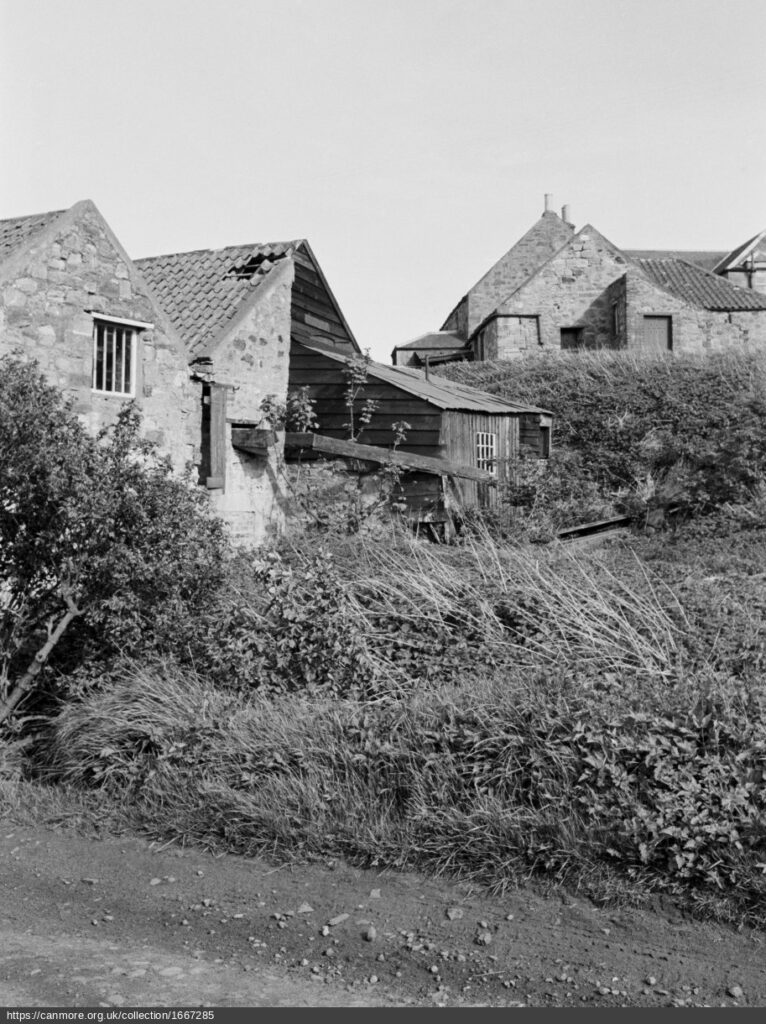
Of course, timber typically underwent seasoning and significant working to make it suitable for use. The 18th century saw a growth in saw mills in the region. In some cases significant parts of these structures survived into recent times. For example, at Cockburnspath the two storeyed 18th-century saw mill and nearby joiner’s shop were still standing in the 1960s and 1970s (Hume 1976, 76). Further research into the sites of sawmills could be of interest.
Timber was used for a wide range of purposes, including the construction of ships and small boats. During the 17th and 18th centuries the South East of Scotland had its own ship-building industry. By the late 18th century substantial dry docks could be found in North Leith beside the old harbour. In the Old Statistical Account of the 1790s it was reported that around 150 carpenters were employed in ship building in Leith (Johnstone 1793, 572). In comparison to the history of ship building in Glasgow and the west coast, post-medieval ship and boat building in South East Scotland is under-researched. Further interdisciplinary study of this topic would be desirable, potentially integrating documentary evidence, survey of relevant sites, and (if discovered) information from wrecks.
Buildings were of course one of the commonest places where large quantities of timber were used. Even substantially stone buildings often used significant amounts of wood in features such as roof supports, flooring, and doors. In recent years there has been dendrochronological study of several of the region’s post-medieval standing buildings. As a growing number of historic timbers are being sampled, both in Scotland and further afield, our understanding of historic buildings and trade networks are improving. For example, pine lintels, rafters, and bressumer beams (long load-bearing beams) from 42-44 Market Street, Haddington were in the 1990s assumed to have come from Scandinavia, but as tree-ring chronologies improved were subsequently identified as being from trees felled in the Eastern Baltic in the 1760s and 1770s (Crone and Mills 2012, 348). Despite the excellent dendrochronological work that has already been undertaken, South East Scotland’s historic buildings still hold considerable untapped potential for understanding the evolution of woodworking and the timber trade during the post-medieval period.